Birth in Nanjing
Born on October 8 in Nanjing, the fifth son of Ming Taizu; demonstrated precocious intelligence and love for classical learning.
朱橚
Zhu Su (朱橚, October 8, 1361 – September 2, 1425), the fifth son of the founding emperor Ming Taizu (Zhu Yuanzhang) and born to Empress Xiaocigao (Empress Ma, with alternate traditions citing Noble Consort Sun), was the first Prince of Zhou of the Ming dynasty, posthumously honored as Prince Ding of Zhou. He was initially ennobled as the Prince of Wu in 1370, re-titled Prince of Zhou in 1378, and formally established his…
Zhu Su (朱橚, October 8, 1361 – September 2, 1425), the fifth son of the founding emperor Ming Taizu (Zhu Yuanzhang) and born to Empress Xiaocigao (Empress Ma, with alternate traditions citing Noble Consort Sun), was the first Prince of Zhou of the Ming dynasty, posthumously honored as Prince Ding of Zhou. He was initially ennobled as the Prince of Wu in 1370, re-titled Prince of Zhou in 1378, and formally established his princely capital at Kaifeng Prefecture, Henan, in 1381. Zhu Su lived through the tumultuous transitions of the early Ming, enduring severe political reversals. During the Hongwu reign, he was exiled to Yunnan after traveling to Fengyang without imperial authorization, an ordeal that brought him into direct contact with frontier epidemics and rural famine. In 1399, he became the primary target of the Jianwen Emperor's reduction of regional principalities, suffering demotion to commoner status and exile to Menghua, Yunnan. Following the Jingnan civil war, his elder brother the Yongle Emperor restored his princely rank and lands; in his later years, to dispel court suspicion, Zhu Su proactively relinquished his three princely garrison guards, securing peace for his household in Kaifeng. In the history of science and medicine, Zhu Su was an exceptional scholar-prince whose contributions attained world renown. In Kaifeng, he established experimental botanical gardens to cultivate and personally test hundreds of wild plants. Organizing eminent physicians and scholars, including Li Heng, Teng Shuo, Liu Chun, and literatus Qu You, he authored Materia Medica for Famine Relief (Jiuhuang Bencao), the earliest botanical treatise dedicated to emergency edible wild plants, featuring precise woodcut illustrations of 414 plant species. Furthermore, he directed the compilation of Prescriptions for Universal Relief (Puji Fang), the largest formulary compendium in Chinese medical history containing over 61,000 remedies, along with Pocket Prescriptions (Xiuzhen Fang) and the literary collection Yuan Palace Lyrics, cementing an enduring legacy in world botany and traditional Chinese medicine.
Born on October 8 in Nanjing, the fifth son of Ming Taizu; demonstrated precocious intelligence and love for classical learning.
Ennobled as Prince of Wu during the initial investiture of imperial sons; pursued classical studies in the capital.
Because the Jiangnan Wu region was crucial for imperial tax revenues, re-titled Prince of Zhou with Kaifeng as his assigned fiefdom.
Departed for Kaifeng in the tenth month, restoring the former palace grounds of Northern Song Bianjing as his princely seat.
Traveled secretly to Fengyang without imperial sanction, incurring Taizu's wrath and suffering exile to Yunnan, where he witnessed border epidemics.
Pardoned by Emperor Taizu and recalled to Kaifeng; began gathering medicinal herbs and organizing scholars to compile formularies.
Targeted as the first victim of the Jianwen Emperor's reduction of regional fiefs; captured by Li Jinglong and demoted to commoner status.
Restored to his princely title and lands by his elder brother Zhu Di upon the capture of Nanjing following the Jingnan civil war.
Completed and published both Jiuhuang Bencao and the monumental 426-volume formulary Puji Fang.
Accused of treason by his second son Zhu Youxun, Zhu Su traveled to Beijing and voluntarily surrendered his princely military guards, dispelling court suspicions.
Passed away in Kaifeng on September 2 at sixty-five; the Hongxi Emperor suspended court and conferred the posthumous title Ding.
Zhu Su was born on October 8, 1361, in Yingtian Prefecture (modern Nanjing) during the late Yuan civil wars. Ranking fifth among the sons of Zhu Yuanzhang, official dynastic histories identify his mother as Empress Xiaocigao, making him a full brother to Crown Prince Zhu Biao, the Prince of Qin (Zhu Shuang), the Prince of Jin (Zhu Gang), and the Prince of Yan (Zhu Di). Intelligent and devoted to literature from youth, he was deeply cherished by both Emperor Taizu and Empress Ma.
In the fourth month of 1370, during the first general investiture of imperial princes, nine-year-old Zhu Su was created Prince of Wu. However, recognizing that the fertile Jiangnan territory of Wu constituted the primary fiscal foundation of the empire, Emperor Taizu deemed it unsuitable for a regional princedom. In 1378, Taizu altered Zhu Su's title to Prince of Zhou, selecting Kaifeng Prefecture, the central strategic metropolis of the Central Plains, as his princely fief.
In the tenth month of 1381, twenty-one-year-old Zhu Su departed the capital for Kaifeng. Rather than levying heavy labor to erect an extravagant palace, he chose the historic palace ruins of the Northern Song and Jin capitals, restoring the existing foundations into the Zhou Princely Palace. In Kaifeng, he promoted civil decorum, mitigated local taxes, and supported famine-stricken communities across Henan, rapidly restoring regional prosperity.
Under the early Hongwu military system, Zhu Su commanded substantial regional forces and was charged with border defense. In 1388, in response to Northern Yuan cavalry raids along the southern desert, Zhu Su joined forces with the Prince of Jin and the Prince of Yan to mobilize regional garrisons across Henan and Shanxi, managing supply logistics and reinforcing northern passes, demonstrating admirable organizational capacity.
However, Zhu Su possessed an independent mind and chafed under the strict imperial prohibitions forbidding princes from leaving their fiefs. In the winter of 1389, yearning to revisit his ancestral home, Zhu Su traveled privately without court permission from Kaifeng to Fengyang to visit the ancestral tombs and estates. When local commanders reported his departure to Nanjing, Emperor Taizu was furious, judging the unauthorized movement an intolerable breach of dynastic discipline. Taizu revoked his princely stipend and military command, summoned him to the capital for severe rebuke, and exiled him to distant Yunnan.
During his exile in Yunnan near Lake Dian, Zhu Su witnessed firsthand the malaria, pestilence, and poverty plaguing the southwestern borderlands. He observed rural inhabitants perishing from treatable diseases or dying from consuming poisonous wild plants during food shortages. This experience awakened in Zhu Su a profound sense of medical compassion, transforming him from a privileged imperial prince into a dedicated natural scientist and physician.
In the intercalary fifth month of 1398, Ming Taizu died and was succeeded by his grandson Zhu Yunwen (the Jianwen Emperor). Advised by Qi Tai and Huang Zicheng, the Jianwen court initiated an aggressive reduction of regional princedoms. Because Zhu Su controlled vital territory in central China and was the full younger brother of the formidable Prince of Yan, the court chose the Zhou princedom as its opening target.
In early 1399, Zhu Su's second son, Zhu Youxun, seeking the princely succession, submitted a secret accusation alleging that his father harbored treasonous ambitions. Seizing this pretext, the Jianwen Emperor dispatched General Li Jinglong on a rapid covert march toward Kaifeng under the guise of frontier defense maneuvers. Li's cavalry surrounded the palace by surprise during a routine military review, capturing Zhu Su and his family. The court stripped Zhu Su of all titles, reduced him to commoner status, and confined him in Nanjing. In 1400, fearing collusion between Zhou supporters and northern rebels, the court banished Zhu Su to Menghua, Yunnan, where he endured harsh confinement under the strict watch of the Marquis of Xiping, Mu Sheng.
Following the conclusion of the Jingnan campaign in 1402, the Yongle Emperor ascended the throne, immediately clearing Zhu Su of all charges and dispatching couriers to escort him from Yunnan. In the autumn of 1402, Zhu Su arrived in Nanjing; the brothers wept together at their reunion. The emperor restored his full princely titles and granted him extensive Henan land revenues, sending him back to Kaifeng in triumph.
Aware of the inherent fragility of princely status under imperial centralization, Zhu Su conducted himself with extreme caution. In the tenth month of 1420, his treacherous second son Zhu Youxun once again petitioned the court, claiming that Zhu Su was hoarding weapons and training assassins in Kaifeng. The Yongle Emperor summoned Zhu Su to Beijing. Appearing before the emperor, Zhu Su prostrated himself, acknowledging his failure in family governance and offering no excuses. He immediately proposed to surrender his three princely guards (including the Zhennan and Xingyang guards) and all military authority to the court.
Moved by his brother's selfless deference, the Yongle Emperor cast the accusation memorial into the brazier, declaring his absolute confidence in Zhu Su's loyalty. The emperor presented lavish rewards of gold, silver, and fine textiles, escorting him honorably back to Kaifeng. Through this magnanimous retreat, Zhu Su insulated the Zhou princely house from further political peril. On September 2, 1425, Zhu Su passed away in his Kaifeng palace at sixty-five. The Hongxi Emperor suspended court sessions and conferred the posthumous name Ding.
Zhu Su's paramount scientific achievement was his authorship of Materia Medica for Famine Relief (Jiuhuang Bencao), a landmark work marking the transition from traditional herbal medicine to empirical botanical science. Noting that classical herbals prioritized pharmacological remedies while ignoring survival during catastrophic famines, Zhu Su designed the work explicitly to preserve human life during starvation.
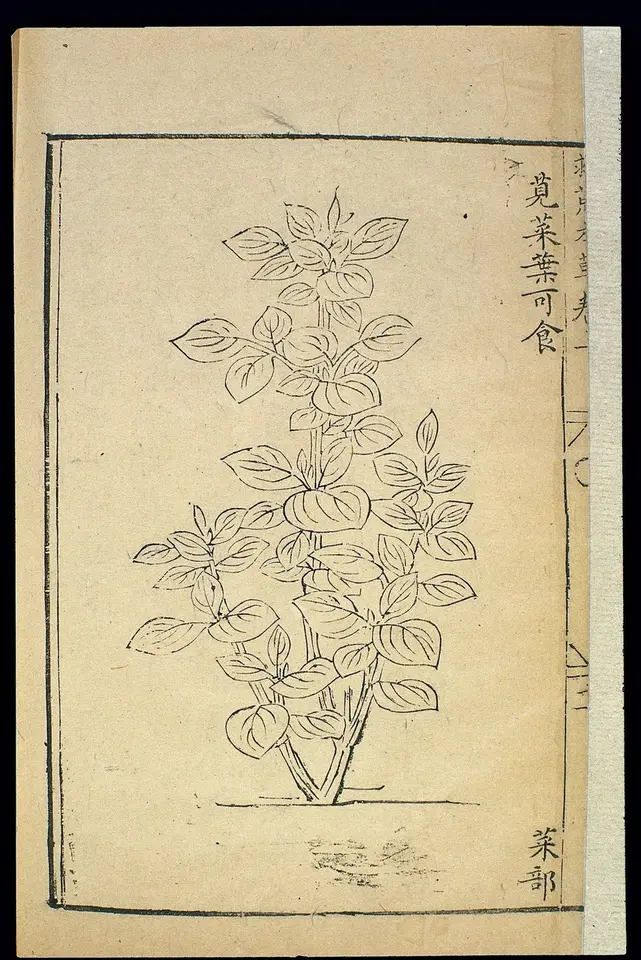
In his Kaifeng palace, he established expansive experimental botanical gardens, sending collectors across Henan and surrounding provinces to gather over four hundred wild herbs, shrubs, and vines for cultivation. Wearing commoner's clothing, Zhu Su spent years inspecting growth cycles across four seasons, observing leaf patterns, flowering, and fruiting, while personally testing the toxicity and taste of wild foliage. For each plant confirmed as edible, he engaged skilled woodblock artists to produce lifelike, accurate line drawings depicting root systems, stem nodes, leaves, and flowers.
Comprising two volumes, the text cataloged 414 plant species, of which 276 were newly identified and documented by Zhu Su. Organizing the flora into five categories—herbs, trees, grains, fruits, and vegetables—he utilized descriptive terminology such as growing in clusters and trailing vines, pioneering botanical morphology. His detailed preparation instructions—such as boiling, leaching with ash water, and repeatedly rinsing to eliminate toxins—saved countless famine victims and earned global acclaim as an early milestone in botanical taxonomy and ecology.
In clinical pharmacology, Zhu Su directed the compilation of Prescriptions for Universal Relief (Puji Fang), the largest and most comprehensive medical formulary in imperial Chinese history. Over more than a decade spanning the Hongwu and Yongle reigns, Zhu Su mobilized Zhou princely resources and assembled dozens of prominent scholars and physicians, including Teng Shuo, Li Heng, and Liu Chun, to systematically index two millennia of medical literature from antiquity to the early Ming.
Spanning 426 volumes across 188 clinical categories, the compendium preserved 61,739 classical and empirical prescriptions alongside 239 anatomical and herbal illustrations. Arranged rigorously by clinical disciplines—internal medicine, surgery, gynecology, pediatrics, and emergency care—each chapter opened with classical discussions of pathology, followed by differential diagnoses, therapeutic principles, and specific herbal formulas.
Puji Fang rescued countless rare medical texts that had been lost during the warfare of the Jin-Yuan transition. The monumental compendium provided foundational material for Li Shizhen's later masterpiece, Compendium of Materia Medica (Bencao Gangmu), which drew the majority of its pre-Ming formulas directly from Zhu Su's collection. Recognized in the Qing Complete Library of the Four Treasuries, Puji Fang remains an invaluable repository of pre-modern clinical medical wisdom.
Beyond his monumental works, Zhu Su compiled Pocket Prescriptions (Xiuzhen Fang) in four volumes, selecting over 3,000 highly effective and economical remedies to assist traveling physicians and rural communities during sudden outbreaks of illness. Compact and practical, it became one of the most widely circulated emergency medical guides during the Ming and Qing eras.
In literary scholarship, Zhu Su composed Yuan Palace Lyrics (Yuan Gong Ci), consisting of one hundred seven-character quatrains based on historical accounts provided by an elderly Yuan court maidservant presented to him by the Yongle Emperor. The poems vividly preserved the ceremonies, seasonal rituals, architectural layouts, and internal events of the Yuan capital, possessing substantial historical value. Within his palace, Zhu Su created the Dongshetang library, amassing thousands of rare volumes and nurturing prominent scholars like Qu You, author of New Tales for the Trimmed Lampwick. This intellectual tradition shaped the Zhou lineage for generations, inspiring prolific playwrights like Zhu Youdun and renowned historians like Zhu Muzhai.
FIGURES ASSOCIATED WITH THIS DYNASTY