Born in Yanshan (present-day Beijing); displayed early brilliance and dedicated himself to traditional rod calculus and mathematical philosophy.
Historical figure
Zhu Shijie (朱世杰)
朱世杰
Zhu Shijie (朱世杰, 1249–1314), courtesy name Hanqing, pseudonym Songting, was a native of Yanshan (present-day Beijing). He was a renowned commoner mathematician and educator of the Yuan dynasty, celebrated alongside Qin Jiushao, Li Ye, and Yang Hui as one of the "Four Great Mathematicians of the Song and Yuan Dynasties." Active during the golden zenith of traditional Chinese rod-calculus algebra, Zhu comprehensively…
Era not stated
PROFILE
Zhu Shijie (朱世杰, 1249–1314), courtesy name Hanqing, pseudonym Songting, was a native of Yanshan (present-day Beijing). He was a renowned commoner mathematician and educator of the Yuan dynasty, celebrated alongside Qin Jiushao, Li Ye, and Yang Hui as one of the "Four Great Mathematicians of the Song and Yuan Dynasties." Active during the golden zenith of traditional Chinese rod-calculus algebra, Zhu comprehensively synthesized and advanced the mathematical achievements of the Song and Jin dynasties. He creatively established the "Four Unknowns Method" (Siyuan Shu), higher-order summation of arithmetic series through "piled-square methods" (Duoji Shu), and high-order interpolation via "reciprocal difference methods" (Zhaochai Shu), elevating ancient Chinese algebra to the pinnacle of medieval world mathematics. In his early years in northern China, Zhu diligently studied major mathematical treatises, drawing inspiration from Li Ye's Sea Mirror of Circle Measurements (Ceyuan Haijing) on celestial unknown algebra, while absorbing the dual-unknown methods of Li Dezai and triple-unknown methods of Liu Dajian. Following the Mongol unification of China after the fall of the Southern Song dynasty in 1279, Zhu spent more than two decades traveling across northern and southern China as an itinerant scholar-mathematician. Traversing Shandong, Henan, Hubei, Jiangsu, and Zhejiang, he investigated southern root-extraction methods, commercial computation algorithms, and popular mnemonics, teaching legions of students wherever he lodged. In 1299, Zhu published his introductory mathematical textbook Introduction to Mathematical Studies (Suanxue Qimeng) in three volumes at Yangzhou, systematically explicating rod arithmetic, nine-return division rhymes, quick calculation tables, and single-unknown algebra. In this work, he formally formulated for the first time in world history the complete rules for multiplication and division of positive and negative numbers. In 1303, Zhu printed his algebraic masterpiece Jade Mirror of the Four Unknowns (Siyuan Yujian) in three volumes at Yangzhou. There he established the theory of multi-variable polynomial equations using four unknowns (Heaven, Earth, Man, and Matter) and formulated the method of elimination for four unknowns, developing general interpolation formulas containing arbitrary high-order differences and summation formulas for piled series more than four centuries ahead of European counterparts. Zhu's treatises exercised profound influence throughout East Asia, earning him international recognition as one of the most brilliant mathematical minds of the medieval world.
- Courtesy Name
- Hanqing
- Pseudonym
- Songting
- Date of Birth
- 1249 (9th year of the Chunyou era of Song Lizong)
- Date of Death
- 1314 (1st year of the Yanyou era of Yuan Renzong)
- Age at Death
- 65
- Native Place
- Yanshan (present-day Beijing)
- Highest Office
- Commoner scholar (never entered bureaucratic service)
- Historical Role
- Leading mathematician and mathematics educator of the Yuan dynasty, one of the "Four Great Mathematicians of the Song and Yuan Dynasties"
LIFE TIMELINE
Mastering Celestial Unknowns
Studied Li Ye's algebraic works; synthesized Li Dezai's dual unknowns and Liu Dajian's triple unknowns to achieve renown in northern mathematical circles.
Itinerant Studies in the South
Following Yuan unification, traveled south into the Yangtze River delta, researching practical commercial calculation techniques and folk mnemonics.
Travelling and Lecturing
Traveled across China for over twenty years without seeking official office, teaching pupils and refining computational treatises.
Publishing the Introduction
Printed Introduction to Mathematical Studies in twenty chapters at Yangzhou, establishing operational signs for positive and negative multiplication.
Printing the Jade Mirror
Published his crowning masterpiece Jade Mirror of the Four Unknowns in twenty-four chapters at Yangzhou, establishing four-variable polynomial algebra, piled-square methods, and interpolation.
Late Years of Teaching
Continued instructing disciples in southern cities, collating mathematical manuscripts and guiding Chinese rod algebra to its zenith.
Passing in Jiangnan
Died during a pedagogical journey through the southern provinces at age sixty-five, leaving behind immortal mathematical monuments.
Relationship graph
BIOGRAPHY
Life and Career
Northern Scholarship and the Mastery of Celestial Unknowns
Zhu Shijie was born in Yanshan during the transition between the Jin and Mongol-Yuan eras. During the mid-thirteenth century, rod-calculus algebra experienced vigorous development in northern China. Naturally gifted with extraordinary intellectual curiosity, Zhu showed a profound fascination with abstract numerical changes and spatial geometric structures from early youth, immersing himself in ancient mathematical texts.
In his twenties, Zhu carefully studied the seminal treatises of the northern master Li Ye, specifically Sea Mirror of Circle Measurements (Ceyuan Haijing) and Old Mathematical Developments Illustrated (Yigu Yanduan). He was enthralled by the "Method of the Celestial Unknown" (Tian Yuan Shu), which placed counting rods on a board to represent a single algebraic unknown (equivalent to $x$) and formulated polynomial equations of high degree for geometric figures. Zhu fully mastered Li Ye's polynomial equation setup and positive-negative root extraction, while recognizing the limitation of dealing with only one unknown.
Subsequently, Zhu investigated the dual-unknown system formulated by northern mathematician Li Dezai (introducing Earth Unknown along with Heaven Unknown), as well as the triple-unknown method expanded by Liu Dajian (adding Man Unknown). By the 1270s, before reaching the age of thirty, Zhu had achieved widespread fame across northern mathematical circles for his mastery of multi-variable polynomial theory.
Decades of Itinerant Teaching Across the Realm
In 1279, Yuan armies defeated the final Southern Song forces at the naval Battle of Yamen, completing the conquest of China. The political unification eliminated more than a century of military partition between north and south, creating vast scope for cross-regional scholarly communication. Filled with intellectual ambitions, Zhu strapped on his traveling bag and journeyed southward to embark on more than two decades of itinerant teaching.
Indifferent to fame and bureaucratic prestige, Zhu never sought civil service rank, choosing to live as a commoner scholar throughout his life. He resided in Shandong, Henan, Anhui, Jiangsu, Hubei, and Zhejiang. In southern cultural centers, he examined the algebraic traditions of southern mathematicians Qin Jiushao and Yang Hui, absorbing Horner-Ruffini root extraction, simultaneous linear equations, modulo remainders, and commercial calculation shortcuts, as well as early forms of abacus reckoning.
Wherever he arrived in prominent prefectures and cities, Zhu established lecture halls to instruct students from modest backgrounds. He was renowned for lucid pedagogical explanations, skillfully combining abstract polynomial equations with intuitive geometric diagrams and practical mercantile problems. Over two decades of teaching, hundreds of disciples studied under his tutelage, providing Zhu with an invaluable archive of computational problems and pedagogical experience.
Pedagogical Treatise and the Yangzhou Publications
In the late 1290s, Zhu arrived in the thriving southeastern metropolis of Yangzhou. Observing that contemporary education lacked a comprehensive, progressive mathematical textbook—causing many beginners to abandon the difficult study of rod calculus—Zhu determined to synthesize northern polynomial algebra with southern practical algorithms into a unified, foundational curriculum.
In 1299, with financial assistance from Yangzhou colleagues and students, Zhu published Introduction to Mathematical Studies (Suanxue Qimeng) in three volumes and twenty chapters, comprising 259 mathematical problems. The book opens with fundamental computational tools including multiplication rhymes, division mnemonics, weight and measure conversion tables, and then progressively guides the reader through fractions, proportions, double false position, right-triangle geometry, and ultimately the cutting-edge "Method of the Celestial Unknown."
Crucially, in the opening volume of Suanxue Qimeng, Zhu systematically articulated the rules for adding and subtracting positive and negative numbers, while formulating for the first time in world history the universal laws for their multiplication and division: "multiplying numbers of the same sign yields positive; multiplying numbers of different signs yields negative." This axiomatic definition provided a rigorous theoretical foundation for symbolic rod algebra. The work was widely praised and became the standard mathematical textbook of the Yuan dynasty.
The Masterpiece of the Four Unknowns
After completing his introductory textbook, Zhu focused his energies on the supreme challenge of Chinese algebra: how to construct a unified system of simultaneous polynomial equations containing up to four distinct unknowns, and how to execute mechanical algebraic elimination to solve for their roots. In 1303, Zhu printed his magnum opus, Jade Mirror of the Four Unknowns (Siyuan Yujian), in Yangzhou.
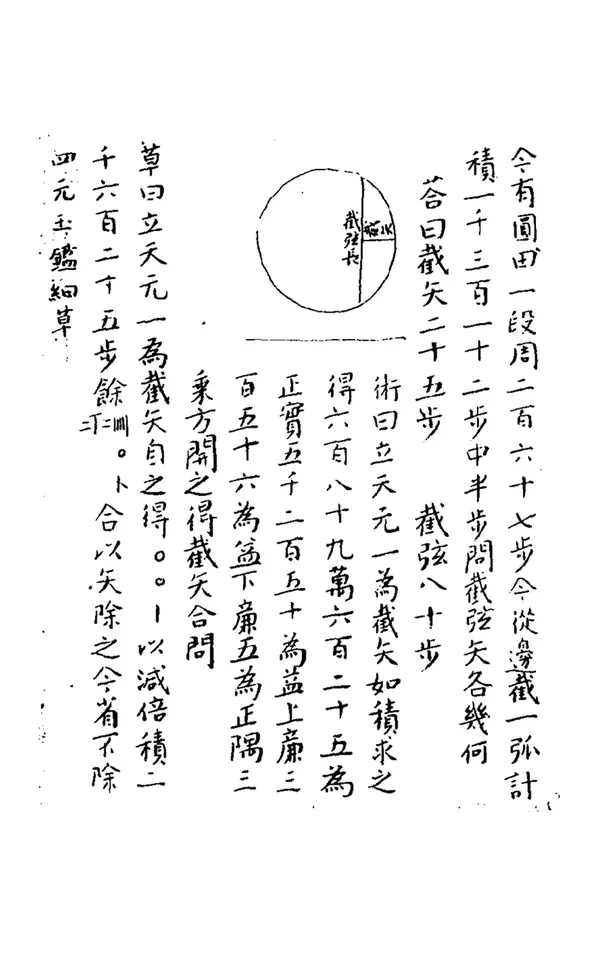
Comprising three volumes and twenty-four chapters with 288 advanced mathematical problems, Siyuan Yujian established the theory of four-variable high-order polynomial equations. Zhu designated Heaven, Earth, Man, and Matter as four directional vectors on the counting board, placing the constant term (Taiji) at the central origin. This two-dimensional matrix notation freed polynomial algebra from geometric dimensional restrictions.
Furthermore, Zhu created the systematic "Four Unknowns Elimination Method" (Siyuan Xiaofa). By cross-multiplying and subtracting polynomial matrices, he systematically eliminated unknowns one by one, reducing a complex four-variable system to a single-variable high-order polynomial equation solvable by root-extraction methods. This mechanical algorithm anticipated the general elimination method of eighteenth-century French mathematician Etienne Bezout by five centuries.
Piled-Square Methods, Interpolation, and Immortal Legacy
Beyond multi-variable algebra, Zhu demonstrated peerless ingenuity in discrete mathematics within Siyuan Yujian. Expanding upon the earlier works of Shen Kuo and Yang Hui, he explored high-order arithmetic series formed by spatial stacking of spheres and blocks, deriving universal formulas known as piled-square methods for triangular, trapezoidal, and pyramidal piles, while utilizing properties of the Pascal arithmetical triangle.
Zhu brilliantly applied these piled-square methods to astronomical calendar calculations, creating the famous "reciprocal difference methods" (Zhaochai Shu) of high-order interpolation. He formulated an equal-interval fourth-order difference formula and derived for the first time in world history a generalized interpolation formula incorporating arbitrary high-order differences. This breakthrough preceded the forward difference interpolation formulas of Isaac Newton and James Gregory by more than four centuries.
Following the publication of Siyuan Yujian, Zhu continued to live simply as an itinerant teacher. In 1314, this master of mathematical truth passed away quietly during a lecturing tour through Jiangnan at the age of sixty-five. He held no official rank and received no grand funerary monument, yet his mathematical treatises shine across world history.
Major Deeds
Establishing Four-Variable Polynomial Algebra and Elimination
Zhu Shijie's greatest scientific contribution to world mathematics was the comprehensive formulation of four-variable high-order polynomial equations and the four-unknown elimination method. He positioned the constant term in the center of the counting board, deploying Heaven, Earth, Man, and Matter along the four cardinal directions (up, down, left, right), while positioning cross-product terms across the four quadrants to create a matrix representation of multivariate polynomials.
Building upon this notation, Zhu developed an algorithmic elimination process. By multiplying and subtracting adjacent rows and columns, he designated one unknown as primary and treated others as polynomial coefficients, progressively reducing four variables to three, then two, and finally to a single-variable polynomial equation solved via iterative root extraction. This algorithm represents the historical zenith of algorithmic mechanization in Chinese traditional algebra.
Expanding Piled-Square Methods for Higher-Order Series
In discrete mathematics, Zhu brought the study of piled-square methods to its classical peak. He systematically investigated various discrete geometric stackings—such as triangular piles, square piles, and complex tiered heaps—deriving summation formulas for multiple orders of arithmetic series.
By analyzing the combinatorial properties of the arithmetic triangle (Pascal's triangle), Zhu established the algebraic identities connecting higher-order arithmetic progressions to triangular pile formulas. These piled-square methods provided powerful analytical tools for calculating architectural material requirements, grain storage logistics, and discrete orbital computations in astronomy.
Formulating Generalized High-Order Interpolation
Integrating piled-square summation with planetary orbital calculations, Zhu established mature reciprocal difference methods in Siyuan Yujian. Expanding upon the third-order difference interpolation used in Guo Shoujing's Shoushi Calendar, Zhu introduced an equal-interval fourth-order difference formula, demonstrating that the interpolation coefficients correspond to the products of consecutive triangular piles.
Zhu further generalized this interpolation formula to encompass arbitrary high-order finite differences. This allowed astronomers to interpolate planetary and lunar coordinates at any given moment with high precision from limited observational datasets. Preceding European finite-difference calculus by four hundred years, it represents the supreme achievement of medieval numerical mathematics.
Educational Innovation and Cross-Cultural Transmission
Zhu was not only an elite theoretical mathematician but also an exceptional educator. His Introduction to Mathematical Studies formed a progressive, self-contained mathematical curriculum, spanning elementary arithmetic rhymes to advanced single-unknown algebra.
Shortly after its publication, Suanxue Qimeng spread to the Korean peninsula and Japan. The Joseon dynasty of Korea designated it as a mandatory textbook for official civil service examinations in mathematics, where prominent scholars wrote commentaries upon it. In Edo-period Japan, celebrated mathematicians such as Seki Takakazu studied the treatise to master single-unknown algebra, laying the bedrock for Japanese traditional mathematics (Wasan). After the original prints were lost in China during the late Ming, Qing scholars Jiao Xun and Ruan Yuan recovered copies from Korea in the early nineteenth century and reprinted them in Yangzhou, sparking a major renaissance in Chinese classical mathematics.
Personal Relationships
- Intellectual Precursor: Li Ye, Jin-Yuan mathematician whose Sea Mirror of Circle Measurements established the celestial unknown method, providing the conceptual foundation for Zhu's algebra.
- Academic Peer: Li Dezai, early Yuan mathematician who invented the dual-unknown method, which Zhu expanded.
- Academic Peer: Liu Dajian, Yuan mathematician who developed the triple-unknown method, upon which Zhu constructed his four-unknown system.
- Southern Precursor: Qin Jiushao, Southern Song mathematician whose Mathematical Treatise in Nine Sections established polynomial root extraction and modular remainders, absorbed by Zhu.
- Southern Precursor: Yang Hui, Southern Song mathematician whose works explored arithmetic progressions and magic squares, deeply influencing Zhu's piled-square methods.
- Preface Author: Zu Yi, Yuan scholar who authored the postface to Siyuan Yujian, detailing the historical emergence of four-unknown algebra.
- Yangzhou Colleague: Mo Ruo, Yuan scholar in Yangzhou who wrote the main preface to Siyuan Yujian, praising Zhu's profound mathematical insights.
Historical Appraisal
- Mo Ruo, Preface to Siyuan Yujian: "Master Zhu Hanqing of Yanshan dedicated over twenty years to mathematical inquiry. His three-volume Jade Mirror of the Four Unknowns profoundly grasps celestial and human principles, illuminating obscure mysteries. Even the secrets of the ancient Nine Chapters cannot surpass this; he is truly a great man of our age!"
- Zu Yi, Postface to Siyuan Yujian: "Master Hanqing earned fame through the Four Unknowns, establishing Heaven, Earth, Man, and Matter as four directional aspects, arranging them symmetrically. His methodology is intricate and profound, unmatched by ancient mathematicians."
- Luo Shilin, Preface to Detailed Commentary on Siyuan Yujian: "Master Hanqing's learning encompassed the workings of nature. His four-unknown elimination, reciprocal difference interpolation, and piled-square methods operate with divine ingenuity, surpassing the ancients to stand as China's foremost mathematical achievement."
- George Sarton, Introduction to the History of Science: "Zhu Shijie was one of the greatest mathematicians of his time, and indeed of all times. His Jade Mirror of the Four Unknowns is the most important mathematical work produced in China, and one of the outstanding mathematical works of the entire Middle Ages."
- Wu Wenjun, Academician of the Chinese Academy of Sciences: "Zhu Shijie's Jade Mirror of the Four Unknowns marks the apex of traditional Chinese algebra. His multi-variable elimination theory not only preceded Western developments by centuries but also offers profound inspiration for modern mathematical mechanization and symbolic computation in computer science."
Related Entries
- Jade Mirror of the Four Unknowns
- Introduction to Mathematical Studies
- Li Ye
- Qin Jiushao
- Yang Hui
- Guo Shoujing
FIGURES ASSOCIATED WITH THIS DYNASTY
Bibliography
- History of Yuan (Yuan Shi), Volume 160, Biography 47 (Biographical notes on Yuan calendar-mathematicians)
- Jade Mirror of the Four Unknowns (Siyuan Yujian), Yuan Dade edition and Qing Daoguang edition with Luo Shilin's commentary
- Introduction to Mathematical Studies (Suanxue Qimeng), Yuan Dade edition and Qing Daoguang Ruan Yuan facsimile of the Joseon print
- Biographies of Astronomers and Mathematicians (Chouren Zhuan), Volume 27, by Ruan Yuan
- Compendium of the History of Chinese Mathematics (Zhongguo Shuxue Shi Daxi), Volume 6: The Zenith of Song and Yuan Mathematics, edited by Wu Wenjun