Birth
Born in Guzhang, Danyang Commandery, originally named Shi Ran.
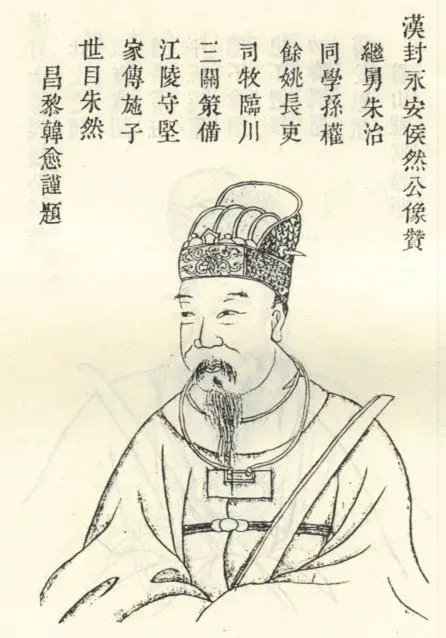
182 CE–249 CE
朱然
Zhu Ran (朱然, 182–249 AD), originally surnamed Shi with the courtesy name Yifeng, was a prominent military commander and senior statesman of the Eastern Wu during the Three Kingdoms Period. Adopted in his youth by Zhu Zhi, a founding pillar of the Sun regime, Zhu Ran was educated alongside Sun Quan, developing a lifelong bond of mutual trust with the future ruler. Following Sun Quan's accession to leadership, Zhu Ran…
Zhu Ran (朱然, 182–249 AD), originally surnamed Shi with the courtesy name Yifeng, was a prominent military commander and senior statesman of the Eastern Wu during the Three Kingdoms Period. Adopted in his youth by Zhu Zhi, a founding pillar of the Sun regime, Zhu Ran was educated alongside Sun Quan, developing a lifelong bond of mutual trust with the future ruler. Following Sun Quan's accession to leadership, Zhu Ran successively served as Chief of Yuyao, Magistrate of Shanyin, and Administrator of Linchuan, demonstrating exceptional administrative competence and swift martial ability by suppressing local rebel uprisings. In 219 AD, Zhu Ran participated in Lu Meng's campaign to seize Jing Province, coordinating with Pan Zhang to intercept and capture Guan Yu at Linju, for which he was ennobled. During the Battle of Yiling in 222 AD, he assisted Commander-in-Chief Lu Xun in destroying Liu Bei's expeditionary forces, severing the Shu retreat routes. Later that year, when Cao Wei launched a massive tripartite invasion and besieged Jiangling with over one hundred thousand troops, Zhu Ran held the isolated fortress with merely five thousand soldiers for six months. In the face of disease, famine, and internal treason, he preserved the stronghold and repelled the enemy, gaining enduring renown across Wei and Shu. Later serving as Commander of Ruxu and leading multiple successful deep strikes into Cao Wei territory at Zhaozhong, Zhu Ran rose to become Left Grand Marshal and Right Military Advisor, the supreme military ranks of the state. Known for his austere personal conduct, strict military discipline, and unwavering devotion to the state, he served as a bedrock of stability for Eastern Wu throughout his life.
Born in Guzhang, Danyang Commandery, originally named Shi Ran.
Adopted by his maternal uncle Zhu Zhi with Sun Ce's formal blessing, officially changing his surname to Zhu.
Studied together with Sun Quan, forming a profound and enduring personal friendship.
Appointed Chief of Yuyao at nineteen, subsequently serving as Magistrate of Shanyin and Commandant of Fortitude.
Appointed Administrator of Linchuan and allocated two thousand troops, pacifying regional rebel forces within a month.
Stationed at Ruxukou against Cao Cao's invasion forces, promoted to Major General.
Aided Lu Meng in seizing Jing Province and captured Guan Yu at Linju, ennobled as Marquis of Xi'an.
Fought under Lu Xun to crush Liu Bei's invasion army, promoted to General Who Pacifies the North.
Successfully held Jiangling with five thousand men against a six-month siege by Cao Zhen, ennobled as Marquis of Dangyang.
Succeeded Zhou Tai as Commander of Ruxu, overseeing the defense lines along the lower Yangtze River.
Appointed General of Chariots and Cavalry, Right Protective General, and Governor of Yan Province upon Sun Quan's imperial accession.
Struck deep into Wei territory at Zhaozhong, ambushing and crushing the army of Wei general Pu Zhong.
Promoted to Left Grand Marshal and Right Military Advisor following the death of Lu Xun.
Died of illness at his military post at age sixty-eight; honored with the posthumous title Marquis Zhao as Sun Quan wore mourning robes.
Zhu Ran was born into the Shi lineage of Guzhang in Danyang Commandery in 182 AD. His maternal uncle, Zhu Zhi, was one of the foremost military commanders under Sun Jian and Sun Ce. In 194 AD, because Zhu Zhi had no biological heir, he petitioned Sun Ce to allow him to adopt his nephew Shi Ran. Sun Ce held Zhu Zhi in profound esteem and granted the request, ordering the local administration of Danyang to escort the boy with ceremonial gifts of wine and sheep. Upon arrival in Wu, Sun Ce feted him and officially enrolled him into the Zhu household, bestowing upon him the name Zhu Ran.
Sun Ce subsequently arranged for Zhu Ran to study the Confucian classics and ancient military treatises alongside his younger brother, Sun Quan. Living and studying together, the two developed a deep, lifelong friendship based on mutual respect. When Sun Ce was assassinated in 200 AD and the nineteen-year-old Sun Quan assumed control of the southern regime, Sun Quan immediately recruited his trusted companion, naming the nineteen-year-old Zhu Ran as Chief of Yuyao. Zhu Ran demonstrated outstanding administrative competence by maintaining public order, curbing abuses, and improving civilian welfare. He was soon promoted to Magistrate of Shanyin, taking charge of the provincial capital of Kuaiji, while being concurrently appointed Commandant of Fortitude to supervise military matters across five counties.
Impressed by Zhu Ran's organizational gifts and martial decisiveness, Sun Quan partitioned Danyang Commandery in 211 AD to establish Linchuan Commandery, naming Zhu Ran as its first Administrator and assigning him two thousand elite soldiers. The mountainous region was troubled by armed indigenous Shanyue clans and bandits exploiting the rugged terrain to defy central authority. Zhu Ran conducted a swift, multi-pronged counterinsurgency campaign, eradicating the rebel bands within a single month and restoring peaceful administration to the entire region.
In the spring of 217 AD, Cao Cao led a massive army south toward Ruxukou, encamping near Hao Creek. Sun Quan established fortified dock defenses on the north bank of the Yangtze River to check the invasion. Zhu Ran was dispatched to garrison the central fortress and the Three Passes redoubts, supervising defensive operations and repulsing repeated enemy assaults. For his steadfast performance, Sun Quan promoted him to Major General.
Following Cao Cao's withdrawal, Sun Quan appointed the veteran general Zhou Tai as Commander of Ruxu. Several high-ranking commanders stationed at Ruxu, including Zhu Ran and Xu Sheng, felt dissatisfied with serving under Zhou Tai. Hearing of the discord, Sun Quan visited Ruxu in person and hosted a grand banquet for all commanders. During the feast, Sun Quan personally walked to Zhou Tai, poured wine, and instructed him to strip off his garment. Sun Quan then pointed to each of Zhou Tai's dozens of battle scars, asking how each had been sustained. As Zhou Tai recounted the desperate encounters where he had risked his life to rescue Sun Ce and Sun Quan, Sun Quan wept with gratitude and granted him the imperial parasol. Zhu Ran, Xu Sheng, and the other officers were profoundly moved, setting aside their reservations and pledging absolute obedience to Zhou Tai.
In the autumn of 219 AD, Guan Yu launched a major offensive in Jing Province, surrounding Cao Ren at Fancheng and capturing Yu Jin's seven armies. Sun Quan formed an alliance with Cao Cao to seize Jing Province. To put Guan Yu off his guard, Eastern Wu commander Lu Meng feigned severe illness and withdrew from the front line, recommending that Sun Quan entrust vital rear-guard and interception operations to commanders of exceptional courage, specifically endorsing Zhu Ran and Pan Zhang.
After Lu Meng captured Jiangling in a surprise amphibious advance, Guan Yu's army collapsed and retreated toward Maicheng. Zhu Ran and Pan Zhang were ordered to advance to Linju to establish ambushes along Guan Yu's only escape route. In the twelfth lunar month, Guan Yu attempted to break out through Jiashi, where Zhu Ran's blocking forces closed the net. Pan Zhang's subordinate commander Ma Zhong successfully captured Guan Yu and his son Guan Ping. Following the total conquest of Jing Province, Sun Quan promoted Zhu Ran to General of Bright Military Prowess and created him Marquis of Xi'an.
In 222 AD, Liu Bei led a massive Shu Han expedition east along the Yangtze River, seeking retribution for the loss of Guan Yu and Jing Province. Sun Quan named Lu Xun as Commander-in-Chief, with Zhu Ran, Pan Zhang, Xu Sheng, and Song Qian serving as vanguard generals. After confronting the Shu forces at Yiling for several months, Lu Xun unleashed a devastating fire attack that incinerated dozens of interconnected enemy camps. Zhu Ran spearheaded a flanking charge directly into the rear of the Shu formations, overrunning frontline encampments and severing Liu Bei's line of retreat. Liu Bei barely escaped to Baidicheng with a remnant force. For his decisive battlefield performance, Zhu Ran was elevated to General Who Pacifies the North and created Marquis of Yong'an.
In the autumn of 222 AD, Cao Pi launched a large-scale three-pronged invasion of Eastern Wu under the pretext that Sun Quan had failed to send his crown prince as hostage to Luoyang. Cao Wei Grand Marshal Cao Zhen, General of the Left Zhang He, and Senior General Xiahou Shang led over one hundred thousand elite troops to besiege the critical fortress of Jiangling in Nan Commandery. At the time, Zhu Ran had only five thousand defenders inside the city walls, while external relief forces were repeatedly driven back by Wei detachments, leaving Jiangling completely isolated.
Zhang He seized the sandbar in the middle of the river outside Jiangling, while Xiahou Shang erected pontoon bridges across the Yangtze to ensure Wei supply lines. The besiegers constructed earthen mounds, excavated assault tunnels, and raised towering mobile siege engines, showering the interior of the city with arrows and stones day and night. An epidemic broke out within the besieged walls, leaving only approximately one thousand soldiers physically fit to bear arms. To make matters worse, Jiangling Magistrate Yao Tai attempted to betray the gates to the enemy. Remaining calm under pressure, Zhu Ran promptly uncovered the conspiracy and executed Yao Tai, immediately stabilizing morale.
Refusing to remain passive, Zhu Ran continually looked for tactical opportunities. Throughout the six-month siege, he repeatedly led night sorties through sally ports, storming and burning two major Wei camps and slaying enemy commanders. Eventually, Eastern Wu relief forces under Zhuge Jin succeeded in burning the Wei pontoon bridges. With their logistical lifeline severed, spring floodwaters rising, and the fortress stubbornly holding out, Cao Zhen had no choice but to lift the siege and withdraw northward in the third month of 223 AD. Zhu Ran's defense against ten times his numbers astounded observers throughout Wei and Shu. Following the victory, Sun Quan promoted him to Earl of Dangyang, later elevated to Marquis of Dangyang.
In 227 AD, following the death of Zhou Tai, Sun Quan appointed Zhu Ran as Commander of Ruxu, placing him in sole charge of the fortified naval and garrison complexes protecting the lower Yangtze corridor against northern attacks. In 229 AD, Sun Quan proclaimed himself emperor at Wuchang, founding the Eastern Wu dynasty. Zhu Ran was appointed General of Chariots and Cavalry, Right Protective General, and Governor of Yan Province, enjoying the highest level of imperial trust.
In 240 AD, Zhu Ran initiated an offensive strike into Cao Wei's Jiangxia Commandery, laying siege to the Zhaozhong region. Maneuvering with tactical precision, he captured several enemy forward fortifications, incinerated defensive weaponry and supply depots, and inflicted thousands of casualties on the opposing forces. In 242 AD, he conducted a second campaign into Zhaozhong. When Wei commanders Pu Zhong and Hu Zhi advanced with several thousand infantry and cavalry to engage him, Zhu Ran lured Pu Zhong into an ambush and routed his forces, forcing Hu Zhi to retreat behind city fortifications.
In 246 AD, Zhu Ran undertook a third expedition into the Zhaozhong basin. Wei general Li Xing attempted to march across his rear with several thousand troops to sever his withdrawal path. Zhu Ran calmly arranged his infantry into tight formations, launched a ferocious nighttime countercharge, and shattered Li Xing's forces, killing hundreds of enemy troops before leading his entire command safely back across the river.
During this period, the veteran chancellor and grand commander Lu Xun died in 246 AD, following the earlier death of Grand Marshal Zhuge Jin. Facing a generational void among the founding leadership, Sun Quan promoted Zhu Ran to Left Grand Marshal and Right Military Advisor, making him the supreme commander of all armed forces in the realm. Despite his exalted standing, Zhu Ran remained an unpretentious soldier at heart, maintaining strict discipline and winning deep admiration from his troops.
Throughout his prolonged military career, Zhu Ran had spent decades in armor on the frontiers, which took a severe toll on his health. By 247 AD, his condition deteriorated significantly, and he became bedridden with chronic illness. Sun Quan was deeply distressed by his friend's declining health, sending imperial physicians and attendants to check on him daily, while dispatching rare medicines and delicacies to his residence. Whenever he heard that Zhu Ran's appetite had improved, Sun Quan rejoiced; if the illness worsened, the emperor was overcome with worry and lost sleep.
During the bitter succession feud between Crown Prince Sun He and Prince of Lu Sun Ba, which polarized the civil and military leadership into rival factions, Zhu Ran steadfastly maintained an impartial and loyal stance. He repeatedly submitted private memorials to Sun Quan, urging the emperor to uphold traditional succession norms to preserve imperial stability and protect the realm from internal ruin.
In the third month of 249 AD, Zhu Ran passed away at his military headquarters at the age of sixty-eight. Upon learning of his death, Sun Quan was inconsolable with grief, personally donning white mourning garments to lament his passing. The emperor bestowed upon him the posthumous title Marquis Zhao. Zhu Ran's only son, Shi Ji (originally Zhu Ji), inherited his military commands and peerage, continuing to serve Eastern Wu with distinction. Having served the Sun family for nearly half a century through countless perilous battles, Zhu Ran was remembered as an irreplaceable pillar of the Eastern Wu state.
The defense of Jiangling in 222–223 AD stands as one of the most famous defensive operations in ancient Chinese military history. Facing over one hundred thousand elite troops commanded by premier Wei generals Cao Zhen, Zhang He, and Xiahou Shang, Zhu Ran was left with only five thousand soldiers inside the city as external relief efforts repeatedly foundered.
Compounding the crisis, an epidemic incapacitated the majority of the garrison, reducing the number of effective combatants to merely one thousand. Under continuous bombardment from elevated siege platforms and facing undermining sapping operations, Zhu Ran remained unflinching, regularly inspecting the parapets to steady the soldiers.
When the local magistrate Yao Tai plotted internal treason, Zhu Ran swiftly executed him, eliminating internal dissent with decisive resolve. Rather than passively waiting behind the walls, Zhu Ran organized daring nighttime sorties that overran and burned two forward Wei fortifications, killing enemy commanders. After six months of futile efforts, the Wei armies were forced into an ignominious retreat, permanently thwarting Cao Pi's ambitions of subjugating the southern realm.
During his tenure overseeing the Ruxu sector and the forward frontiers of Jing Province, Zhu Ran repeatedly utilized proactive offensive maneuvers to forestall Wei incursions. In 240, 242, and 246 AD, he personally spearheaded three deep expeditions into the open plains of Zhaozhong in Jiangxia Commandery.
The flat terrain of Zhaozhong favored northern cavalry maneuvers, yet Zhu Ran neutralized this advantage through disciplined combined-arms formations and tactical deceptions. In 242 AD, he ambushed and routed Pu Zhong's forces; in 246 AD, when his retreat route was threatened by Li Xing's mobile force, Zhu Ran organized a sudden nighttime counterattack that scattered the enemy. These preemptive campaigns inflicted substantial personnel losses on Cao Wei and created a secure strategic buffer for Eastern Wu along the middle reaches of the Yangtze River.
Although Zhu Ran attained the highest ministerial and military rank as Left Grand Marshal, he preserved an austere and disciplined personal lifestyle throughout his existence. He refused to accumulate private real estate or amass fortunes, wearing modest robes and using plain household furnishings akin to a common scholar.
Conversely, in matters concerning arms manufacturing, defensive armor, and combat training, Zhu Ran insisted on supreme craftsmanship and rigorous preparation. Even in times of prolonged peace in the garrison towns, he insisted on maintaining round-the-clock watches and strict readiness, conducting himself as though constantly on the verge of battle. This seamless blend of personal rectitude and professional rigor earned him boundless veneration across the army, making his commands among the most formidable combat units in Eastern Wu history.
FIGURES ASSOCIATED WITH THIS DYNASTY