Ordination and Scriptural Study in India
Ordained in Central India, mastering the Tripitaka with deep expertise in Prajnaparamita and Pratyutpanna samadhi scriptures.
竺佛朔
Zhu Foshuo (竺佛朔, birth and death dates unrecorded in standard histories), also known as Zhu Shuofo, was an eminent Indian Buddhist monk and foundational master translator during the mid-to-late Eastern Han dynasty. In ancient China, monks from foreign lands adopted their realm of origin as their surname; Zhu Foshuo's surname Zhu marked his origin as an authentic master from India (Tianzhu). Sometime between the reigns of…
Zhu Foshuo (竺佛朔, birth and death dates unrecorded in standard histories), also known as Zhu Shuofo, was an eminent Indian Buddhist monk and foundational master translator during the mid-to-late Eastern Han dynasty. In ancient China, monks from foreign lands adopted their realm of origin as their surname; Zhu Foshuo's surname Zhu marked his origin as an authentic master from India (Tianzhu). Sometime between the reigns of Emperor Huan and Emperor Ling (second half of the second century CE), Zhu Foshuo was inspired by the vow to spread Mahayana teachings to China. Journeying across the Pamir Mountains with trading caravans, he arrived at the Eastern Han imperial capital of Luoyang. He gathered with contemporary pioneers such as Lokaksema, An Shigao, Zhu Dali, An Xuan, Zhi Yao, and Kang Mengxiang, helping establish Luoyang as the paramount hub of Mahayana translation in ancient Asia. Zhu Foshuo holds an irreplaceable founding role in Chinese Buddhist intellectual history. In 179 CE (the second year of the Guanghe era under Emperor Ling), bringing original Sanskrit birch-bark manuscripts of the Astasahasrika Prajnaparamita (Daoxing bore jing or Daoxing jing) and the Pratyutpanna Samadhi Sutra (Banzhou sanmei jing) from India, he convened a collaborative translation assembly in Luoyang. Zhu Foshuo established an organized cooperative translation bureau: he chanted the original Sanskrit text, Great Yuezhi master Lokaksema translated the Indic syntax into oral Chinese, and Chinese literati Meng Fu and Zhang Lian recorded the words in writing, supported by patrons Sun He and Zhou Tili. This seven-member translation bureau translated the first Mahayana Prajnaparamita text in Chinese history alongside the foundational scripture of Pure Land Amitabha visualization. In translation philosophy, Zhu Foshuo established the principle of prioritizing unadorned doctrinal fidelity over rhetorical embellishment. In his Collection of Records on the Translation of the Tripitaka, Liang dynasty scholar Sengyou praised his work as "discarding superficial literary ornamentation to preserve substantive essence, profoundly capturing canonical meaning," highlighting how his austere phrasing faithfully preserved the original intent of Indian Mahayana philosophy. In the fourth century, the great master Shi Dao'an revered Zhu Foshuo as the ultimate fountainhead of Prajnaparamita studies in China. The emptiness philosophy and Pure Land meditation introduced by Zhu Foshuo shattered earlier Chinese misconceptions that equated Buddhism with physical Daoist alchemy, inaugurating the golden age of Wei-Jin Xuanxue philosophy and Six Dynasties Mahayana Buddhism.
Ordained in Central India, mastering the Tripitaka with deep expertise in Prajnaparamita and Pratyutpanna samadhi scriptures.
Traveled along the Silk Road carrying Sanskrit palm-leaf manuscripts to the Eastern Han capital of Luoyang.
Recited the Sanskrit text in Luoyang, producing China's first Mahayana Prajnaparamita translation, the Daoxing jing, with Lokaksema.
Translated the two-volume Banzhou sanmei jing with Lokaksema, introducing Pure Land Amitabha visualization to China.
Lectured on Mahayana non-dual philosophy in Luoyang, instructing Chinese disciples in copying and chanting the new scriptures.
Withdrew from public life following the destruction of Luoyang by warlord Dong Zhuo; his translations were preserved in the canonical collections.
Zhu Foshuo was born in ancient India (Tianzhu). During the mid-second century CE, Mahayana Buddhism was flourishing across Central and Northern India, as foundational Prajnaparamita literature and meditative samadhi texts transitioned from oral preservation to written Sanskrit manuscripts.
Ordained in a celebrated Indian monastery, Zhu Foshuo strictly observed monastic precepts while delving into the depths of Mahayana doctrine. He recognized that while previous translations in China—such as those by An Shigao—had introduced basic meditation and numerical doctrinal lists, the core insights of Mahayana Buddhism, particularly the emptiness of all phenomena (sarva-dharma-sunyata), remained completely unknown in China.
Pained that the people of China remained bound to notions of physical immortality and folk sorcery, Zhu Foshuo resolved to bring authentic Mahayana teachings to the Central Plains. Gathering Sanskrit palm-leaf manuscripts of the Astasahasrika Prajnaparamita and the Pratyutpanna Samadhi Sutra, he departed India, crossing the Indus basin, scaling the freezing precipices of the Pamirs, and traversing the Taklamakan Desert. After years of perilous travel, he reached the Eastern Han capital of Luoyang during the late Yanxi era of Emperor Huan or the early Jianning era of Emperor Ling.
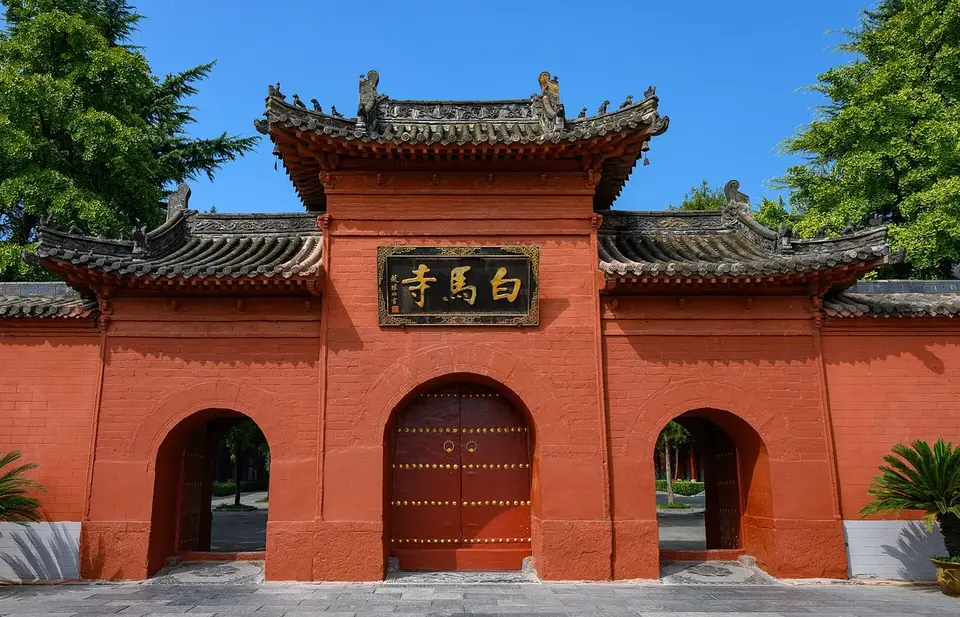
Upon arriving in Luoyang, Zhu Foshuo took up residence at White Horse Temple and nearby cloisters. A modest and contemplative ascetic, he initially spoke little Chinese, yet his profound grasp of the Sanskrit texts commanded the respect of local monastics and lay intellectuals.
In Luoyang, Zhu Foshuo formed an enduring bond with Lokaksema (Zhi Qian's lineage predecessor), a brilliant Great Yuezhi monk who was fluent in both Indic languages and standard Chinese. Simultaneously, prominent local scholars and lay devotees—including Meng Fu (styled Yuanshi) of Henan, Zhang Lian (styled Shao'an) of Nanyang, along with Zibi of Nanhai, Sun He, and Zhou Tili—rallied to support their work.
Under Zhu Foshuo's guidance, China's first systematically structured collaborative translation bureau was established. As recorded in the contemporary Postscript to the Daoxing Scripture preserved by Liang dynasty scholar Sengyou in the Collection of Records on the Translation of the Tripitaka, the translation bureau comprised seven core members working in harmony: Indian master Zhu Foshuo chanted the Sanskrit text; Great Yuezhi master Lokaksema interpreted the Indic words into spoken Chinese; Chinese literati Meng Fu and Zhang Lian served as transcribers (bishou), writing down the sentences; Zibi of Nanhai assisted with manuscript preparation; and wealthy patrons Sun He and Zhou Tili provided financial provisions and paper resources. This institutional model established the classic template for Chinese translation assemblies for centuries to follow.
In 179 CE (the second year of the Guanghe era under Emperor Ling), the translation assembly completed the Chinese translation of the Daoxing jing (Astasahasrika Prajnaparamita Sutra, or the Eight-Thousand-Line Perfection of Wisdom).
The Daoxing jing was the earliest translation of the Small Perfection of Wisdom in China. Prior to its appearance, Chinese society understood Buddhism as an offshoot of Huang-Lao Daoism, assuming that the Buddha was a foreign wizard teaching breath retention and dietary abstinence to attain physical longevity.
Zhu Foshuo's translation overturned these preconceptions. Through dynamic dialogues between the Buddha and disciples Subhuti and Sariputra, the scripture expounded the revolutionary philosophy of emptiness: all phenomena, from worldly riches to the attainment of nirvana, arise through dependent origination and possess no independent substantiality. The Bodhisattva perceives the five aggregates as empty, avoiding attachment even to the state of Buddhahood.
The publication of the Daoxing jing in Luoyang ignited an intellectual revolution across northern China. Literati encountered a transcendent metaphysics that went far beyond traditional categories of being and non-being. This text became the foundational catalyst for the rise of Third-century Wei-Jin Xuanxue philosophy (Dark Learning) under He Yan and Wang Bi, as well as the later Six Dynasties Prajnaparamita schools.
Following the completion of the Daoxing jing, Zhu Foshuo reconvened the translation bureau on the eighth day of the tenth month of 179 CE to translate another masterpiece: the two-volume Pratyutpanna Samadhi Sutra (Banzhou sanmei jing).
Working with Lokaksema and transcribers Meng Fu and Zhang Lian, Zhu Foshuo translated this text on meditative visualization. The term Pratyutpanna Samadhi denotes the meditative absorption in which all Buddhas of the ten directions stand present before the practitioner. The text instructed meditators to concentrate on the name and luminous form of Amitabha Buddha in the Western Pure Land of Sukhavati, promising that through unbroken mindfulness, the practitioner would behold Amitabha in direct visionary experience.
The scripture employed the celebrated dream analogy: "Just as a person dreams of objects and recalls them clearly upon waking without entering darkness or coming into physical form, so too does the practitioner who single-mindedly contemplates Amitabha behold all Buddhas of the ten directions in samadhi, neither phantom nor tangible, arising from the purified mind."
The translation of the Pratyutpanna Samadhi Sutra marked the introduction of Amitabha and the Western Pure Land into Chinese civilization. Two centuries later, when the great master Shi Huiyuan founded the White Lotus Society on Mount Lu in 402 CE, gathering 123 scholars to practice communal Pure Land meditation, his scriptural authority was this translation produced by Zhu Foshuo in 179 CE.
In translational technique, Zhu Foshuo stood as a pioneer of unadorned literalism (zhi).
During the second century, Chinese literati favored ornate, parallel prose. When Meng Fu and Zhang Lian drafted the Chinese manuscript, they initially sought to rephrase Buddhist concepts into elegant Confucian terminology. However, Zhu Foshuo and Lokaksema resisted, insisting that the sublime subtleties of the Dharma could easily be corrupted by stylistic vanity. They maintained that a translation must remain faithful to the Sanskrit original, preferring plain, unembellished phrasing over decorative rhetoric.
Sengyou commended this ethos in the Collection of Records on the Translation of the Tripitaka: "Zhu Foshuo translated scriptures by discarding superficial literary ornamentation to preserve substantive essence, profoundly capturing canonical meaning without unnecessary embellishment."
In the fourth century, master Shi Dao'an compiled the Catalogue of Consolidated Scriptures, praising Zhu Foshuo as the foremost founder of Chinese Prajna studies. Dao'an noted that because Zhu Foshuo preserved the raw simplicity of the Sanskrit original, his translations provided subsequent generations with an incorruptible standard against which all later interpretations could be verified.
Following Dong Zhuo's destruction of Luoyang in 190 CE, Zhu Foshuo dispersed into seclusion with the monastic community, his final years unrecorded. Yet by carrying the Prajnaparamita and the Pratyutpanna Samadhi across the deserts, Zhu Foshuo illuminated the spiritual landscape of China, leaving an enduring legacy in East Asian culture.
Zhu Foshuo journeyed from Central India carrying Sanskrit manuscripts of the Astasahasrika Prajnaparamita and Pratyutpanna Samadhi Sutra.
He was among the first Indian masters to deliver the foundational scriptures of Mahayana emptiness and Pure Land visualization to the Eastern Han capital of Luoyang.
In 179 CE, Zhu Foshuo organized the first structured cooperative translation assembly, integrating Sanskrit recitation, oral interpretation, transcription, and patronage.
Collaborating with Lokaksema and transcribers Meng Fu and Zhang Lian, he established the institutional prototype for all subsequent Chinese Buddhist translation bureaus.
Zhu Foshuo recited the Sanskrit text that produced the Daoxing jing, China's earliest translation of the Perfection of Wisdom corpus.
The scripture introduced the revolutionary metaphysics of non-duality and emptiness, serving as the philosophical catalyst for Wei-Jin Xuanxue and Six Dynasties Buddhist schools.
In 179 CE, he translated the two-volume Pratyutpanna Samadhi Sutra, introducing the worship of Amitabha Buddha and the Sukhavati Pure Land to China.
This translation served as the doctrinal foundation for master Huiyuan's founding of the White Lotus Society on Mount Lu, initiating the East Asian Pure Land lineage.
FIGURES ASSOCIATED WITH THIS DYNASTY