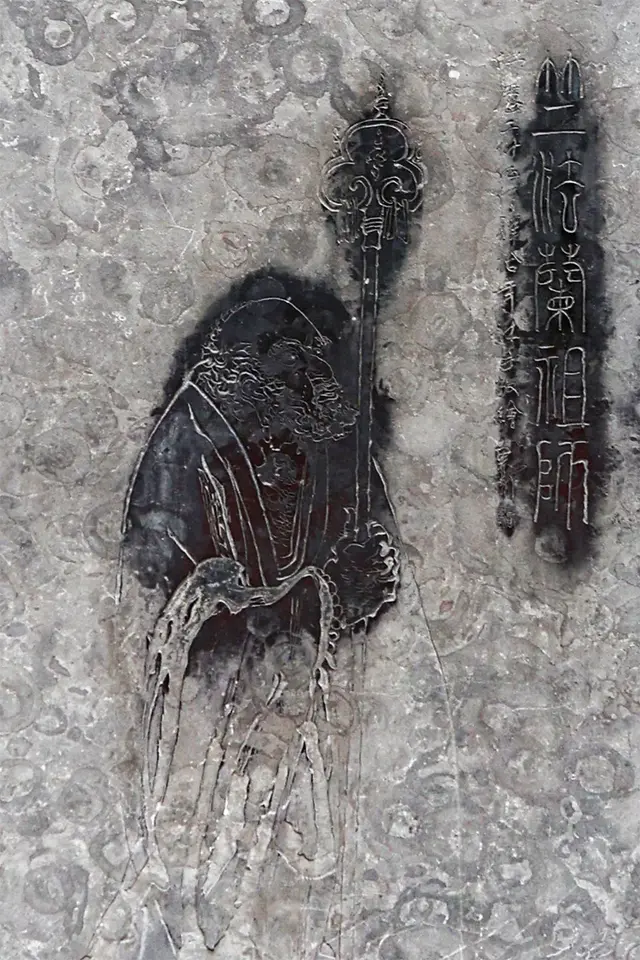
Biography
Indian Erudition and Encounter with Han Envoys
Zhu Falan was a native of Central India, belonging to the scholarly Brahmin caste before entering the Buddhist sangha in his youth, where he mastered the Tripitaka and the twelve divisions of Mahayana and Nikaya scriptures. Renowned for his vast learning and photographic memory, Zhu Falan could recite tens of thousands of verses of Buddhist treatises and sutras by heart, commanding immense veneration among monastic academies across ancient India.
During the Yongping era of Emperor Ming of Han, the sovereign dreamed of a golden figure sixteen feet tall with a radiant halo flying around the imperial courtyard. The following morning, Grand Astrologer Fu Yi reported that there was an enlightened holy figure in the western lands known as the "Buddha," whose appearance mirrored the golden being in the dream. Emperor Ming consequently dispatched a grand mission comprising Gentleman Cai Yin, Erudite Disciple Qin Jing, and sixteen other officers to traverse the Silk Road westward to seek the Dharma.
After traversing formidable deserts, Cai Yin's delegation reached the Kingdom of the Great Yuezhi (in modern Afghanistan and Central Asia), where they met Zhu Falan and the eminent monk Kasyapa Matanga on a teaching pilgrimage. Recognizing the solemn bearing and profound wisdom of the two Indian masters, Cai Yin conveyed the Han Emperor's imperial invitation to bring the teachings to the Central Plains. Sensing that the auspicious karmic conditions for the eastward transmission of the Dharma had matured, Zhu Falan and Kasyapa Matanga readily agreed to accompany the Han envoys.
However, Zhu Falan's renown in India was so profound that when the news of his impending departure to China spread, local monastic disciples and lay patrons gathered in protest to block his travel, petitioning the local king to bar him at border garrisons. Demonstrating unyielding dedication to his missionary vocation, Zhu Falan relinquished his honored position in his homeland. Under cover of night, he detached himself from his retinue and traveled along treacherous, circuitous mountain defiles, successfully slipping past the blockades to rejoin Cai Yin and Kasyapa Matanga. Loading Sanskrit birch-bark scriptures and Shakyamuni statues onto white horses, they embarked on the ten-thousand-li journey to Luoyang.
Settlement at White Horse Temple and the First Translation
In 67 CE (the tenth year of the Yongping era), Cai Yin, Zhu Falan, and Kasyapa Matanga completed their perilous journey across the Pamirs and the Hexi Corridor, arriving safely in the imperial capital of Luoyang. Delighted by their arrival, Emperor Ming led court ministers outside the capital walls to welcome them, accommodating the foreign monks at the prestigious Honglu Court hostel outside the Xiyong Gate with the honors accorded to foreign ambassadors.
In 68 CE (the eleventh year of the Yongping era), in gratitude for the white horses that had carried the sacred texts and images, Emperor Ming ordered the construction of an official Buddhist monastery outside the Honglu Court, officially naming it "White Horse Temple." Zhu Falan and Kasyapa Matanga took up permanent residence there, using the serene Qingliang Terrace as their sanctuary for meditation, recitation, and scriptural translation.
Although Zhu Falan arrived in Luoyang without knowledge of the Chinese language, he applied his sharp intellect to studying the syntax, phonology, and literary conventions of the Central Plains. Within a few months, he achieved fluent oral proficiency in Chinese and mastered the rhetorical nuances of literary Chinese prose. Working from the Sanskrit manuscripts brought from Central Asia, Zhu Falan and Kasyapa Matanga commenced China's first official scriptural translation project.
Taking into account that Chinese audiences were encountering Buddhism for the first time, the two masters distilled fundamental Buddhist concepts into a accessible catechism, producing the one-volume Sutra of Forty-Two Chapters consisting of slightly over two thousand characters. The text systematically expounded monastic renunciation, moderation of desires, mental purification, karma, and cyclic existence. The Sutra of Forty-Two Chapters became the earliest extant Chinese Buddhist translation in history, initiating a two-millennium tradition of Buddhist literary translation in East Asia.
Transmitting Buddha Icons and Explaining the Kalpa Ash
Beyond his scriptural translation, Zhu Falan introduced the tangible visual art of Buddhism to the imperial court. Cai Yin had brought back from the Great Yuezhi a rare painted icon of Shakyamuni Buddha, copied from the famed original sandalwood statue commissioned by King Udayana of Kaushambi during the Buddha's lifetime.
Zhu Falan presented this sacred icon to Emperor Ming, who revered it deeply and commissioned imperial palace artists to paint faithful replicas. The Emperor decreed that these sacred icons be enshrined at the imperial Qingliang Terrace and inside his future imperial mausoleum at Xianjie Ling. As a result, Buddhist figural art made its first monumental appearance within imperial palaces and dynastic burial complexes, exerting a formative influence on the development of early Chinese Buddhist iconography and cave temples.
During his years in Luoyang, Zhu Falan also resolved an ancient intellectual puzzle that had perplexed Han literati for over a century. During the reign of Emperor Wu of the Western Han, when workers excavated the vast bed of Kunming Lake in Chang'an, they unearthed deep layers of mysterious, dense black ash. Emperor Wu had questioned the polymath Dongfang Shuo about its origin, to which Dongfang Shuo replied: "I do not know its cause; in future times Your Majesty may ask people from the western regions."
When Zhu Falan settled in Luoyang, prominent Confucian scholars visited White Horse Temple to inquire about Dongfang Shuo's ancient riddle. Zhu Falan serenely explained: "The universe undergoes cyclical epochs of formation, continuation, destruction, and void. At the close of a cosmic cycle, a catastrophic kalpa fire erupts, consuming all material structures. This black ash unearthed from the lake bed is the physical residue of ancient kalpa fires from a previous cycle." Zhu Falan's explanation perfectly verified Dongfang Shuo's prophecy and introduced Han intellectuals to the expansive temporal scale of Indian cosmology, dramatically enhancing the prestige of Buddhist doctrine among capital literati.
Continued Translation and Eternal Rest
Following Kasyapa Matanga's passing, Zhu Falan assumed sole responsibility for the translation bureau at White Horse Temple, persevering in translating and propagating Buddhist scriptures. According to early scriptural catalogues, Zhu Falan translated several other significant works from Sanskrit, including the Shidi duanjie jing, the Fo bensheng jing, the Fahai zang jing, and the Fo benxing jing.
Although most of these early translations were lost in the fires of warfare during the fall of Luoyang to Dong Zhuo and the disasters of the Yongjia era, their contents were recorded in early monastic chronicles, providing essential doctrinal terminology for later translators such as Lokaksema, An Shigao, and Kumarajiva.
Zhu Falan devoted the remainder of his life to White Horse Temple, living in strict asceticism and upholding early monastic precepts. During the Jianchu era of Emperor Zhang of Han, Zhu Falan passed away at White Horse Temple at the age of over sixty. The sangha and lay followers interred his remains in a commemorative stupa on the monastery grounds, where his tomb has been preserved and venerated through successive centuries.
Major Achievements
Daring Journey to Bring Buddhism to Luoyang
Zhu Falan was already an acclaimed Buddhist preceptor in Central India before his journey to China. When Han envoys under Cai Yin arrived to invite him, he resolved to travel ten thousand li to spread the Dharma. Confronted by passionate resistance from his students and royal border restrictions, he braved great danger by slipping through rugged mountain tracks under cover of darkness to escape his homeland.
His arrival in Luoyang with Kasyapa Matanga, with scriptures and icons carried on white horses, prompted the construction of White Horse Temple, the first Buddhist monastery in China. Zhu Falan's mission broke through geographical barriers and initiated the first state-sanctioned spiritual dialogue between the ancient civilizations of India and China.
Translating the Sutra of Forty-Two Chapters
Upon arriving in Luoyang, Zhu Falan swiftly mastered the Chinese language and co-translated the Sutra of Forty-Two Chapters at the Qingliang Terrace of White Horse Temple alongside Kasyapa Matanga. Tailored for an audience unfamiliar with Indian scholasticism, the text presented forty-two concise aphorisms on morality, monastic discipline, and mental purity.
As the earliest surviving Chinese Buddhist scripture, the Sutra of Forty-Two Chapters established the initial linguistic framework for rendering Sanskrit concepts into classical Chinese. Its clear, natural literary style allowed Buddhist ideas to harmonize smoothly with the prevailing Confucian mores of Eastern Han society.
Elucidating the Kalpa Ash and Enlightening Han Scholars
Zhu Falan's explanation of the black ash beneath Kunming Lake through the Buddhist concept of cosmic kalpa fires demonstrated the profound philosophical breadth of Indian cosmology to Han scholars.
Where traditional Han thought conceived of the universe primarily in terms of cyclical yin-yang harmony, Zhu Falan introduced a grand vision of cosmic destruction and renewal operating across vast cosmic epochs. By confirming the long-standing mystery associated with Dongfang Shuo, Zhu Falan dissolved contemporary prejudices against foreign teachings, easing the transition of Buddhism from an esoteric court curiosity into a widely respected philosophical tradition.