Birth in the North
Born into the Wei lineage in Julu; tonsured under Master Zhu Fatai and adopted the religious surname Zhu.
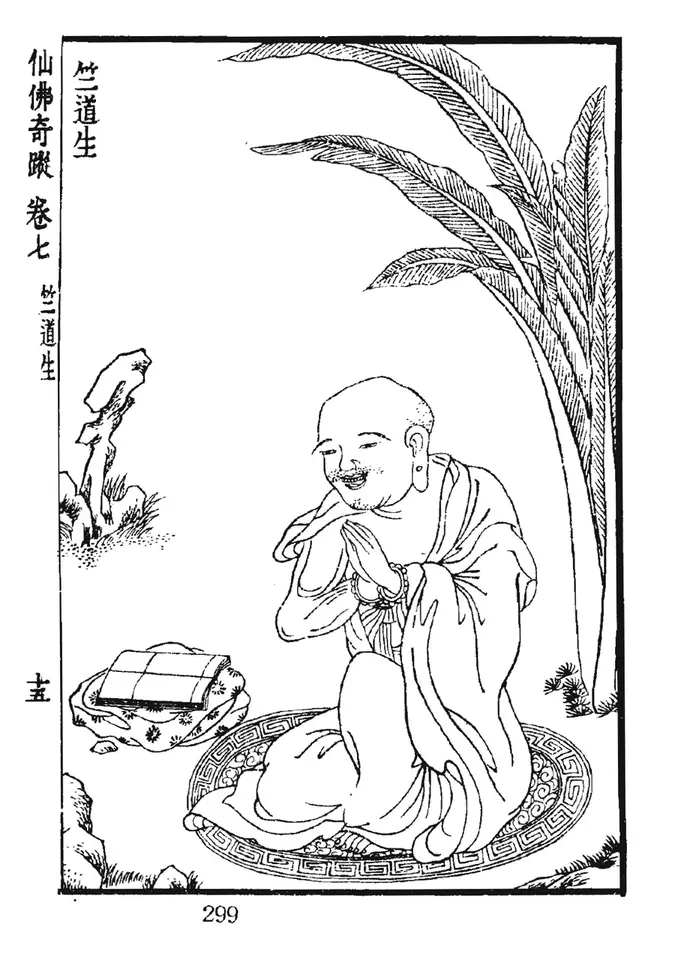
竺道生
Zhu Daosheng (竺道生, 355 – 434), secular surname Wei (魏), historically referred to as Daosheng or Master Sheng (生公), was a native of Julu (modern Pingxiang County, Hebei Province) residing in Pengcheng (modern Xuzhou, Jiangsu Province). He was one of the most revolutionary Buddhist philosophers in early medieval China, the founder of the Chinese Nirvana Buddha-nature tradition, and celebrated as one of the "Four Sages" under…
Zhu Daosheng (竺道生, 355 – 434), secular surname Wei (魏), historically referred to as Daosheng or Master Sheng (生公), was a native of Julu (modern Pingxiang County, Hebei Province) residing in Pengcheng (modern Xuzhou, Jiangsu Province). He was one of the most revolutionary Buddhist philosophers in early medieval China, the founder of the Chinese Nirvana Buddha-nature tradition, and celebrated as one of the "Four Sages" under the master translator Kumarajiva. Originating from a gentry household, he was tonsured in childhood under Master Zhu Fatai. Exhibiting prodigious intellectual gifts, he took the lecture platform at age fifteen and received the full monastic vows (Upasampada) at twenty. In 397, Daosheng secluded himself on Mount Lu for seven years to study under Master Huiyuan. In 404, he traveled west to Chang'an to join Kumarajiva's translation bureau, earning widespread acclaim for his intuitive grasp of Madhyamaka emptiness. Returning to Jiankang, he examined the six-volume Nirvana Sutra translated in 418 by Faxian and Buddhabhadra, which claimed that "icchantikas" (individuals devoid of faith and moral roots) lacked Buddha-nature. Drawing upon profound insights into non-duality, Daosheng famously declared that even icchantikas possessed Buddha-nature and would attain Buddhahood. Conservative clergy in Jiankang condemned him as a heretic and expelled him from the sangha. Retreating to Tiger Hill in Wu Commandery, legend recounts that his preaching moved the rocks to nod in agreement (sheng gong shuo fa, wan shi dian tou). Later, when Dharmaksema's complete forty-volume translation arrived from Northern Liang explicitly affirming that icchantikas could attain Buddhahood, the southern Buddhist community was astounded by his prophetic discernment. In 434, while concluding a lecture on the Lotus Sutra on Mount Lu, Daosheng passed away serenely upon the Dharma seat at age eighty. His doctrines of sudden enlightenment and universal Buddha-nature fundamentally shaped the evolution of Chan, Tiantai, and Huayan Buddhism.
Born into the Wei lineage in Julu; tonsured under Master Zhu Fatai and adopted the religious surname Zhu.
Received full monastic vows at age twenty in Jiankang, gaining renown for his mastery of both canonical treatises and classical literature.
Traveled to Mount Lu to study under Master Huiyuan, meditating in seclusion for seven years.
Traveled to Chang'an with companions Huiyan and Huirui, becoming one of the premier "Four Sages" of the Kumarajiva academy.
Resided at Qingyuan Temple in Jiankang, producing seminal philosophical essays including Good Deeds Incur No Karmic Retribution.
Asserted that icchantikas possessed Buddha-nature; expelled from Jiankang and retreated to Tiger Hill in Suzhou.
Dharmaksema's forty-volume Mahaparinirvana Sutra arrived in Jiankang, fully verifying Daosheng's doctrine.
Passed away peacefully upon the lecture dais on Mount Lu after preaching the Lotus Sutra, aged eighty.
Zhu Daosheng was born into the prominent Wei family of Julu Commandery. His father served as Magistrate of Guangqi under the Eastern Jin, later migrating south to Pengcheng in modern Jiangsu Province to escape warfare. From early childhood, Daosheng displayed extraordinary composure, moral dignity, and a natural inclination toward spiritual transcendence. Recognizing his vocation, his father permitted him to enter the monastic community under Master Zhu Fatai, a celebrated master of Prajna studies. Following contemporary monastic custom, Daosheng took his teacher's surname, adopting the name Zhu Daosheng.
Under Zhu Fatai's mentorship, Daosheng made rapid intellectual progress. He immersed himself in both Buddhist scriptures and native Confucian-Daoist classics. When he was only fifteen years old, Zhu Fatai invited him to ascend the rostrum to explicate difficult texts. Daosheng presented his interpretations with such clarity and eloquence that veteran scholars listened with admiration. At the age of twenty, Daosheng formally took the complete monastic vows (Upasampada) in Jiankang, solidifying his stature as one of the rising intellectual lights of southern Buddhism.
In 397, dissatisfied with the ornate rhetoric characterizing southern scholastic circles, Daosheng departed the capital and traveled to Mount Lu in Jiangzhou to study under Master Huiyuan, the founder of the White Lotus Society. For seven uninterrupted years, Daosheng lived an austere life on the mountain, drinking from mountain springs and subsisting on wild herbs. Under Huiyuan's tutelage, he deepened his understanding of Prajnaparamita emptiness, Sarvastivada Abhidharma psychology, and the mechanics of karmic retribution.
In 404, hearing that the renowned Kuchean translator Kumarajiva had arrived in Chang'an under the patronage of King Yao Xing of Later Qin, Daosheng undertook an arduous journey north alongside his fellow monks Huirui and Huiyan. At Caotang Monastery in Chang'an, Daosheng assisted Kumarajiva in translating foundational Prajnaparamita scriptures and Madhyamaka treatises.
Kumarajiva held Daosheng in high esteem, ranking him alongside Sengzhao, Sengrui, and Daorong as the elite "Four Sages" of his academy. Monks across northern China admired his intuitive penetration of texts. Daosheng famously declared that language was merely an external symbol, and that one had to discard the symbols to directly grasp the ultimate truth, comparing it to discarding the fish trap once the fish was caught.
In 409, Daosheng returned south to Jiankang, taking up residence at Qingyuan Monastery. He preached widely and composed influential treatises, including On the Non-retribution of Good Deeds, On Sudden Enlightenment, and On the Formlessness of the Dharmakaya. Emperor Wendi of Liu Song and aristocratic lineages extended him great honor.
In 418, the pilgrim monk Faxian and Indian master Buddhabhadra translated the six-volume Da banniehuan jing (Nirvana Sutra) at Daochang Monastery in Jiankang. Monks across southern China embraced the text eagerly. However, this preliminary edition contained an explicit reservation: "Except for icchantikas, all beings possess Buddha-nature." In Buddhist terminology, an icchantika represented an incorrigible wrongdoer whose roots of goodness were entirely severed. Conservative southern masters treated this clause as an absolute truth.
Daosheng scrutinized the underlying metaphysics of universal emptiness. He reasoned that since all dharmas were devoid of inherent self-nature and the Buddha-nature was inherently universal, no sentient being could be fundamentally severed from the ultimate ground of awakening. An icchantika's corruption was temporary and obscured by delusion, but not immutable. Daosheng therefore boldly announced: "Even icchantikas possess Buddha-nature and can attain Buddhahood!"
Daosheng's revolutionary thesis ignited fierce outrage in Jiankang. Conservative monks condemned his declaration as heretical rebellion against scripture. Traditionalist factions convened a monastic council, subjected Daosheng to severe verbal assaults, and formally expelled him from the monastic assembly.
Unshaken by the tempest, Daosheng stood resolutely before the assembly. Raising his hands, he took a solemn vow: "If my declaration contradicts the ultimate truth of the Dharma, may my physical body be afflicted with malignant leprosy in this present life; but if my interpretation accords with the true intent of the Buddha, may I abandon this mortal coil while seated upon the Dharma throne!" With that declaration, he departed Jiankang.
Traveling east to Wu Commandery, he resided at Tiger Hill in Suzhou. According to popular tradition, finding no human ears willing to listen to his non-dual teaching, Daosheng gathered boulders upon the hillside to serve as his disciples. As he expounded the profound meaning of the Nirvana Sutra and asked whether even icchantikas possessed Buddha-nature, the surrounding boulders bowed their stony heads in affirmation—a moment memorialized in the famous Chinese idiom "when Master Sheng speaks, even stubborn stones nod."
In 430, the complete forty-volume translation of the Mahaparinirvana Sutra, translated in Northern Liang by the Indian master Dharmaksema, was transmitted to southern China. Monks in Jiankang opened the scrolls and discovered, to their profound astonishment, that the Longevity and Bodhisattva Noble Virtue King chapters explicitly declared: "Even icchantikas, though their roots of goodness be severed, possess Buddha-nature and shall attain Buddhahood!"
The southern Buddhist establishment was stunned. The very teachers who had banished Daosheng acknowledged their shortsightedness, extolling his prophetic genius and describing his insight as "solitary brightness shining forth in advance."
By this time, Daosheng had retired to Mount Lu. Refusing imperial summons to return to court, he devoted his remaining years to expounding the complete Nirvana Sutra and the Lotus Sutra to thousands of disciples.
On December 23, 434, having concluded an exhaustive lecture on the Lotus Sutra before a packed hall on Mount Lu, Daosheng gently leaned his flywhisk against his desk and reclined upon his armrest in meditative repose. When his disciples stepped forward, they realized that the venerable master had passed away peacefully upon the lecture seat at the age of eighty, precisely fulfilling his prophetic vow taken years earlier in Jiankang. He was interred on Mount Lu, where his memorial stupa endured for centuries.
Zhu Daosheng's most monumental contribution to intellectual history was his assertion of universal Buddha-nature, establishing the principle that every sentient being—without exception—can attain enlightenment. By perceiving that the preliminary translation of the Nirvana Sutra was incomplete and courageously daring to assert that even icchantikas possessed the tathagatagarbha, he dismantled the rigid spiritual caste hierarchies inherited from Indian traditions.
His validation by Dharmaksema's complete translation permanently canonized his thesis as the bedrock of Chinese Mahayana philosophy. This universalist doctrine transformed Buddhism in East Asia, shaping subsequent schools such as Tiantai, Huayan, and Chan.
Daosheng stood as the architect of the "Sudden Enlightenment" (dunwu) doctrine in Chinese Buddhism. Rejecting gradualist models that posited salvation as a fractional, stage-by-stage acquisition of merit, Daosheng argued that ultimate truth is singular and indivisible.
Because the non-dual reality cannot be divided into fragments, direct realization must occur as a singular, comprehensive breakthrough. While moral discipline and study serve as preparatory clearing, the final awakening occurs in a flash of direct intuition. This foundational insight became the theoretical core of Southern Chan under the Sixth Patriarch Huineng.
In his celebrated essay Good Deeds Incur No Karmic Retribution, Daosheng introduced a profound reinterpretation of Buddhist ethics. Critiquing the common tendency to view good works as transactional investments to secure heavenly rebirth or worldly prosperity, he argued that merit-seeking actions remain trapped within the cyclical suffering of samsara.
True spiritual liberation, Daosheng argued, requires action performed without ego, attachment, or desire for reward—pure non-action (wuwei). By decoupling moral virtue from self-serving transactional expectations, Daosheng elevated Buddhist ethical practice into a selfless realization of emptiness, exerting a lasting influence upon Chinese literati culture.
FIGURES ASSOCIATED WITH THIS DYNASTY