Birth in Yuzhang
Born into the Ming imperial clan in Nanchang, Jiangxi, as a ninth-generation descendant of Prince Ning, named Tongzhi.
朱耷
Zhu Da (朱耷, 1626–1705), a ninth-generation descendant of Prince Ning (Zhu Quan, seventeenth son of Ming founder Emperor Taizu), clan register name Zhu Tongzhi (朱统𨰥), monastic name Chuanqi with courtesy name Ren'an, and globally celebrated by his art name Bada Shanren (八大山人), was an epochal master painter of Chinese spontaneous ink-wash art, an innovative calligrapher, and a poignant loyalist poet. Grouped alongside Shitao,…
Zhu Da (朱耷, 1626–1705), a ninth-generation descendant of Prince Ning (Zhu Quan, seventeenth son of Ming founder Emperor Taizu), clan register name Zhu Tongzhi (朱统𨰥), monastic name Chuanqi with courtesy name Ren'an, and globally celebrated by his art name Bada Shanren (八大山人), was an epochal master painter of Chinese spontaneous ink-wash art, an innovative calligrapher, and a poignant loyalist poet. Grouped alongside Shitao, Hongren, and Kuncan as the "Four Monk Masters of the Early Qing," Zhu Da was born in Nanchang, Jiangxi, achieving government student status at age seventeen. Following the cataclysmic fall of the Ming dynasty in 1644 and the Qing massacre in Nanchang, which claimed the lives of his father, wife, and child, he fled into mountain seclusion and took monastic tonsure at Mount Jiegang and Gengxiang Cloister in Fengxin for over twenty years. Faking madness to escape coerced service under Qing magistrate Hu Yitang in 1680, he burned his monastic robes, returned to secular life in Nanchang, and adopted the signature "Bada Shanren." Written in a continuous, conjoined cipher, his signature deliberately resembled both "crying" and "laughing," serving as a heartbreaking symbol of a prince mourning his lost homeland. He revolutionized Chinese ink-wash painting with stark, minimalist compositions, eccentric brushwork, and monumental spatial voids, famously depicting fish, birds, and withered lotuses gazing upward with "upturned white eyes" in defiant, unyielding spiritual aloofness. His idiosyncratic "Bada style" calligraphy and profound philosophical verse, epitomized by the epic scroll Flowers on the River, exerted a profound influence on the Eight Eccentrics of Yangzhou, Qi Baishi, and Western expressionism. He is universally recognized as one of the seventeenth century's supreme creative geniuses.
Born into the Ming imperial clan in Nanchang, Jiangxi, as a ninth-generation descendant of Prince Ning, named Tongzhi.
Composes regulated verse at age eight and executes monumental ink paintings on walls at age nine.
Renders monumental blue-and-green landscape scrolls at age eleven, astonishing regional literati.
Passes the prefectural examination to become a government student at age seventeen, renowned across Jiangxi.
Beijing falls to peasant rebels and Emperor Chongzhen commits suicide; Qing forces storm Nanchang in 1645, leaving his family dead and driving him into mountain hiding.
Enters monastic orders at Mount Jiegang in Jinxian to escape Manchu purges, taking the religious name Chuanqi and courtesy name Ren'an.
Moves to Gengxiang Cloister in Fengxin, receiving Zen transmission from Chan Master Hongmin and adopting the alias Xuege.
Feigns madness to resist patronage from Qing magistrate Hu Yitang, burning his robes and returning to Nanchang on foot.
Constructs Wuge Thatched Cottage in Nanchang, inaugurating the famous signature "Bada Shanren," styled like "crying and laughing."
Directs the restoration of the Qingyunpu Daoist Temple, deepening his art through Daoist philosophical meditation.
Briefly visits Beijing; alienated by the sycophancy of court officials, he swiftly returns to Jiangxi.
Completes his monumental thirteen-meter masterpiece scroll Flowers on the River, inscribing the epic lyric Song of Flowers on the River.
Forges a profound artistic friendship with fellow imperial clansman Shitao, painting Master Dadie's Thatched Cottage for him.
Passes away serenely in an upright seated posture at Wuge Thatched Cottage in Nanchang in the autumn, aged eighty.
Zhu Da was born in 1626 (the sixth year of the Tianqi reign of Ming) into an imperial clan family in Nanchang County, Nanchang Prefecture, Jiangxi. He was a ninth-generation descendant of Zhu Quan (Prince Ning, the seventeenth son of Ming founder Emperor Taizu), belonging to the Yiyang cadet princely branch. His grandfather Zhu Duozheng was an accomplished poet, painter, and calligrapher; his father Zhu Moujin was an acclaimed Jiangnan painter who mastered landscapes and flower-and-bird painting in the spare style of Yuan master Ni Zan. Raised amid aristocratic refinement and surrounded by centuries of rare art scrolls, Zhu Da developed extraordinary visual sensitivity and artistic memory from earliest youth.
He was recognized as a child prodigy throughout Jiangxi. By age eight, he composed metrically flawless regulated poems; by age nine, he splashed ink across large hanging scrolls, producing remarkably vivid compositions. At age eleven, he painted monumental blue-and-green landscape scrolls characterized by towering peaks and crystalline mineral pigments, prompting senior scholars to compare his brushwork to Tang and Song masters Li Sixun and Wang Ximeng. Immersing himself in calligraphy, he copied the stone steles of Wei and Jin masters, particularly internalizing the fluid grace and noble bone-structure of Wang Xizhi and Wang Xianzhi.
In 1642 (the fifteenth year of Chongzhen), seventeen-year-old Zhu Da sat for the prefectural examinations in Nanchang, passing with top honors to become a government student (xiucai). His proud father urged him to cultivate scholarly virtue and serve the empire. However, the late Ming state was collapsing beneath peasant rebellions and Manchu border invasions; studying in his library, the sensitive youth observed the darkening political horizon with acute foreboding.
In March 1644, Li Zicheng captured Beijing, and Emperor Chongzhen committed suicide on Coal Hill, ending Ming imperial rule. The catastrophic news stunned Jiangnan. In 1645, Qing Prince Dodo led Manchu eight-banner armies across the Yangtze, taking Nanjing and advancing toward Jiangxi. In 1646, Qing forces stormed Nanchang, initiating ruthless searches and executions targeting Ming royal princes. Zhu Da's noble pedigree was transformed overnight into a fatal death warrant.
During the bloody conquest, Zhu Da suffered overwhelming tragedy. His father Zhu Moujin died from grief and terror, while his young wife and infant child perished in the chaos of war. The ancestral princely halls were burned to the ground. Shattered by the loss of his family and empire, the twenty-year-old prince wept bitterly toward heaven. To evade relentless Qing search patrols, he disguised his identity, loosened his hair, discarded his shoes, and fled into the rugged mountain forests outside Nanchang, enduring years of starvation and hardship.
In 1648, as Qing forces crushed regional anti-Qing uprisings and subjected Nanchang to another bloody pacification, Zhu Da took monastic tonsure at Mount Jiegang in Jinxian County to preserve his life and moral integrity without shaving his head according to Manchu edicts. He assumed the Buddhist name Chuanqi and courtesy name Ren'an. In 1653, the twenty-eight-year-old monk traveled to Gengxiang Cloister in Fengxin County, formally entering the lineage of Chan Master Hongmin of the Linji Zen School. Master Hongmin recognized his transcendent spiritual insight and austere purity, accepting him as an intimate disciple and transmitting the monastic robe.
During his twenty-year monastic retreat, Zhu Da secluded himself in Zen meditation, studying the Avatamsaka Sutra and Lankavatara Sutra, channeling his inconsolable grief into the transcendent emptiness of Chan philosophy. He adopted successive monastic aliases, including Xuege (Snowflake), Geshan (Individual Mountain), and Renwu (Human Abode). Residing in simple mountain hermitages, he consorted with Ming loyalist scholars, exchanging poetry and paintings. His motifs during this period—withered trees, solitary stones, shattered lotuses, and cold winter birds—laid the foundation for his mature, desolate aesthetic.
In 1659, at age thirty-four, Zhu Da created his renowned Album of Sketches from Life (Chuanqi Xiesheng Ce, now in the National Palace Museum, Taipei) at Mount Jiegang. Comprising fifteen leaves, the album depicts melons, taro roots, pomegranates, narcissus blossoms, ancient plum boughs, and banana palms with dry, wiry brushwork, signed simply "Chuanqi." This album is his earliest surviving securely dated masterwork, vividly documenting his austere monastic mind and his rigorous assimilation of Song dynasty academic linework.
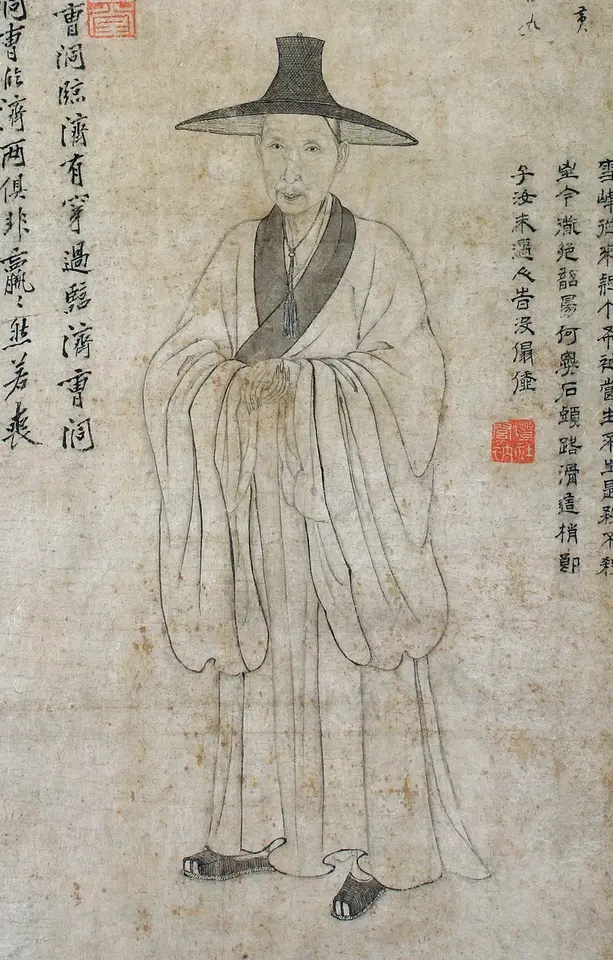
In 1674, when Zhu Da was forty-nine, his friend Huang Anping painted the famous Portrait of Master Geshan (Geshan Xiaoxiang) at Gengxiang Cloister. The portrait captures Zhu Da wearing a black hood and expansive monastic robes, his gaunt face and knit brows projecting profound historical sorrow. Zhu Da inscribed several autobiographical poems around the image, and his nephew Peng Wenzheng added detailed marginal notes recording his imperial princely lineage and the circumstances of his tonsure, providing modern historians with an irreplaceable visual witness to his true identity.
In 1674, the Revolt of the Three Feudatories erupted, and rebel forces occupied Fuzhou, throwing Jiangxi into administrative upheaval. In 1678, Linchuan County Magistrate Hu Yitang, having heard of Zhu Da's artistic renown, dispatched constables to forcibly summon him to the magistrate's yamen, seeking to compel him to serve as a secretarial aide and paint celebratory scrolls. Hu was an imperial Qing official who paraded in Manchu court robes, provoking profound revulsion and existential agony in the Ming prince.
Refusing to serve as a pet artist for imperial conquerors, Zhu Da fell into acute despair. In the autumn of 1680, he suffered an apparent nervous breakdown. Inside the official yamen, he burst into wild, echoing laughter that rattled the ceiling tiles; moments later, he beat his chest and wept uncontrollably in agonizing sorrow. At night, he threw himself onto the muddy courtyard, screaming and tearing his monastic robes to shreds before casting the remnants into an open fire.
Zhu Da then seized a large brush and inscribed a monumental character "Mute" (Ya) upon the main gate, refusing to utter another syllable. When officials interrogated him, he stared coldly with blazing eyes or sketched in the dirt. Terrified that the mad monk might die in custody and invite administrative censure, Hu Yitang released him. At age fifty-five, wearing ragged clothing, Zhu Da walked hundreds of li on foot, stumbling back to his hometown of Nanchang.
Returning to Nanchang, Zhu Da abandoned his thirty-year monastic identity to live as a secular loyalist hermit. He built Wuge Thatched Cottage beside Lake Qingshan, enduring austere poverty while reclaiming absolute spiritual freedom. In 1684, at age fifty-nine, he began signing his paintings and calligraphy with the immortal pseudonym "Bada Shanren" (Mountain Man of the Eight Greats), discarding all earlier religious names.
When signing this pseudonym, Zhu Da conjoined the four characters into an ambiguous, dynamic visual glyph: viewed from one angle, it read as "crying" (kuzhi); viewed from another, it appeared as "laughing" (xiaozhi). This ingenious artistic cipher captured the tragic dilemma of a surviving Ming prince: a condition beyond words, caught between tears and mocking laughter. Outside his cottage, he posted a wooden placard reading "Mute," refusing all contact with Qing officialdom. When wealthy imperial officials offered gold for his paintings, he barred his gate and hurled curses; yet when impoverished woodcutters, monks, or loyalists brought simple wine, he painted joyfully until dawn.
During his early return to secular life in Nanchang, Zhu Da lived in severe destitution. One day, spotting giant rolls of pristine white xuan paper in a local paper shop, Zhu Da was seized with creative longing but lacked money. Heavily intoxicated, he strode into the shop, seized a large brush soaked in thick ink, and boldly painted rolling lotus leaves and craggy rocks across the counter. The shopkeeper initially rushed forward to beat the intruder, but stopped in awe as the painting took shape with celestial vitality; watching customers competed to buy the scroll for a hundred silver taels. The overjoyed proprietor subsequently treated Zhu Da as an honored master, providing him with endless paper and ink.
Living in Nanchang, Zhu Da frequently used feigned eccentricities to mock social hypocrisy. During hot summer months when wealthy officials paraded silk robes in their couryards to flaunt their status, Zhu Da laughed derisively. Stripping off his shirt, he lay bare-chested on the scorching stone steps of his cottage. When bewildered passersby asked what he was doing, he roared with laughter: "You gentlemen are sunning silk and fur; I am merely sunning the classics and histories in my belly!" His proud disdain for worldly wealth became legendary across Jiangxi.
In 1687, at age sixty-two, Zhu Da directed the restoration of the Qingyunpu Daoist Temple (originally Qingyunpu) beside Lake Meihu in Nanchang, residing there to cultivate his spirit. Daoist concepts of pristine emptiness, spontaneous nature, and transcendent equanimity deepened his artistic vision, triggering a magnificent explosion of creative power in his senior years.
During his years at Qingyunpu, Zhu Da's ink-wash painting reached its ultimate historical zenith. Using worn, blunt brushes soaked in thick, dry ink, he executed brushstrokes with lightning speed and the weight of falling boulders. His depictions of flora and fauna departed from all conventional manuals: swimming fish were rendered with a few spare strokes, suspended in vast blank space, glaring upward with white eyes; solitary birds crouched on single legs atop crags with drawn-in necks, their gazes proud and defiant; gnarl-trunked trees twisted like cold iron, and shattered lotus pads resembled cleaved armor. Through radical minimalism, he constructed a sublime, desolate spiritual universe.
While residing at Qingyunpu, Zhu Da observed aquatic life and waterfowl with profound contemplative intimacy. He sat for hours beside overgrown garden lotus ponds, studying wild ducks, cormorants, and swimming fish darting among weed-choked rocks. When painting birds, he never pursued photographic plumage; instead, he defined the skull and spine with bold strokes of concentrated dry ink, swept pale ink across the breast, and added a piercing dot of scorched ink for the eccentric, off-center pupil. This spontaneous fusion of inner spiritual intention with external natural form elevated every ink painting produced at Qingyunpu into an immortal treasure.
In 1690, Zhu Da painted his biting political satire Peacocks, Bamboo, and Rocks. The scroll portrays two grotesque, bloated peacocks perching upon an overhanging rock, their tails sprouting only three scraggly peacock feathers. Above the composition, Zhu Da inscribed a famous quatrain: "Peacocks and famous blossoms screen the rainy bamboo; thousands of phrases on bamboo stems speak of imperial peace. The world does not understand the sorrow in my heart—how few are the blue three-eyed peacock feathers!" The work hurled withering contempt at former Ming officials who surrendered their loyalty to the Qing court for three-eyed peacock feather court decorations.
In his later years, Zhu Da formed an intimate intellectual communion with Shitao (Zhu Ruoji), another Ming imperial clansman and fellow giant among the Four Monk Masters. Although residing far apart and never meeting face-to-face, the two artists maintained continuous correspondence through mutual friends. Shitao frequently wrote from Yangzhou, requesting prefaces and monumental hanging scrolls from his elder kinsman. Zhu Da warmly complied, painting masterpieces such as Master Dadie's Thatched Cottage for Shitao and praising his heroic, untrammeled brushwork.
Their artistic dialogue remains one of the most poignant episodes in late imperial Chinese art history. In Nanchang, Zhu Da also maintained close ties with independent scholars including Shao Jiuyi, Fang Shiqiao, and Qiu Lian. Admiring his uncompromising moral integrity, these scholars gathered at Wuge Cottage to share wine, tea, and classical philosophy, offering Zhu Da profound human warmth during his solitary old age.
Despite his aloof demeanor, Zhu Da possessed deep humanitarian empathy. Legend recounts that beside Lake Qingshan, the daughter of an impoverished salt merchant was about to be forced into concubinage to clear usurious debts, driving her to attempt suicide by drowning. Zhu Da intervened, locked himself in his studio for two days, and painted monumental landscapes and flower scrolls. Entrusting them to trusted friends to sell to wealthy patrons, he raised hundreds of silver taels to redeem the girl's freedom. The episode won him universal acclaim across Nanchang.
Around 1690 to 1691, art historians record a mysterious northern journey undertaken by Zhu Da to Beijing. At that time, the Qing court sponsored the Boxue Hongci special examinations and the compilation of the official History of Ming. Former Ming scholars serving the Qing court, including Song Luo, admired Bada Shanren's fame and invited him north for artistic exchanges. Upon arriving in Beijing, Zhu Da was appalled by the sycophancy of courtiers and imperial flattery, feeling profoundly alienated. He departed after a few months, taking a boat back to Jiangxi.
Returning to Nanchang, Zhu Da withdrew further into reclusion, resolving never again to associate with worldly ambitions. He wrote to friends: "Between heaven and earth, only authentic artistic feeling cannot be deceived!" This northern journey purged the final vestiges of worldly curiosity from his mind, endowing his brushwork with unvarnished, archaic austerity.
Between 1699 and 1705, Zhu Da entered his final, incandescent artistic summit. He created supreme masterpieces of Chinese art, including Anwan Album, Flowers on the River, Willows and Bathing Birds, Cats, Rocks, and Flowers, and Autumn Forest and Twin Deer. Among these, Flowers on the River, painted in 1697 across thirteen meters of handscroll, traced the entire life cycle of lotuses from emergence to decay with wild, calligraphic dry brushwork, celebrated as the greatest ink-wash handscroll in Chinese history.
In 1694, the sixty-nine-year-old master created the twenty-two-leaf Anwan Album (now in the Sen-oku Hakuko Kan, Kyoto). Integrating poetry, calligraphy, and painting, the album depicts paired ducks, solitary birds, severed lotuses, and cursive verses. In this album, the fierce, erratic anger of his earlier years dissolved into serene, crystalline equanimity. Entitling the work "Anwan" (Peaceful Evening), Zhu Da expressed his reconciliation with exile and life's twilight.
Decades of poverty, grief, and relentless physical labor gradually drained the octogenarian master's strength. In the autumn of 1705, at age eighty, Zhu Da fell critically ill at Wuge Thatched Cottage. Declining medicines, he calmly bathed, adjusted his formal robes, sat cross-legged on a wooden chair, and passed away with a serene smile. Following his death, friends and loyalists mourned Zhu Da deeply, dressing his body in simple cotton robes and burying him beside Lake Meihu north of Nanchang. During the eighteenth and nineteenth centuries, scholars and connoisseurs repeatedly visited his hermitage and grave, gradually converting Qingyunpu into the Bada Shanren Memorial. Modern masters including Luo Zhenyu, Wang Guowei, Qi Baishi, and Zhang Daqian made pilgrimages to Meihu, venerating his unyielding moral heroism and artistic supremacy as an immortal monument of Chinese civilization.
Zhu Da was the most iconoclastic and transformative giant of spontaneous ink-wash painting in Chinese history, acclaimed alongside Shitao, Hongren, and Kuncan as the foremost leader of the Four Monk Masters of the early Qing. Smashing the academic conventions of decorative realism and polite literati landscape painting, he forged an entirely modern pictorial language founded upon structural compression, radical abstraction, and existential tension.
His compositions daringly abandoned symmetrical balance, utilizing steep diagonals and vast empty spaces. A painting frequently featured only an overhanging rock, a fractured lotus leaf, or a single bird crouching at the lower edge, surrounded by boundless blank paper. This technique of "treating white space as black ink" endowed his works with cosmic desolation, elevating Chinese literati painting to a philosophical plane of pure abstraction.
Zhu Da's compositions anticipated the formal revolutions of twentieth-century modern art. He pioneered the aesthetics of fragmentation and asymmetric weight, deliberately abandoning conventional equilibrium. In Willows and Bathing Birds, mountain rocks hang inverted or surge upward like cleaving blades, while immense negative space below evokes abyss-like depths. His birds perch on knife-edge precipices in miraculous balance, utilizing minimal brushstrokes to command vast voids in a masterclass of pure geometric tension.
Zhu Da's depictions of birds, fish, and animals represent some of the most powerful psychological self-portraits in world art. His creatures possess distorted anatomical forms: birds stand on a single leg with hunched shoulders; fish hover horizontally in midair; most strikingly, their pupils are placed at the upper rim of the eyeball, gazing upward with "upturned white eyes."
This piercing upward glare was both Zhu Da's personal defiance against the violent Manchu conquest and a visual manifesto of individual moral sovereignty in an age of political corruption. Modern master Qi Baishi famously marveled: "Xu Wei and Bada Shanren transcended all mortal limits; in old age, Wu Changshuo discovered his own path. I would gladly serve as a gate-dog in the underworld, rotating through the studios of these three masters."
In brush and ink technique, Zhu Da reached unmatched heights. He specialized in centered-tip brushwork using worn, blunt brushes, generating lines that resembled bent iron wire or cast bronze. His strokes possessed intense inner tension, granting a single lotus stem or fish fin the monumentality of an ancient stele.
In ink application, he masterfully harmonized "parched dry ink" (kemo) with explosive ink splashes (pomo). Dipping blunt brushes in concentrated dark ink, he swept across raw rice paper with uninhibited fury; deep velvety blacks interpenetrated airy dry streaks without muddying the composition. Scholar Zhang Geng celebrated him in Guochao Huazheng Lu: "His brushwork is terse and archaic, his compositions eccentric; his brush flows with boundless freedom, standing as an unmatched master across thousands of years."
Art historians divide Zhu Da's lifelong artistic journey into three distinct phases. The first phase, his monastic period (1648–1680), exemplified by the Album of Sketches from Life, was marked by taut, dry linework and ascetic minimalism. The second phase, his period of emotional crisis following secularization (1680–1690), exemplified by Peacocks, Bamboo, and Rocks, featured tempestuous brushwork, intense irony, and the establishment of his upturned white-eye animal icons. The third phase, his artistic culmination (1690–1705), represented by Flowers on the River and the Anwan Album, saw fierce angularity soften into profound, circular wholeness, achieving the transcendent serenity of an ultimate master.
Zhu Da's calligraphy developed in organic symbiosis with his painting, establishing an immortal standard of Chinese calligraphic aesthetics. In his youth, he copied the fluid elegance of Wang Xizhi; in middle age, he integrated the wild cursive momentum of Huai Su and the architectural geometry of Huang Tingjian; in his senior years, he synthesized pre-Qin seal script and Han-Wei steles to create the "Bada Shanren style."
His calligraphy featured compressed vertical structures, centered blunt-brush lines, rounded corners, and thick, coiled strokes resembling ancient vines. His running-cursive inscriptions displayed wide interlinear spacing contrasted with dense character grouping, radiating musical rhythm. Qing scholar Bao Shichen ranked his calligraphy in the highest class in Yizhou Shuangji, praising it as "balanced in bone and flesh, purely spontaneous, capturing the profound spirit of Jin masters."
Zhu Da's calligraphy remains a supreme benchmark in Chinese art history. Rejecting the delicate grace of Dong Qichang and the frantic continuous looping of Wang Duo, Zhu Da championed natural simplicity and archaic weight. Blending the rounded enclosure of archaic seal and clerical script with the rapid turns of cursive writing, each character stood autonomous yet bound by invisible energy. Master Huang Binhong marveled that Zhu Da's calligraphy "discarded all Tang and Song conventions, capturing the monumental gravity of Han and Wei inscriptions," while Sha Menghai ranked him among the greatest cursive masters of the Qing dynasty.
Zhu Da was also an accomplished loyalist poet. Versed in Buddhist sutras and Daoist allegories, his inscriptions were intentionally arcane and elliptical, employing Zen paradoxes and historical metaphors to mask dangerous loyalist sentiments.
His thirteen-meter scroll Flowers on the River culminates in his epic Song of Flowers on the River, a long poem in seven-character ancient meter meditating upon the emergence, bloom, and decay of lotuses as metaphors for dynastic ruin and cosmic transformation. The poem synthesizes the tragic nobility of Qu Yuan's Li Sao with the metaphysical transcendence of Zhuangzi's Qiwulun, standing as one of the finest philosophical poems of the Qing dynasty.
Created in 1697 across thirteen meters of handscroll, Flowers on the River is universally celebrated as the crown jewel of Zhu Da's oeuvre. Executed entirely in spontaneous ink, the painting sweeps from emerging lotus shoots in the opening section to blossoming flowers battered by torrential storms in the center, concluding with withered stems fading into tranquil waters. His long running-cursive poem Song of Flowers on the River inscribed at the end weaves painting and poetry into an epic visual and literary symphony mourning dynastic ruin and contemplating the eternal cycles of nature.
Zhu Da's changing pseudonyms reflected his spiritual evolution. His monastic name Chuanqi (Transmitting the Vital Tendon) hinted at his royal Ming bloodline; Xuege (Snowflake) and Geshan (Solitary Mountain) invoked the steadfast integrity of winter bamboo; Renwu (Human Abode) drew from Zhuangzi's cosmic transcendence. His final name, Bada Shanren, derived from the Buddhist Sutra of the Eight Great Awakenings, conveying spiritual enlightenment while subtly proclaiming his descent from royal princes who chose to live as humble mountain recluses.
In seal carving, Zhu Da invented remarkable poetic ciphers. His surviving seals, such as "Can Become an Immortal," "Mouth Like a Carrying Pole," and "Why Need Three Perfections," carried deep philosophical allegories. The "Mouth Like a Carrying Pole" seal symbolized his absolute vow of silence regarding Qing political affairs, while his oval "Bada Shanren" seal, shaped like an archaic coin or bronze mirror, provided a striking geometric counterpoint to his minimalist paintings.
In the twentieth century, Zhu Da's geometric compositions, calligraphic linework, and expressionist distortion astonished modern European artists. When Pablo Picasso and Henri Matisse viewed albums of Bada Shanren's works, they expressed awe that China had produced an artist possessing pure modernist independence three centuries earlier. Standing as a transcendent peak of Chinese civilization, Zhu Da's art continues to inspire the global imagination.
FIGURES ASSOCIATED WITH THIS DYNASTY