Birth and Early Confucian Cultivation
Born in Xianyang, studied classical texts and martial arts before withdrawing into the Zhongnan Mountains.
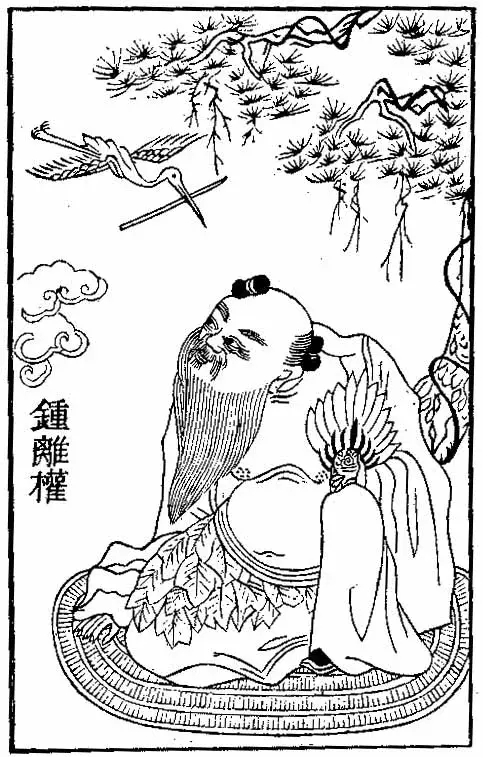
钟离权
Zhongli Quan (钟离权), compound surname Zhongli, given name Quan, courtesy name Jidao, style names Master Yunfang (云房先生) and Zhengyangzi (正阳子), was a native of Xianyang in Jingzhao (modern Xianyang, Shaanxi Province). He was an eminent Daoist scholar, master of internal alchemy, second patriarch of the Northern Five Patriarchs of the Quanzhen School, and one of the iconic Eight Immortals in Chinese popular folklore. In popular…
Zhongli Quan (钟离权), compound surname Zhongli, given name Quan, courtesy name Jidao, style names Master Yunfang (云房先生) and Zhengyangzi (正阳子), was a native of Xianyang in Jingzhao (modern Xianyang, Shaanxi Province). He was an eminent Daoist scholar, master of internal alchemy, second patriarch of the Northern Five Patriarchs of the Quanzhen School, and one of the iconic Eight Immortals in Chinese popular folklore. In popular novels, drama, and folklore, he was widely known as "Han Zhongli" due to his ancient Han-style dress or literary legends retroactively associating him with Han dynasty generals. Historical and literary records from the Complete Tang Poems, Xuanhe Calligraphy Manual, and the Treatise on Bibliography in the History of Song demonstrate that Zhongli Quan was an authentic historical recluse active during the mid-to-late Tang dynasty and the Five Dynasties and Ten Kingdoms period. In his early years, he studied archery, horse riding, and Confucian classics. Disillusioned by late Tang political corruption and chronic warlord conflicts, he retreated to the Zhongnan Mountains, Mount Hua, and Mount Kongtong to cultivate Daoist self-cultivation. Studying under the legendary immortal Master Wang Xuanfu (Donghua Dijun), he mastered secret formulas of internal alchemy, founding the Zhong-Lü Golden Elixir lineage centered on the dual cultivation of internal nature and life-energy, decisively replacing the hazardous external alchemy traditions of the earlier Han, Wei, and Tang periods. Zhongli Quan's most significant historical contribution lay in initiating and instructing Lu Dongbin (Pure Yang Patriarch) at a tavern in the imperial capital Chang'an, laying the foundation for the influential Zhong-Lü Golden Elixir School, which was later institutionalized by Wang Chongyang in the Quanzhen movement. Canonical scriptures such as the Collection of Zhong-Lü Transmitting the Dao and the Arcane Methods of the Lingbao are attributed to his teachings. The Complete Tang Poems preserves his extant poems, including his three quatrains inscribed on the Chang'an tavern wall. Yuan dynasty emperors Kublai Khan and Haishan posthumously honored him as "Perfect Sovereign Zhengyang Kaihua" and "Emperor Zhengyang Kaihua Chunyou," securing his enduring status in Chinese intellectual and religious history.
Born in Xianyang, studied classical texts and martial arts before withdrawing into the Zhongnan Mountains.
Traveled to Mount Kongtong, studied under Wang Xuanfu, and received the profound doctrines of internal elixir cultivation.
Resided in a stone grotto on Mount Zhongnan under the style Master Yunfang, synthesizing internal alchemy principles.
Encountered Lu Dongbin at a Chang'an tavern, awakening him through the yellow millet dream and establishing their lineage.
Formulated the core oral and written doctrines preserved in the Arcane Methods of the Lingbao and related texts.
Granted the exalted imperial title of Perfect Sovereign Zhengyang Kaihua by decree of Kublai Khan.
Promoted to Emperor Zhengyang Kaihua Chunyou by imperial edict, enshrined in Quanzhen temples nationwide.
Zhongli Quan bore the compound surname Zhongli, the given name Quan, the courtesy name Jidao, and the Daoist appellations Master Yunfang and Zhengyangzi. His lineage hailed from Xianyang in Jingzhao, the metropolitan heartland of Guanzhong (modern Xianyang, Shaanxi Province).
In early Daoist anthologies and historical catalogs prior to the Song and Yuan dynasties, Zhongli Quan was recorded as a historical recluse of the mid-to-late Tang dynasty. Volume 856 of the Complete Tang Poems preserves his verses along with an authoritative biographical sketch: "Zhongli Quan was a man of Xianyang. He received arcane methods from an elder and later studied under Master Huayang and the supreme immortal Wang Xuanfu, entering Mount Kongtong to cultivate the Dao, styling himself Master Yunfang, and subsequently attained transcendence."
Zhongli Quan grew up during an era of escalating turmoil following the An Lushan Rebellion, characterized by regional military governors asserting autonomy and court eunuchs dominating central politics. Described as possessing a tall, robust physique, a long beard reaching his waist, and an unconventional, unrestrained demeanor, he initially studied classical archery, equestrian arts, and Confucian treatises. Realizing the transience of worldly wealth and fame amidst civil strife, he severed mundane ties and retreated into the Zhongnan Mountains to seek spiritual liberation.
Among the secluded gorges of Mount Zhongnan and Mount Hua, Zhongli Quan dwelled in stone cliff caverns, subsisting on simple rations and practicing embryonic breathing techniques. While traversing Mount Kongtong, he met the legendary master Wang Xuanfu (Donghua Dijun). Recognizing Zhongli Quan's profound spiritual aptitudes, Wang Xuanfu initiated him into the supreme transmission of the Arcane Methods of the Lingbao and the secret principles of internal alchemical rejuvenation. After years of rigorous contemplation and meditation in the deep peaks of Kongtong, Zhongli Quan mastered the Book of Changes and inner alchemical cultivation, adopting the hermitage name Master Yunfang.
From the Eastern Han, Wei, and Jin periods through the High Tang, Chinese alchemical traditions were dominated by external operative alchemy (waidan). Numerous monarchs and elite scholars consumed synthetic elixirs brewed from toxic minerals such as cinnabar, mercury, realgar, and sulfur in search of physical immortality. This catastrophic practice caused the premature deaths of several Tang emperors, including Emperor Xianzong, Emperor Muzong, and Emperor Wuzong, precipitating a systemic theological and social crisis for external alchemy.
Perceiving the hazardous delusion of external mineral concoctions, Zhongli Quan enacted an epochal intellectual transformation. He innovatively posited that "the human body itself serves as the crucible, while original essence, vital energy, and spirit constitute the true medicine." He asserted that the human organism mirrors the macrocosm, sustained entirely by internal innate vital essence, primordial breath, and spiritual consciousness. Instead of seeking external chemical elixirs, practitioners must cultivate inner tranquility, guide embryonic breathing, and circulate internal energy within the cinnabar fields to transmute mundane vitality back into pristine pure yang nature, thereby achieving health, mental clarity, and spiritual enlightenment.
This philosophical doctrine systematically synthesized and elevated the conceptual foundations of the Classic of the Yellow Court and the Cantong Qi. It steered Chinese Daoist cultivation away from hazardous external laboratory experiments toward internal human physiology, psychosomatic hygiene, and profound contemplative philosophy, erecting the doctrinal bedrock for the transition from external to internal alchemy in medieval China.
During the Guangqi and Zhonghe eras of the late Tang, Zhongli Quan had achieved mastery of internal cultivation and frequently walked through metropolitan markets and taverns, concealing his spiritual attainment beneath the facade of an eccentric, wine-drinking wanderer.
According to widespread Daoist accounts, an educated scholar from Jiangxia named Lu Yan (courtesy name Dongbin), then over sixty years old, traveled to the imperial capital Chang'an to sit for the civil service examinations. Facing examination failure, Lu Dongbin sat dejectedly in a Chang'an tavern drinking alone. At that moment, Zhongli Quan strode into the tavern with twin topknots, wearing worn Daoist robes and holding a horsetail whisk, taking a seat directly opposite Lu Dongbin. Captivated by Lu Dongbin's refined spirit, Zhongli Quan picked up a brush and inscribed verses upon the tavern wall.
Preserved in the Complete Tang Poems under the title Three Quatrains Inscribed on the Wall of a Chang'an Tavern, Zhongli Quan wrote: "Sitting or reclining, I always carry a flask of wine, never letting my eyes be dazzled by the imperial capital. Vast is heaven and earth without need for renown, a simple, unconventional man in the mortal world!" Profoundly moved by this lofty detachment, Lu Dongbin conversed with him while Zhongli Quan placed a pot of yellow millet on the hearth to cook. As Lu Dongbin drifted into a slumber, Zhongli Quan cast a spiritual vision that guided Lu Dongbin through a complete lifetime: placing first in the imperial examinations, attaining high ministerial office, enjoying half a century of supreme power and opulence, only to suffer sudden slander, family execution, desolate exile to icy frontiers, and freezing death.
Waking in cold sweat and terror, Lu Dongbin discovered that the yellow millet was not yet cooked. Zhongli Quan laughed heartily, noting that a full lifetime of glory and grief had transpired before the grain had even boiled. Awakening to the illusory nature of secular glory, Lu Dongbin immediately bowed before Zhongli Quan, pleading to be accepted as his disciple.
Zhongli Quan subsequently subjected Lu Dongbin to the famous "Ten Trials," testing his steadfastness against worldly desires, wealth, terror, and mortality. Passing every test, Lu Dongbin received the complete oral lineage of internal alchemy and spiritual illumination, becoming Patriarch Pure Yang. Traveling together across the empire to disseminate the teaching, master and disciple founded the renowned Zhong-Lü Golden Elixir School.
Zhongli Quan was both an accomplished practitioner and a profound philosopher whose doctrinal formulations were recorded in canonical scriptures within the Daoist Canon, most notably the Collection of Zhong-Lü Transmitting the Dao and the Arcane Methods of the Lingbao.
The Collection of Zhong-Lü Transmitting the Dao comprises eighteen chapters structured as dialogues between Zhongli Quan and Lu Dongbin. The text systematically investigates core theoretical problems of internal alchemy, including classifications of immortals, macrocosmic Yin and Yang, cosmic cyclic meetings, internal water and fire harmonizations, cyclical elixir regeneration, and mental transcendence. It has long been venerated by later generations as the foundational catechism of Daoist internal alchemy.
The Arcane Methods of the Lingbao, attributed to Zhongli Quan's transmission, provides an advanced structural blueprint for meditation practice. It organizes internal cultivation into three progressive grades: Lesser Accomplishment, Middle Accomplishment, and Greater Accomplishment, subdivided into ten systematic stages. By rendering the esoteric transmutation of essence, breath, and spirit into clear pedagogical tiers, it shaped the standardized curriculum of Song and Yuan Daoist lineages.
The Treatise on Bibliography in the History of Song catalogs poems and songs attributed to Zhongli Quan. The Southern Song scholar Hong Mai recorded multiple popular narratives of Zhongli Quan's benevolent deeds in Record of the Listener. His literary compositions exhibited heroic cadence, spontaneous wit, and transcendent detachment.
During the Song and Jin dynasties, the Zhong-Lü internal elixir doctrines flourished throughout northern China. When Wang Chongyang founded the Quanzhen School in Shaanxi during the twelfth century, he traced his spiritual lineage through Lu Dongbin back to Zhongli Quan, honoring Zhongli Quan as the second patriarch among the Northern Five Patriarchs of Quanzhen.
Following the Mongol reunification of northern China, the Yuan imperial court patronized the Quanzhen order. In the first month of 1269, Kublai Khan issued an imperial edict posthumously conferring upon Zhongli Quan the title of "Perfect Sovereign Zhengyang Kaihua." In 1310, Emperor Wuzong of Yuan elevated his title to "Emperor Zhengyang Kaihua Chunyou," establishing Zhengyang Halls in Quanzhen temples across the empire.
Concurrently, through Song and Yuan theatrical dramas such as The Eight Immortals Crossing the Sea and Wu Yuantai's Ming dynasty novel Journey to the East, Zhongli Quan's popular image became permanently codified among the Eight Immortals. He was depicted with twin hair knots, an exposed rotund belly, a joyful bearded expression, and waving a large plantain fan, frequently riding a water buffalo across oceanic waves and using magic to assist the destitute. In Ming and Qing decorative arts, his plantain fan became an iconic auspicious symbol representing the dispelling of malevolent spirits and the granting of longevity. From a late Tang hermit to a foundational Quanzhen patriarch and an immortal hero of Chinese folklore, Zhongli Quan transcended history to become an enduring pillar of Chinese civilization.
Cultivated deep meditation in the Zhongnan and Hua mountains, receiving the inner alchemical doctrines from Wang Xuanfu (Donghua Dijun).
Mastered the Book of Changes and ancient esoteric formulas, adopting the hermitage titles Master Yunfang and Zhengyangzi.
Decisively rejected toxic external mineral concoctions that had plagued the Han, Wei, and Tang courts, identifying the human body as the true alchemical crucible.
Established the core theoretical architecture of the Zhong-Lü Golden Elixir School, ushering Daoism into its golden age of internal alchemy.
Encountered the frustrated examination candidate Lu Dongbin at a Chang'an tavern, inscribing verses and shattering his worldly ambitions through the yellow millet dream.
Instructed Lu Dongbin through the ten ethical trials, transmitting the complete inner alchemy lineage and establishing the prominent Zhong-Lü order.
Formulated the theoretical and meditative frameworks codified in the Collection of Zhong-Lü Transmitting the Dao and the Arcane Methods of the Lingbao.
Preserved poetic works in the Complete Tang Poems and dynastic catalogs, enriching medieval Chinese religious literature.
Revered as the Second Patriarch of the Northern Five Patriarchs of Quanzhen Dao, receiving grand imperial posthumous titles from Yuan emperors.
Celebrated as a prominent leader of the Eight Immortals, with his plantain fan serving as an enduring national symbol of protection, blessing, and longevity.
FIGURES ASSOCIATED WITH THIS DYNASTY