Birth in Suzhou
Born at Xumen in Suzhou during Taiping wartime evacuation; returned shortly to Minhou, Fujian.
郑孝胥
Zheng Xiaoxu (1860–1938), courtesy name Sukan, secondary courtesy name Taiyi, and pseudonyms Haizang and Yeqi'anzhu, ancestral home in Min County, Fuzhou Prefecture, Fujian Province, was born at Xumen in Suzhou, Jiangsu. He was a celebrated late Qing and early Republican poet, calligrapher, core leader of the Min School of the Tongguang Style poetic movement, prominent constitutional reformer, and later an unyielding Qing…
Zheng Xiaoxu (1860–1938), courtesy name Sukan, secondary courtesy name Taiyi, and pseudonyms Haizang and Yeqi'anzhu, ancestral home in Min County, Fuzhou Prefecture, Fujian Province, was born at Xumen in Suzhou, Jiangsu. He was a celebrated late Qing and early Republican poet, calligrapher, core leader of the Min School of the Tongguang Style poetic movement, prominent constitutional reformer, and later an unyielding Qing loyalist who became the first Prime Minister of the puppet state of Manchukuo. Placing first as the Provincial Examination Graduate (Jieyuan) in Fujian in 1882, he served in the secretariats of Li Hongzhang and Zhang Zhidong, held consular and diplomatic posts in Tokyo, Kobe, and Osaka, and served as Guangxi Frontier Defense Commissioner, Judicial Commissioner of Anhui, and Provincial Administration Commissioner of Hunan. Following the 1911 Revolution, he refused to serve the Republic, residing at his Haizang Pavilion in Shanghai as a cultural leader promoting Song-style poetry and developing an angular, austere calligraphic mode known as the Haizang Style. Appointed to the Hall of Diligent Government in the Forbidden City in 1923, he became Puyi's closest confidant. Following the 1931 Mukden Incident, driven by fanatic royalist revanchism, he accompanied Puyi to Manchuria, serving as Prime Minister of Manchukuo and signing the Japan-Manchukuo Protocol that ceded northeastern territorial sovereignty to Imperial Japan, earning lasting infamy as a collaborator. Dismissed by the Kwantung Army in 1935, he died in Changchun in 1938.
Born at Xumen in Suzhou during Taiping wartime evacuation; returned shortly to Minhou, Fujian.
Passed the Fujian provincial examination as the top graduate (Jieyuan), rising to prominence.
Traveled to Tianjin to join Viceroy Li Hongzhang's secretariat, handling foreign affairs documentation.
Appointed Secretary to the Qing Legation in Tokyo and subsequently Consul in Kobe and Osaka.
Granted an imperial audience by Emperor Guangxu during the Hundred Days' Reform; urged cautious administrative reform.
Founded the Association of Preparatory Constitutionalism in Shanghai, serving as its inaugural president.
Appointed Provincial Administration Commissioner of Hunan; fled to Shanghai upon the Wuchang Uprising.
Summoned by the abdicated emperor Puyi to manage the Imperial Household Department in Beijing.
Escorted Puyi to Manchuria, assumed the premiership of puppet Manchukuo, and signed the Japan-Manchukuo Protocol.
Stripped of official power by the Japanese Kwantung Army; established the Wangdao Academy in Changchun.
Died of a sudden abdominal illness in his Changchun mansion at age seventy-seven.
On May 2, 1860 (the twelfth day of the intercalary third lunar month in the tenth year of the Xianfeng reign), Zheng Xiaoxu was born at Xumen in Suzhou, Jiangsu Province. At the time, Taiping forces led by Loyal King Li Xiucheng were advancing across southern Jiangsu. Zheng's father, Zheng Shoulian, evacuated his family from Beijing to Suzhou, and before the infant was a month old, sent the family back to their ancestral home in Min County, Fujian, while returning to his imperial post in Beijing.
The Zheng household was an established scholarly lineage. Zheng Xiaoxu was primarily educated by his granduncle Zheng Shigong, an accomplished neo-Confucian philosopher and poet who held the metropolitan degree and directed provincial academies. Under Zheng Shigong's rigorous guidance, Zheng began reading the classics at age four, memorizing lexicographical works like Erya and ancient dynastic histories, developing consummate skill in examination essay writing by his early teens. Following his father's death in Beijing, Zheng returned to Fujian to focus on civil examination preparations.
In 1882 (the eighth year of the Guangxu reign), twenty-three-year-old Zheng placed first as the Provincial Examination Graduate (Jieyuan) in the Fujian provincial examinations. His triumph brought immediate acclaim throughout southeastern literati networks. Subsequently, he entered the secretariat of Governor-General Shen Baozhen, befriending prominent regional scholars such as Chen Yan, Shen Yuqing, and Lin Shoutu, laying the philosophical and stylistic foundations for the Song-style poetic movement.
In 1885, twenty-six-year-old Zheng traveled north to join the secretariat of Grand Secretary and Zhili Governor-General Li Hongzhang in Tianjin. Handling diplomatic correspondence and commercial negotiations within Li's yamen, Zheng gained firsthand exposure to coastal defense, foreign treaties, and Western technology, interacting with modernizing intellectuals like Yan Fu and Wu Tingfang.
In 1891 (the seventeenth year of the Guangxu reign), recommended by Li Hongzhang and Minister to Japan Li Jingfang, Zheng was appointed Secretary to the Qing Legation in Tokyo, subsequently serving as Consul in Kobe and Osaka. Residing in Japan on the eve of the First Sino-Japanese War, Zheng closely observed the institutional transformations brought about by the Meiji Restoration, engaging with Japanese political figures such as Ito Hirobumi and Okuma Shigenobu. He acquired numerous rare editions of Chinese classics preserved in Japan, while his calligraphy gained renown among Japanese literati.
Following the outbreak of the Sino-Japanese War in 1894, Zheng returned to China. The humiliating defeat and the Treaty of Shimonoseki filled him with profound sorrow, convincing him that imperial survival required comprehensive administrative and educational overhaul.
In 1895, Zheng traveled to Nanjing to join the secretariat of Liangjiang Governor-General Zhang Zhidong. Zhang entrusted him with directing modern academies, including the Jiangnan Ziqiang Academy and Jiangnan Chucai Academy. Zheng energetically restructured curricula to replace eight-legged essays with foreign languages, mathematics, and engineering sciences.
During the Hundred Days' Reform in 1898, Zheng was granted an audience by Emperor Guangxu. Zheng advocated administrative consolidation, fiscal overhaul, and educational modernization while urging monarchical caution, distancing himself from the radical palace coup strategies of Kang Youwei and Liang Qichao. Following the conservative crackdown, Zheng's moderate posture protected him from purges, allowing him to continue serving under Viceroys Liu Kunyi and Zhang Zhidong.
In the early twentieth century, Zheng served as Frontier Defense Commissioner in Guangxi, overhauling defense garrisons along the Sino-Vietnamese border, before being promoted to Judicial Commissioner of Anhui. In 1906, following the imperial decree promising preparatory constitutionalism, Zheng co-founded the Association of Preparatory Constitutionalism in Shanghai alongside Zhang Jian and Tang Shouqian, serving as its inaugural president. He drafted constitutional petitions, founded the journal Constitutionalism News, organized parliamentary study societies, and led regional delegations petitioning for an immediate national assembly, becoming the foremost political leader of the southeastern constitutional monarchist movement.
In early 1911, the imperial court appointed him Provincial Administration Commissioner of Hunan to stabilize regional finances. However, the dynasty was already on the verge of disintegration.
On October 10, 1911, the Wuchang Uprising erupted, and provinces declared independence in rapid succession. Realizing the imperial regime was beyond rescue, Zheng abandoned his official post in Changsha and fled to Shanghai.
Following the 1912 Qing abdication and the establishment of the Republic of China, Zheng adopted the identity of an intransigent Qing loyalist (Yimin). Constructing a Western-style villa on Route Doumer in the French Concession of Shanghai, he named it "Haizang Pavilion" and styled himself "Master of Haizang." Throughout his decades in Shanghai, he refused to serve the Republic, rejected the Republican calendar in his diaries and letters, and wore traditional scholar's attire.
In Shanghai, Zheng was venerated as the intellectual figurehead of the expatriate loyalist community. He frequently convened poetry gatherings with fellow loyalists like Chen Baochen, Chen Yan, Shen Zengzhi, and Zhu Zumou, promoting the Song poetic tradition. His distinctive calligraphy was in immense demand across urban commercial centers; prominent institutions such as the Bank of Communications and the Commercial Press utilized his brushwork for their official corporate signage. Yet beneath this tranquil scholarly exterior burned an enduring hatred for republicanism and a relentless ambition to restore the Qing throne.
In 1923, recommended by Grand Tutor Chen Baochen, Zheng was summoned to the Forbidden City by the deposed emperor Puyi. Appointed to the Hall of Diligent Government and placed in charge of the Imperial Household Department, Zheng overhauled bureaucratic corruption and audited imperial art treasures. His decisive measures earned the young emperor's total trust, enabling Zheng to displace older courtiers and become Puyi's chief political counselor.
In the autumn of 1924, warlord Feng Yuxiang executed the Beijing Coup, expelling Puyi and his court from the Forbidden City. Zheng escorted Puyi into refuge at the Japanese Legation in the Legation Quarter. Within the legation, Zheng urged Puyi to rely on Japanese imperialist backing to achieve dynastic restoration. In early 1925, engineered by Zheng and Japanese military attachés, Puyi slipped out of Beijing to the Japanese Concession in Tianjin, establishing his court at the Zhang Garden with Zheng as Chief of General Affairs.
During their seven years in Tianjin, Zheng formulated his notorious "Three Common Ownerships" theory, arguing that the fall of the Qing was not due to the Republic but to international forces, predicting that republicanism would yield to communism, which would inevitably be supplanted by foreign joint protectorates (Gongguan). He fanatically maintained that allying with the Japanese Kwantung Army to establish a regional base in Manchuria was the sole path toward imperial restoration, steering Puyi into complete collaboration with foreign invaders.
Following the Mukden Incident in September 1931, the Japanese Kwantung Army seized all of northeastern China. Kwantung Army intelligence operative Kenji Doihara met secretly with Zheng in Tianjin to orchestrate Puyi's covert flight to Manchuria. Zheng convinced Puyi to seize the opportunity, personally assisting Japanese operatives in smuggling the former emperor aboard a vessel bound for Yingkou and Dalian.
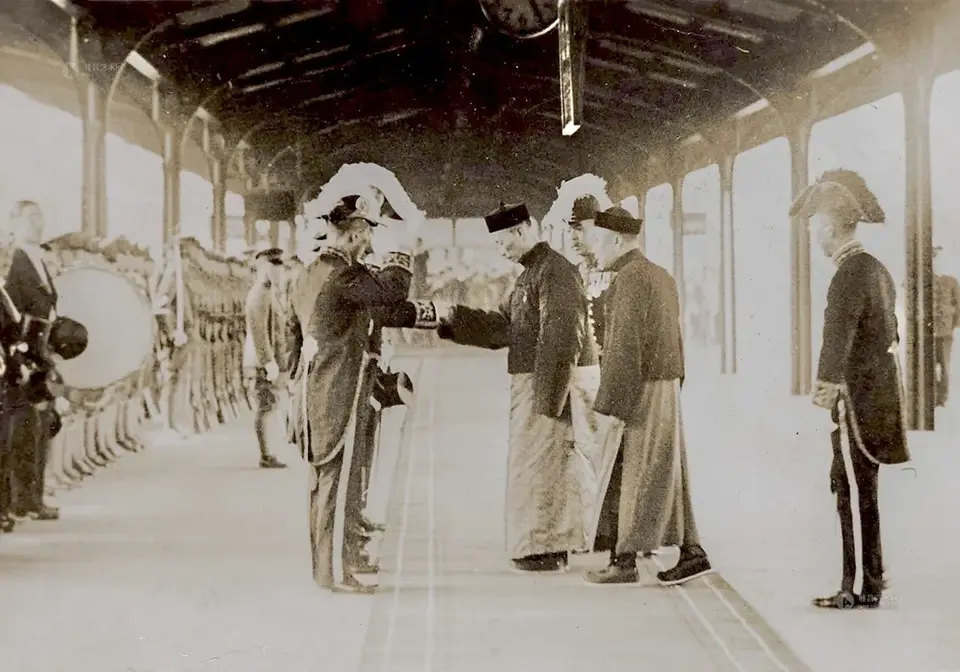
On March 1, 1932, the puppet state of Manchukuo was proclaimed in Changchun. Puyi was installed as Chief Executive, and Zheng was appointed the first Prime Minister of the State Council and Minister of Education. On September 15, 1932, Zheng signed the Japan-Manchukuo Protocol alongside Kwantung Army Commander Nobuyoshi Muto, formalizing Japanese military garrisoning, economic exploitation, and political administrative control over northeastern China. The treaty provoked nationwide fury; lifelong literati companions such as Chen Yan published public announcements severing all ties with him.
In March 1934, when Puyi declared himself Emperor of Manchukuo, Zheng became Prime Minister of the Empire. However, real authority was monopolized by Japanese directors in the General Affairs Board. Constantly monitored by Japanese military police, Zheng realized that the promise of sovereign restoration was an illusion, lamenting privately: "Japan and Manchuria cooperate in form, but the closer the form, the more distant the spirit."
Zheng's occasional expressions of discontent alienated the Kwantung Army command. In May 1935, General Jiro Minami forced Zheng into retirement, replacing him with the more compliant collaborator Zhang Jinghui. Granted nominal honorary privileges, Zheng relocated to a private residence on Liutiao Road in Changchun, founding the Wangdao Academy to lecture on Confucian statecraft. On March 6, 1938, after delivering a public address, he suffered a sudden severe intestinal affliction and died on March 28, 1938, at age seventy-seven. While the puppet regime staged a state funeral, the Chinese public condemned him as a traitor.
In late imperial and modern Chinese literary history, Zheng Xiaoxu was among the most influential masters of classical verse, revered as the preeminent leader of the Min (Fujian) branch of the Tongguang Style.
During the Tongzhi and Guangxu eras, reacting against earlier decorative verse and rigid Tang imitation, a group of prominent literati championed the intellectual rigor of Song dynasty poetry. Zheng, alongside Chen Yan, formulated the core aesthetics of the Tongguang Style. Rather than indulging in superficial verbal polish, Zheng drew directly from Northern Song masters Su Shi and Huang Tingjian as well as mid-Tang poets Han Yu and Meng Jiao, emphasizing profound philosophical reflection and unyielding structural bone.
His verse was compiled into the thirteen-volume Haizang Pavilion Poetry Collection. Characterized by striking diction, austere phrasing, and monumental emotional restraint, his poetry broke decisively with late Qing sentimentalism, constructing an atmosphere of desolate classical grandeur. Scholar Wang Guowei praised Zheng's verse as possessing cold, soaring beauty rarely matched in modern times. Even after Zheng's political defection, literary figures such as Lu Xun acknowledged that Zheng represented the artistic zenith of modern classical Song-style poetic composition.
Beyond his poetic fame, Zheng was a calligraphic innovator whose distinctive aesthetic occupied a prominent position in twentieth-century East Asian calligraphy, celebrated as the "Haizang Pavilion Style."
During the late Qing, while the Stele School revived Northern Dynasties stone inscriptions, many practitioners lapsed into rustic heaviness; conversely, orthodox model-book adherents remained trapped in glossy mannerisms. Zheng achieved an original synthesis. Grounding his art in the regular scripts of Yan Zhenqing and Liu Gongquan, he absorbed the angular tension of Northern Wei steles such as the Zhang Menglong Stele during his residence in Japan, subsequently integrating the sweeping, expansive strokes of Huang Tingjian's running script.
Zheng's regular and running scripts featured elongated, perilous architectures with tightly compressed centers and sweeping, sword-like exterior strokes. Combining square and rounded brush mechanics, his brushwork executed rapid, decisive angular turns, projecting an austere, aristocratic chill. His calligraphy enjoyed immense prestige throughout Jiangnan and Beijing, leaving an indelible imprint upon modern architectural signage and monumental rock carvings across China.
Zheng Xiaoxu's most tragic historical legacy was his collaboration with Japanese militarist invaders in an obsessive quest to restore the fallen Qing monarchy.
Following the 1911 Revolution, rejecting democratic republicanism, Zheng formulated his reactionary "Three Common Ownerships" doctrine, which rationalized imperialist partition and justified foreign military subjugation of the Chinese populace. Following the 1931 Mukden Incident, he served as the principal political architect orchestrating Puyi's flight to the northeast and establishing the puppet Manchukuo regime.
As Prime Minister of Manchukuo, Zheng signed the Japan-Manchukuo Protocol, surrendering northeastern territory, resources, and railways to Japanese colonial exploitation, subjecting over thirty million northeastern Chinese to fourteen years of brutal military rule. His descent from an eminent scholar into an imperialist puppet remains an enduring cautionary lesson in modern Chinese history.
During the late Qing reform era prior to the 1911 Revolution, Zheng contributed meaningfully to the modernization of Chinese publishing and institutional education.
Around 1903, as Shanghai's Commercial Press transitioned from a modest print shop into modern China's premier publishing enterprise, founders led by Xia Ruifang invited Zheng to serve as Chairman of the Board. In this capacity, Zheng appointed distinguished reformers such as Zhang Yuanji, Cai Yuanpei, and Gao Fengqian to direct compilation bureaus, aggressively publishing standardized primary and secondary textbooks, modern dictionaries, and translated foreign academic treatises that laid the foundation for modern Chinese mass literacy.
Furthermore, Zheng helped establish the China Public School in Shanghai and partnered with entrepreneur Zhang Jian to develop modern industrial textile enterprises, editing Constitutionalism News to cultivate civic awareness among the populace, reflecting the progressive inclinations of late Qing reformist gentry.
FIGURES ASSOCIATED WITH THIS DYNASTY