Birth in Lin'an
Zheng Sixiao was born beside West Lake in Hangzhou to the Confucian scholar Zheng Qi.
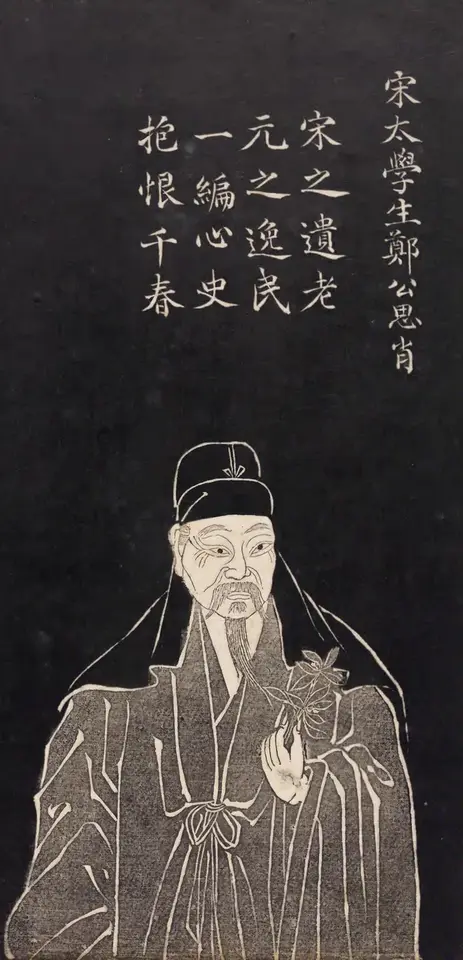
郑思肖
Zheng Sixiao (郑思肖) was an outstanding patriotic literatus, loyalist painter, and thinker of the late Southern Song and early Yuan dynasties. His original name was little known; following the fall of the Southern Song, out of unyielding fidelity to the Zhao imperial house, he adopted the character Xiao as his given name, took the courtesy name Yiweng, and styled himself Suonan, vowing never to sit or sleep facing north. When…
Zheng Sixiao (郑思肖) was an outstanding patriotic literatus, loyalist painter, and thinker of the late Southern Song and early Yuan dynasties. His original name was little known; following the fall of the Southern Song, out of unyielding fidelity to the Zhao imperial house, he adopted the character Xiao as his given name, took the courtesy name Yiweng, and styled himself Suonan, vowing never to sit or sleep facing north. When Mongol forces advanced on Lin'an, Zheng submitted an urgent memorial at the palace gates urging institutional reforms and resolute defense, but his frank words were suppressed by powerful ministers. Following dynastic collapse, he lived as a hermit among Buddhist temples in Suzhou, adamantly refusing to serve the Yuan. In painting, Zheng created the unique motif of ink orchids without soil or roots, symbolizing that Chinese land had been seized by alien conquerors, boldly refusing official requests with the declaration: "My head may be severed, but my orchids cannot be painted." In his later years, he sealed his poignant loyalist writings into an iron casket and submerged it in a dry well at Chengtian Temple in Suzhou. Discovered over 350 years later in the late Ming Dynasty, this work, titled Xinshi, electrified the nation, establishing him as an immortal paragon of Chinese moral integrity.
Zheng Sixiao was born beside West Lake in Hangzhou to the Confucian scholar Zheng Qi.
He moved with his father to Yuanqiao in Suzhou, passed the local civil service qualifying exams, and began traveling.
As Yuan armies closed in on Lin'an, he presented an urgent memorial at the palace gates, which was suppressed.
Following the fall of Song at Yamen, he adopted the name Sixiao and art name Suonan, vowing never to serve the Yuan.
When Zhao Mengfu accepted Yuan officialdom, Zheng broke all ties and barred his doors.
Requesting a spirit tablet inscribed "Unfilial and Disloyal Zheng Sixiao of the Great Song," he passed away facing south at age seventy-eight.
The ancestral roots of Zheng Sixiao stretched back to antiquity; during the Western Jin Yongjia migration, his lineage branched into Fujian, settling in Toubao, Lianjiang. In 1220, his father Zheng Qi (courtesy name Shuqi, art name Jushan) moved the family to Lin'an. In 1241, Zheng Sixiao was born beside West Lake. His father was an upright scholar who later served as head of the Pingjiang Academy in Suzhou. Imbued with familial teachings from childhood, Zheng Sixiao thoroughly studied Confucian classics and absorbed principles of filial piety and political loyalty.
In 1254, fourteen-year-old Zheng Sixiao accompanied his parents in relocating to Yuanqiao in Suzhou, where he passed the regional qualifying exams to become a student of the prefectural academy, embarking on wide travels. In his early twenties, he entered the National University as an honor student, participated in the Broad Scholarship Examination, and was appointed director of the Hejing Academy. Gifted in poetry, calligraphy, and painting, he quickly achieved prominence among Jiangnan literati.
During the late Southern Song, the imperial court suffered severe political decay under dominant chancellors such as Jia Sidao. Residing in Suzhou amid domestic poverty and escalating wartime instability, Zheng Sixiao relocated seven times over a dozen years. In 1255, fleeing political disturbances, his family moved from Yuanqiao to Tiaofang Lane, living there for ten years. In 1262, his father passed away in Suzhou, leaving twenty-two-year-old Zheng to maintain mourning under strained financial conditions. In subsequent years, he moved successively to Huangniufang Bridge, Cailian Lane, Renwang Temple, Shuangban Bridge, and Shizi Street. Amid these frequent moves, he compiled the draft of his Xianchun Collection, showcasing deep patriotic anxiety.
In 1274, Emperor Duzong died, and the young Zhao Xian ascended the throne under Grand Empress Dowager Xie's regency. Mongol forces led by Bayan mounted a multi-pronged assault, shattering Song frontier defenses. Witnessing dynastic collapse, Zheng traveled to Lin'an and knelt before the imperial palace to present a comprehensive memorial. He vehemently denounced corrupt ministers, pleading for administrative cleansing, military discipline, and the mobilization of brave commanders. However, his unvarnished language offended powerful courtiers, and his memorial was withheld from imperial review. Thwarted in his patriotic ambitions, Zheng returned to Suzhou in bitter grief.
In the second month of 1279, Song forces were annihilated at the naval battle of Yamen, terminating the dynasty. Overcome with grief, Zheng Sixiao fasted and wept for days. Modeling himself on the ancient recluses Boyi and Shuqi, he swore never to submit to Mongol rule. To demonstrate devotion to the Song royal house, he renamed himself Sixiao (meaning remembering the Zhao clan), styled himself Yiweng, took the art name Suonan, and inscribed his chamber with the plaque "Benxue Shijia", an anagram secretly reading "Great Song Lineage". Furthermore, he authored a text titled Da Wu Gong Shi Kong Jing, an anagram for "Great Song Scripture." In daily life, he resolutely refused to sit or lie facing north, and on traditional holidays he walked to the southern outskirts of Suzhou to weep and bow toward the south.
Zheng had previously enjoyed a close friendship with the Song imperial descendant and painter Zhao Mengfu. In 1286, when Zhao accepted a summons to serve the Yuan court in Dadu, Zheng was infuriated by what he viewed as betrayal of scholar-official honor. He immediately declared their friendship severed. When Zhao later attempted to visit him in Suzhou, Zheng shut his gate tightly, shouting denunciations from within and refusing to see him, an uncompromising act that astounded contemporaries.
Zheng Sixiao was an accomplished painter who specialized in ink orchids. After the fall of Song, his painted orchids possessed sparse blossoms and slender leaves, but notably lacked any earth or roots. When questioned, Zheng retorted: "All the land has been stolen away by alien barbarians; do you not know that?" His works radiated desolate loyalty. When Mongol dignitaries and wealthy collaborators attempted to purchase or coerce paintings from him, he refused adamantly, reserving his art for poor scholars and innocent youths. Once, a local magistrate tried to compel Zheng to paint by threatening him with exorbitant corvée taxes. Zheng slammed his fist on the table, declaring: "My head may be severed, but my orchids cannot be painted!" Intimidated by his fierce integrity, the official dared not harm him.
In his late years, Zheng embraced Chan Buddhist philosophy, staying frequently in local temples. He carved a sixteen-character seal: "Demanded, it is denied; unasked, it may be given; old eyes gaze into empty space; clean breeze endures for eternity." His surviving Ink Orchid Scroll, marked by extreme economy of brushwork, became an enduring cultural icon of Chinese loyalist resistance.
In his twilight years, Zheng assembled his 250 poems and essays denouncing corrupt traitors and recording the fall of Song into three volumes titled Xinshi. Because the Yuan court enforced harsh literary persecution, printing the work was impossible. Zheng sealed the manuscript inside a sturdy iron casket, inscribed the exterior with "Sealed with a Hundred Bows by Zheng Sixiao, Solitary Minister of the Great Song," and covertly lowered it into a dry well at Chengtian Temple in Suzhou, praying for heaven's protection.
Zheng lived a solitary late life, having lost his parents decades earlier while his sole sister had entered a Buddhist nunnery and disappeared. He donated his meager land and possessions to indigent neighbors and temples. In 1318, falling fatally ill, he asked his friend Tang Dongyu to craft a spirit tablet reading "Unfilial and Disloyal Zheng Sixiao of the Great Song." Finishing his words, he turned toward the south and peacefully passed away at age seventy-eight.
Zheng Sixiao revolutionized Chinese literati painting by transforming flower-and-bird painting into an instrument of political defiance and ethical resistance. His rootless ink orchids, executed with sparse, wiry brushstrokes without shading or ground, discarded decorative charm to embody unyielding integrity. Surviving works such as the Ink Orchid Scroll were revered by subsequent dynasties as supreme symbols of Southern Song loyalism, profoundly influencing late Ming and early Qing protest painters.
Zheng's Xinshi, sealed inside an iron casket, lay buried in the dry well for 350 years until Buddhist monks cleaning the well uncovered it in the winter of 1638. The paper and ink remained pristine. Leading late Ming scholars such as Qian Qianyi and Chen Zilong wept upon reading it, quickly transcribing and printing editions. Xinshi preserved authentic historical accounts absent from official histories, illustrating the profound patriotic resolve of Southern Song loyalists. Liang Qichao later declared that as long as this book endured beneath heaven, Zheng's spirit would never vanish from China.
Zheng Sixiao's poetry occupied an elevated place in Song-Yuan literature. He emphasized genuine emotional inspiration and cosmic spirit, rejecting superficial ornamentation. His 250 surviving poems conveyed poignant grief and unbending resolve. In Elegy for Commissioner Li Fei, he lauded the heroic martyrs who fell defending Tanzhou, while in Two Grindstones, he invoked ancient parallels of King Goujian and Shen Baoxu to express his vow never to let China succumb to alien conquest. His famous line from Inscription on Painted Chrysanthemum —"Better to cling to the branch and die in fragrance, than to be blown away by the northern wind"—remains an immortal motto of moral endurance.
FIGURES ASSOCIATED WITH THIS DYNASTY