Birth in Putian
Born into an esteemed scholar-gentry lineage in Putian County, Xinghua Military Prefecture.
郑樵
Zheng Qiao (郑樵, 1104–1162), courtesy name Yuzhong (渔仲) and pseudonym Master Jiaji (夹漈先生), was a native of Putian in Xinghua Military Prefecture (present-day Putian, Fujian Province). He was an illustrious Southern Song universal historian, bibliographer, pioneering master of Chinese textual criticism (jiaochou xue), and encyclopedic naturalist. Endowed with extraordinary intellectual brilliance from infancy, he mastered the…
Zheng Qiao (郑樵, 1104–1162), courtesy name Yuzhong (渔仲) and pseudonym Master Jiaji (夹漈先生), was a native of Putian in Xinghua Military Prefecture (present-day Putian, Fujian Province). He was an illustrious Southern Song universal historian, bibliographer, pioneering master of Chinese textual criticism (jiaochou xue), and encyclopedic naturalist. Endowed with extraordinary intellectual brilliance from infancy, he mastered the Confucian classics, historical canons, epigraphy, historical phonology, linguistics, astronomy, geography, and botanical natural history. Following the catastrophic Jingkang Incident of 1126, disillusioned with the corruption of civil service examinations, he swore a lifelong vow to remain a commoner scholar and emulate Sima Qian by single-handedly compiling a monumental comprehensive history that synthesized all human knowledge. Residing in solitary hermitage at his thatched cottage on Mount Jiaji for thirty years, he endured extreme poverty while borrowing private archives from across southern China and conducting empirical field studies of flora and fauna. Despite severe imperial prohibitions against private historiography enforced under chancellor Qin Hui, Zheng Qiao undertook four arduous journeys to the imperial capital of Lin'an to present his manuscripts. Summoned to the palace by Emperor Gaozong, he was appointed Collator in the Historiography Institute and Editorial Compiler of the Bureau of Military Affairs. His lifetime magnum opus, the 200-volume, five-million-word Comprehensive History (Tongzhi), achieved worldwide renown for its celebrated Twenty Treatises (Ershi Lue), which integrated linguistics, phonology, epigraphy, cartography, bibliography, and botanical natural history into dynastic history for the first time. His foundational historiographical philosophy of "universal synthesis" (huitong) and his bibliographical doctrine of "distinguishing scholarly lineages and clarifying source traditions" profoundly influenced later intellectual giants including Zhang Xuecheng and Liang Qichao.
Born into an esteemed scholar-gentry lineage in Putian County, Xinghua Military Prefecture.
Walked thousands of li to Suzhou at age sixteen to escort his deceased father's coffin home, observing filial mourning beside the tomb.
Constructed Nanfeng Study to borrow and transcribe private collections, relocating to Xianglin Temple on Mount Jiaji the following year.
Memorialized the Bureau of Military Affairs regarding defense against the Jurchens; finding his counsel unheeded, renounced civil examinations forever.
Built a thatched cottage in the deep valleys of Mount Jiaji, entering a thirty-year reclusion of intensive research and writing.
Authored Letter to Vice Minister Fang of the Ministry of Rites, outlining his grand design for compiling the Tongzhi.
Traveled on foot to the capital Lin'an to present his initial manuscripts, but received no response due to Qin Hui's ban on private history.
Endured the tragic deaths of his brother, young son, and wife within months; carried 140 volumes of manuscripts back to Lin'an, where they were archived.
Completed the 200-volume first draft of Tongzhi after three decades of relentless research.
Summoned by Emperor Gaozong for an imperial audience; appointed Right Digong Gentleman and Collator in the Historiography Institute.
Traveled two thousand li to submit the complete 200-volume Tongzhi alongside his formal imperial memorial.
Passed away peacefully from exhaustion at his capital residence at age fifty-nine; interred at the foot of Mount Jiaji.
Zheng Qiao was born in 1104 into a scholarly household in Putian County, Xinghua Military Prefecture. His ancestors were local Confucian scholars and regional administrative assistants. His father, Zheng Guoqi, studied at the imperial National University in Kaifeng, celebrated for his refined scholarship and pristine integrity. From early infancy, Zheng Qiao displayed precocious brilliance, reportedly recognizing characters at age three, comprehending classical texts upon hearing them at age five, reciting ten thousand words daily at age six, composing balanced literary prose at age eight, and mastering the Five Classics by age nine, earning him universal acclaim as a child prodigy across Fujian.
In 1119, when Zheng Qiao was only sixteen, tragic adversity struck his family. His father fell fatally ill in Suzhou while traveling home from the National University and died in a roadside hostel. The sudden demise plunged the family into dire poverty. Amid summer heat and roving bandits along the postal highways, the sixteen-year-old youth strapped on straw sandals and walked thousands of li alone to Suzhou. Through exhausting perseverance, he located his father's coffin, personally escorting the hearse over rivers and mountain passes back to Putian, interring him beneath Yuewang Peak.
Following the burial, Zheng Qiao adhered strictly to ancient rites, erecting a thatched hut beside his father's grave to observe a three-year vigil. During this ascetic period, surrounded by wilderness and grave mounds, he studied day and night. Because his impoverished household could not afford expensive books, he shouldered a travel bag and walked between monastic libraries and aristocratic households across southern China, borrowing manuscripts and hand-copying rare editions through the night, constructing a profound academic foundation.
Upon completing his mourning period, Zheng Qiao built the Nanfeng Study in a secluded valley to continue his studies with his younger brother Zheng You. To overcome his family's booklessness, he embarked on continuous book-hunting expeditions. Whenever he heard of an ancient library or a rare collection, he would travel on foot for days to seek borrowing privileges.
Local folklore in Putian preserves numerous celebrated anecdotes regarding his photographic memory. According to local historical lore, Zheng Qiao learned of a wealthy family possessing ten thousand volumes near Yanshou Bridge. The master of the house was initially skeptical of the raggedly dressed youth. Zheng Qiao serenely requested that the volumes be laid out along the wooden planks of the bridge, allowing the river breezes to flutter the leaves. As the wind turned each page, Zheng Qiao silently committed its contents to memory. Within a single day, he announced that he had completed the entire library. Convinced of his deceit, the owner opened obscure passages to cross-examine him, only to find Zheng Qiao reciting each line verbatim without a single error, prompting the astonished host to grant him unrestricted access to his collections.
Whenever he secured an exceptional manuscript, Zheng Qiao transcribed the text in its entirety by candlelight. Through decades of relentless study, he absorbed the Confucian classics, dynastic histories, pre-Qin philosophers, astronomical treatises, geographical gazetteers, traditional pharmacology, and ancient phonological rhyme tables, attaining universal erudition celebrated as "having read eight-tenths of all literature under Heaven."
In 1126, Jurchen cavalry captured Kaifeng, abducting Emperors Huizong and Qinzong in the catastrophic Jingkang Incident. Outraged by the collapse of northern China, the twenty-three-year-old commoner Zheng Qiao and his cousin Zheng Hou submitted two urgent memorials to Yuwen Xuzhong, Director of the Bureau of Military Affairs. They articulated strategic plans to mobilize local militias, secure the Huai River frontier, and restore state revenues.
Although Yuwen Xuzhong marveled at the young men's strategic vision, the capitulationist court factions refused to enact their proposals. Witnessing the rapid collapse of the Northern Song and the displacement of millions of refugees, Zheng Qiao experienced a profound disillusionment with the imperial examination system. He recognized that scholar-officials spent their lives memorizing examination templates merely for personal wealth and rank, completely helpless when dynastic catastrophe arrived.
Convinced that cultural continuity depended upon empirical historical scholarship, Zheng Qiao swore an unshakeable oath: he permanently abandoned civil service examinations, vowing to live as an unadorned commoner scholar and dedicate his life to emulating Sima Qian by writing an all-encompassing universal history that captured the evolution of Chinese civilization.
In 1132, seeking absolute seclusion from worldly distractions, Zheng Qiao relocated his library deep into the mist-shrouded valleys of Mount Jiaji, establishing his celebrated "Jiaji Thatched Cottage" and adopting the pseudonym "Master Jiaji." Over the next thirty years, he conducted a heroic, monastic intellectual odyssey.
Mount Jiaji was an isolated, precipitous peak plagued by seasonal storms, biting winter frosts, and venomous insects. Living in Spartan poverty, Zheng Qiao wore coarse linen, subsisted on wild mountain herbs, and endured winters without charcoal and summers without mosquito nets. Yet within his modest study, tens of thousands of hand-copied scrolls lined the walls, and empirical botanical specimens covered his tables.
Zheng Qiao utterly rejected abstract scholasticism. At Mount Jiaji, he divided his research into dozens of specialized disciplines. He regularly hiked into mountain hamlets with a bamboo walking stick, consulting elderly farmers on crop varieties, questioning woodcutters and fishermen on wildlife habits, examining tools alongside village blacksmiths, and analyzing dialectal sounds with regional storytellers. In 1138, he composed his famous Letter to Vice Minister Fang of the Ministry of Rites, unveiling the grand theoretical architecture of his forthcoming Tongzhi and sending shockwaves of excitement through southern intellectual circles.
Prominent anti-Jurchen chancellors, including Zhao Ding and Zhang Jun, recognized Zheng Qiao's genius and repeatedly recommended him to Emperor Gaozong. However, despotic chancellor Qin Hui seized complete power, enforcing a policy of appeasement toward the Jurchens. To suppress intellectual dissent, Qin Hui issued three sweeping imperial edicts during his sixteen-year dictatorship, strictly banning private historical compilation and prosecuting offenders under capital treason statutes.
This political reign of terror posed a direct threat to Zheng Qiao's project. While many frightened scholars burned their drafts, Zheng Qiao persevered in secret. In May 1146, the forty-three-year-old scholar carried his manuscripts on foot two thousand li to Lin'an to present them to the court. However, under Qin Hui's suppression, his submission was shelved without imperial acknowledgment, forcing him to return home empty-handed.
Upon his return to Putian, catastrophic personal tragedies battered his household. Within a span of months, his devoted younger brother Zheng You, his beloved young son Zheng Ti, and his lifelong wife Madam Chen all succumbed to illness and poverty. Devastated by the destruction of his family, Zheng Qiao nearly collapsed from grief. Yet, driven by his intellectual mission, he packed 140 volumes of newly revised manuscripts and walked back to Lin'an through winter snows in November 1148. After months of petitioning, the court merely ordered the texts "archived in the Secretarial Court," granting no financial support. Zheng Qiao returned once more to his lonely hermitage on Mount Jiaji.
In October 1155, chancellor Qin Hui died, dissolving the despotic ban on private historiography. In 1157, after thirty continuous years of solitary writing, Zheng Qiao completed the massive 200-volume first draft of Tongzhi.
In February 1158, recommended by Senior Academician He Yunzhong, Emperor Gaozong summoned Zheng Qiao to the capital for a personal audience at Yanhe Hall. Standing before the throne in simple rustic robes, Zheng Qiao addressed the emperor: "Your servant has dwelled in mountain forests for more than thirty years, completing fifty distinct treatises. For the remaining work, your servant harvested records from all past dynasties, beginning from the Three Sovereigns and ending with the Five Dynasties, synthesizing them into a single comprehensive history after the model of Sima Qian. The compilation is now complete, awaiting only final transcription."
Zheng Qiao expounded upon historical governance and the principles of dynastic rise and fall with dazzling clarity. Deeply moved, Emperor Gaozong praised him for "elucidating ancient scholarship to establish an independent school," ordering the imperial library to transcribe his works and appointing him Right Digong Gentleman and Collator in the Historiography Institute, subsequently promoting him to Editorial Compiler of the Bureau of Military Affairs.
However, Zheng Qiao's meteoric elevation as a commoner incited bitter jealousy among entrenched court academicians. When the emperor granted Zheng Qiao special borrowing privileges in the Three Imperial Libraries (Zhao'wen Hall, Jixian Institute, and Historiography Academy), the resident Hanlin scholars obstructed him at every turn. Renowned contemporary poet Lu You recorded in Weinan Wenji: "I met Zheng Yuzhong at court; he was a master of antiquities and truly an exceptional gentleman. Yet the court bureaucracy slandered him relentlessly. When he was permitted to borrow books from the Three Libraries, the academicians were deeply resentful." Unperturbed by their hostility, Zheng Qiao worked through the night, using royal archives to polish his life's work.
In 1161, Zheng Qiao arrived in Lin'an carrying the finalized 200-volume manuscript of Tongzhi, submitting his formal Memorial on Presenting the Tongzhi. At that exact juncture, Jin emperor Wanyan Liang launched a massive military invasion across the Huai River. Emperor Gaozong departed Lin'an to supervise armies at Jiankang, issuing an edict appointing Zheng Qiao as Superintendent of Nanyue Temple in Tanzhou while ordering him to await imperial instructions in the capital.
In March 1162, Emperor Gaozong returned to Lin'an and recalled Zheng Qiao's monumental book, formally commanding the Directorate of Astronomy and National University to transcribe duplicate copies for imperial preservation. Tragically, on the very day the imperial decree was promulgated, the fifty-nine-year-old scholar collapsed from chronic exhaustion in his Lin'an hostel and passed away peacefully.
Scholars throughout the realm mourned his passing. Grand Chancellor Cao Xun composed an impassioned funerary elegy, celebrating him as a moral and academic titan whose monumental history stood alongside Sima Guang's Comprehensive Mirror. His disciples transported his casket back to Fujian, laying him to rest at the foot of Mount Jiaji, leaving behind an immortal intellectual monument.
Zheng Qiao's paramount historical monument was his single-handed compilation of the 200-volume, five-million-word universal history Comprehensive History (Tongzhi), comprising 18 volumes of Basic Annals, 6 volumes of Hereditary Houses, 115 volumes of Biographies, 8 volumes of Special Records, and 52 volumes of the celebrated Twenty Treatises (Ershi Lue).
In historical philosophy, Zheng Qiao revitalized Sima Qian's grand vision of "investigating the boundaries between Heaven and humanity and penetrating the transformations of past and present." In his famous General Preface to the Tongzhi, he formulated his revolutionary doctrine of "universal synthesis" (huitong). He launched an uncompromising assault against the dynasty-by-dynasty tradition established by Ban Gu's Book of Han, arguing that dynastic histories severed the living continuity of historical institutions, turning history into disjointed fragments.
Zheng Qiao asserted that authentic historical analysis must trace the unbroken evolutionary trajectory of institutions across millennia. His universalist methodology shattered centuries of historiographical parochialism, revitalizing the spirit of Sima Qian's Records of the Grand Historian and establishing the theoretical cornerstone for the "Three Comprehensive Histories" alongside Du You's Tongdian and Ma Duanlin's Wenxian Tongkao.
The enduring crown jewel of the Tongzhi is its celebrated Twenty Treatises (Ershi Lue), covering Clans, Six Scripts, Seven Tones, Capital Cities, Posthumous Names, Regalia and Costumes, Music, Celestial Phenomena, Stellar Observances, Anomalies, Geography, Universal Writing, Administrative Residences, Epigraphy, Cartography, Bibliography, Textual Criticism, Inscriptions, and Insects and Vegetation.
Among these twenty monographs, ten categories were unprecedented innovations within official Chinese historiography. Zheng Qiao broadened historical inquiry beyond the narrow machinery of taxation, penal codes, and court ceremonies, systematically integrating linguistics, phonology, archaeology, visual cartography, bibliography, and natural history into the historical canon.
In Capital Cities, he analyzed the strategic geography and geopolitical positioning of imperial capitals; in Posthumous Names and Regalia, he scrutinized the evolution of aristocratic hierarchies; in Epigraphy, he pioneered the systematic analysis of pre-Qin bronze and stone inscriptions; and in Insects and Vegetation, he established the history of natural science. The Twenty Treatises are celebrated worldwide as an extraordinary pioneering series of specialized monographs in imperial Chinese historiography.
Within the Twenty Treatises, Zheng Qiao's Treatise on Clans (Shizu Lue) established the empirical foundation for traditional Chinese sociology and genealogical analysis. Prior to Zheng Qiao, scholars followed the simplistic five-category rubric outlined in the Zuo Zhuan.
Through exhaustive examination of over ten thousand surnames from antiquity through the Song Dynasty, Zheng Qiao classified thirty-two distinct etymological sources of surnames, including feudal states, fief towns, administrative offices, aristocratic titles, and posthumous names, creating an unshakeable taxonomy of Chinese kinship structures.
Crucially, in his preface, Zheng Qiao articulated two foundational sociological axioms: "Surnames (xing) originated from birth; clan names (shi) were conferred from landed fiefs," and "Prior to the Three Dynasties, xing and shi were distinct: men were identified by shi to distinguish nobility from baseness; women were identified by xing to regulate marriages. Those of noble rank possessed shi, while commoners had personal names but no shi. After the Three Dynasties, xing and shi merged into one, serving solely to regulate marriages while their hierarchical distinction dissolved." This brilliant insight provided an indispensable framework for understanding the transition from ancient feudal aristocracy to imperial bureaucratic society.
Zheng Qiao was a brilliant pioneer of historical linguistics and phonological sciences, authoring the five-volume Treatise on the Six Scripts (Liushu Lue) and the two-volume Treatise on the Seven Tones (Qiyin Lue).
In the Treatise on the Six Scripts, he investigated character morphology and graphic evolution, breaking away from Xu Shen's Han Dynasty Shuowen Jiezi to classify Chinese characters into primary matrix radicals and secondary semantic compounds. He demonstrated that Chinese characters evolved dynamically in response to changing material culture and institutional practices.
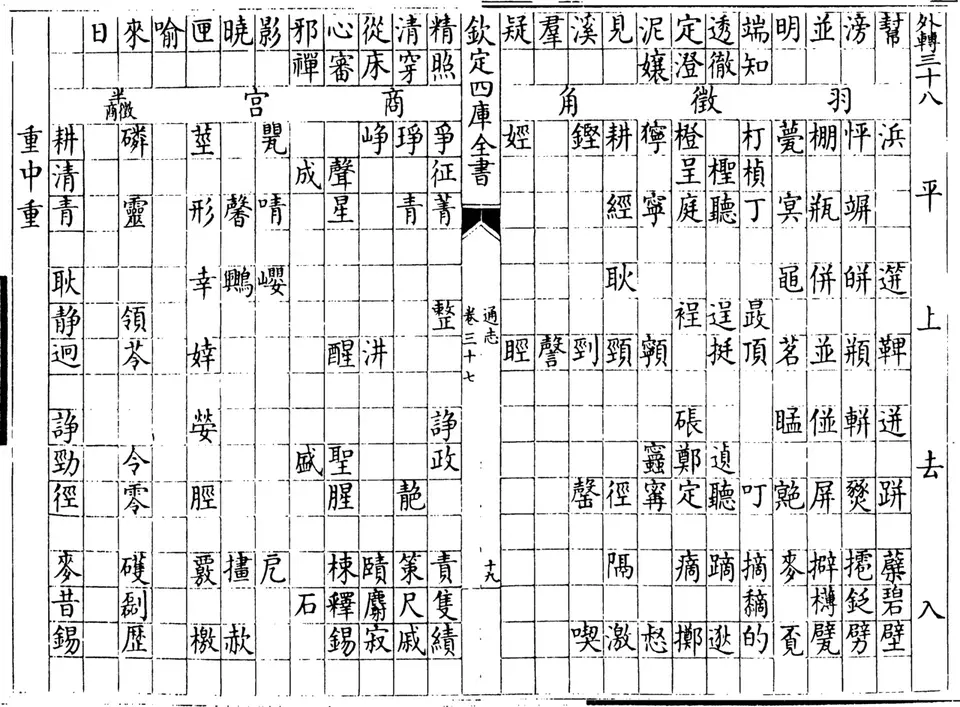
In the Treatise on the Seven Tones, Zheng Qiao constructed an extraordinary phonological grid utilizing the thirty-six initial consonants and seven points of articulation (gutturals, velars, linguals, labials, dentals, palatals, and retroflexes), cross-referenced with four tonal registers. His three-dimensional phonetic matrix provided an objective, scientific instrument for resolving regional dialect variations and comparing Chinese phonetics with Sanskrit and Central Asian languages.
Zheng Qiao is universally revered as the primary founder of Chinese textual criticism (jiaochou xue) and classical bibliography. His Treatise on Textual Criticism (Jiaochou Lue) and Treatise on Bibliography (Yiwen Lue) established the theoretical architecture of Chinese library science.
Prior to Zheng Qiao, bibliographers merely listed book titles and brief summaries. Zheng Qiao introduced the revolutionary principle that "once classifications and subcategories are clarified, the evolution of scholarship becomes self-evident," formulating the foundational doctrine of "distinguishing scholarly lineages and clarifying source traditions" (bianzhang xueshu, kaojing yuanliu). He insisted that bibliographical classification must reflect the intellectual progression and branching of human thought.
To resolve the catastrophic loss of state archives following civil wars, Zheng Qiao formulated his celebrated "Eight Methods of Book-Seeking" (Qiu Shu Ba Fa): searching by subject class, searching by related categories, searching by geographic origin, searching by private collections, searching in public archives, searching among private households, searching through individual collectors, and searching by historical era. This rigorous methodology remains a cornerstone of modern archival and library sciences.
Recognizing that traditional scholars excessively favored literary texts while neglecting visual materials, leading to the loss of ancient diagrams, Zheng Qiao formulated a comprehensive theory of visual cartography in his Treatise on Cartography (Tupu Lue).
Zheng Qiao declared: "Diagrams are the warp; texts are the woof. Only when warp and woof interlace can complete understanding emerge. To read text without seeing diagrams is to hear sound without seeing form; to see diagrams without reading text is to see form without hearing sound. Diagrams are concise; texts are comprehensive. Seeking principles through diagrams makes principles immediately clear; seeking visual forms through texts makes forms difficult to discern."
He produced specialized pictorial atlases covering astronomy, geography, battle formations, architectural engineering, and botanical morphology, pioneering visual and spatial methodologies in Chinese historiography.
In an era dominated by abstract Neo-Confucian speculation regarding mind and metaphysical nature, Zheng Qiao demonstrated an astonishing commitment to empirical materialism and natural science.
He fiercely condemned scholars who remained barricaded within their studies, parsing ancient passages through pure semantic guesswork without observing nature. While examining plant and animal names in the Classic of Poetry and the Erya, Zheng Qiao explored the hills and waterways of Fujian, collecting empirical specimens and cross-examining experienced farmers, herbalists, and fishermen.
In his Treatise on Insects and Vegetation (Kun Chong Cao Mu Lue), he criticized classical commentators for their armchair speculations, boldly proclaiming that scholars must learn from common working people. In astronomy, he championed direct sky observations, sweeping away superstitious astrology and apocryphal star manuals. In geography, he emphasized the empirical tracing of river headwaters and watershed divides, demonstrating profound scientific foresight.
Zheng Qiao distinguished himself by his fearless intellectual skepticism and relentless pursuit of empirical reality. In classical studies, he swept aside the rigid scholastic commentaries that had suffocated Chinese education since the Han and Tang dynasties.
He argued that later commentators had buried the profound simplicity of the ancients beneath mountains of arbitrary glosses. He dared to challenge Master Mao's moralistic interpretations of the Classic of Poetry, corrected textual omissions in the Rites of Zhou, and exposed historical interpolations in pre-Qin canons.
This uncompromising critical spirit broke down rigid factional dogmas, creating space for independent intellectual inquiry. His methodology inspired Southern Song independent thinkers like Lin Guangchao and provided an essential conceptual reservoir for late Ming and Qing empirical scholars such as Gu Yanwu and Zhang Xuecheng.
FIGURES ASSOCIATED WITH THIS DYNASTY