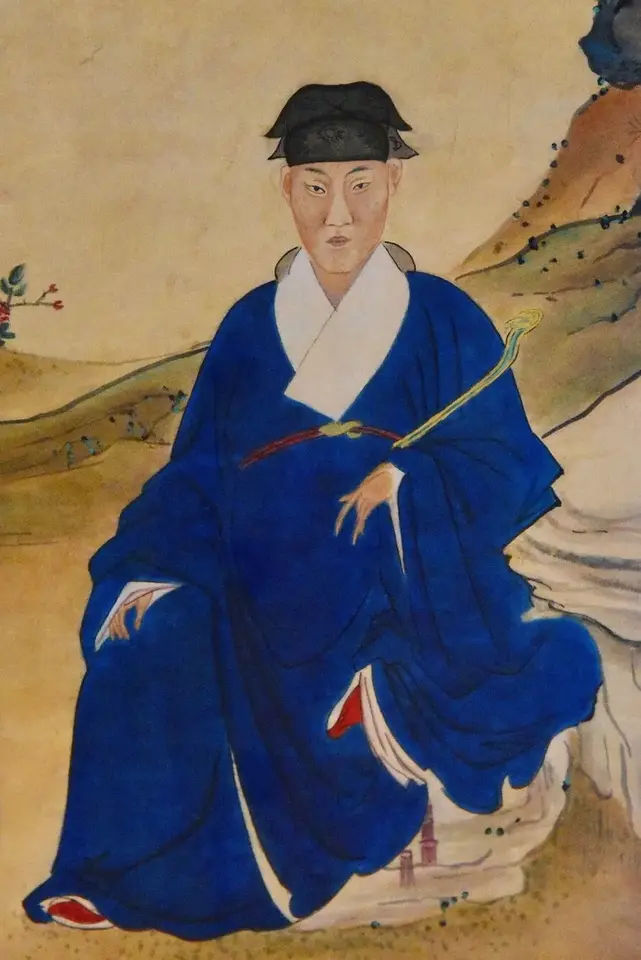
Biography
Princely Descent and Early Youth in Taiwan
Zheng Keshuang was born on August 13, 1670 (the twenty-eighth day of the seventh lunar month in the twenty-fourth year of the Yongli era), in Anping, Chengtian Prefecture, Taiwan. He was the second son of Zheng Jing, the Prince of Yanping, and his consort Lady Huang, and the grandson of Koxinga, who had liberated Taiwan from Dutch colonial rule in 1662.
Known informally as Qinshe during his childhood, Zheng Keshuang grew up in luxury within the secluded palaces of Anping. In contrast, his elder half-brother Zheng Kezang, born to Lady Zhaoniang and married to the daughter of prominent minister Chen Yonghua, possessed an austere, resolute demeanor reminiscent of Koxinga. While Zheng Jing led military expeditions on the mainland coast during the Revolt of the Three Feudatories, Zheng Kezang governed Taiwan as regent with exemplary fairness, winning deep admiration from soldiers and civilians alike. Zheng Keshuang, by comparison, was compliant and sheltered. Seeing an opportunity to consolidate clan dominance, military commander Feng Xifan betrothed his young daughter to Zheng Keshuang, turning the prince into the political figurehead of his faction.
The Dongning Coup and Minority Rule
In 1680, following the total defeat of Zheng Jing's continental campaign against Qing forces, the Dongning army retreated to Taiwan. Dispirited and ailing, Zheng Jing abandoned state affairs. In the same year, Grand Chancellor Chen Yonghua was forced out of office through intrigue and died shortly after, depriving the regime of its most capable administrator.
In the first lunar month of 1681, Zheng Jing passed away in Chengtian Prefecture, bequeathing his sword to regent Zheng Kezang. Immediately following Zheng Jing's death, Feng Xifan conspired with Zheng Jing's younger brothers to fabricate claims that Zheng Kezang was not of legitimate royal blood. They staged a violent coup d'etat, strangling Zheng Kezang in the palace. Feng Xifan then installed the twelve-year-old Zheng Keshuang as Prince of Yanping and General-in-Chief for Subjugation.
Under the young prince, governance fell under the autocratic control of Feng Xifan and admiral Liu Guoxuan. Feng was created Count of Zhongcheng, while Liu was created Marquis of Wuping. Rampant corruption, internal purges, and exorbitant taxation alienated the local population. Compounded by severe Qing maritime embargos, Taiwan suffered soaring grain prices and fiscal exhaustion, leaving the regime teetering on collapse.
Naval Disaster at Penghu and the Decision to Surrender
In June 1683, Emperor Kangxi endorsed the strategic plan of Fujian Governor-General Yao Qisheng, assigning Shi Lang, a former Zheng general serving as Commander-in-Chief of the Fujian Fleet, to launch a massive amphibious assault on Taiwan.
Shi Lang marshaled three hundred warships and twenty thousand veteran troops, confronting Liu Guoxuan's main fleet at the Penghu Islands. Utilizing favorable winds and superior tactical discipline, the Qing navy devastated the Dongning fleet, sinking or capturing nearly two hundred warships and inflicting over twelve thousand casualties. Liu Guoxuan barely escaped with a handful of vessels, fleeing back to Taiwan in utter defeat.
With Penghu lost, Taiwan's sea defenses were completely shattered. While some hardline officers urged fighting to the death and others proposed sailing to Luzon in the Philippines to maintain an overseas redoubt, Liu Guoxuan and Feng Xifan recognized that the military balance was irrevocably broken. Both urged fourteen-year-old Zheng Keshuang to surrender to the Qing empire.
Zheng Keshuang chose not to sacrifice his people in futile bloodshed. On July 15, 1683, he dispatched envoys to Shi Lang's naval headquarters in Penghu with an official letter of surrender. In this document, Zheng made three explicit humanitarian appeals: that the Qing court spare the lives of the Zheng royal family, protect the lives and property of all surrendering civil and military officers, and grant amnesty to all civilian residents of Taiwan.
Submission to Qing Rule and Relocation to the Capital
Shi Lang accepted Zheng Keshuang's terms and sailed into Luermen on August 13. Zheng Keshuang led his civil and military officials to the harbor to welcome the Qing forces, officially handing over the dynastic seals of the Prince of Yanping, military tallies, population registers, and land surveys. On August 18, Zheng Keshuang and his court shaved their heads in compliance with Qing regulations. Accompanied by Shi Lang, Zheng visited Koxinga's ancestral temple to offer sacrifices and honor his grandfather's legacy. The surrender formally ended twenty-two years of autonomous Ming Zheng administration, peacefully integrating Taiwan into the Qing administrative system.
In the spring of 1684, the Qing court ordered the relocation of Zheng Keshuang, Liu Guoxuan, and Feng Xifan to Beijing. In August, Zheng was received in imperial audience by Emperor Kangxi at the Zhongnanhai Yingtai Pavilion. Recognizing his compliance, Kangxi enrolled Zheng into the Han Eight Banners (Plain Red Banner) and conferred upon him the noble rank of First-Class Duke Haicheng.
Life in Beijing and Passing
In Beijing, Zheng was granted the former residence of his great-grandfather Zheng Zhilong outside Chaoyang Gate. Though honored with a dukedom, Zheng held no actual military or administrative posts, living under vigilant banner supervision. Supporting an extended retinue of over one hundred family members on modest imperial stipends placed heavy financial strain on the household, leading to persistent economic hardship.
In 1699, troubled that the ancestral remains of Koxinga and Zheng Jing remained buried in overseas Taiwan, Zheng Keshuang petitioned Emperor Kangxi to rebury them in their ancestral cemetery in Nan'an County, Fujian. Sympathetic to his filial devotion, Emperor Kangxi not only granted the petition but personally composed an elegiac couplet honoring Koxinga's steadfast loyalty.
In his final years, Zheng lived in reclusive modesty, spending his days with literature and family. Following the death of his mother Lady Huang in 1708, the family fell deeply into debt. Zheng submitted an urgent appeal to the Board of Revenue requesting the restoration of confiscated ancestral properties in Fujian to pay off funeral debts, but the petition was rejected.
On September 22, 1717, Zheng Keshuang died in his Beijing residence at the age of forty-eight. His noble title of Duke Haicheng was inherited by his son Zheng Anfu, and his descendants continued to reside in the Beijing and Hebei regions for generations.
Major Achievements
Facilitating Peaceful Unification with Mainland China
Following the catastrophe at Penghu in 1683, the Ming Zheng regime stood at a critical historical crossroads. Rather than prolonging civil conflict through reckless defiance or fleeing abroad, the fourteen-year-old monarch chose peaceful capitulation.
By submitting to the Qing dynasty and transferring all administrative registers, military forces, and territory to imperial control, Zheng Keshuang brought a peaceful resolution to thirty-eight years of cross-strait military standoff. His decisive act averted devastating warfare and allowed the Qing court to establish Taiwan Prefecture with three subordinate counties, solidifying indisputable sovereign authority over Taiwan.
Humanitarian Surrender Terms Protecting Soldiers and Civilians
During the surrender negotiations, Zheng Keshuang prioritized the welfare of his subjects over personal pride. In his official submission, he formulated three explicit humanitarian stipulations: preserving the lives of his royal lineage, protecting the personal safety and property of thousands of officers and soldiers, and sparing the civilian population of Taiwan from looting and slaughter.
Impressed by his sincerity, Shi Lang instituted strict military discipline, forbidding his soldiers from harming civilians or confiscating private property. Zheng's prudent submission saved more than forty thousand military personnel and hundreds of thousands of settlers from the horrors of war.
Reburial of Ancestral Remains and Preservation of Koxinga's Legacy
While residing in Beijing, Zheng Keshuang remained dedicated to ancestral honor. In 1699, concerned that the tombs of Koxinga and Zheng Jing were exposed to neglect in distant Taiwan, he petitioned Emperor Kangxi to transfer their remains to the ancestral burial grounds in Nan'an, Fujian.
This petition prompted the Qing court to officially recognize Koxinga's patriotic defense of Ming loyalty and anti-colonial resistance against the Dutch. By securing imperial recognition and state-sponsored reburial for his grandfather, Zheng Keshuang ensured that Koxinga's historical stature was preserved for posterity.