Birth in Xiangshan
Born on the seventeenth day of the sixth lunar month in Yongmo Village, Xiangshan County, Guangdong, receiving classical education.
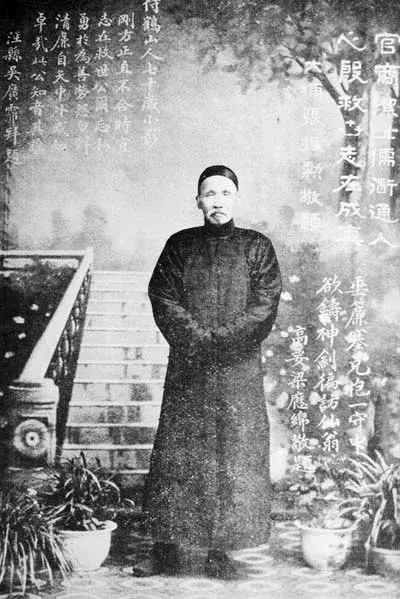
郑观应
Zheng Guanying (1842–1922) was a preeminent thinker of the late Qing reformist movement, an outstanding pioneer of modern Chinese national industry and commerce, and the author of the epoch-making treatise Words of Warning in Times of Prosperity (Shengshi Weiyan). Born in Xiangshan, Guangdong, he rose from a commercial apprentice and compradore in Western trading firms in Shanghai to become a leading executive directing…
Zheng Guanying (1842–1922) was a preeminent thinker of the late Qing reformist movement, an outstanding pioneer of modern Chinese national industry and commerce, and the author of the epoch-making treatise Words of Warning in Times of Prosperity (Shengshi Weiyan). Born in Xiangshan, Guangdong, he rose from a commercial apprentice and compradore in Western trading firms in Shanghai to become a leading executive directing core modern enterprises during the Self-Strengthening Movement. Deeply alarmed by foreign imperialist encroaching upon China, Zheng Guanying formulated the strategic concept of "Commercial Warfare" (Shangzhan), advocating that national survival depended not merely on military defense but decisively on economic self-reliance, tariff autonomy, parliamentary constitutional governance, and practical industrial education. His profound reformist blueprint profoundly inspired late Qing reformers, Sun Yat-sen, and modern Chinese revolutionaries, cementing his legacy as a titan in modern Chinese intellectual and economic history.
Born on the seventeenth day of the sixth lunar month in Yongmo Village, Xiangshan County, Guangdong, receiving classical education.
Traveled to Shanghai after failing county civil exams, entering Xinde foreign firm as an apprentice and learning English.
Entered British firm Dent & Co., attending evening classes for two years at the Anglo-Chinese School founded by John Fryer.
Joined Shengxiang Tea Firm as an interpreter and co-managed Gongzheng Steamship Company, later managing the Baoji Salt Bureau.
Appointed general manager of the British Butterfield & Swire Steamship Company, expanding Yangtze shipping and investing in self-strengthening firms.
Appointed manager of Shanghai Cotton Cloth Mill and Shanghai Telegraph Bureau; published the reformist treatise Yiyan (Easy Words).
Recruited by Li Hongzhang as assistant manager of China Merchants' Steam Navigation Company, negotiating pooling agreements and rising to manager.
Dispatched by Peng Yulin to French Indochina for intelligence reconnaissance during the Sino-French War and arranging defense logistics for Taiwan.
Exhausted by financial disputes and litigation, retired to the Mandarin's House in Macao for eight years of prolific scholarly writing.
Published the definitive 5-volume edition of Words of Warning in Times of Prosperity (Shengshi Weiyan), calling for commercial warfare and constitutional monarchy.
Appointed by Zhang Zhidong as general manager of Hanyang Iron Works and later director of the Guangdong-Hankou Railway.
Co-founded the Guangzhou General Chamber of Commerce and established the Guangdong Technical Institute, defending railway sovereign rights.
Returned to the China Merchants' Steam Navigation Company as director and associate manager, inspecting Yangtze ports.
Passed away in May at the China Merchants' Public School in Shanghai at age seventy-nine; his remains were returned to Xiangshan.
Zheng Guanying was born on July 24, 1842, in Yongmo Village, Xiangshan County, Guangdong Province, into a family of traditional literati. His grandfather was a county scholar who taught in private academies, while his father served as a village schoolmaster. Under strict family discipline, Zheng received comprehensive classical training from childhood.
Following the First Opium War and the opening of five treaty ports, Western trade flooded into coastal cities like Shanghai and Guangzhou. As Western trading firms expanded, maritime Cantonese youths increasingly entered modern commercial intermediary roles. In 1858, having failed the local civil service examinations, sixteen-year-old Zheng Guanying followed his father's advice to abandon bureaucratic ambitions for practical commerce, traveling north to Shanghai.
Arriving in Shanghai, Zheng resided with his uncle Zheng Tingjiang, a compradore at Xinde Trading Firm. Working as an apprentice, he mastered bookkeeping, shipping routines, and commercial documentation while vigorously studying English during evenings.
During his tenure at Dent & Co. (Baoshun), Zheng recognized that resisting foreign economic dominance required absolute fluency in Western languages, scientific methods, and institutional mechanisms. Returning to Shanghai in 1860, he enrolled in night courses at the Anglo-Chinese School, studying English, physics, geography, and international trade under the British missionary and translator John Fryer.
Displaying exceptional organizational and language skills, Zheng quickly earned promotion at Dent & Co., managing its lucrative raw silk purchasing pavilion and overseeing steamship cargo distribution. In 1868, following the liquidation of Dent & Co., Zheng collaborated with Chinese merchants to establish native banks and shipping agencies.
Between 1873 and 1874, Butterfield & Swire (Taigu) established its shipping branch in Shanghai and hired Zheng Guanying as general manager and chief accountant with substantial compensation. Over nearly a decade, Zheng expanded Swire's Yangtze and coastal shipping networks while accumulating invaluable firsthand experience regarding Western corporate governance, joint-stock management, and international shipping cartels.
From the early Guangxu reign, Zheng began systematically channeling his accumulated personal capital into Chinese modern enterprises supervised by officials and managed by merchants. He made significant shareholding investments in the Shanghai Cotton Cloth Mill, China Merchants' Steam Navigation Company, Tianjin-Shanghai Telegraph Bureau, Chinese Engineering and Mining Company, and several mining enterprises in Shandong and Jinzhou.
In 1880, Viceroy Li Hongzhang appointed Zheng as general manager of the Shanghai Cotton Cloth Mill and subsequently manager of the Shanghai Telegraph Bureau. During this period, observing mounting foreign encroachment, Zheng authored Easy Words (Yiyan), proposing comprehensive institutional reforms, economic defense, and Western scientific development.
In 1882, upon concluding his contract with Butterfield & Swire, Zheng declined lucrative foreign offers and formally joined the China Merchants' Steam Navigation Company as assistant manager. He initiated financial restructuring and operational audits, strengthening Chinese coastal transport capabilities against foreign competitors.
In 1884, the Sino-French War erupted as French naval forces attacked Fujian and threatened the Taiwan Strait. Moved by intense patriotism, Zheng volunteered for frontline service. Peng Yulin, Imperial Commissioner for Guangdong Defense, recognized Zheng's linguistic fluency and international acumen, dispatching him on a covert intelligence mission to Saigon, Bangkok, and Singapore to assess French troop movements and diplomatic intentions.
Returning to Guangzhou, Zheng submitted an urgent seven-point military defense memorial. He was appointed to organize defense logistics for Taiwan, traveling to Hong Kong to purchase weapons, ammunition, and provisions while chartering transport vessels under tight British neutral surveillance.
However, wartime financial panic struck Shanghai, causing severe credit contractions and native bank bankruptcies. The Shanghai Cotton Cloth Mill suffered defaults on loans, and Gong Shoutu, Zheng's successor as manager, scapegoated Zheng to cover his own embezzlement. Disillusioned by bureaucratic factionalism and slander, Zheng withdrew to his family mansion in Macao in late 1884, seeking solace in literature, health preservation, and rigorous intellectual contemplation.
In 1891, with past financial disputes cleared, Zheng returned to public enterprise under Li Hongzhang's auspices, serving as general manager of the Chinese Engineering and Mining Company Guangdong Bureau to build coal storage terminals. Following the catastrophic defeat in the First Sino-Japanese War, his warnings were vindicated, and Words of Warning in Times of Prosperity circulated nationwide.
In 1896, Huguang Viceroy Zhang Zhidong appointed Zheng as general manager of the Hanyang Iron Works, Asia's largest metallurgical complex, to overhaul smelting processes and severe financial deficits. Zheng reorganized supply lines for coal and iron ore, curbed administrative waste, and stabilized technical operations. In 1897, he oversaw the Guangdong-Hankou Railway Bureau.
In 1904, Zheng returned to Guangzhou to lead the Guangdong Railway Land Acquisition Company and co-founded the Guangzhou General Chamber of Commerce, establishing technical craft institutes for impoverished youths. In 1906, he rejoined China Merchants' Steam Navigation Company in Shanghai, managing business operations until 1916. Following the 1911 Revolution, disillusioned with warlord infighting, Zheng devoted his remaining years to education, directing the China Merchants' Public School in Shanghai until his peaceful death in May 1922.
Zheng Guanying occupies a towering position in modern Chinese intellectual history. His magnum opus, Words of Warning in Times of Prosperity (Shengshi Weiyan), stands as the most comprehensive, sophisticated programmatic treatise of late nineteenth-century bourgeois reformism. Centered on national enrichment, defense, and institutional transformation, the work addressed statecraft, military strategy, industrial capitalism, and political modernization.
Originally published in 1894 in five volumes before the Sino-Japanese War, the work was subsequently expanded to fourteen and twenty volumes, circulating hundreds of thousands of copies nationwide. Imperial officials including Li Hongzhang, Weng Tonghe, and Zhang Zhidong lauded the book, and Emperor Guangxu ordered 2,000 copies distributed to high-ranking court ministers. The work deeply influenced Kang Youwei and Liang Qichao's Hundred Days' Reform, shaped the young Sun Yat-sen's revolutionary consciousness, and even inspired Mao Zedong during his youth in Hunan.
The core of Zheng Guanying's economic thought was his pioneering doctrine of "Commercial Warfare" (Shangzhan). Convinced that Western imperialist domination was driven primarily by industrial and financial power rather than mere military prowess, Zheng argued that military battles only inflicted localized casualties, whereas commercial exploitation drained a nation's vital resources permanently.
Zheng discarded centuries of orthodox Confucian disdain toward commerce, elevating merchant activity to the supreme foundation of national survival. He insisted that true wealth creation depended upon domestic manufacturing, scientific mining, mechanized agriculture, and competitive maritime trade, urging the Qing court to champion commercial interests as the vanguard of national resistance.
In works like Shangzhan and Commercial Laments, Zheng further proposed an integrated economic framework connecting agriculture, industry, and commerce. He insisted that commercial vigor required modern machinery and scientific agronomy. He urged the Qing court to establish an imperial ministry of commerce, enact formal commercial law, corporate codes, and patent protections, and eliminate arbitrary bureaucratic levies, securing a transparent legal environment for national enterprise.
Zheng Guanying was among the earliest Chinese theorists to advocate the replacement of feudal autocracy with a constitutional parliamentary system. In essays such as Parliament, he analyzed Western representative assemblies, arguing that British and American wealth stemmed from institutional mechanisms unifying government policy with popular consensus.
Zheng proposed establishing a two-tiered parliament with upper and lower chambers. Members would be elected through merit and public franchise, exercising powers of legislative oversight, budgetary auditing, and executive impeachment. This constitutional vision served as the direct intellectual springboard for the subsequent constitutional reform movements of the late Qing period.
Leveraging decades of compradore and management experience, Zheng became the earliest modern Chinese economist to systematically advocate recovering tariff autonomy and instituting trade protectionism. He denounced unequal treaties like the Treaty of Nanjing, which stripped China of tariff independence and capped duties at an artificially low five percent.
Zheng championed modern international legal principles, arguing that China must reassume unilateral customs authority. He formulated the principle of protective tariffs: taxing exported domestic goods lightly to encourage foreign market penetration, while heavily taxing competing manufactured foreign imports and luxury items to shelter nascent domestic industries. Concurrently, he urged the complete abolition of corrupt inland transit dues (lijin).
As a business leader, Zheng translated economic theories into commercial reality. Managing the China Merchants' Steam Navigation Company over several decades, he spearheaded institutional reforms, drafted sixteen fundamental management regulations, instituted cost auditing, and promoted bilingual technical experts to counter Western shipping monopolies on Chinese waterways.
Facing cutthroat price-slashing by British competitors Jardine Matheson and Butterfield & Swire, Zheng combined strategic passenger solidarity with commercial diplomacy. When fleet parity was achieved, he negotiated the historic Freight Pooling Agreement (Qijia Hetong), setting unified freight rates and allocating coastal route quotas. This maneuver prevented foreign cartels from crushing China's pioneer modern shipping firm, turning enterprise deficits into sustainable profits.
Zheng's entrepreneurial leadership encompassed the primary pillars of modern Chinese industrial development. At the Shanghai Cotton Cloth Mill, he procured advanced British textile machinery, recruited technical personnel, established standardized operational workflows, and challenged foreign textile dumping.
At the Hanyang Iron Works, Zheng resolved critical smelting defects, restructured furnace designs, procured high-grade iron and coal resources, and audited industrial accounts, stabilizing Asia's premier metallurgical enterprise during its formative trials. Furthermore, through his leadership in the Shanghai Telegraph Bureau, Chinese Engineering and Mining Company, and regional railway trunk lines, Zheng built essential infrastructural foundations for Chinese industrial modernization.
Zheng recognized that human talent formed the bedrock of national resurgence. In chapters such as Schools, Western Learning, and Examinations, he launched a scathing critique of traditional civil service examinations, arguing that classical rote memorization produced officials utterly incapable of understanding global affairs, industrial engineering, or naval technology.
Zheng proposed replacing the eight-legged essay with a modern three-tiered schooling system comprising primary, secondary, and collegiate education. He demanded that scientific curricula—including mathematics, physics, chemistry, geology, mechanical engineering, and international law—form the core of national instruction, supplemented by vocational institutes and overseas study missions.
Zheng also championed female education and gender equality. In Education for Women, he condemned foot-binding and traditional subjugation, advocating public girls' schools to teach modern science and occupational skills. He argued that enlightened mothers were essential for raising capable citizens, declaring female empowerment vital to national strength.
Reflecting on his wartime experiences during the Sino-French War, Zheng formulated advanced perspectives on naval technology and coastal defense. He emphasized that modern warfare was a contest of industrial power and technological innovation rather than blind individual valor.
Zheng proposed dividing the coastline into northern, eastern, and southern naval defense theaters, equipped with ironclad battleships, torpedo boats, and defensive mine networks. He urged China to build domestic shipyards and cannon arsenals, train professional naval officers, and establish synchronized coastal telegraph and signaling systems to secure sovereign waters.
In literary theory and composition, Zheng was an early advocate of cultural modernization. Rejecting flowery archaism and rigid classical imitation, he championed poetic realism, maintaining that poetry should directly record contemporary events, convey moral critique, and reflect genuine human emotions.
Zheng asserted that literature must avoid obscure antique diction and embrace lucid vernacular language. His pioneering experiments with colloquial verse and popular songs in late Qing poetry anticipated the subsequent "Poetic Revolution" of Huang Zunxian and the broader New Culture Movement.
FIGURES ASSOCIATED WITH THIS DYNASTY