Auspicious Birth into Illustrious Lineage
Born in Wuji, Zhongshan; miraculous jade robes seen over her bed; physiognomist Liu Liang predicted supreme nobility.
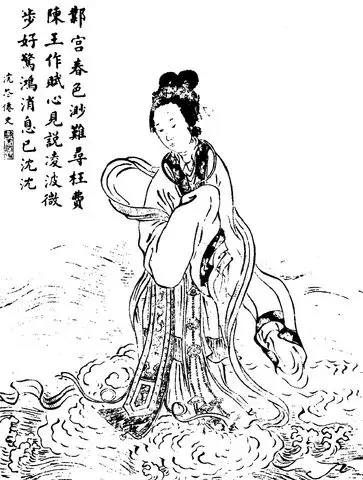
甄氏
Lady Zhen (甄氏, January 26, 183 – August 4, 221), posthumously revered in official dynastic history as Empress Wenzhao, was a native of Wuji in Zhongshan (present-day Wuji County, Shijiazhuang, Hebei). She was a descendant of Zhen Han, Grand Protector (Taibao) during the Western Han dynasty, and an eminent female political and cultural figure, poet, and exemplar of filial devotion during the late Eastern Han and Three Kingdoms…
Lady Zhen (甄氏, January 26, 183 – August 4, 221), posthumously revered in official dynastic history as Empress Wenzhao, was a native of Wuji in Zhongshan (present-day Wuji County, Shijiazhuang, Hebei). She was a descendant of Zhen Han, Grand Protector (Taibao) during the Western Han dynasty, and an eminent female political and cultural figure, poet, and exemplar of filial devotion during the late Eastern Han and Three Kingdoms (Cao Wei) periods. She was the first lawful wife of Cao Pi (Emperor Wen of Wei) and the biological mother of Cao Rui (Emperor Ming of Wei) and Princess Dongxiang. Born into an illustrious two-thousand-bushel administrative lineage whose father Zhen Yi served as Magistrate of Shangcai, Lady Zhen displayed precocious intellect and peerless beauty from childhood. The famed physiognomist Liu Liang marveled at her appearance, prophesying that she would attain inestimable nobility. Deeply devoted to historical texts to learn from past wisdom, she earned the moniker of the "chamber scholar." During the devastating famine of the late Han collapse, she persuaded her mother to open the family granaries to feed starving neighbors, and treated her deceased elder brother's widowed wife and orphan with selfless devotion. In the early Jian'an era, Yuan Shao, the supreme warlord of northern China, arranged for his second son Yuan Xi to marry Lady Zhen. When Yuan Xi was appointed Inspector of Youzhou in 199, Lady Zhen remained at the regional headquarters in Ye to serve her mother-in-law, Lady Liu. In the autumn of 204 (Jian'an 9), when Cao Cao and his son Cao Pi conquered Ye, Cao Pi rushed into the Yuan mansion, was captivated by her transcendent beauty, and married her as his principal wife. For over a decade, Lady Zhen enjoyed exclusive imperial favor, giving birth to Cao Rui and Princess Dongxiang. Within the inner court, she exemplified filial piety in attending Empress Dowager Bian, who repeatedly lauded her as a true filial daughter-in-law. Free from jealousy, Lady Zhen actively urged Cao Pi to take additional consorts to ensure the dynastic succession and knelt to plead for disgraced concubines, earning universal veneration across the Cao Wei realm. However, after Cao Pi ascended the throne as Emperor Wen and relocated the capital south to Luoyang, Lady Zhen, afflicted by illness, remained behind in the old palace at Ye and gradually fell out of imperial favor. New favorites, including Guo Nuwang (Empress Wende) and Consorts Li and Yin, monopolized the emperor's attention. Grieved by her abandonment, Lady Zhen occasionally expressed sorrow in verse (traditionally credited with the renowned yuefu poem Tangs hang Xing). Taking advantage of her isolation, Consort Guo and her faction concocted malicious slanders, accusing Lady Zhen of harboring treasonous resentment and practicing witchcraft. In the sixth month of 221 (Huangchu 2), an enraged Cao Pi dispatched an envoy bearing imperial seals to Ye, forcing Lady Zhen to commit suicide; her corpse was subjected to the indignity of having her hair draped over her face and her mouth stuffed with grain husks. Following Cao Pi's demise, Emperor Ming (Cao Rui) ascended the throne, completely rehabilitated his mother's memory, posthumously elevated her as Empress Wenzhao, reinterred her at Chaoyang Mausoleum, and enfeoffed her kinsmen with ducal and marquis titles. Her peerless beauty and tragic demise were immortalized in Cao Zhi's masterpiece Rhapsody on the Goddess of the Luo River (Luoshen Fu), elevating her into an eternal symbol of transcendent grace and sorrow in Chinese civilization.
Born in Wuji, Zhongshan; miraculous jade robes seen over her bed; physiognomist Liu Liang predicted supreme nobility.
Lost her father Zhen Yi at age three, mourning with the sorrow of an adult, displaying extraordinary sensitivity.
Devoted herself to historical classics at age nine to learn moral lessons from the past, earning the title of chamber scholar.
Convinced her family to distribute grain reserves to starving neighbors, nurturing her widowed sister-in-law and orphan nephew.
Wedded to Yuan Shao's second son Yuan Xi; remained in Ye to serve her mother-in-law Lady Liu while Yuan Xi governed Youzhou.
Cao Cao's forces captured Ye; Cao Pi was captivated by her beauty and married her, inaugurating over a decade of devotion.
Bore Cao Pi his eldest son Cao Rui (future Emperor Ming of Wei), followed by the birth of Princess Dongxiang.
Wept day and night in Ye when Lady Bian fell ill at Mengjin during campaigns; Lady Bian praised her as a true filial daughter-in-law.
Radiated serenity when reunited with family after illness; pleaded on her knees to save disgraced concubine Lady Ren.
Cao Pi proclaimed himself emperor and moved to Luoyang; Lady Zhen remained ill in Ye, gradually losing imperial favor.
Slandered by Consort Guo over sorrowful poems; forced by Cao Pi's decree to commit suicide at Ye, aged thirty-nine.
Cao Rui ascended the throne, wept bitterly for his mother, posthumously honored her as Empress Wenzhao, and enfeoffed her clan.
Reinterred with imperial majesty at Chaoyang Mausoleum, establishing ancestral temples to clear her historical name.
Lady Zhen was born on the Dingyou day of the twelfth lunar month in the fifth year of Guanghe (January 26, 183) in Wuji County, Zhongshan State, Jizhou (present-day Wuji County, Shijiazhuang, Hebei). The Zhongshan Zhen clan was one of the most prominent noble families in the two Han dynasties, descending directly from Zhen Han, who served as Grand Protector and Grand Minister of Works during the reigns of Emperors Cheng and Ai of Western Han. For generations, her ancestors held high ministerial and two-thousand-bushel commandery governorships.
Her father, Zhen Yi, served as Magistrate of Shangcai in Runan Commandery, while her mother, Lady Zhang, hailed from an eminent family in Changshan. Zhen Yi and Lady Zhang had three sons and five daughters, with Lady Zhen being the youngest daughter. Family traditions recorded that during her infancy, whenever she slept at night, attendants and her mother frequently saw an ethereal jade garment draped gently across her body, shining with pristine radiance, an omen that filled the household with wonder.
When Lady Zhen was barely three years old, her father passed away. Though an infant, Lady Zhen wept inconsolably before the funeral bier, expressing a depth of mourning comparable to an adult, astonishing all who witnessed it. Shortly thereafter, the celebrated physiognomist Liu Liang was invited to examine the fortunes of the Zhen children. Examining Lady Zhen, Liu Liang gasped in awe and declared: "This young lady possesses an extraordinary countenance; in the future, her nobility will be beyond all earthly measure!"
From childhood, Lady Zhen avoided frivolity. When she was eight years old, acrobats and trick riders performed outside the courtyard gate. Her mother, brothers, and four elder sisters climbed the observation terrace to watch and applaud, yet eight-year-old Lady Zhen remained seated calmly in her room. When her sisters reproached her for not joining them, she calmly replied: "Are dangerous horse games and spectacles proper things for a well-bred maiden to view?"
At age nine, she developed an intense love for scholarship. Possessing an eidetic memory, she comprehended the profound meanings of classical treatises at first glance. She frequently borrowed her brothers' writing brushes and inkstones to practice calligraphy and study historical texts. Her brothers teasingly told her: "A woman should dedicate herself to needlework and weaving. What use is literary study? Do you intend to become a female court erudite?" Lady Zhen solemnly answered: "Throughout history, virtuous women invariably studied the successes and failures of past dynasties to discipline their own conduct. If a woman does not read, upon what foundation can she examine herself?" Her reputation as a chamber erudite spread across Hebei.
During the Chuping and Xingping eras of Emperor Xian, central and northern China were ravaged by relentless warfare among regional warlords, aggravated by catastrophic droughts and locust plagues. Millions of starving commoners sold their family heirlooms, gold, and jade ornaments at negligible prices simply to purchase a few pints of grain to survive.
Holding vast arable estates, the Zhen family stored hundreds of thousands of bushels of grain in their warehouses. Taking advantage of the crisis, her kinsmen purchased enormous quantities of gold, silver, and precious jewels from desperate peasants in exchange for minimal amounts of grain, amassing immense material wealth.
Observing this, fourteen-year-old Lady Zhen cautioned her mother: "The Han dynasty is disintegrating, and the world is engulfed in civil war. In times of chaos, hoarding precious gems is a perilous path. As the ancients observed, a commoner incurs guilt by harboring jade; this is what is called bringing disaster upon oneself through wealth! Today, the populace is starving. Rather than amassing treasure, our family should open our granaries to distribute grain unconditionally to the starving neighbors. Relieving the misery of the multitude accumulates immense virtue and wins the devotion of the people, which is the only true way to safeguard our clan." Her mother and brothers embraced her counsel, opening the granaries to feed starving families throughout the county. When peasant uprisings and bandits swept Hebei, the Zhen clan was protected by local inhabitants on account of their benevolence.
Around this time, her second elder brother Zhen Yan passed away prematurely from illness after serving as a Gentleman of the Imperial Secretariat and Magistrate of Quliang. He left behind a young widow and an infant son. Lady Zhen's mother was stern and imposed demanding domestic standards upon her daughter-in-law. Witnessing her young sister-in-law weeping while nursing the orphan, Lady Zhen knelt before her mother, pleading with tears: "My second brother died young, leaving his widow to preserve the family line. Though she is a daughter-in-law, my mother should cherish and love her as your own daughter!" Moved to tears, Lady Zhang softened her discipline. Lady Zhen shared daily life with her widowed sister-in-law, managing domestic affairs and caring for her nephew, becoming a celebrated model of familial harmony.
During the early Jian'an era, Yuan Shao ruled as the preeminent warlord of northern China, controlling Jizhou, Qingzhou, Youzhou, and Bingzhou. Hearing of Lady Zhen's peerless beauty and moral virtue, Yuan Shao dispatched matchmakers to propose a formal alliance, marrying Lady Zhen to his second son, Yuan Xi.
In 199 (Jian'an 4), Yuan Shao annihilated Gongsun Zan at the Battle of Yijing, securing Youzhou. Yuan Shao appointed Yuan Xi as Inspector of Youzhou to govern the northern frontier. Because Youzhou bordered hostile nomadic tribes and Yuan Shao's main headquarters was located at the grand fortress-city of Ye (present-day Linzhang, Hebei), Lady Zhen remained in Ye to care for her mother-in-law, Lady Liu.
During her years in Ye, Lady Zhen served Lady Liu with filial devotion, maintaining domestic order while civil war shifted northern balances. In 200, Cao Cao crushed Yuan Shao at the Battle of Guandu. Yuan Shao died of illness in 202, and his sons Yuan Tan and Yuan Shang engaged in suicidal fratricidal conflict, paving the way for Cao Cao's final northern campaign.
In the eighth month of 204 (Jian'an 9), after an arduous siege, Cao Cao's forces breached the defensive perimeter and captured Ye.
Upon entering the city, Cao Cao's eighteen-year-old eldest surviving son, Cao Pi (then General of the Five Offices), galloped into Yuan Shao's grand mansion. Sword in hand, Cao Pi strode into the inner chambers to discover Yuan Shao's wife, Lady Liu, and a young woman embracing in terror, weeping beside the couch. The young woman's hair was disheveled, completely veiling her face as she buried her head in Lady Liu's bosom.
Cao Pi demanded: "Who is that weeping woman?" Lady Liu trembling replied: "She is the wife of Yuan Xi, Lady Zhen." Cao Pi stepped forward, ordering attendants to gently lift her tresses. When Lady Zhen raised her tear-stained face, Cao Pi was spellbound by her beauty: her skin was like polished jade, her eyes like autumnal pools, radiating a celestial dignity that eclipsed all earthly comparison. Cao Pi sheathed his sword and assured Lady Liu: "Do not be afraid, madam; I shall ensure that your household comes to no harm!"
Shortly thereafter, Cao Cao arrived. Observing Lady Zhen beside Cao Pi, Cao Cao stroked his beard and remarked with admiration: "Truly, she is the ideal wife for my son!" With Cao Cao's official consent, Cao Pi married twenty-one-year-old Lady Zhen as his principal consort.
Following their marriage, Cao Pi was devoted to Lady Zhen. In 205 (Jian'an 10), she gave birth to Cao Rui (the future Emperor Ming of Wei), followed by the birth of Princess Dongxiang. Cao Cao adored infant Cao Rui, keeping him by his side and exclaiming that this grandson would preserve the Cao family foundation for three generations. Blessed with an heir and captivating grace, Lady Zhen enjoyed more than a decade of exclusive devotion in the Cao Wei household.
Lady Zhen won the profound respect of the Cao clan through her exemplary moral conduct, particularly her filial devotion toward her mother-in-law, Empress Dowager Bian (Empress Wuxuan).
In 211 (Jian'an 16), Cao Cao led an expedition west to subjugate warlords Ma Chao and Han Sui in Guanzhong. Lady Bian accompanied the campaign, but upon reaching Mengjin on the Yellow River, she fell gravely ill and remained behind in military encampments. Lady Zhen remained at the base in Ye. Anxious over her mother-in-law's condition, Lady Zhen wept continuously day and night. Whenever military dispatch couriers arrived from the western front, Lady Zhen personally questioned them behind a silk screen, weeping bitterly. Seeing her growing thin, attendants attempted to comfort her by falsely claiming that Lady Bian had fully recovered. Lady Zhen shook her head: "The Empress Dowager has long suffered from chronic ailments, and traveling through wilderness has exacerbated them. How could she recover so quickly? You speak only to console me; how can I rest easy?"
Only when Lady Bian's personal letter arrived confirming her recovery did Lady Zhen's anxieties ease. In the first month of 212, when the army returned to Ye, Lady Zhen rushed to the palace gates, collapsed to her knees, and wept tears of relief. Seeing Lady Zhen emaciated from grief, Lady Bian broke into tears, embraced her, and sighed: "My daughter-in-law thought my illness was severe, and upon hearing of my distress, she worried herself to this extent! Truly, she is a daughter-in-law of pure filial devotion!"
In the winter of 216 (Jian'an 21), Cao Cao launched a southern offensive against Sun Quan, accompanied by Lady Bian, Cao Pi, young Cao Rui, and Princess Dongxiang. Lady Zhen was unable to accompany them due to illness, remaining behind in Ye for nearly a year. When the imperial family returned in 217, Lady Bian noticed that Lady Zhen appeared refreshed and radiant. Astonished, Lady Bian asked: "You have been separated from your young children for an entire year; did you not worry about them? Why do you look so healthy?" Lady Zhen bowed serenely: "My children were in the care of the Empress Dowager, who nurtures them with ten times more maternal love than I could provide. With complete peace of mind, why would I harbor anxiety?" Lady Bian was deeply touched by her noble trust.
Lady Zhen also practiced extraordinary magnanimity within the inner court. She never monopolized Cao Pi's affections, repeatedly advising him to select virtuous concubines from distinguished lineages to ensure abundant offspring. When Cao Pi was enraged by his outspoken concubine Lady Ren and ordered her expelled, Lady Zhen knelt before him, pleading with tears: "Lady Ren hails from an honorable lineage, possessing beauty and virtue superior to mine. If you banish her over a minor fault, people will accuse me of jealousy and blame Your Lordship for discarding former affections. I beg you to reconsider!" Though Cao Pi remained stubborn, the entire household revered Lady Zhen's lack of jealousy.
The elevation of political power transformed intimate bonds into tragedy.
In the first month of 220 (Jian'an 25), King Wu of Wei, Cao Cao, passed away in Luoyang. Cao Pi inherited the royal title in Ye, and in the tenth month of that year, he forced Emperor Xian of Han to abdicate, founding the Cao Wei dynasty and adopting the era name Huangchu.
Following his enthronement, Cao Pi moved the imperial court south to Luoyang. However, Lady Zhen, hindered by persistent illness, remained behind in the old palace at Ye.
Physical separation and court politics swiftly eroded their marriage. In Luoyang, Emperor Wen was surrounded by younger concubines skilled in political manipulation, preeminently Guo Nuwang (Empress Wende), as well as Consorts Li and Yin. Furthermore, the deposed Emperor Xian presented his two daughters to Cao Pi's inner court.
Isolated in the quiet halls of Ye, Lady Zhen watched her youth fade amid chronic illness, neglected by the sovereign she had supported for two decades. In deep sorrow, she composed elegiac verses. Among them, the celebrated yuefu poem Tang shang Xing (Song on the Pond Bank) captures her heartache: "Duckweed grows in my pond, its leaves flourishing... People's slanders can melt gold, causing my lord to part from me... Do not, because of new noble companions, cast aside what you once loved; do not, because fish and meat are cheap, discard scallions and leeks..." Her verses voiced the timeless anguish of an abandoned wife mourning the betrayal of affection.
Spies reporting to Luoyang conveyed distorted versions of Lady Zhen's poems, framing her sorrow as treasonous defiance. With the position of empress still vacant, Consort Guo and her faction resolved to eliminate Lady Zhen to secure the imperial crown.
Consort Guo relentlessly whispered poisonous slanders into Cao Pi's ears, twisting Lady Zhen's poetry into an attack on imperial majesty and fabricating charges of witchcraft. Overcome by insecurity, arrogance, and paranoia, Cao Pi forgot twenty years of marital devotion, viewing her complaints as an intolerable challenge to his autocratic authority.
On the Dingmao day of the sixth lunar month in 221 (Huangchu 2), Cao Pi dispatched an imperial envoy carrying vermilion decrees to Ye, commanding Lady Zhen to commit suicide by poison immediately.
Confronting the death decree, Lady Zhen drank the poison in anguish. To prevent her spirit from seeking divine vengeance, executioners enacted a horrifying occult defilement: they unraveled her hair, draping it over her face (bei fa fu mian), and stuffed her mouth with coarse grain husks (yi kang sai kou) before hastily nailing her coffin shut. The most cultured and virtuous woman of the age was martyred at thirty-nine.
In 222, Cao Pi enthroned Consort Guo as empress over ministerial objections. Yet the hidden tragedy awaited retribution.
In the fifth month of 226, Cao Pi died suddenly at forty. Lady Zhen's eldest son, Cao Rui, ascended the throne as Emperor Ming.
Having endured the trauma of his mother's horrific execution at seventeen, Cao Rui immediately launched the restoration of her name. He posthumously elevated her as Empress Wenzhao. In the eleventh month of 230 (Taihe 4), Cao Rui dispatched high ministers to Ye to exhume her coffin, reinterring her with supreme imperial rites at Chaoyang Mausoleum.
During the funeral, Emperor Ming removed his imperial robes, donned coarse hemp mourning garments, and walked barefoot through the falling snow beside his mother's hearse. Weeping inconsolably before her coffin, his lamentations echoed across the hills, moving the entire court to tears. Emperor Ming erected an imperial ancestral shrine at the tomb and placed her spirit tablet in the imperial ancestral temple.
Emperor Ming showered her maternal clan with extraordinary honors, posthumously enfeoffing her father Zhen Yi as Marquis of Anzuocheng with ten thousand households, and granting marquis and ducal titles to more than ten members of the Zhen lineage.
In literature, Lady Zhen attained eternal apotheosis. In 222, Cao Pi's younger brother, the poet Cao Zhi, passed the Luo River and composed the immortal Rhapsody on the Goddess of the Luo River (Luoshen Fu). Later commentators (such as Li Shan) noted that the rhapsody was originally titled Gan Zhen Fu (Rhapsody Moved by Lady Zhen), expressing boundless grief over her beauty and untimely death: "Soaring gracefully like a startled swan, supple like a swimming dragon. Luminous as an autumn chrysanthemum, luxuriant as a spring pine. Dimly veiled like the moon shrouded in light clouds, floating freely like snow whirled by drifting wind..." Transcending dynastic dust, Lady Zhen became the supreme cultural archetype of celestial elegance and tragic female virtue in Chinese civilization.
Born into the aristocratic Zhen lineage in Zhongshan, prophesied by physiognomist Liu Liang to attain inestimable nobility.
Refused trivial entertainment and embraced historical texts at age nine, establishing the ideal of the chamber scholar.
Convinced her family to distribute their grain reserves to starving peasants during late Han famines, preserving lives and clan integrity.
Wedded to Cao Pi after the capture of Ye in 204, enjoying exclusive favor for over a decade.
Bore Cao Rui (Emperor Ming of Wei) and Princess Dongxiang, securing the dynastic continuity of the house of Cao.
Demonstrated deep filial devotion toward Empress Dowager Bian, twice earning commendation as a true filial daughter-in-law.
Maintained absolute lack of jealousy, urging the sovereign to recruit talented consorts and pleading for disgraced concubines.
Composed renowned yuefu poetry including Tang shang Xing, articulating the emotional depth of the neglected consort.
Falsely accused of treason and witchcraft, forced to commit suicide in 221 with her hair draped and mouth stuffed with chaff.
Vindicated by Emperor Ming in 226, posthumously honored as Empress Wenzhao and reinterred at Chaoyang Mausoleum with supreme honors.
Immortalized through Cao Zhi's Luoshen Fu, becoming the ultimate cultural embodiment of female beauty and divine grace in Chinese history.
FIGURES ASSOCIATED WITH THIS DYNASTY