Birth in Shaoxing
Born in Kuaiji into a declining merchant family, demonstrating extraordinary intellectual brilliance.
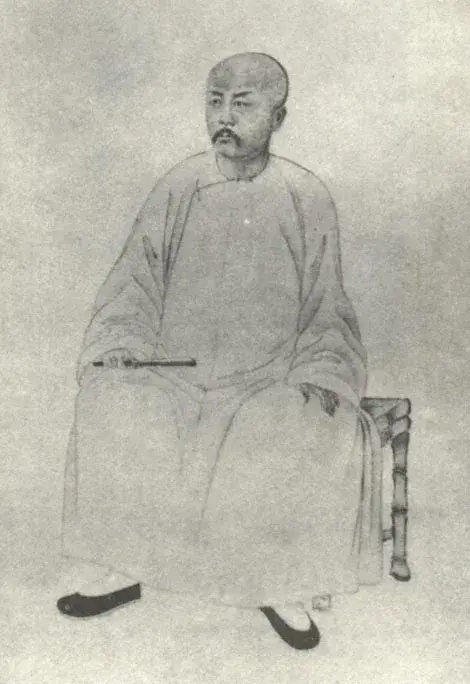
赵之谦
Zhao Zhiqian (1829–1884), courtesy names Yifu and Weishu, art names Lengjun, Bei'an, Mei'an, and Wumen, studio names Erjindietang and Yangshi Qianqibaiershijiu Hezhai, native of Kuaiji (modern Shaoxing, Zhejiang), was an extraordinary calligrapher, painter, seal engraver, and epigraphic scholar of the late Qing dynasty. A polymath who excelled in poetry, calligraphy, painting, and seal carving, he held towering prestige in…
Zhao Zhiqian (1829–1884), courtesy names Yifu and Weishu, art names Lengjun, Bei'an, Mei'an, and Wumen, studio names Erjindietang and Yangshi Qianqibaiershijiu Hezhai, native of Kuaiji (modern Shaoxing, Zhejiang), was an extraordinary calligrapher, painter, seal engraver, and epigraphic scholar of the late Qing dynasty. A polymath who excelled in poetry, calligraphy, painting, and seal carving, he held towering prestige in late imperial cultural circles, revered as the synthesizing giant of late Qing epigraphic art and the foundational pioneer of the Shanghai School of Painting (Haipai). Precocious in classical letters and Yan Zhenqing's regular script, Zhao passed the Zhejiang provincial civil service examinations in 1859 as a Provincial Graduate. During the subsequent Taiping campaigns in eastern Zhejiang, his wife and daughter perished amid wartime flight, a trauma that led him to adopt the sobriquet "Bei'an" (Grief Hermit). Seeking refuge in Wenzhou and Fuzhou, he studied Bao Shichen's Yizhou Shuangji, decisively shifting his artistic foundation from classical model-book (tiexue) traditions to Northern Wei stele inscriptions (beixue). In Beijing during the Tongzhi era, he collaborated with epigraphers such as Hu Shu, Shen Yunchu, and Wei Xizeng, compiling the Erjindietang Seal Book and assimilating ancient scripts from Qin-Han coins, mirrors, tiles, and steles. After four unsuccessful attempts at the metropolitan examinations, Zhao abandoned examination life in 1871, accepting appointments as county magistrate in Jiangxi—successively governing Poyang, Fengxin, and Nancheng. In office, he reformed corrupt practices, constructed river dikes, and edited the Jiangxi Provincial Gazetteer, while observing an absolute vow never to carve seals again. He died in office in Nancheng in 1884 at the age of fifty-five. Zhao's calligraphy integrated Northern Wei monumental vigor into running and cursive hands, establishing the famed "Northern Wei bone with Yan Zhenqing flesh." His painting synthesized Yun Shouping's boneless floral technique with the expressive freedom of the Yangzhou Eccentrics, creating a radiant, dense palette infused with epigraphic brushwork. His seals pioneered the use of relief side-inscriptions and diverse archaeological scripts, profoundly influencing generations of modern masters including Wu Changshuo, Qi Baishi, and Huang Mufu. Modern master Pan Tianshou lauded him as having "opened the very vanguard of the Shanghai School."
Born in Kuaiji into a declining merchant family, demonstrating extraordinary intellectual brilliance.
Passed county examination as Licentiate, copying regular script of Yan Zhenqing daily.
Passed provincial civil examination in Zhejiang as 35th Provincial Graduate.
Taiping forces sacked Shaoxing; his wife and daughter perished in flight; escaped to Wenzhou and Fuzhou.
Grief-stricken by family deaths, adopted art name Bei'an; published Erjindietang Seal Book in Fuzhou.
Failed metropolitan examinations in Beijing; associated with Hu Shu, Shen Yunchu, and Wei Xizeng.
Relinquished imperial examinations after four failures; assigned as expectant magistrate to Jiangxi.
Served as acting magistrate of Poyang County, reforming regional taxation and grain storage.
Appointed magistrate of Fengxin, constructing river dikes and pacifying local litigations.
Commissioned by Governor Li Wenmin to direct compilation of the Jiangxi Gazetteer.
Transferred as magistrate of Nancheng, died of acute exhaustion in the official yamen during defense preparations.
Zhao Zhiqian was born on August 8, 1829 (the ninth day of the seventh lunar month in the ninth year of the Daoguang reign) in Kuaiji County, Shaoxing Prefecture, Zhejiang. His father was a merchant whose fortunes steadily deteriorated, plunging the household into poverty. Precocious and endowed with an extraordinary memory, Zhao mastered classical literature and poetry in boyhood. Before the age of twenty, he devoted himself to the regular script of Tang dynasty master Yan Zhenqing, transcribing five hundred characters daily from the Family Temple Stele, cultivating a monumental calligraphic structure.
In his twenties, Zhao supported his family by operating private village schools, ghostwriting, and painting fans. During this period, he associated with regional painters such as Ren Xiong and Ding Wenwei, copying ancient paintings and exploring seal engraving. While the Zhe School of the Xiling Eight Masters dominated contemporary seal cutting, Zhao initially imitated Chen Mansheng before integrating the dynamic brushwork of Deng Shiru's Wan School.
In 1855, Zhao passed the preliminary examinations as a Licentiate, and in 1859 (the ninth year of the Xianfeng reign), at age thirty-one, he passed the Zhejiang provincial civil service examination as a Provincial Graduate. Examiners praised his profound statecraft essays, and regional literati anticipated a brilliant ascent at the metropolitan examinations in Beijing. However, the cataclysm of the Taiping Rebellion disrupted his career.
In the spring of 1860, Taiping general Li Xiucheng broke through the Great Camp of Jiangnan, capturing Hangzhou, Shaoxing, and Ningbo. Zhao fled with his kin amid chaotic fighting. His wife Fan Daochun and infant daughter succumbed to starvation and disease during their flight. Overwhelmed by grief, Zhao contemplated suicide, taking the tragic sobriquet "Bei'an" (Grief Hermit) and carving seal legends such as "Gazing into the Horizon, Where Are My Loved Ones?"
Exiled in Wenzhou and Ru'an along the southern Zhejiang coast, Zhao observed exotic marine fauna and coastal vegetation, painting his celebrated scrolls Unusual Fish and Flora and Fauna of Ou, radically expanding the subject matter of Chinese literati painting.
During his exile in Wenzhou, Zhao studied Bao Shichen's monumental treatise Yizhou Shuangji, which profoundly reshaped his artistic worldview. Perceiving that centuries of model-book (tiexue) imitation had degenerated into mannerism, Zhao abandoned traditional two-Wang orthodoxy to immerse himself in the rugged, monumental epigraphy of the Northern Dynasties and Han steles.
In 1862 (the first year of the Tongzhi reign), invited by his friend Fu Jiezi, Zhao sailed to Fuzhou. There he met his greatest epigraphic confidant, Wei Xizeng (courtesy name Jiasun). Wei recognized Zhao's extraordinary genius and urged him to channel his full energies into seal engraving and epigraphy, proposing to compile and print Zhao's works in the Erjindietang Seal Book.
In 1863, Zhao journeyed to Beijing to sit for the metropolitan examinations. Though he failed to place on the examination rosters, he embarked on a decade of intense epigraphic research in the cultural district of Liulichang. Collaborating daily with scholars Hu Shu, Shen Yunchu, and grand collector Pan Zuyin (later Minister of Works), Zhao examined thousands of Shang-Zhou bronze rubbings, Han steles, and Northern Dynasties stone inscriptions.
Between his thirty-fourth and thirty-sixth years, Zhao experienced an unmatched creative explosion in seal engraving. Spurred by Wei Xizeng, he carved more than two hundred masterworks for himself, Wei, Hu Shu, Shen Yunchu, and Pan Zuyin. He transcended the narrow conventions of Han bronze seals, incorporating scripts from Warring States coins, Han mirrors, Qin imperial edict weights, clay seals, and Six Dynasties cave steles into his seal compositions. Moreover, he revolutionized the art of seal side-inscriptions by carving them in relief with Northern Wei script, turning the Erjindietang Seal Book into a foundational monument of modern epigraphy.
In calligraphy, studying the Northern Wei Zheng Wengong Stele, Zhao developed a proprietary "rolling-brush" (juanfeng) technique that transitioned side-brush square momentum into centered brushwork, solving the ancient difficulty of executing fluid running and cursive scripts with angular stele strokes. His running script, known as "Northern Wei bone with Yan Zhenqing flesh," combined monumental weight with scholarly grace, captivating elite grandees such as Pan Zuyin.
In official advancement, Zhao endured persistent misfortune. In 1863, 1865, 1868, and 1871, he sat four times for the metropolitan examinations, failing on each occasion because his robust, unorthodox calligraphy defied the effeminate symmetry demanded by the imperial palace examination standard (Guangeti). Realizing the futility of continued examination attempts at age forty-two, Zhao sought direct administrative appointment.
In 1871 (the tenth year of the Tongzhi reign), having served as a copyist in the State Historiography Institute, Zhao received an imperial qualification assigning him to Jiangxi as an expectant county magistrate. On the eve of his departure, Zhao announced a startling decision: a magistrate's duty was to devote every heartbeat to public welfare rather than artistic leisure, swearing an oath never to carve seals again. Throughout his remaining thirteen years in Jiangxi, except for a single seal carved as a rare favor for his patron Pan Zuyin, Zhao honored his vow, laying aside the carving knife during his peak artistic maturity.
Arriving in Nanchang in 1872, Zhao served on the secretarial staff of the Governor of Jiangxi before receiving magisterial postings in Poyang, Fengxin, and Nancheng from 1877 onward. Discarding literati aloofness, Zhao established a reputation as an incorruptible, proactive administrator.
In Poyang, he suppressed predatory yamen runners and overhauled corrupt granary collections. In Fengxin, he restored Confucian academies, constructed hundreds of yards of flood embankments that irrigated tens of thousands of mu of farmland, and released emergency grain reserves during drought. In 1881, commissioned by Governor Li Wenmin, he directed the comprehensive revision of the eighty-volume Jiangxi Provincial Gazetteer, applying rigorous philological standards to historical geography.
In 1884, following the outbreak of the Sino-French War, Zhao was transferred as Magistrate of Nancheng, tasked with organizing local militias and provisioning coastal defensive armies. Months of relentless administrative labor shattered his health. On November 18, 1884 (the first day of the tenth lunar month in the tenth year of the Guangxu reign), Zhao died of a sudden stroke in his official yamen at fifty-five. Leaving virtually no personal estate, his casket was transported back to Shaoxing through donations from provincial colleagues and devoted disciples.
While Ruan Yuan formulated the Northern and Southern School theory and Bao Shichen championed Northern steles in Yizhou Shuangji, early practitioners such as Deng Shiru and Bao Shichen restricted stele techniques largely to regular and clerical scripts, reverting to Tang and Two-Wang models for running and cursive writing.
Zhao Zhiqian was the first master in Chinese history to systematically apply Northern Wei stele brushwork across all script types: regular, running, cursive, clerical, and seal. His regular script drew from Northern Wei steles such as Zheng Wengong, Shimen Ming, and Zhang Menglong, executing angular beginnings with flattened, architectural spacing, celebrated as "Northern Wei bone with Yan Zhenqing flesh." In seal script, he integrated Wei angularity into Deng Shiru's rounded forms.
His crowning innovation was the adaptation of stele brushwork to running script. Devising the "rolling-brush" method, he eliminated awkward transitions between square and rounded strokes, allowing the chiselled vigor of stone inscriptions to flow seamlessly across paper. His running script discarded late imperial effeminacy, exerting an immense shaping influence upon Kang Youwei, Liang Qichao, and twentieth-century modernists.
In seal and clerical scripts, Zhao displayed revolutionary originality. While acknowledging Deng Shiru's monumental revival of seal script, Zhao refused to be bound by Deng's framework. He synthesized Qin-Han small seal script with the archaic structural principles of Sun Xingyan and Qian Dian, while infusing the angular cuts of Northern Wei steles. His mature seal script achieved exceptional tension, flexibility, and architectural grace, establishing an independent school alongside Deng Shiru and Wu Rangzhi.
In clerical script, Zhao systematically studied dozens of Han monuments, including the Shimen Song and Fenglongshan Stele. Integrating the supple continuity of seal script with the brisk modulation of Han clerical carving, he developed a distinctive mode characterized by broad, asymmetrical balance and sweeping flaring strokes. He also pioneered double-hook tracing techniques, recording rare fragmentary stones in his ten-volume compendium and restoring lost inscriptions with painstaking fidelity.
In Chinese art history, Zhao Zhiqian served as the primary bridge linking classical literati painting to modern treaty-port art. During the Daoguang and Xianfeng eras, when bird-and-flower painting languished in repetitive imitation, Zhao merged the boneless color palettes of Yun Shouping with the vigorous expressive washes of Xu Wei and the Yangzhou Eccentrics.
Executing paintings with calligraphic force, Zhao applied pigment with unyielding density and saturated vibrancy without lapsing into vulgar commercialism. Furthermore, he radically expanded pictorial motifs. Wandering the southeastern coast during the Taiping wars, he painted marine species, tropical botanicals, and coastal flora in masterworks such as Unusual Fish and Flora of Ou. Master Pan Tianshou declared in History of Chinese Painting: "Zhao Zhiqian of Kuaiji painted flowers with the archaic vigor of epigraphy and calligraphy, grand and antique, opening the very vanguard of the Shanghai School." Giants such as Wu Changshuo, Qi Baishi, and Chen Shizeng were directly nurtured by his aesthetic.
Before Zhao Zhiqian, Ming and Qing seal engravers operated under the conservative rubric of "seeking seals within seals," endlessly imitating Han bronze seals or practicing the delicate slicing strokes of the Zhe School. Zhao boldly proposed "founding a new portal for seal carvers of the past six hundred years," establishing the modern principle of "seeking seals outside seals."
In the Erjindietang Seal Book, Zhao became the first carver to incorporate Warring States coin inscriptions, Han mirror inscriptions, clay seals, roof tiles, and Northern Dynasties stone stele carvings into seal design. In his white-script seals, he captured Han monumental dignity; in red-script seals, he harnessed the structural balance of archaic bronze scripts. In side-inscriptions, he made the breakthrough of cutting relief inscriptions in Northern Wei regular script. Though carving fewer than four hundred seals in his lifetime, his radical aesthetic directly inspired Huang Mufu's Yishan School, Wu Changshuo's Wu School, and Qi Baishi's single-knife technique.
Beyond artistic practice, Zhao was an accomplished evidential scholar. Accumulating rare rubbings and manuscripts in his studios, he published the thirty-eight-volume Hezhai Congshu, preserving numerous rare treatises on classics, history, and epigraphy.
His monographs, including Continuation to the Records of Han Learning Academics, Supplement to the Records of Visiting Steles in the Realm, and Idle Talks from Yonglu, demonstrated rigorous philological analysis of Six Dynasties variant characters and the archaeology of Chinese snuff bottles. In his final years, his editorial direction of the Jiangxi Provincial Gazetteer and the Nancheng County Gazetteer illustrated his consummate dedication to historical documentation.
FIGURES ASSOCIATED WITH THIS DYNASTY