Detailed Biography
Royal Lineage and Loyalist Reclusion
Zhao Youqin was born in 1279 in Poyang, Raozhou. As a direct twelfth-generation descendant of Song Emperor Taizong, he belonged to the imperial royal clan. His birth coincided with the tragic Battle of Yamen, which witnessed the final extinction of the Song dynasty. Raised under the traumatic shadow of dynastic fall, Zhao was imbued from childhood with profound loyalist grief and an unyielding commitment to eremitism.
In his youth, Zhao pursued extensive learning in astrological calendars, tactical geography, and esoteric calculations, harboring aspirations of heroic statecraft. However, under the Mongol Yuan hierarchy, Song imperial scions were subjected to strict surveillance and discrimination. While visiting a tavern in Zhishan, Jiangxi, Zhao met a senior adept of Shi Tai's Southern lineage of internal alchemy, who transmitted to him the Seven-Return Seven-Turn Alchemical Scripture (Qihuan Qifan Danshu). This encounter prompted him to abandon worldly ambition, vowing never to serve the Yuan dynasty and turning entirely toward the empirical investigation of nature.
Scientific Research at Jiming Mountain
Traveling through Zhejiang, Zhao settled at the foot of Jiming Mountain in Longyou County, Quzhou. He married into the wealthy Fan family, whose substantial resources funded his scientific instruments and laboratory facilities.
At Jiming Mountain, Zhao established a comprehensive astronomical observatory. He excavated deep square pits in the open ground, housing armillary spheres, simplified instruments, 100-foot gnomons, and bronze sighting tubes, maintaining unbroken celestial observations across decades.
Rejecting speculative scholasticism, Zhao formulated the radical empirical principle: "Never draw a conclusion without seeing it with one's own eyes and hearing it with one's own ears." Inside two interconnected multi-story chambers, he excavated two deep round wells, utilizing thousands of candles on tiered frames as light sources to conduct the earliest systematically controlled optical experiments in human history.
Coastal Seclusion and Scientific Masterpiece
In addition to physics, Zhao was an accomplished Daoist philosopher and cosmologist. He lived alone on a deserted island off the eastern coast for ten years, contemplating tidal rhythms and celestial movements, authoring tens of thousands of words in commentary on the Book of Changes (Zhouyi).
Returning to Longyou in his later years, Zhao synthesized his empirical observations, optical experiments, circle-cutting algorithms, and calendar calculations into his five-volume masterwork Gexiang Xinshu (New Treatise on Celestial Patterns). In 1341, Zhao passed away peacefully at his Longyou estate at the age of sixty-three and was buried beneath Jiming Mountain. His manuscript was preserved by his disciple Zhang Jun, prefaced by the great Ming scholar Song Lian, and celebrated across Chinese intellectual history.
Major Achievements
Controlled Camera Obscura Experiments and Photometric Laws
Zhao's crowning contribution to world physics is recorded in the "Light and Shadow Through Small Apertures" (Xiaoxia Guangjing) section of Gexiang Xinshu:
- Method of Controlled Variables: Utilizing two indoor light wells over ten feet deep as a camera obscura, adjustable apertures of varied geometries (square, circular, triangular), and tiered candle frames with up to a thousand candles, Zhao varied one parameter at a time—object distance, image distance, aperture diameter, hole shape, and light intensity.
- Law of Pinhole Image Formation: He established the definitive law: "A small image takes the shape of the light source, whereas a large image reflects the shape of the aperture." He proved that when the aperture is tiny, the projected image is an inverted image of the light source independent of aperture geometry; when the aperture is expanded, it produces a cast shadow of the opening. The Needham Research Institute acclaimed this as the most sophisticated experimental optics project of the thirteenth century.
- Lunar Illumination and Angular Optics: In "Half-Illumination of the Moon" (Yueti Banming), he employed suspended black-lacquered spheres illuminated by lateral light sources to model lunar phases, proving that the moon does not generate light but reflects solar rays, while formulating geometric perspective laws relating apparent size to distance.
Astronomical Innovations and Empirical Proof of the Spherical Earth
Zhao made breakthrough contributions to observational astronomy:
- Meridian Transit Observation: He pioneered the technique of recording the precise time difference of stars crossing the local celestial meridian to determine right ascension, anticipating modern transit circle techniques and reducing error from fifteen degrees to 0.1 degree.
- Improved Gnomon and Precise Solar Year: Utilizing a 100-foot gnomon with a pinhole shadow-definer (jingfu), he eliminated penumbral blur to determine the winter solstice within fifteen minutes, calculating the tropical year at 365.2425 days.
- Empirical Proof of a Spherical Earth: By measuring variations in the celestial pole's elevation across latitudes alongside regional time discrepancies during lunar eclipses, he empirically demonstrated that the Earth is a spherical body suspended in space.
Circle-Cutting Algorithm and Fourth-Order Interpolation
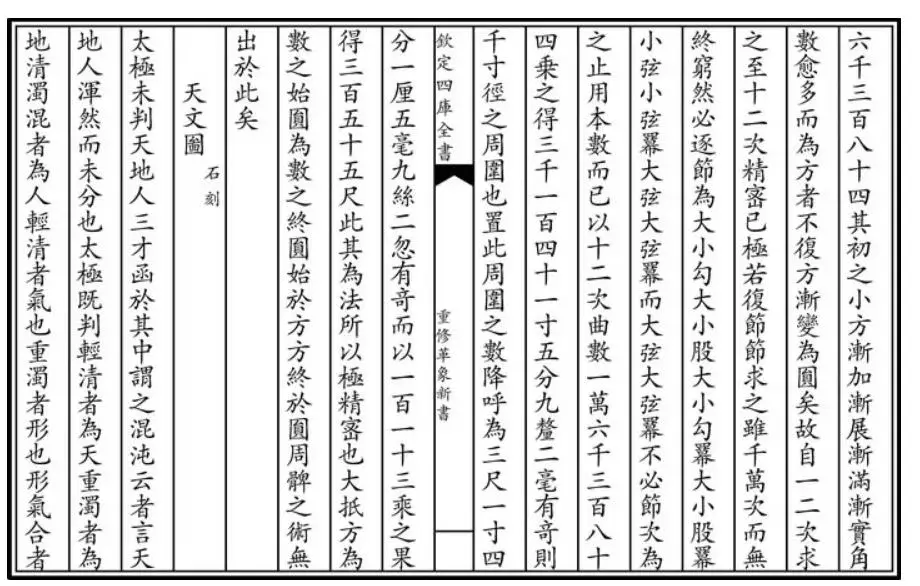
In mathematics, Zhao advanced the classical circle-cutting method (geyanshu) in the "Choubi of Celestial Patterns" chapter. Beginning with an inscribed square and doubling its sides ten consecutive times, he computed the side length of an inscribed polygon with 16,384 sides, determining pi to 3.141592. Furthermore, to compute irregular planetary movements, he developed a fourth-order finite-difference interpolation method.