Eminent Birth
Born in Luoyang as the fourth son of Zhao Hongyin, displaying keen intelligence and studious habits, originally named Zhao Kuangmei.
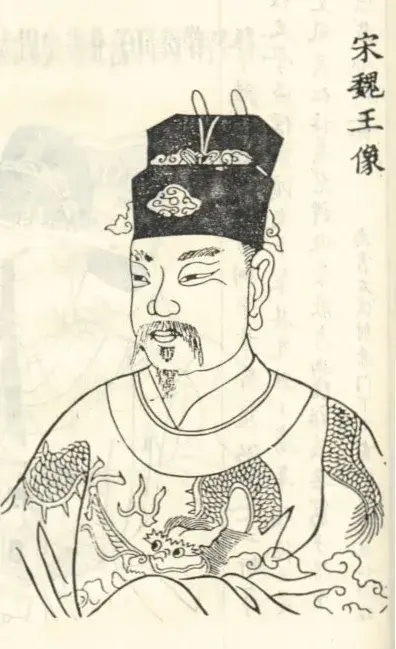
赵廷美
Zhao Tingmei (赵廷美, 947–984), courtesy name Wenhua, originally named Zhao Kuangmei and later renamed Zhao Guangmei and Zhao Tingmei to observe imperial naming taboos, was an ancestral native of Zhuo Commandery (modern Zhuozhou, Hebei Province) born in Luoyang. He was an eminent founding member of the Northern Song imperial house, the fourth son of Zhao Hongyin (Emperor Xuanzu), born to Empress Dowager Zhaoxian (née Du), and…
Zhao Tingmei (赵廷美, 947–984), courtesy name Wenhua, originally named Zhao Kuangmei and later renamed Zhao Guangmei and Zhao Tingmei to observe imperial naming taboos, was an ancestral native of Zhuo Commandery (modern Zhuozhou, Hebei Province) born in Luoyang. He was an eminent founding member of the Northern Song imperial house, the fourth son of Zhao Hongyin (Emperor Xuanzu), born to Empress Dowager Zhaoxian (née Du), and the youngest full brother of Emperor Taizu (Zhao Kuangyin) and Emperor Taizong (Zhao Jiong). Zhao Tingmei was celebrated for his generous nature, handsome bearing, administrative proficiency, and studious disposition. In 960, upon the founding of the Song dynasty, Zhao Tingmei was appointed Defense Commissioner of Jiazhou. In 973, he was made Honorary Grand Guardian and Palace Attendant, concurrently serving as Intendant of the Capital and Military Commissioner of Yongxing Army, governing the strategic northwestern territories around Chang'an. Following the ascension of Emperor Taizong, according to the legendary "Pledge of the Golden Coffer" establishing fraternal succession, Zhao Tingmei assumed a prominent status as heir presumptive. He was appointed Prefect of Kaifeng and concurrent Secretariat Director, ennobled as Prince of Qi, and granted the rank of Honorary Grand Preceptor. In 979, he took part in the Northern Han expedition, conquering Taiyuan and advancing to Prince of Qin, ranking above Taizu's sons Zhao Dezhao and Zhao Defang. However, as Emperor Taizong consolidated his autocratic rule and sought to pass the throne to his own progeny, Zhao Tingmei fell prey to intense imperial suspicion orchestrated by elder grand councilor Zhao Pu. In 982, Zhao Pu accused Tingmei of seditious conspiracy; Taizong dismissed him from the Kaifeng prefecture and exiled him to Luoyang. Shortly thereafter, surveillance agents alleged covert communications between Tingmei and Grand Councilor Lu Duoxun. Tingmei was stripped of all offices, demoted to Duke of Fuling County, and placed under strict confinement in remote Fangzhou (modern Fang County, Hubei). In 984, Zhao Tingmei succumbed to grief and illness at thirty-eight. After Emperor Zhenzong ascended the throne, he fully exonerated his late uncle, posthumously creating him Prince of Wei with the posthumous title Dao.
Born in Luoyang as the fourth son of Zhao Hongyin, displaying keen intelligence and studious habits, originally named Zhao Kuangmei.
Renamed Zhao Guangmei to observe Taizu's taboo, appointed Defense Commissioner of Jiazhou, serving in palace defense guards.
Appointed Honorary Grand Guardian, Palace Attendant, Intendant of the Capital, and Military Commissioner of Yongxing Army.
Renamed Zhao Tingmei following Taizong's accession, appointed Prefect of Kaifeng and Secretariat Director, ennobled as Prince of Qi.
Accompanied the campaign conquering Northern Han at Taiyuan; advanced to Prince of Qin, ranking first among imperial princes.
Accused of treason by Zhao Pu, dismissed to Luoyang, and subsequently reduced to Duke of Fuling County and exiled to Fangzhou.
Died of grief and illness in exile at thirty-eight; Emperor Taizong expressed public sorrow and mourning.
Emperor Zhenzong restored his honors, granting the posthumous rank of Prince of Wei and the posthumous name Dao.
Zhao Tingmei was born in 947 in Luoyang. His father, Zhao Hongyin, was an eminent palace guard commander under the Later Zhou dynasty, and his mother was Empress Dowager Zhaoxian (née Du). He was the fourth surviving son of Zhao Hongyin, originally named Zhao Kuangmei.
In 960, his eldest brother Zhao Kuangyin launched the Chenqiao Mutiny and founded the Song dynasty. To avoid using the emperor's personal name, Kuangmei took the name Zhao Guangmei and was commissioned Defense Commissioner of Jiazhou. From his youth, he earned praise for his striking poise, acute judgment, and scholarly devotion, often serving alongside Emperor Taizu in palace guard security.
In 973, in an effort to pacify the strategic Guanzhong region, Emperor Taizu appointed Zhao Guangmei Honorary Grand Guardian and Palace Attendant, designating him Intendant of the Capital and Military Commissioner of Yongxing Army. Stationed in Chang'an, he repaired water conservancy projects, settled disputes with equanimity, and established civil order across Shaanxi. During the southern campaign against the Southern Tang in 975, Zhao Guangmei supervised logistics along the Bian River and received the deposed Southern Tang ruler Li Yu, impressing surrendered officials with his dignified demeanor.
In the tenth month of 976, Emperor Taizu died suddenly, and his third brother Zhao Kuangyi ascended the throne as Emperor Taizong. Zhao Guangmei was renamed Zhao Tingmei to observe the new imperial name.
During the opening phase of Taizong's reign, rumors circulated concerning the "Pledge of the Golden Coffer," purportedly dictated on Empress Dowager Du's deathbed, prescribing that the crown pass from Taizu to Taizong, then from Taizong to Tingmei, and finally from Tingmei to Taizu's son Zhao Dezhao. To display compliance with filial piety, Emperor Taizong honored Tingmei with the highest offices, appointing him Honorary Grand Preceptor, concurrent Secretariat Director, and Prefect of Kaifeng, and creating him Prince of Qi. In early Song administrative tradition, holding the prefecture of Kaifeng concurrently with the secretariat directorship marked one as heir apparent.
In 979, Zhao Tingmei accompanied Emperor Taizong on the expedition that eliminated Northern Han at Taiyuan, receiving promotion to Prince of Qin. Meanwhile, Taizu's eldest son, Zhao Dezhao, took his own life following a reprimand from Taizong after the battle of Gaoliang River, and Taizu's second son, Zhao Defang, died abruptly in 981. With these dynastic heirs deceased, Prince of Qin Zhao Tingmei stood as the sole formidable contender threatening Taizong's plan to pass the imperial line to his own sons (such as Zhao Yuanzuo and Zhao Yuanxi).
In 981, former grand councilor Zhao Pu, seeking a return to power, aligned himself with Emperor Taizong's desire to secure succession for his biological sons. Zhao Pu submitted confidential memorials criticizing Tingmei's growing influence and urging the court to eliminate this internal challenge.
In the third month of 982, informants alleged that Zhao Tingmei harbored resentment and plotted a coup during the emperor's planned visit to the Jinming Pool. Seizing this pretext, Emperor Taizong dismissed Tingmei as Prefect of Kaifeng and sent him into semi-exile as Regent of the Western Capital at Luoyang. Once reinstalled as grand councilor, Zhao Pu intensified the pursuit. Secret agents headed by Chai Yuxi reported that Minister of War and Bureau of Military Affairs Director Lu Duoxun had maintained illicit correspondence with Zhao Tingmei, exchanging secret intelligence and presents in anticipation of Taizong's death.
Shocked by the disclosures, Emperor Taizong launched a sweeping purge against Lu Duoxun's circle. Lu Duoxun was stripped of rank and exiled to Yazhou; Zhao Tingmei was deprived of all princely titles, demoted to Duke of Fuling County, and escorted under military guard to remote Fangzhou (modern Fang County, Hubei).
Cast down from exalted fraternal prince and head of the capital administration to a state prisoner in a secluded mountainous outpost, Zhao Tingmei suffered profound mental and physical torment. Afflicted by the damp climate and unending anxiety, his health deteriorated rapidly. In 984, Zhao Tingmei died in exile at the age of thirty-eight. Upon learning of his death, Emperor Taizong shed tears of grief, blamed advisors for exacerbating fraternal strife, and granted the posthumous title Prince of Fuling.
Following Emperor Zhenzong's accession in 997, the new sovereign issued an edict clearing the memory of his uncle Zhao Tingmei, restoring his posthumous rank as Secretariat Director and Prince of Qin, elevating him to Prince of Wei with the posthumous title Dao, and restoring full privileges to his descendants across successive generations.
Governing the northwestern frontier as Intendant of the Capital and Military Commissioner of Yongxing Army during the Kaibao era, he repaired irrigation, eased litigation, and brought stability to Shaanxi.
Following Taizong's coronation, he held the capital prefecture, Secretariat Director, and Honorary Grand Preceptor, advancing to Prince of Qi and Prince of Qin as first prince of the realm.
Entangled in the dynastic succession crisis following the Golden Coffer myth, he was framed by Zhao Pu and implicated in Lu Duoxun's trial, suffering demotion to Duke of Fuling and dying in exile.
Rehabilitated by Emperor Zhenzong in 997, his noble rank was fully restored, receiving the posthumous title Prince of Wei and the posthumous name Dao.
FIGURES ASSOCIATED WITH THIS DYNASTY