Entering Government
Summoned by Minister of Works Fang Zhi; memorialized to grant senior commandery governors three years of mourning leave for parents; later governed Pixi County with distinction
赵岐
Zhao Qi, originally named Zhao Jia with the courtesy name Taiqing, later renamed Zhao Qi with courtesy name Binqing while in hiding, was a preeminent Confucian classicist, senior statesman, historian, and mural painter of the late Eastern Han dynasty hailing from Changling in Jingzhao. Endowed with profound intellectual breadth, he was celebrated in his youth for mastery of the classics, literature, and the arts. During…
Zhao Qi, originally named Zhao Jia with the courtesy name Taiqing, later renamed Zhao Qi with courtesy name Binqing while in hiding, was a preeminent Confucian classicist, senior statesman, historian, and mural painter of the late Eastern Han dynasty hailing from Changling in Jingzhao. Endowed with profound intellectual breadth, he was celebrated in his youth for mastery of the classics, literature, and the arts. During Emperor Huan's reign, his unbending rectitude earned him the lethal enmity of the despotic eunuch faction led by Tang Heng. His lineage was mercilessly slaughtered, forcing Zhao Qi to flee in disguise across northern China, surviving by selling flatbread in the markets of Beihai. Rescued by the righteous gentleman Sun Song, he was hidden inside a hollow double wall for years, dedicating his confinement to classical scholarship. Following an imperial amnesty, he resurfaced, serving successively as Inspector of Bingzhou, Gentleman Consultant, and Grand Groom (Taipu) during Dong Zhuo's regency and Emperor Xian's flight. When Cao Cao escorted Emperor Xian to Xu, Zhao Qi was elevated to Minister of Ceremonies (Taichang), the foremost rank among the Nine Ministers. In his eighties, he traveled as an imperial envoy to Jingzhou, successfully mediating hostilities between warlords Liu Biao and Yuan Shu. His supreme intellectual achievement was the fourteen-volume Mengzi Zhangju (Mencius with Chapter and Sentence Commentary), which elevated the Mencius from minor philosophical literature to the core Confucian canon. He died in 201 at over ninety years of age.
Summoned by Minister of Works Fang Zhi; memorialized to grant senior commandery governors three years of mourning leave for parents; later governed Pixi County with distinction
Hunted by eunuch Tang Heng; hid in disguise as a market flatbread peddler in Beihai before being hidden inside a double wall by Sun Song
Emerged after general amnesty following Tang Heng's death; summoned to the Ministry of Works and appointed Inspector of Bingzhou
Served as Gentleman Consultant and Grand Groom during Dong Zhuo's usurpation, refusing to compromise his loyalty to the Han dynasty
At over eighty years old, traveled with imperial tally to Jingzhou to pacify warlords Liu Biao and Yuan Shu
Elevated to Minister of Ceremonies by Emperor Xian and Cao Cao at the new capital of Xu, officiating over grand imperial sacrifices
Died peacefully at over ninety in Jingzhou; interred at Changling in a tomb adorned with self-painted murals
Born into a prestigious gentry lineage of Changling in the Western Capital region, Zhao Qi mastered the Confucian canon, belles-lettres, and painting from early youth. He married Ma Zongjiang, the cousin of the prominent scholar Ma Rong. However, because Ma Rong maintained close ties with the imperial consort clan of Empress Deng and lived in lavish ostentation, Zhao Qi despised his sycophantic tendencies and strictly refused to leverage their marital relationship for political elevation.
In his thirties, Zhao Qi suffered a debilitating illness that confined him to bed for seven years. Rather than despairing, he used this prolonged confinement to deepen his moral fortitude and penetrate the metaphysical foundations of classical philosophy, resolving to dedicate his remaining life to rectitude and scholarship.
In 154, having recovered from his illness, Zhao Qi was recruited by Minister of Works Fang Zhi. In this capacity, he submitted a successful memorial advocating that commandery governors with 2,000-bushel stipends be granted three full years of ritual mourning for their parents.
Later appointed Magistrate of Pixi County in Hedong, he suppressed corrupt local magnates, revitalized public academies, and instituted clean, transparent administration. His impartial enforcement of statutory laws earned him the deep affection of the local populace and widespread renown across the central plains.
At court, the powerful eunuch Regular Attendant Tang Heng held dictatorial sway, while his brother Tang Xuan served as Hubao Commander in the capital. Tang Xuan repeatedly attempted to cultivate Zhao Qi, but Zhao Qi adamantly shunned him due to the family's eunuch connections. When Tang Xuan was appointed Intendant of the Capital in 158, he unleashed vengeful wrath upon Zhao Qi's family, executing his elder brother and numerous relatives. Zhao Qi escaped under cover of night, adopting the alias Zhao Qi and wandering as a fugitive.
Reaching Beihai Commandery in Qingzhou (present-day Weifang, Shandong), Zhao Qi disguised himself as a common merchant, operating a modest cart in the marketplace selling sesame flatbreads. Sun Song, an esteemed Beihai gentleman, observed the ragged peddler and was struck by his dignified bearing and cultivated eloquence. Convinced he was a noble gentleman in distress, Sun Song invited Zhao Qi into his carriage, where Zhao Qi revealed his true identity. Deeply moved, Sun Song constructed a concealed cavity inside his home's inner wall, secreting Zhao Qi behind the masonry for several years. Secluded in total isolation, Zhao Qi devoted himself to annotating the Mencius.
Following Tang Heng's death in 166, an imperial amnesty was proclaimed, and Sun Song escorted Zhao Qi out of confinement to widespread astonishment among literati. Recruited by the Grand Commandant and Minister of Education, Zhao Qi served as Inspector of Bingzhou before suffering political proscription during the Disasters of the Partisan Prohibitions.
When Dong Zhuo usurped control in 189 and forcibly evacuated the court to Chang'an, he sought to legitimize his regime by appointing respected literati, naming Zhao Qi Gentleman Consultant and Grand Groom. Throughout Dong Zhuo's tyranny and the subsequent civil warfare surrounding the young Emperor Xian, Zhao Qi remained an unyielding bulwark of dynastic loyalty, refusing to flatter the warlord and earning Dong Zhuo's reluctant forbearance.
In 194, as warlord warfare threatened to annihilate the imperial house, Emperor Xian dispatched Zhao Qi, then over eighty years old, to travel south as an imperial commissioner. Reaching the Han River basin, Zhao Qi utilized his legendary moral authority to rebuff the insubordinate maneuvers of Yuan Shu and Liu Biao, orchestrating a temporary truce that preserved regional stability for the populace.
In 196, after Cao Cao escorted Emperor Xian to Xu, Zhao Qi was appointed Minister of Ceremonies (Taichang), presiding over ancestral rites and canonical statecraft. Revered as an imperial elder, he was consulted by Cao Cao on all major military and legislative policies.
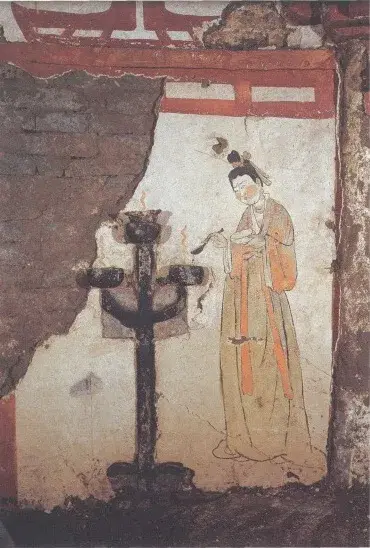
Zhao Qi was also an accomplished painter and sculptor. In his final years, anticipating his demise, he personally supervised the construction of his tomb at Changling. He painted murals depicting four ancient paragons of virtue—Ji Zha, Zichan, Yan Ying, and Shuxiang—along with a portrait of himself seated as their humble guest, adding inscriptions that captured his lifelong philosophical ideals.
In 201, he passed away peacefully in Jingzhou at over ninety years of age. His remains were returned to his native Changling for burial, mourned deeply by literati and court ministers across the empire.
In 196, Emperor Xian relocated the imperial capital from ruined Luoyang to Xu under Cao Cao's escort. Luoyang's palaces had been incinerated by Dong Zhuo, court ministers were reduced to starvation, and dynastic ritual institutions were entirely shattered. Appointed Minister of Ceremonies (Taichang), Zhao Qi, though over eighty years of age, worked tirelessly to establish and restore ancestral sacrifices and imperial court protocols.
Drawing upon his profound mastery of classical Han ritual codes, Zhao Qi pragmatically adapted traditional Zhou and Han rites to the austere realities of the wartime capital. He directed the construction of the imperial ancestral temple, the Mingtang, and the state altars at Xu, codifying suburban sacrifices and official seating orders to restore dynastic dignity to the Han court.
Serving as Minister of Ceremonies with imperial tallies to pacify the Huai and Jingxiang regions, Zhao Qi not only reconciled warring warlords but made investigating popular customs and discovering latent talent his primary mission. While crossing Yang Province, he recognized the exceptional talent and statesmanly vision of the young scholar Yan Xiang, who held no prior office.
Overcoming bureaucratic skepticism, Zhao Qi vigorously recommended Yan Xiang to the court. Trusting Zhao Qi's discernment, the throne appointed Yan Xiang Inspector of Yang Province, where he governed with distinction, pacifying refugees and restoring local order. In Jingzhou, Zhao Qi engaged in intellectual exchanges with eminent figures such as Sima Hui and Pang Degong, preserving northern classical scholarship amid southern refuge.
Zhao Qi's greatest legacy to East Asian civilization was his fourteen-volume Mengzi Zhangju. Prior to his scholarship, the Mencius was categorized merely as secondary philosophy rather than a canonical classic. Zhao Qi provided comprehensive syntactic and philosophical exegesis, championing Mencius's doctrines of inherent human goodness and benevolent governance. His commentary laid the textual groundwork for the Song Neo-Confucian elevation of the Mencius into the Four Books.
A master of capital topography and genealogies, Zhao Qi compiled the seven-volume Sanfu Juelu (Decisions and Records of the Three Metropolitan Districts), chronicling the elite lineages, local customs, and biographies of the Guanzhong region. Later annotated by Zhi Yu, it remains an indispensable primary source for Western Han and Eastern Han social history.
Throughout the turbulent collapse of the Han dynasty, Zhao Qi leveraged his personal integrity to intercede between violent warlords, championing the peace and well-being of the realm at immense personal peril into his tenth decade of life. At the critical juncture when Liu Biao and Yuan Shu clashed in deadly conflict, Zhao Qi entered their military encampments alone, invoking moral duty to persuade both sides to cease hostilities, saving hundreds of thousands of civilians.
In his later years, Zhao Qi possessed extraordinary discernment in identifying future pillars of state. Encountering the unheralded scholar Yan Xiang during his travels, he discerned his profound strategic mind and championed him before the court. The throne elevated Yan Xiang to Inspector of Yang Province, where his remarkable governance became celebrated in literati memory as a classic testament to Zhao Qi's peerless eye for talent.
FIGURES ASSOCIATED WITH THIS DYNASTY