Birth in Haiyan
Born into an imperial clan family in Guangchen, Haiyan, immersed from childhood in classical texts and calligraphy rubbings.
赵孟坚
Zhao Mengjian (赵孟坚, 1199–1264), courtesy name Zigu, art name Yizhai, was a native of Guangchen, Haiyan. An eleventh-generation descendant of Emperor Taizu of Song, he was an acclaimed member of the imperial clan, civil official, painter, calligrapher, and antiquarian connoisseur during the late Southern Song dynasty. Earning his jinshi degree in 1226, Zhao served successively as Prefectural Assistant in Huzhou, staff…
Zhao Mengjian (赵孟坚, 1199–1264), courtesy name Zigu, art name Yizhai, was a native of Guangchen, Haiyan. An eleventh-generation descendant of Emperor Taizu of Song, he was an acclaimed member of the imperial clan, civil official, painter, calligrapher, and antiquarian connoisseur during the late Southern Song dynasty. Earning his jinshi degree in 1226, Zhao served successively as Prefectural Assistant in Huzhou, staff officer in the Fiscal Commission, Magistrate of Zhuji, and Director of the Left Treasury. While serving as Prefect of Yanzhou during a severe drought and locust plague, he opened official granaries without authorization to relieve starvation, saving more than fifty thousand families. Early in the Jingding reign, he was elevated to Hanlin Academician Recipient of Edicts before retiring from public office. Renowned for his poetry, classical prose, and epigraphic expertise, Zhao achieved enduring fame for his monochrome ink orchids, fine-line ink narcissi, and paintings of the Three Friends of Winter, pioneering a refined scholar-gentleman painting style. A passionate collector of ancient bronzes, stone rubbings, and master calligraphies, he traveled across Jiangnan rivers in a customized vessel loaded with books, antiquities, and musical instruments, known as Zhao Zigu's Painting and Calligraphy Boat. In 1259, he risked his life during a boating accident to save an undamaged copy of Wang Xizhi's Lanting Xu, inscribing the famous declaration that life is secondary while supreme treasures must be preserved. Passing away in 1264 with the posthumous title Wenjian, his masterpieces, including Three Friends of Winter and Narcissus Scroll, remain timeless treasures of Chinese ink art.
Born into an imperial clan family in Guangchen, Haiyan, immersed from childhood in classical texts and calligraphy rubbings.
Passed the imperial palace examinations, initially serving as Compiler in the Jixian Hall and subsequently entering local judicial and fiscal administration.
Appointed Magistrate of Zhuji, reforming land taxation, curbing oppressive gentry, and winning high praise from local inhabitants.
Elevated to Director of the Left Treasury, managing official treasury reserves with rigorous incorruptibility.
Appointed Grand Master for Court Audiences and Prefect of Yanzhou; opened state granaries during a devastating famine, saving over fifty thousand households.
Acquired an undamaged five-character Lanting Xu rubbing; when his boat overturned in a storm on the Shan River, stood in waist-deep water holding the scroll aloft.
Promoted to Hanlin Academician Recipient of Edicts; weary of court factionalism, resigned shortly thereafter to live in retirement.
Passed away peacefully at his Guangchen residence at the age of sixty-six, composing a final farewell poem on worldly vanity.
Zhao Mengjian was born in 1199 in Guangchen, Haiyan, an eleventh-generation direct descendant of Emperor Taizu of Song. His father, Zhao Yucai, held respectable ministerial appointments and maintained a cultivated family environment. In his youth, Zhao combined deep study of the Confucian classics with an insatiable fascination for ancient bronze inscriptions from the Three Dynasties and calligraphic masterworks of the Wei, Jin, Tang, and Song dynasties.
In 1226, Zhao passed the imperial examinations and attained the jinshi degree, initially receiving an appointment as Compiler in the Jixian Hall. Over the following years, he served as a staff officer in Huzhou and in the Liangzhe Fiscal Commission, earning widespread acclaim for his mastery of administrative statutes and equitable judicial decisions. While serving as Magistrate of Zhuji, he overhauled local taxation, relieved prison overcrowding, founded Confucian county schools, and settled displaced peasant families. Promoted to Director of the Left Treasury, he supervised the imperial treasury's financial disbursements with flawless probity.
During the Baoyou era, Zhao was elevated to Grand Master for Court Audiences and appointed Prefect of Yanzhou. Situated among the rugged hills of western Zhejiang, Yanzhou possessed infertile soils and impoverished populations. Shortly after his arrival, the commandery suffered catastrophic droughts and locust infestations, causing crops to wither and grain prices to skyrocket, pushing hundreds of thousands toward famine.
Confronting this dire calamity, subordinate officials hesitated to distribute emergency relief grain without formal approval from the central court. Zhao declared resolutely that human lives superseded bureaucratic regulations, ordering the immediate opening of state granaries to sell grain at stabilized prices. He established dozens of soup kitchens and spent his private salary to distribute medicines and suppress unscrupulous grain hoarding. His timely actions preserved the lives of over fifty thousand families, earning him the eternal gratitude of the populace.
In 1260, Zhao was summoned to Lin'an as Hanlin Academician Recipient of Edicts. At that time, the Southern Song court fell increasingly under the arbitrary domination of Grand Councilor Jia Sidao. Recognizing the irreversible decay of dynastic fortunes and refusing to flatter courtiers, Zhao submitted his resignation and retired to his native Guangchen in Haiyan.
In retirement, Zhao detached himself from political affairs, dedicating his final years to artistic creation and connoisseurship. He constructed a lightweight boat furnished with zithers, rare scrolls, antique inkstones, and scholar's studio implements, sailing leisurely along Lake Tai, the Shan River, and West Lake. Enjoying wine, verse, and sunsets, he became a legend among southern intellectuals, who affectionately dubbed his vessel Zhao Zigu's Painting and Calligraphy Boat.
In 1259, while traveling in Wuxing, Zhao acquired an exceptionally rare five-character undamaged Dingwu rubbing of Wang Xizhi's Lanting Xu. Sailing home along the Shan River near Moushan at night, a violent storm capsized his vessel. While attendants floundered in the dark water, Zhao stood in the cold shallows, holding the precious rubbing above the waves with both hands and shouting that as long as the Lanting Xu survived, nothing else mattered. Upon returning home, he inscribed eight characters atop the scroll declaring that human life is light while supreme cultural treasures must be preserved.
In 1264, Zhao passed away at his home in Guangchen at the age of sixty-six. Prior to his passing, he composed a final verse reflecting that his worldly endeavors had dissolved into surface bubbles, yet his pursuit of beauty remained eternal. The court posthumously bestowed upon him the honorable title Wenjian.
Zhao Mengjian occupies a foundational position in the history of Chinese art. Inheriting the ink-wash tradition of Northern Song Buddhist monk Yang Wujiu, he synthesized meticulous fine-line drawing with scholar-gentleman ink washes, completely liberating flower painting from the decorative opulence of Southern Song academic styles.
He specialized particularly in monochrome ink orchids and fine-line narcissi. His celebrated Narcissus Scroll depicted twisting leaves, crisp blossoms, and dynamic compositions rendered with subtle brushwork, capturing both pristine spiritual purity and resilient structural grace. Furthermore, he pioneered the technique of directly painting orchids with pure ink strokes, inspiring generations of masters, including Yuan dynasty luminary Zhao Mengfu.
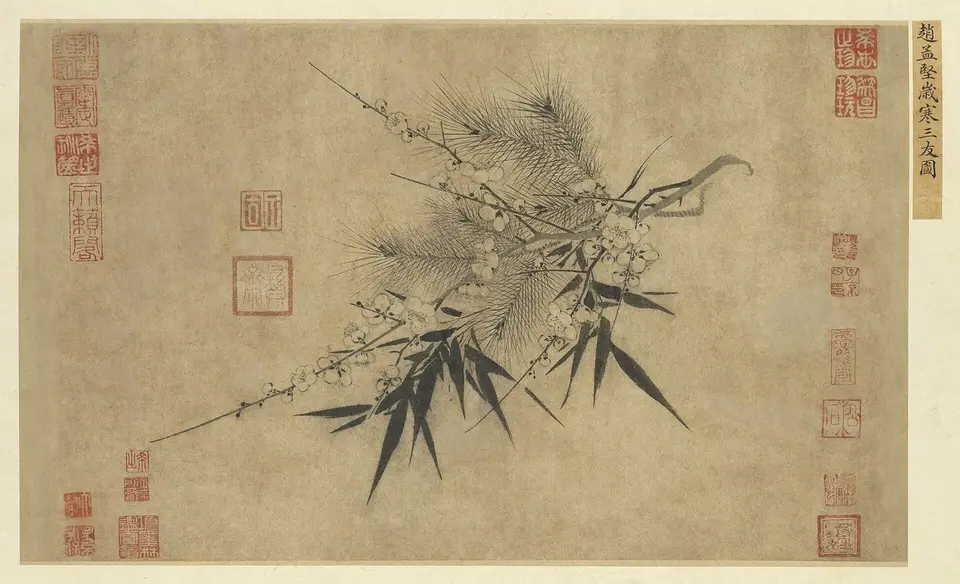
Zhao was the first master in Chinese painting history to place the pine, bamboo, and plum blossom together within a single unified composition, establishing the iconic theme of the Three Friends of Winter (Suihan Sanyou). His surviving masterpiece, Three Friends of Winter, utilized sparse, chilled ink strokes to portray the unbending pine, resilient bamboo, and blossoming plum amidst cosmic solitude.
Against the tragic backdrop of foreign Mongol invasion and impending dynastic fall, this motif was not merely a celebration of natural resilience; it served as a profound spiritual metaphor for the moral integrity and patriotic endurance of Song scholar-officials. Following Zhao's innovation, the Three Friends of Winter became one of the most enduring themes in Chinese literati painting.
Zhao Mengjian was universally recognized as one of the most discerning antiquarian scholars of the Southern Song. He amassed an extraordinary collection of Shang and Zhou bronzes, Qin and Han stone stele rubbings, and Jin and Tang master calligraphies, sparing no expense to secure endangered relics.
He brought rigorous philological scholarship to calligraphic authentication, authoring Meipu (Treatise on Plum Blossoms) and four volumes of Yizhai Wenbian. His running and cursive script harmonized the classical elegance of the Wei and Jin dynasties with the vigorous spontaneity of Mi Fu. His passionate collection and defense of classical texts helped preserve the vital spark of Jiangnan cultural heritage during the traumatic Song-Yuan transition.
FIGURES ASSOCIATED WITH THIS DYNASTY