Humble Birth in Chang'an
Born to a humble bondservant Zhao Lin in Chang'an, later entering the household of Princess Yang'a alongside Zhao Feiyan.
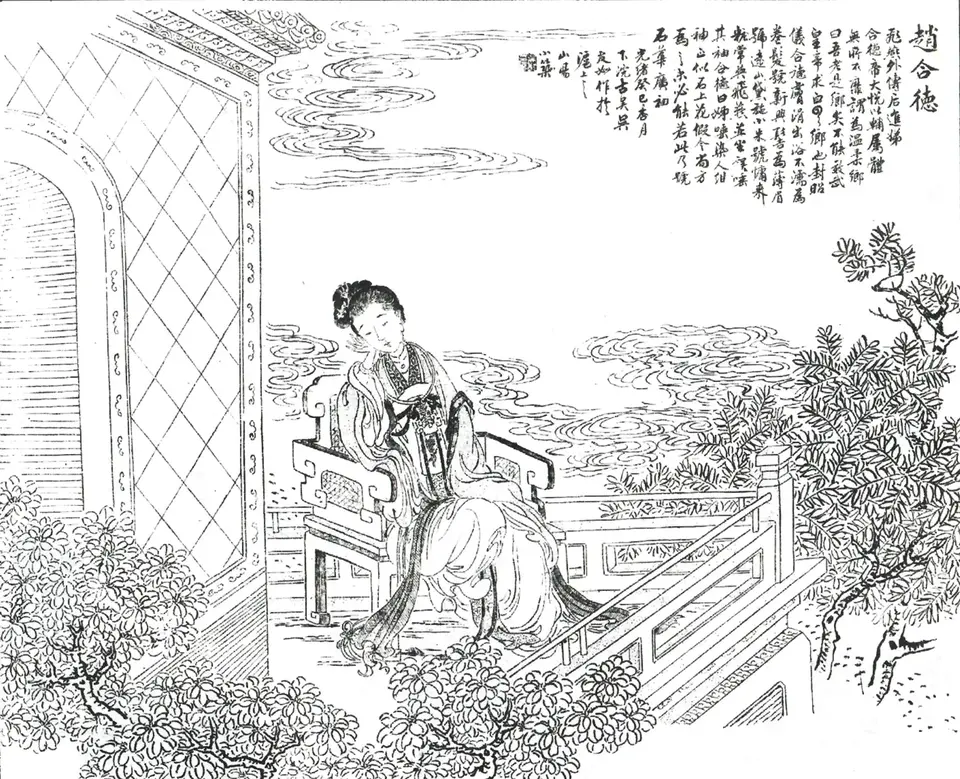
赵合德
Zhao Hede (赵合德, ? – 7 BCE) was the supremely favored imperial consort (Bright Deportment, Zhaoyi) of Emperor Cheng of Han (Liu Ao) during the late Western Han dynasty. She was the younger daughter of Zhao Lin, Marquis of Chengyang, and the younger sister of Empress Zhao Feiyan. In her youth, Zhao Hede served alongside her sister in the household of Princess Yang'a, learning dance, music, and court manners. When Emperor Cheng,…
Zhao Hede (赵合德, ? – 7 BCE) was the supremely favored imperial consort (Bright Deportment, Zhaoyi) of Emperor Cheng of Han (Liu Ao) during the late Western Han dynasty. She was the younger daughter of Zhao Lin, Marquis of Chengyang, and the younger sister of Empress Zhao Feiyan. In her youth, Zhao Hede served alongside her sister in the household of Princess Yang'a, learning dance, music, and court manners. When Emperor Cheng, traveling incognito, visited the princess's mansion and favored Zhao Feiyan, the new favorite felt isolated in the palace and lavishly praised the beauty and grace of her younger sister. Emperor Cheng promptly summoned Zhao Hede to Weiyang Palace. Both sisters were initially appointed as Handsome Ladies (Jieyu), captivating the emperor so thoroughly that Empress Xu and Consort Ban Jieyu completely lost favor. In 16 BCE (the first year of the Yingshi era), Zhao Feiyan was created empress, and Zhao Hede was promoted to Bright Deportment (Zhaoyi). While Emperor Cheng's affection for the empress waned after her elevation, his devotion to Zhao Hede intensified to an obsessive degree. Emperor Cheng lavishly rebuilt Zhaoyang Hall for her residence, featuring crimson courtyards, cinnabar lacquer, copper sills plated in gold, white jade stairs, and walls encrusted with Lantian jade, pearls, and iridescent kingfisher feathers—a level of luxury unprecedented in the Western Han inner court. Enjoying exclusive imperial favor for over a decade, both sisters remained childless and harbored murderous jealousy toward other concubines who conceived. During the Yuanyan and Suihe eras, Zhao Hede orchestrated the elimination of imperial heirs born to Palace Scribe Cao Gong and Consort Xu Meiren. Driven by her coercive jealousy, Emperor Cheng was manipulated into ordering the secret murder of his newborn infant sons, committing the notorious crime known to history as the Swallows Pecking Imperial Grandchildren and leaving himself without progeny. In 9 BCE (the fourth year of the Yuanyan era), Zhao Hede accepted lavish bribes from Consort Dowager Fu of Dingtao, joining with General of Agile Cavalry Wang Gen to successfully persuade Emperor Cheng to designate Liu Xin, King of Dingtao, as crown prince (later Emperor Ai of Han). In March 7 BCE, Emperor Cheng suffered a sudden apoplectic stroke and died in Zhao Hede's bedchamber. Amid intense public outcry, Grand Empress Dowager Wang Zhengjun commanded the imperial authorities to investigate the emperor's sudden demise, prompting Zhao Hede to commit suicide in terror.
Born to a humble bondservant Zhao Lin in Chang'an, later entering the household of Princess Yang'a alongside Zhao Feiyan.
Summoned into Weiyang Palace by Emperor Cheng upon Feiyan's recommendation; both sisters were made Handsome Ladies.
Supported Feiyan in denouncing Empress Xu for practicing witchcraft curses, resulting in the empress's deposition and Ban Jieyu's withdrawal.
Promoted to Bright Deportment while Feiyan became empress; took up residence in the newly opulent Zhaoyang Hall.
Female scribe Cao Gong bore an imperial son; Zhao Hede coerced the emperor into executing the infant and forcing Cao Gong to drink poison.
Xu Meiren gave birth to a son; Zhao Hede demanded the infant be sealed in a leather hamper and buried secretly, terminating the emperor's lineage.
Received rare jewels from Dowager Fu of Dingtao, teaming with Wang Gen to convince Emperor Cheng to name Liu Xin as crown prince.
Emperor Cheng collapsed and died in her bedchamber; faced with judicial interrogation by the court, Zhao Hede took poison and died.
Zhao Hede was the younger daughter of Zhao Lin, later enfeoffed as Marquis of Chengyang, and the younger sister of Empress Zhao Feiyan. While later romanticized fictional accounts like the Outer Biography of Zhao Feiyan claimed the sisters were fathered by musician Feng Wanjin through an illicit liaison with Princess Gusu, the authoritative official history Book of Han explicitly records that their father was Zhao Lin, a humble official bondservant in Chang'an.
During their early childhood, the family was impoverished to the point where their parents struggled to feed them. As they matured, the sisters were sent to the residence of Princess Yang'a (daughter of Emperor Jing) as domestic maidservants in charge of shoes and garments. In the princess's mansion, Zhao Feiyan practiced delicate dancing until she could perform with airy lightness, while Zhao Hede grew into a plump, voluptuous, and exquisitely radiant beauty with skin smooth as congealed lard and an enchanting, submissive disposition.
In 18 BCE (the third year of Emperor Cheng's Hongjia era), the young emperor visited the princess's estate incognito. Entertained by palace dancing girls, Emperor Cheng was captivated by Zhao Feiyan and brought her into Weiyang Palace. Once installed, Feiyan recognized that imperial favor was fleeting, Empress Xu came from an illustrious family, and Lady Ban Jieyu was universally respected for her virtue. Lacking domestic lineage backing, Feiyan repeatedly praised her sister Zhao Hede before Emperor Cheng, claiming her sister's sensual allure surpassed her own. Intrigued, Emperor Cheng sent imperial carriages to bring Zhao Hede to the palace. Upon beholding her, the emperor was mesmerized by her seductive tenderness. Emperor Cheng appointed both sisters Handsome Ladies (Jieyu), showering them with overwhelming affection and leaving Empress Xu and Consort Ban completely discarded.
Once entrenched in the inner palace, the Zhao sisters used their monopoly over imperial affection to eliminate their rivals.
In the autumn of 18 BCE, distressed by the lack of an imperial heir, Empress Xu's elder sister Xu Ping'an hired sorceresses to conduct altar sacrifices and curse pregnant concubines, implicating palace officials. Zhao Feiyan and Zhao Hede seized upon this discovery, formally accusing Empress Xu of treasonous sorcery before Emperor Cheng.
Grand Empress Dowager Wang Zhengjun was outraged and ordered a thorough investigation by judicial officers. Emperor Cheng subsequently issued an imperial decree stripping Empress Xu of her title and banishing her to the auxiliary Zhaotai Palace. Consort Ban Jieyu was also interrogated but defended herself with eloquence, remarking that life, death, and fortune were ordained by heaven, before requesting permission to retire to Changxin Palace to serve the empress dowager, permanently leaving the harem struggle. With both prominent rivals removed, the sisters stood unchallenged.
Emperor Cheng wished to elevate Zhao Feiyan to empress, but Empress Dowager Wang objected to their plebeian background. Emperor Cheng conspired with the empress dowager's nephew Chunyu Zhang, enfeoffing the sisters' father Zhao Lin as Marquis of Chengyang with one thousand households in April 16 BCE to elevate their social standing. In June, Zhao Feiyan was officially consecrated empress, and Zhao Hede was elevated to Bright Deportment (Zhaoyi), the highest rank below empress.
After Feiyan became empress, her haughty demeanor and increasingly slender frame caused the emperor's passion for her to diminish. In contrast, Emperor Cheng's infatuation with Zhao Hede grew into an consuming obsession.
To demonstrate his devotion, Emperor Cheng demolished and rebuilt Zhaoyang Hall within Weiyang Palace on an unprecedented scale. The courtyard was painted crimson with cinnabar; palace pillars and beams were coated with gleaming black lacquer; doorsteps and sills were covered in bronze encased in pure gilded gold; and courtyard staircases were crafted from slabs of white jade. Golden rings were embedded into wall paneling, framing insets of polished Lantian jade, while lamps, screens, and window lattices were adorned with sea pearls and iridescent peacock feathers. Across the two centuries of the Western Han dynasty, no harem residence had ever rivaled Zhaoyang Hall in extravagance.
Zhao Hede enjoyed exclusive intimacy within Zhaoyang Hall for more than a decade. However, whether due to lifestyle excess or the continuous use of secret skin-lightening cosmetics such as musk-based skin pills, neither sister ever succeeded in conceiving a child.
As Emperor Cheng passed his thirties without an heir, the succession crisis became a grave threat to the empire. Driven by imperial duty and anxiety over succession, the emperor occasionally sought intimacy with other palace women. Yet this natural desire provoked psychotic, murderous jealousy in Zhao Hede. Capitalizing on Emperor Cheng's helplessness before her charms, she bound him to a cruel pact that no other woman should bear his heirs, instigating the horrific tragedy known as the Swallows Pecking Imperial Grandchildren.
In 12 BCE (the first year of the Yuanyan era), palace female scribe Cao Gong (styled Weineng) conceived after an encounter with Emperor Cheng and secretly gave birth to a healthy boy in the palace quarters. When Zhao Hede's spies reported the birth, she flew into a hysterical rage. Summoning Emperor Cheng to her bedchamber, she tore her hair, slammed her head against the wooden pillars, threw herself onto the floor, and wailed in fury: "Your Majesty promised never to betray our covenant! Whence came this child by the bondservant Cao Gong? How do you intend to dispose of me? I would rather return home and die!"
Subjugated by her tantrums, Emperor Cheng abjectly apologized and surrendered to her demands. He dispatched palace eunuchs to confiscate the newborn infant of eight days and smother him. Zhao Hede personally sent poison and a sealed letter to Cao Gong, forcing her to commit suicide. Before drinking the lethal draught, Cao Gong cried out in despair: "The Zhao sisters truly seek to usurp all under heaven! My boy had thick hair on his forehead resembling Emperor Yuan, yet he was brutally slain!" She then took the poison and died.
In 11 BCE (the second year of the Yuanyan era), Consort Xu Meiren, a distant relative of the deposed empress, gave birth to another healthy son in an external residence. Learning of this, Zhao Hede staged another furious hunger strike. To placate her, Emperor Cheng lost all semblance of humanity. He ordered attendants to pack his infant son into a raw leather hamper and carry the sealed box directly into Zhaoyang Hall.
There, in the presence of Zhao Hede, the emperor inspected the hamper, applied the official seal of the Imperial Vice Censor, and ordered the living child taken out and buried beneath the earthen wall of the palace prison. With the destruction of this second prince, Emperor Cheng's last direct bloodline was extinguished. From that moment on, whenever any concubine was suspected of pregnancy, Zhao Hede forced her to consume abortifacients, terrifying the harem and permanently ending the emperor's progeny.
Having extinguished the emperor's lineage, Zhao Hede realized that Emperor Cheng was aging and that her future safety depended upon cultivating a loyal successor among the imperial princes before the emperor died.
In 9 BCE (the fourth year of the Yuanyan era), Emperor Cheng convened the royal princes in Chang'an to select a successor. Only two candidates qualified: the emperor's surviving younger brother, King Liu Xing of Zhongshan, and his nephew, King Liu Xin of Dingtao (son of Emperor Cheng's late half-brother King Kang of Dingtao).
King Liu Xing appeared awkward and uninspiring during court audiences, disappointing the emperor. In contrast, the seventeen-year-old King Liu Xin demonstrated mastery of the Confucian classics and polished poise. Liu Xin's grandmother, Consort Dowager Fu (formerly Consort Fu to Emperor Yuan), was a master of palace maneuvering. She traveled to Chang'an armed with vast treasures of gold and precious gems.
Dowager Fu lavished these treasures upon the two most influential figures in Chang'an: General of Agile Cavalry Wang Gen (the emperor's uncle) and the all-powerful consort Zhao Hede.
Enticed by Dowager Fu's magnificent gifts and seeking long-term security, Zhao Hede formed a pact with Wang Gen. Day and night in Zhaoyang Hall, she whispered into Emperor Cheng's ear, praising Liu Xin's filial devotion and sagacity. In 8 BCE, Emperor Cheng formally issued an edict investing Liu Xin as imperial crown prince, effectively sealing the future transfer of sovereign power.
In March 7 BCE (the second year of the Suihe era), disaster struck Zhaoyang Hall, shattering Zhao Hede's empire of pleasure and intrigue.
Emperor Cheng was forty-four years of age and generally enjoyed robust health. To satisfy Zhao Hede's insatiable desires, the emperor had long consumed aphrodisiac pills known as Shenxu Jiao. On an evening in March, after heavy drinking, Emperor Cheng retired to the bedchamber of Zhao Hede in the White Tiger Hall.
At dawn the following morning, Emperor Cheng attempted to rise from the bed and dress for court. Suddenly, his body trembled violently, his trousers slipped from his grasp, and his facial muscles convulsed into paralysis, rendering him unable to utter a sound. Terrified attendants and maidservants rushed to his aid, but the stroke was fatal. Before ten segments had passed on the water clock, Emperor Cheng expired on Zhao Hede's bed.
News of the emperor's sudden demise on his favorite consort's bed stunned the empire, inciting furious outrage among court ministers and the populace, who blamed Zhao Hede for corrupting and destroying the sovereign. Grand Empress Dowager Wang Zhengjun immediately issued an imperial edict from Changxin Palace, ordering Grand Marshal Wang Mang, Chancellor Kong Guang, the Imperial Censor, and the Commandant of Justice to arrest palace eunuchs and thoroughly investigate the circumstances of the emperor's death, targeting Zhao Hede directly.
Trapped within Zhaoyang Hall, Zhao Hede saw her imperial patron turned into a cold corpse. With her crimes of infanticide and regicide laid bare before the highest court tribunals, and knowing she faced dismemberment in the marketplace, Zhao Hede swallowed poison and died, bringing a bloody end to her era of domestic tyranny.
Zhao Hede enjoyed unrivaled devotion from Emperor Cheng, residing in the lavishly rebuilt Zhaoyang Hall adorned with white jade, pure gold, and Lantian jade.
Her unprecedented luxury set a historic high watermark for palace extravagance, serving as an enduring historical symbol of sovereign decadence.
Teaming with Zhao Feiyan, she exposed Empress Xu's witchcraft rituals, leading to the empress's deposition and Ban Jieyu's withdrawal.
This victory enabled her father to be enfeoffed as marquis and cemented the sisters' undisputed dominion over the Western Han court for over a decade.
Driven by infertile jealousy, she coerced Emperor Cheng into slaughtering his newborn sons born to Cao Gong and Xu Meiren.
Her campaign of abortion and infanticide completely extinguished Emperor Cheng's biological progeny, precipitating a constitutional succession crisis for the dynasty.
In 9 BCE, she accepted bribes from Dowager Fu, aligning with Wang Gen to secure the appointment of Liu Xin (Emperor Ai) as crown prince.
Following Emperor Cheng's sudden death in her bedchamber in 7 BCE, she committed suicide under judicial siege, ending her turbulent career as an archetypal femme fatale.
FIGURES ASSOCIATED WITH THIS DYNASTY