Classical Mastery under Shan Fu
Born in Luoyang, Henan; studied Nine Palaces calculations and astrology under Palace Attendant Shan Fu.
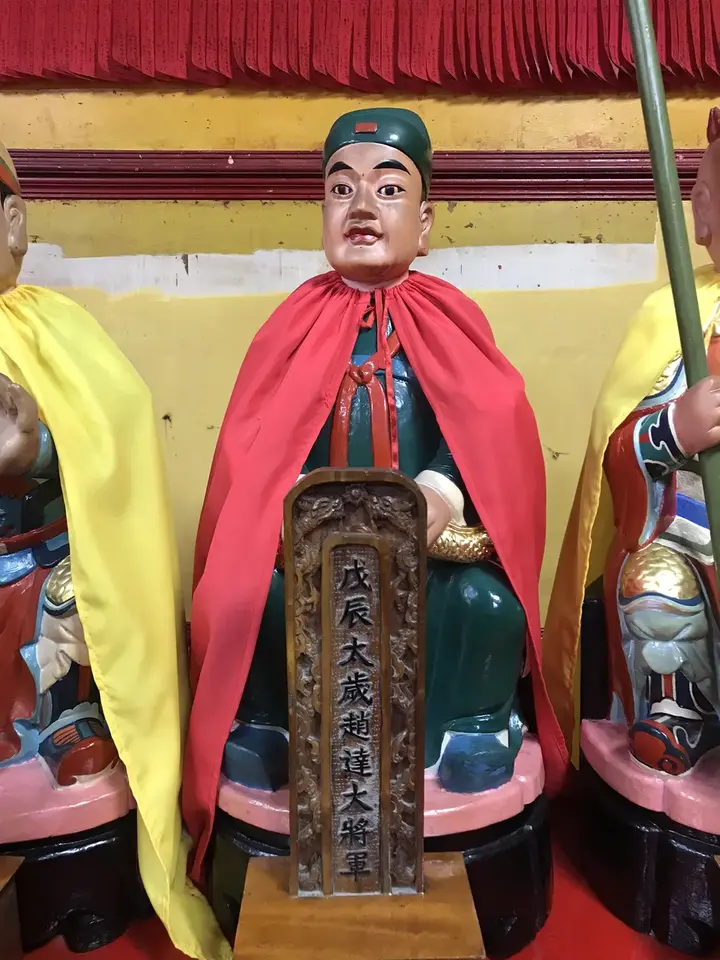
赵达
Zhao Da (赵达, birth and death dates unrecorded in standard histories) was a native of Henan Commandery (present-day Luoyang, Henan). He was an eminent mathematician, court astrologer, and master of esoteric prognostication during the Three Kingdoms era in Eastern Wu, celebrated alongside calligrapher Huang Xiang, chess master Yan Wu, and painter Cao Buxing as one of the Eight Paragons of Jiangnan (Jiangbiao Bajue, specifically…
Zhao Da (赵达, birth and death dates unrecorded in standard histories) was a native of Henan Commandery (present-day Luoyang, Henan). He was an eminent mathematician, court astrologer, and master of esoteric prognostication during the Three Kingdoms era in Eastern Wu, celebrated alongside calligrapher Huang Xiang, chess master Yan Wu, and painter Cao Buxing as one of the Eight Paragons of Jiangnan (Jiangbiao Bajue, specifically the Master of Calculation). In his youth, Zhao Da studied under Shan Fu, a Palace Attendant of the Eastern Han court, acquiring exceptional analytical precision in astronomical calendar computation, rod calculus, and wind-angle divination. As the Central Plains collapsed into civil warfare during the late Han dynasty, Zhao Da observed the night sky and divined that the aura of sovereign kingship was ascending in the southeastern Jiangnan region, prompting him to flee south across the Yangtze River to enter the service of the Sun Wu regime. Zhao Da perfected the esoteric computational art known as the Nine Palaces and One Calculation (Jiugong Yisuan), synthesizing the metaphysical diagrams of the Luoshu (Luo River Writing) with practical rod calculus algorithms. His computational abilities were hailed as divine, operating with instantaneous speed: "He produced answers instantaneously upon encountering questions, responding with godlike accuracy." He could calculate the exact number of flying locusts in a swarm or count the holes bored into bamboo texts by bookworms in a moment. Sun Quan, Emperor Da of Eastern Wu, placed immense trust in his calculations, consulting him on major military expeditions. When Gongsun Yuan of Liaodong betrayed Eastern Wu after feigning allegiance, Sun Quan prepared to personally lead a trans-oceanic naval fleet to destroy him; Zhao Da accurately calculated that Gongsun Yuan was doomed to self-destruction within years without military intervention, advising against a costly expedition. When Gongsun Yuan was indeed defeated and beheaded by Wei forces shortly thereafter, Sun Quan promoted Zhao Da to Major General. Throughout his life, Zhao Da demonstrated remarkable computational wonders: instantaneously counting tens of thousands of beans scattered across a mat, predicting the arrival and weight of gifts from guests down to the exact hour, estimating the exact capacity of granaries, and accurately calculating that Sun Quan would rule as emperor for precisely twenty-four years. However, Zhao Da was intensely secretive and haughty, guarding his mathematical methods as private treasures. Despite passionate pleas from fellow master Wu Fan to transmit his knowledge to preserve it for posterity, Zhao Da refused. Even when Sun Quan ordered Crown Prince Sun Deng to study under him, Zhao Da withheld his secrets, provoking imperial fury. After accurately predicting his own date of death, Zhao Da passed away; imperial investigators ransacked his house searching for his secret treatises, and finding none, Sun Quan executed his young attendant in frustration. Zhao Da remains one of the most enigmatic and brilliant figures in the history of ancient Chinese mathematics and divination.
Born in Luoyang, Henan; studied Nine Palaces calculations and astrology under Palace Attendant Shan Fu.
Divined sovereign kingship in the southeast as the Central Plains fell into war, migrating south to join Sun Wu.
Regularly counseled Sun Quan on military campaigns; predicted Gongsun Yuan's doom and was made Major General.
Counted thousands of scattered beans instantaneously; calculated that Sun Quan would reign as emperor for twenty-four years.
Refused to transmit his algorithms to Wu Fan; concealed teachings from Crown Prince Sun Deng, incurring Sun Quan's anger.
Accurately predicted his own death and passed away; Sun Quan ransacked his home and executed his attendant in rage.
Zhao Da lived during the turbulent transition from the late Eastern Han to the Three Kingdoms era. He was born in Henan Commandery (the capital region of Luoyang, Henan). For centuries, Luoyang had served as the political, administrative, and intellectual heart of the Han Empire, gathering the foremost classical scholars, mathematicians, and calendar scientists. Hailing from an educated family, Zhao Da displayed rare logical acuity and computational talent from an early age.
In his youth, Zhao Da apprenticed himself to Shan Fu, an Eastern Han Palace Attendant and renowned master of mathematical divination. Shan Fu was celebrated for his mastery of the Book of Changes, calendar cycles, and the Nine Palaces cosmological charts. Under Shan Fu's guidance, Zhao Da immersed himself in counting-rod mathematics, astronomical tracking, and wind-angle divination, spending days and nights manipulating calculating rods to uncover mathematical laws governing celestial movements.
Toward the end of the Zhongping era of Emperor Ling, the Yellow Turban Rebellion erupted across the provinces, followed by Dong Zhuo's tyrannical coup, which reduced the imperial palaces of Luoyang to ashes. Amid the gathering cataclysm, Zhao Da observed the heavens, discovering that while the imperial stars over the Central Plains were obscured, a vibrant purple aura of imperial majesty was rising over the southeastern Jiangnan territory. Discerning that the southeast offered both safety and dynastic potential, Zhao Da gathered his mathematical texts, left his ancestral home in Luoyang, crossed the Yangtze River, and sought refuge in the rising realm of the Sun clan.
Arriving in Jiangnan, Zhao Da quickly attained renown across the region for his computational abilities. Within contemporary Han-Wei mathematical arts, none was considered more arcane than the system known as Nine Palaces and One Calculation (Jiugong Yisuan).
The Nine Palaces system originated from the ancient cosmological diagram known as the Luoshu (Luo River Writing), dividing space and directional forces into nine mathematical grids corresponding to the cardinal points, trigrams, and elements. The "One Calculation" represented a sophisticated algorithmic methodology employing physical counting rods to perform advanced multiplication, modular progression, and cyclical forecasting. While most practitioners found the system difficult, prone to cascading errors, Zhao Da comprehended its underlying mathematical principles, converting immense datasets into rapid mental algorithms.
Contemporary accounts record that Zhao Da's calculations operated with effortless speed: "He produced answers instantaneously upon encountering questions, responding with godlike accuracy." While ordinary diviners required days of incense burning and rod casting, Zhao Da formulated precise quantitative answers the moment an inquiry was uttered. His precision encompassed vast ranges: from forecasting the success of imperial military operations and dynastic durations to calculating the exact number of flying locusts in a cloud or counting the tiny holes bored into bamboo manuscripts by bookworms. Eminent figures of Sun Wu, including Gu Yong and Zhuge Jin, praised him as an unmatched computational genius comparable to Sang Hongyang and Yan Junping of antiquity.
Sun Quan, the ruler of Eastern Wu, actively recruited individuals with rare talents to support his governance. Recognizing Zhao Da's abilities, Sun Quan summoned him to his staff, according him generous honors. During the major military expeditions of Eastern Wu, Zhao Da served as a confidential strategic counselor. Whenever Sun Quan mobilized fleets or armies, Zhao Da calculated enemy strengths, terrain variables, and temporal factors, with historical records noting that his predictions "were invariably verified by events," granting Eastern Wu tactical advantages.
During the Huanglong era, the warlord Gongsun Yuan of Liaodong rebelled against Cao Wei, dispatching envoys across the sea to declare allegiance to Eastern Wu. Overjoyed at gaining a northern ally to encircle Wei, Sun Quan dispatched high ministers Zhang Mi and Xu Yan with ten thousand soldiers and naval fleets laden with gold and silks to invest Gongsun Yuan as King of Yan. However, Gongsun Yuan acted with treachery: after seizing the imperial treasures, he executed the Wu envoys and sent their severed heads to Luoyang to seek favor with Wei.
When news of this betrayal reached Jianye, Sun Quan felt deeply humiliated and swore to lead the entire Wu navy across the Yellow Sea to conquer Liaodong. Chancellor Gu Yong and Grand Commander Lu Xun remonstrated against the perilous voyage across stormy seas, but Sun Quan remained obstinate.
At this critical juncture, Sun Quan summoned Major General Zhao Da to divine the expedition's outcome. After manipulating his counting rods, Zhao Da serenely advised the emperor: "Analyzing the cosmic cycles of the Nine Palaces, Gongsun Yuan has violated righteousness and exhausted his fortune. He is destined to perish by his own transgressions within three years. Your Majesty has no need to exhaust the state's military resources on a distant sea voyage; Cao Wei will carry out heaven's retribution on our behalf!" Guided by Zhao Da's reputation for accuracy, Sun Quan relented, canceling the dangerous naval expedition.
A few years later, Grand Commandant Sima Yi of Cao Wei led a northern army to besiege Xiangping, crushing Gongsun Yuan's forces and executing the warlord, validating Zhao Da's prophecy. Sun Quan rewarded Zhao Da lavishly and confirmed his permanent status as Major General.
Zhao Da's computational abilities in everyday life became legendary.
On one occasion, Zhao Da visited an old friend. The host, living in modest circumstances, playfully asked: "You are the greatest calculator under heaven; why not calculate whether we will have the fortune to enjoy fine food and drink today?" Zhao Da smiled, rearranged a few counting rods on the low table, and declared with confidence: "Do not worry! By noon, a guest from the southeast will arrive bearing a fat rooster and two jugs of aged wine at the third quarter of the hour, providing ample food for our feast!" At noon, a knock sounded at the gate: a relative from the countryside had arrived carrying a hot roasted chicken and two jugs of wine, matching Zhao Da's prediction in weight and timing.
Another scholar, skeptical of his reputation, decided to test him publicly. While Zhao Da turned to take tea, the scholar reached into a pouch, grabbed two handfuls of small beans, and scattered them across a broad straw mat, challenging him: "If you can truly count minute things, tell me immediately how many beans are scattered on this mat!" Zhao Da turned, glanced at the mat, and instantly proclaimed an exact five-digit figure. Sarcastic, the scholar summoned servants to count every bean one by one. After an hour of counting, the number matched Zhao Da's figure without a single bean's discrepancy. The scholar knelt in apology.
On another occasion, passing the grand state granaries of Eastern Wu, Zhao Da pointed at a sealed building and declared its exact grain capacity down to the bushel. When officials inspected the inventory ledgers, the recorded quantities matched his estimate.
Most astonishingly, Zhao Da calculated the dynastic lifespan of Sun Quan's reign. In a confidential consultation, he remarked to close associates: "The sovereign will receive heaven's mandate, reigning as emperor for exactly twenty-four years." At that time, Sun Quan had not yet assumed the imperial title, and few believed the claim. Yet decades later, Sun Quan proclaimed himself emperor in 229 (Huanglong 1) and died in 252 (Taiyuan 1), having reigned as emperor for precisely twenty-four years, fulfilling Zhao Da's prediction.
Despite his brilliance, Zhao Da possessed a secretive and haughty disposition, guarding his methods as private property.
Fellow master Wu Fan, recognizing the historic value of his system, repeatedly urged Zhao Da: "Your Nine Palaces system is unmatched throughout the realm! Why not select worthy disciples to transmit it? If your allotted lifespan ends, this wondrous knowledge will perish with you; would that not be a tragedy?" Zhao Da merely smiled and remained silent, refusing to disclose his methods.
Sun Quan desired to institutionalize the Nine Palaces system as an imperial tradecraft. He commanded his beloved eldest son, Crown Prince Sun Deng, to study under Zhao Da as a humble disciple. However, confronted by the heir apparent, Zhao Da offered evasive generalities, withholding his core computational principles. When Sun Deng returned empty-handed, Sun Quan erupted into fury, resenting Zhao Da's defiance of royal authority.
In his later years, after calculating his own chart, Zhao Da pushed his rods aside and sighed to his wife: "I have exhausted the numbers of heaven and earth, and my own lifespan is at an end. According to the Nine Palaces, on such-and-such day, I will die of acute illness!"
Hearing this, his wife wept bitterly. Pitying her grief, Zhao Da comforted her: "Do not weep! I was merely making a jest; my lifespan is not yet exhausted!" His wife was relieved.
Yet on the exact day he had predicted, Zhao Da fell ill at dawn and died peacefully in his chair, leaving his own death predicted down to the day.
Upon learning of his sudden demise, Sun Quan dispatched security officers to seal and search Zhao Da's residence, tearing through rafters, floorboards, and walls to find his manuscripts. However, Zhao Da had committed his methods entirely to memory and burned all notes prior to his death. Finding nothing, Sun Quan suspected that Zhao Da's favorite young attendant had hidden the papers, ordering the youth executed on the spot. Through his excessive secrecy, Zhao Da's mathematical system perished with him, leaving behind an enduring mystery in ancient Chinese science.
Studied under Eastern Han Palace Attendant Shan Fu in Luoyang, mastering the Nine Palaces, calendar computation, and rod calculus.
Observed astronomical omens indicating rising kingship in the southeast during the collapse of the Han Empire, migrating south to serve Eastern Wu.
Synthesized the Luoshu diagrams with practical rod calculus, producing instant computational solutions for complex astronomical and military problems.
Calculated the numbers of flying locusts in a swarm and holes bored into bamboo manuscripts, reaching the peak of early medieval mathematical forecasting.
Counseled Sun Quan during military campaigns, foretelling battlefield movements and being promoted to Major General.
Dissuaded Sun Quan from launching a perilous trans-oceanic expedition against Gongsun Yuan, correctly predicting the warlord's internal collapse.
Accurately predicted the arrival of roasted chicken and wine, counted thousands of scattered beans instantaneously, and estimated granary volumes.
Calculated that Sun Quan would reign as emperor for precisely twenty-four years, verified by Sun Quan's reign from 229 to 252.
Refused to transmit his algorithms to Wu Fan or Crown Prince Sun Deng, incurring Sun Quan's resentment.
Accurately predicted his own death; the destruction of his manuscripts led Sun Quan to execute his attendant, causing the loss of the Nine Palaces system.
FIGURES ASSOCIATED WITH THIS DYNASTY