Birth in Chang'an
Born in the metropolitan hostel, named Guiling following his mother's premonitory dream of a sacred turtle.
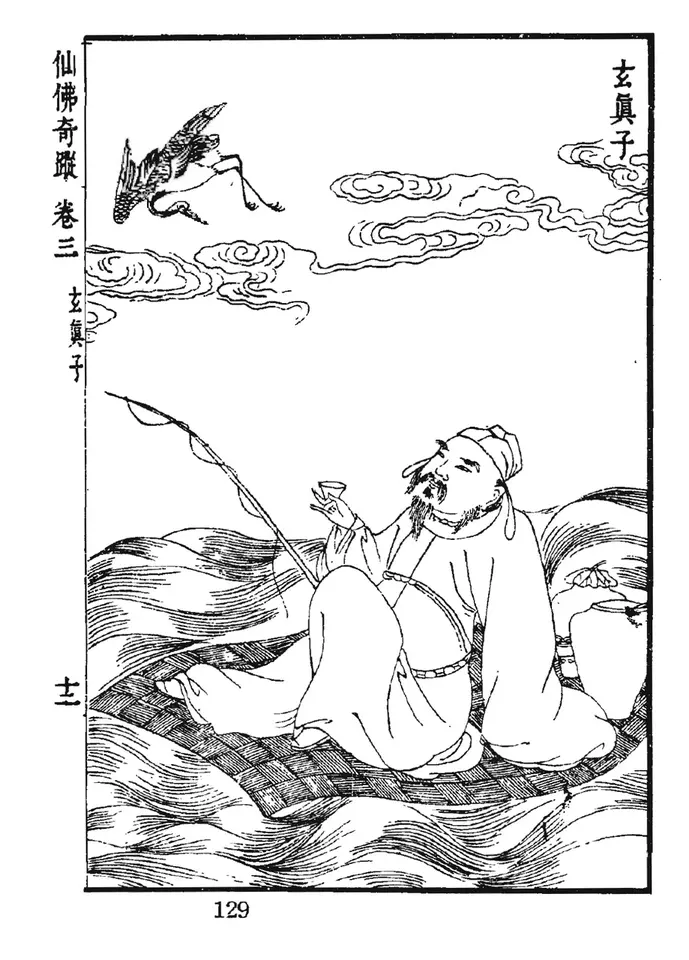
张志和
Zhang Zhihe (张志和) was a celebrated lyricist, poet, Daoist thinker, and eminent recluse of the Tang Dynasty, revered in Chinese literary history as the foundational father of the Yufu (Fisherman ci) lyric tradition. Originally named Zhang Guiling, he took the courtesy name Zitong and adopted the Daoist sobriquets Master Xuanzhen (Xuanzhenzi) and Angler of Mists and Waves (Yanbo Diaotu). A child prodigy who composed…
Zhang Zhihe (张志和) was a celebrated lyricist, poet, Daoist thinker, and eminent recluse of the Tang Dynasty, revered in Chinese literary history as the foundational father of the Yufu (Fisherman ci) lyric tradition. Originally named Zhang Guiling, he took the courtesy name Zitong and adopted the Daoist sobriquets Master Xuanzhen (Xuanzhenzi) and Angler of Mists and Waves (Yanbo Diaotu). A child prodigy who composed literature at age six, he was tested directly by Emperor Xuanzong and accommodated within the Hanlin Academy. Upon Prince Li Heng's ascension as Emperor Suzong during the An Lushan Rebellion, the sovereign personally conferred the name "Zhihe" and appointed him Administrative Assistant in the Left Military Guard. Following outspoken remonstrances against relying upon Uyghur cavalry under humiliating concessions, Zhang was demoted and subsequently withdrew permanently from bureaucratic life to live as an unconstrained fisherman-recluse along southern waterways. Zhang Zhihe possessed universal artistic and intellectual mastery, excelling in lyric verse, landscape painting, musical performance, and Daoist cosmology. Drifting across the Taihu Lake and Tiaoxi river networks, he formed an intimate intellectual fellowship with calligrapher and Huzhou Prefect Yan Zhenqing, Tea Sage Lu Yu, and poetic monk Jiaoran. His supreme masterpiece Fisherman ci (Yufu Ci) (Yufu Ci)—immortalized by the lines: "Before Mount Xisai white egrets take flight / Peach blossoms float on flowing streams where mandarin fish are fat / Green bamboo hat, green straw cape / In slanting wind and drizzling rain there is no need to return"—fused Jiangnan landscape painting with Daoist spiritual detachment, establishing lyric verse (ci) as an autonomous classical genre. His surviving twelve-chapter metaphysical treatise Xuanzhenzi systematically explored cosmic yin-yang mechanics, preserving his reputation as an immortal icon of classical reclusion.
Born in the metropolitan hostel, named Guiling following his mother's premonitory dream of a sacred turtle.
Tested by Emperor Xuanzong at age seven after reciting complex anthologies, accommodated in the imperial academy.
Completing studies at the National University, Crown Prince Li Heng renames him "Zhihe" and appoints him to palace guard administration.
Remonstrating against shameful imperial concessions to Uyghur mercenaries, he is demoted to District Defender of Nanpu, soon resigning.
Following the death of his parents and wife, he renounces the world to fish along Mount Xisai, calling himself the Angler of Mists and Waves.
Gathers with Yan Zhenqing, Lu Yu, and Jiaoran in Huzhou, composing the immortal Fisherman ci (Yufu Ci).
Passes away during travels in Yuezhou at age forty-three, legendary accounts asserting his Daoist ascension to immortality.
Full Name: Zhang Zhihe; Original Name: Zhang Guiling; Courtesy Name: Zitong; Literary Name: Xuanzhenzi (玄真子), Angler of Mists and Waves (烟波钓徒); Native Place: Jinhua, Wuzhou; Date of Birth: 732 (Kaiyuan 20, Tang Dynasty); Date of Death: 774 (9th Year of Dali, Tang Dynasty); Age at Death: 43; Highest Office: Administrative Assistant in the Left Military Guard (左金吾卫录事参军); Major Offices: Administrative Assistant in the Left Military Guard (左金吾卫录事参军), District District Defender of Nanpu (南浦县尉); Principal Identity: Tang Dynasty Lyricist, Poet, Daoist Philosopher, Hermit, Progenitor of Fisherman Songs;
Zhang Zhihe was born into an educated gentry household in Chang'an, where his father was staying. According to biographical accounts, his mother dreamed of receiving a miraculous celestial turtle prior to conception, prompting his birth name Guiling ("Turtle Longevity"). Exhibiting extraordinary intellectual gifts, Zhang began reading at three and composed complex essays at six, possessing a photographic memory. In 739, while visiting the Hanlin Academy with his father, academician scholars tested the seven-year-old with intricate classical volumes; Zhang recited them instantly without error. Impressed by reports of the prodigy, Emperor Xuanzong summoned him to the palace for personal examination. The youth answered intricate statecraft inquiries with effortless brilliance, prompting Xuanzong to order his maintenance and education within the imperial academy.
In 751, upon concluding his studies at the National University (Taixue), Crown Prince Li Heng personally intervened in his career. Recognizing his combined literary talent and tactical understanding, the prince bestowed upon him the formal name "Zhihe" ("Aspiring to Harmony") with the courtesy name Zitong, appointing him Administrative Assistant in the Left Military Guard, charged with confidential military communications within the Heir Apparent's entourage.
In 755, the catastrophic An Lushan Rebellion erupted, with rebel forces overrunning the Central Plains and forcing Emperor Xuanzong into Sichuan exile. Crown Prince Li Heng retreated to Lingwu in the northwest, ascending the throne as Emperor Suzong. Zhang Zhihe accompanied the new sovereign to the frontier, joining senior counselors like Li Mi in designing military strategies to recapture the capitals, for which he was ennobled with the prestigious rank of Grand Master of the Palace with Golden Seal and Purple Ribbon.
However, during the crucial offensive to liberate Chang'an and Luoyang in 757, Emperor Suzong agreed to humiliating terms to secure Uyghur cavalry assistance, granting nomadic horsemen permission to pillage the wealth and civilian women of Luoyang. Horrified by the impending slaughter of imperial subjects, Zhang Zhihe courageously presented direct remonstrances before the throne, urging the emperor to rescind the concession and preserve dynastic honor. Infuriated by his blunt criticism, Suzong banished him to serve as District Defender of Nanpu in the mountainous gorges of Sichuan. Recognizing the moral bankruptcy of court politics, Zhang resigned his post shortly thereafter when his mother and father passed away, observing traditional filial mourning in retirement.
Following the completion of the three-year mourning period, Zhang's wife Lady Cheng succumbed to illness. The compounded loss of his entire immediate family dissolved all remaining attachments to worldly prestige. To escape repeated imperial summons from Emperor Suzong, Zhang dissolved his household, retained only two domestic servants, and purchased a lightweight wooden boat, resolving to spend his remaining days wandering along the waterways of the Taihu Lake and the Fuchun River.
He adopted the Daoist literary name Xuanzhenzi ("Master of Mysterious Truth") and styled himself the "Angler of Mists and Waves." He spent his days drifting across southern riverways with a fishing rod that had no bait, explaining to curious onlookers: "My intention lies in the pure joy of mountains and waters, not in catching fish." When Emperor Suzong dispatched an imperial gift of two household servants, Zhang accepted them, arranged their formal marriage, and named them Fisherman Boy (Yutong) and Firewood Maiden (Qiaoqing), keeping them as companions on his riverboat. Settling beneath Mount Xisai west of Huzhou, he completed his twelve-chapter philosophical treatise Xuanzhenzi.
In 772, the preeminent statesman and calligrapher Yan Zhenqing arrived to assume office as Prefect of Huzhou. Deeply admiring Zhang Zhihe's unbending integrity and artistic genius, Yan sought him out, establishing an intimate creative fraternity. In the spring of 773, Yan hosted a magnificent literati gathering along the Tiaoxi River, bringing together dozens of contemporary masters, including Tea Sage Lu Yu and poet-monk Jiaoran.
Surrounded by drifting peach blossoms, springtime waters, and soaring white egrets, Zhang Zhihe composed five lyric songs titled Fisherman ci (Yufu Ci) (Yufu Ci), opening with the immortal lines: "Before Mount Xisai white egrets take flight / Peach blossoms float on flowing streams where mandarin fish are fat / Green bamboo hat, green straw cape / In slanting wind and drizzling rain there is no need to return." Overwhelmed with admiration, Yan Zhenqing, Lu Yu, and Jiaoran immediately composed matching verses in response. Yan transcribed Zhang's lyrics in his monumental regular script, while Zhang dynamically brushed a sweeping monochrome landscape painting upon white silk. In 774, during travels through Yuezhou, Zhang passed away peacefully in a guest lodge at age forty-three, legendary tradition asserting that he had ascended into Daoist immortality.
Zhang Zhihe's primary historical milestone was his creation of Fisherman ci (Yufu Ci) (Yufu Ci), which marked the formal birth of literati lyric poetry (ci) as an autonomous aesthetic genre.
Prior to Zhang Zhihe, song lyrics were largely anonymous musical entertainment performed in urban pleasure quarters. Zhang transformed the lyric format by infusing it with pristine landscape aesthetics and Daoist spiritual transcendence. His evocative imagery of the solitary angler clad in bamboo hat and straw cape, rejoicing in mist and rain, established the supreme archetypal motif of spiritual freedom in East Asian literature, providing an indispensable model for later Song Dynasty masters like Su Shi and Huang Tingjian.
Beyond his poetry, Zhang Zhihe occupies an esteemed position in the intellectual history of Tang Daoism. During his seclusion beneath Mount Xisai, he composed the twelve-volume treatise Xuanzhenzi (three volumes surviving today).
Within this work, Zhang synthesized classical Laozi and Zhuangzi thought with Yin-Yang and Five Elements cosmology. He argued for the complete ontological harmony between human consciousness and cosmic nature, asserting that true wisdom consists in shedding artificial social ambitions to return to spontaneous simplicity. His writings were formally anthologized in the Ming Dynasty Daoist Canon (Daozang), standing as fundamental texts of Tang Daoist metaphysics.
Zhang Zhihe was a universal Renaissance figure of medieval Chinese culture. He achieved peerless mastery across lyric composition, instrumental flute and drum performance, and monochrome landscape painting.
During the famous gathering along the Tiaoxi River, he demonstrated the complete synthesis of the arts, improvising lyrics to his own musical cadence while simultaneously painting sweeping ink landscapes to illustrate the poetic imagery. This organic integration of literary sentiment and visual art anticipated the literati painting (wenren hua) movement formulated by Su Shi centuries later, making Zhang an essential progenitor of classical Chinese aesthetic theory.
FIGURES ASSOCIATED WITH THIS DYNASTY