Birth in Dantu
Born in Dantu County, Zhenjiang Prefecture, displaying grave decorum and photographic memory; ranked first in the county examinations at age eleven.
张玉书
Zhang Yushu (1642–1711), courtesy name Sucun, art name Runpu, and late sobriquet Jingjiang, was a native of Dantu (modern Zhenjiang), Jiangsu Province. He was an eminent statesman, prime minister, and cultural leader during the Kangxi reign of the Qing dynasty. Achieving the jinshi degree in 1661, he entered the Hanlin Academy as a bachelor and was appointed compiler. Zhang rose steadily through high academic and…
Zhang Yushu (1642–1711), courtesy name Sucun, art name Runpu, and late sobriquet Jingjiang, was a native of Dantu (modern Zhenjiang), Jiangsu Province. He was an eminent statesman, prime minister, and cultural leader during the Kangxi reign of the Qing dynasty. Achieving the jinshi degree in 1661, he entered the Hanlin Academy as a bachelor and was appointed compiler. Zhang rose steadily through high academic and administrative posts, serving as director of studies in the National University, sub-chancellor of the Grand Secretariat, vice minister of rites, chancellor of the Hanlin Academy, and minister of justice, war, and rites. In 1690, he was elevated to Grand Secretary of the Wenhua Palace concurrently Minister of Revenue, participating in supreme imperial decision-making for over two decades. Alongside Chen Tingjing and Li Guangdi, he was revered as an exemplary grand minister of the Kangxi golden age, praised by contemporary scholars as an ideal peacetime prime minister. Zhang was celebrated for upright incorruptibility, balanced prudence, and profound statesmanship, winning the unreserved trust of the Kangxi Emperor. Versed in imperial hydraulic engineering, he repeatedly surveyed the Yellow and Huai rivers and the Grand Canal, vindicating Director-General of Waterways Jin Fu against factional slanders and directing essential channel dredging. When the emperor led military campaigns against Galdan in the northern deserts, Zhang was the sole Han grand secretary selected to accompany the expedition, orchestrating military strategy and supply logistics. In cultural administration, he directed the imperial compilation of monumental compendia including the Kangxi Dictionary (Kangxi Zidian), Peiwen Yunfu, Da Qing Huidian, Da Qing Yitongzhi, and the History of Three Reigns, establishing the institutional and cultural bedrock of the Qing golden age. He passed away at the Rehe traveling palace in 1711, received the posthumous title Wenzhen, and was enshrined in the Temple of Eminent Statesmen.
Born in Dantu County, Zhenjiang Prefecture, displaying grave decorum and photographic memory; ranked first in the county examinations at age eleven.
Passed the Jiangnan provincial examination at age sixteen, achieving widespread literary renown across the southeast.
Passed the palace examination as a second-class jinshi graduate at age twenty, selected as Hanlin bachelor and appointed compiler.
Promoted to Director of Studies in the National University and Daily Imperial Lecturer, highly commended by the Kangxi Emperor.
Elevated to Sub-Chancellor of the Grand Secretariat and Vice Minister of Rites, accompanying the emperor on his ancestral pilgrimage to Shengjing in 1682.
Returned home for ancestral mourning, successfully memorializing to exempt riverbank farmers from taxes; later served as Minister of Justice, War, and Rites.
Elevated to Grand Secretary of the Wenhua Palace concurrently Minister of Revenue, participating in supreme state council affairs.
Accompanied the Kangxi Emperor on his northern expedition against Galdan as the sole Han grand minister, securing victory at Jao Modo.
Commissioned as chief director to supervise the compilation of the Kangxi Dictionary and the literary treasury Peiwen Yunfu.
Died of illness at the Rehe traveling palace at age seventy; granted the posthumous name Wenzhen and enshrined in the Temple of Eminent Statesmen.
Zhang Yushu was born in 1642 into a distinguished scholar-gentry lineage in Dantu County, Zhenjiang Prefecture, Jiangsu Province. His father, Zhang Jiuzheng, was an 1652 jinshi graduate who served as Education Intendant of Henan, widely admired for deep classical scholarship and unblemished integrity. From early childhood, Zhang Yushu exhibited an austere, dignified demeanor, speaking little while possessing an extraordinary eidetic memory. At age eleven, he took the elementary examinations, repeatedly placing first and earning acclaim for mature classical reasoning.
In 1657, at only sixteen years of age, Zhang traveled to Nanjing to sit for the Dingyou Jiangnan provincial examinations, passing with high honors as juren. In 1661, at age twenty, he passed the Xinchou palace examination, placing twelfth in the second class of jinshi graduates. Appointed as a Hanlin bachelor and subsequently as compiler, Zhang lived a life of rigorous study within the capital academy, spending over a decade poring over pre-Qin canonical commentaries and dynastic histories, winning universal respect for his immense learning.
In 1676, Zhang was appointed Director of Studies in the National University, advancing to Hanlin expositor and diarist of the imperial diaries. At that time, the young Kangxi Emperor was determined to master classical governance, summoning daily lecturers to explicate canonical statecraft. Zhang delivered lucid, penetrating lectures that deconstructed past dynastic triumphs and administrative failures with absolute candor, earning warm imperial commendations and the honorary title of Supervisor of the Household.
In 1681, following the suppression of the Revolt of the Three Feudatories, Zhang was promoted to Senior Sub-Chancellor of the Grand Secretariat and Vice Minister of Rites, serving concurrently as lecturer in the Classics Colloquium. In 1682, he was chosen to accompany the emperor on his ancestral pilgrimage to Shengjing (Mukden), surveying frontier defenses in Liaodong. In 1684, upon his father's death, Zhang returned home to observe ancestral mourning. At that time, massive riverbank collapses along the Yangzi River in Dantu had washed away extensive agricultural lands, leaving thousands destitute. Despite wearing mourning garments, Zhang memorialized the provincial governor and the throne, successfully securing tax exemptions for submerged lands and saving thousands of peasant households from economic ruin.
Following the conclusion of mourning, Zhang was sequentially appointed Minister of Justice, Minister of War, and Minister of Rites. During this period, intense factional strife erupted over grand hydraulic projects directed by Director-General of Waterways Jin Fu, whom rival courtiers accused of financial embezzlement and administrative overreach. The Kangxi Emperor commissioned Zhang to conduct an impartial on-site investigation. Traveling with minimal retinue, Zhang surveyed the dikes and levees along the Yellow and Huai rivers, interviewing local laborers and residents to audit engineering ledgers. Zhang submitted an objective, meticulous memorial that fully vindicated Jin Fu's integrity and practical engineering triumphs, ensuring the continuity of vital national flood control projects.
In June 1690, recognizing Zhang's mature wisdom and incorruptibility, the Kangxi Emperor appointed him Grand Secretary of the Wenhua Palace concurrently Minister of Revenue. Stationed at the pinnacle of civilian administration, Zhang served as grand councilor for over twenty years. Approaching governance with broad vision, he avoided narrow partisan bias, harmonizing relations between Manchu and Han courtiers and maintaining fiscal stability, celebrated across the realm for possessing the magnanimous temperament of an ancient prime minister.
In 1696, Galdan, leader of the Dzungar Mongol federation, launched an armed rebellion that threatened northern frontier borders. The Kangxi Emperor resolved to personally lead three imperial armies across the Gobi Desert. In this critical campaign to preserve imperial territorial integrity, Zhang was selected as the sole Han grand secretary to accompany the emperor's traveling headquarters. Enduring desert blizzards, Zhang supervised military logistics, food supplies, and inter-army communications, assisting the emperor in formulating tactical plans to wear down enemy forces. These operations culminated in General Fiyanggu's decisive destruction of Galdan's army at the Battle of Jao Modo. Upon returning to the capital, Zhang led the official congratulations and was appointed director-general of the official military chronicle Pingding Shuomo Fanglüe.
In May 1711, despite being seventy years old and in failing health, Zhang accompanied the emperor to the Mountain Resort in Rehe. The grueling travel worsened his chronic ailments. The emperor dispatched imperial physicians and rare medicines, but on July 2, 1711, Zhang passed away at the imperial encampment. Deeply grieved, the Kangxi Emperor contributed three thousand taels of silver for funeral expenses, dispatched grand secretaries to escort his casket, granted imperial sacrifices, bestowed the posthumous rank of Grand Guardian, conferred the honored posthumous name Wenzhen, and decreed his enshrinement in the Temple of Eminent Statesmen.
Zhang Yushu's most monumental cultural contribution was directing the compilation of authoritative imperial encyclopedias and reference works that defined traditional Chinese scholarship for centuries.
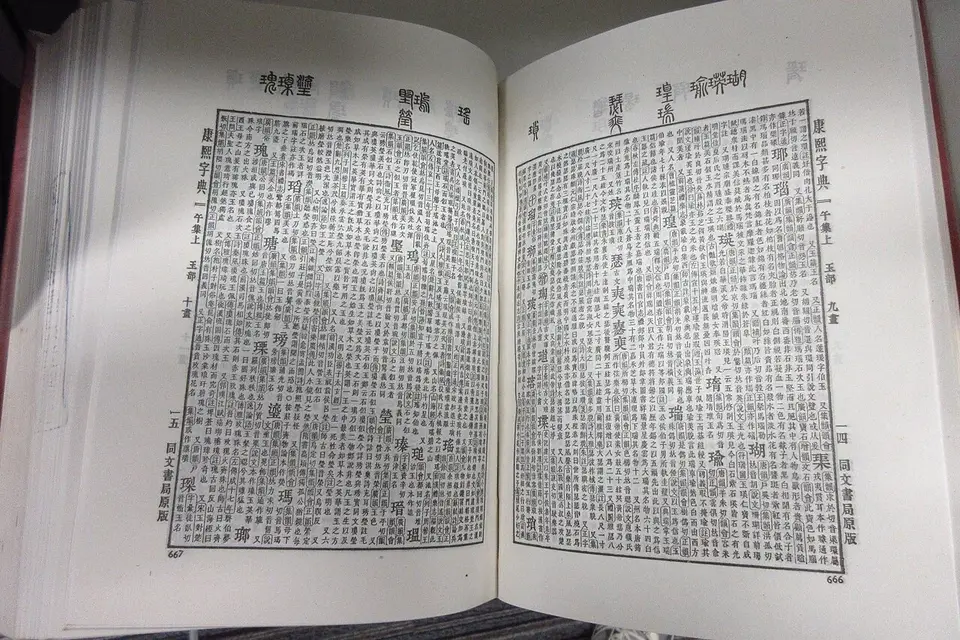
In 1710, to standardize Chinese orthography and clarify canonical meanings, the Kangxi Emperor issued an edict convening the empire's foremost scholars to compile a definitive lexicon, appointing Grand Secretaries Zhang Yushu and Chen Tingjing as chief directors. Zhang established the structural guidelines for the work, tracing ancient Han-Wei pronunciations, refining the 214-radical classification system, and rectifying thousands of errors found in earlier dictionaries like Zihui and Zhengzitong. Completed in 1716, the Kangxi Dictionary (Kangxi Zidian) gathered 47,035 characters, representing the most comprehensive and philologically rigorous official lexicon in premodern Chinese history.
Additionally, Zhang served as director-general for the compilation of the massive 106-volume rhyming treasury Peiwen Yunfu. He personally inspected ancient classics and dynastic histories to supply omitted phrases and verify citations. He also directed the compilation of vital state compendia, including Da Qing Huidian (Collected Statutes of the Great Qing), Da Qing Yitongzhi (Comprehensive Gazetteer of the Great Qing), the History of Three Reigns, and strategic campaign chronicles for the suppression of the Three Feudatories and the Dzungars, establishing the core administrative and cultural canon of the Qing dynasty.
Beyond his literary leadership, Zhang was an accomplished hydraulic strategist who played a central role in resolving flood crises across the Yellow River, Huai River, and Grand Canal.
During the Kangxi reign, frequent breaches of the Yellow and Huai rivers disrupted vital tribute grain shipments along the Grand Canal. In 1688 and 1691, Zhang conducted extensive field surveys around Gaoyou Lake, Hongze Lake, and the Qinghe River estuary, measuring water levels and drainage outlets. Rejecting the conventional reliance on passive dike building, Zhang advocated dredging channels and regulating water flow through overflow diversion weirs.
Crucially, in 1707, while inspecting the Qinghe estuary alongside the Kangxi Emperor, Zhang addressed the recurring crisis of silt-laden Yellow River waters flowing backward into the Huai River. He formulated the strategic hydraulic principle of using the Wen River to replenish the canal, utilizing Huai waters to counter Yellow River backflow, and directing Yellow River floodwaters toward the sea. By maintaining elevated water levels in the Huai River to hold back Yellow River silt, the sediment was forced seaward. The emperor praised this strategic vision and ordered its implementation, stabilizing river defenses across the region.
Serving as Grand Secretary for two decades, Zhang exhibited extraordinary geopolitical insight during the campaigns against Galdan.
During the three imperial expeditions to pacify Dzungar rebellions, Zhang stood firmly with the Kangxi Emperor to defend national unity against court appeasers. In the 1696 campaign, amidst punishing desert sandstorms and logistical supply crises, Zhang, as the sole civilian grand minister accompanying the imperial camp, managed logistics and coordinated official correspondence between Manchu and Han forces. In the imperial command tent, he analyzed northern topography and enemy movements, proposing tactics of tactical containment and defensive wear, which ensured army morale and led to the victory at Jao Modo. His firsthand campaign journal Congzheng Jilüe and the official chronicle Pingding Shuomo Fanglüe remain vital primary sources for Qing military historiography.
FIGURES ASSOCIATED WITH THIS DYNASTY