Birth in Tongcheng
Born into an established scholar-gentry lineage in Tongcheng, Anhui; passed elementary examinations with highest honors at age fourteen.
张英
Zhang Ying (1638–1708), courtesy name Dunfu, art name Puweng, and late sobriquet Legu, was a native of Tongcheng, Anhui Province. He was an eminent statesman, prime minister, literary figure, and founding patriarch of the renowned Tongcheng Zhang lineage during the Kangxi reign of the Qing dynasty. In 1667, he passed the Dingwei metropolitan examinations, placing second in the second class of jinshi graduates, entering the…
Zhang Ying (1638–1708), courtesy name Dunfu, art name Puweng, and late sobriquet Legu, was a native of Tongcheng, Anhui Province. He was an eminent statesman, prime minister, literary figure, and founding patriarch of the renowned Tongcheng Zhang lineage during the Kangxi reign of the Qing dynasty. In 1667, he passed the Dingwei metropolitan examinations, placing second in the second class of jinshi graduates, entering the Hanlin Academy as a bachelor and becoming a compiler. In 1677, when the Kangxi Emperor established the Southern Study (Nan Shufang), Zhang was chosen alongside Gao Shiqi as the inaugural imperial confidants to serve within the inner court, drafting secret edicts and tutoring Crown Prince Yinreng. He subsequently served as Chancellor of the Hanlin Academy, Minister of Works, and Minister of Rites, culminating in his elevation in 1699 to Grand Secretary of the Wenhua Palace concurrently Minister of Rites. Zhang was celebrated for upright diligence, modest restraint, and refusal to associate with court factions, earning the profound trust of the Kangxi Emperor. In a famous boundary dispute involving his ancestral residence in Tongcheng, he penned the immortal verse: "Sending a letter across a thousand leagues merely for a wall, what harm is there in ceding three feet?" This gesture moved his neighbor to yield an equal distance, creating the legendary Six-Foot Lane (Liu Chi Xiang), an enduring emblem of mutual accommodation and civic harmony in Chinese civilization. A dedicated family educator, Zhang authored Congxunzhai Yu and Hengchan Suoyan, laying down strict ancestral precepts. His son Zhang Tingyu served three successive emperors as grand secretary and became the only Han official enshrined in the Imperial Ancestral Temple, while another son Zhang Tinglu placed second in the palace examinations, inaugurating the historic familial triumph of "two prime ministers in two generations and nine jinshi scholars in one household." In cultural affairs, he oversaw the compilation of the 450-volume Yuanjian Leihan, the Zhengzhi Dianxun, and the Da Qing Yitongzhi. He passed away in 1708, was granted the posthumous name Wenduan, and was enshrined in the Temple of Eminent Statesmen.
Born into an established scholar-gentry lineage in Tongcheng, Anhui; passed elementary examinations with highest honors at age fourteen.
Placed twelfth in the Jiangnan provincial examination, winning wide acclaim across southeastern intellectual circles.
Placed second in the second class of the palace examination; Grand Secretary Li Wei praised him as a pillar of the state.
Ranked second in the Hanlin graduation evaluation, appointed compiler, and studied Manchu language and administrative history.
Placed first in imperial essay trials during an imperial excursion to Nanyuan, appointed Daily Imperial Lecturer.
Summoned as an inaugural privy councilor to staff the newly founded Southern Study, advising the throne and tutoring the Crown Prince.
Elevated to Sub-Chancellor of the Grand Secretariat and Chancellor of the Hanlin Academy; retained at court by special imperial decree.
Promoted from Minister of Works to Minister of Rites, supervising state ceremonial protocols and imperial examination standards.
Elevated to Grand Secretary of the Wenhua Palace concurrently Minister of Rites, joining the supreme inner council.
Permitted to retire with the brevet rank of Junior Guardian of the Heir Apparent, returning to Mount Longmian in Tongcheng.
Died peacefully at his Longmian Mountain Villa at age seventy-one; conferred the posthumous name Wenduan and enshrined in the Temple of Eminent Statesmen.
Zhang Ying was born on January 30, 1638, in Tongcheng County, Anqing Prefecture. His mother, Lady Wu, passed away during his childhood, while his father, Zhang Bingyi, was a virtuous local scholar who maintained strict disciplinary standards. Endowed with serious intellectual focus, Zhang comprehended canonical commentaries by age eleven. When he took the local qualifying exams at fourteen, examiners praised his essays as those of a veteran master, ranking him first among county licentiates.
In 1663, Zhang placed twelfth in the Jiangnan provincial examination. Traveling to Beijing in 1667 for the metropolitan examination, he achieved second place in the second class during the palace trials. Chief Examiner and Grand Secretary Li Wei examined his paper, admiring his profound command of dynastic statecraft and praising him as a peerless talent of the nation. Selected as a bachelor in the Hanlin Academy, Zhang studied the Manchu tongue and early Qing legal precedents. In 1672, upon concluding his academy internship, the Kangxi Emperor ranked him second, officially appointing him compiler in the Hanlin Academy.
In April 1673, during an imperial excursion to Nanyuan, the Kangxi Emperor convened a special policy examination for Hanlin academicians. Zhang submitted his celebrated On the Source of the Yellow River and Nanyuan Rhapsody, earning first honors. Seeking upright scholars versed in statecraft to serve as imperial companions, Chancellor Xiong Cili and others recommended Zhang Ying and Li Guangdi. The emperor appointed Zhang as Daily Imperial Lecturer, entrusting him with leading palace seminars on classical philosophy.
In October 1677, aiming to circumvent the conservative Deliberative Council of Princes and Ministers, the Kangxi Emperor established the Southern Study (Nan Shufang) within the inner palace. Zhang Ying and Gao Shiqi were selected as the first confidential secretaries to enter service. Accompanying the monarch day and night, Zhang drafted confidential rescripts and advised on military strategies during the Revolt of the Three Feudatories and the unification of Taiwan. Concurrently, he served as tutor to Crown Prince Yinreng, patiently expounding classical texts. Renowned for discretion, Zhang never leaked palace discussions to outside officials, earning the emperor's lasting trust and rising to Sub-Chancellor of the Grand Secretariat.
In 1686, when the chancellorship of the Hanlin Academy became vacant, the Kangxi Emperor announced to the Grand Secretariat that Zhang's mature prudence and refusal to engage in outside factionalism made him the ideal candidate. That same year, the emperor issued an edict to the Ministry of Personnel declaring that Zhang's literary brilliance and pure character required him to remain permanently at court to draft state documents, strictly prohibiting the ministry from reassigning him to provincial governorships.
Zhang subsequently served as Minister of Works and Minister of Rites. In 1699, he was elevated to Grand Secretary of the Wenhua Palace concurrently Minister of Rites, joining the inner cabinet as prime minister. Serving during the height of the Kangxi peace, Zhang maintained modest restraint, never accumulating private patronage networks. On matters of imperial taxation, ritual administration, and river engineering, he submitted honest, practical memorials. His gentle mediation resolved friction among court factions, preserving harmony between Manchu and Han ministers and reinforcing domestic stability.
In 1701, at age sixty-four, Zhang submitted repeated petitions for retirement due to failing health. Reluctant to part with his trusted councilor, the Kangxi Emperor conferred upon him the title of Junior Guardian of the Heir Apparent, bestowed generous traveling stipends, and dispatched imperial guards to escort him home to Tongcheng.
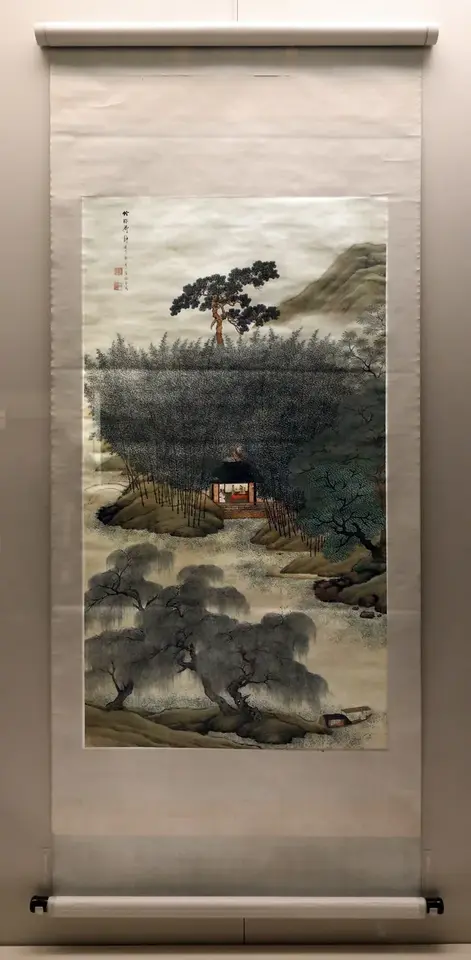
Retiring to Mount Longmian in Tongcheng, Zhang built the Shuangxi Thatched Retreat, styling himself Legu and spending his days amidst bamboo groves, educating his children and grandchildren. During his southern inspection tours in 1703 and 1705, the Kangxi Emperor summoned Zhang aboard the imperial barge, conversing warmly and bestowing calligraphic plaques and imperial poems. In June 1708, Zhang passed away peacefully at his Longmian retreat at age seventy-one. Deeply moved, the emperor granted one thousand taels of silver for his funeral, conferred the posthumous title Wenduan, and in 1723, the Yongzheng Emperor decreed his enshrinement in the Temple of Eminent Statesmen.
Zhang Ying's most significant institutional legacy was serving as the foremost confidential secretary in the early Southern Study, actively facilitating the historic shift of supreme imperial decision-making away from the aristocratic council toward the direct authority of the throne.
Established in 1677, the Southern Study functioned not merely as a drafting salon but as the functional nerve center handling confidential memorials and war planning during the height of the Revolt of the Three Feudatories. Serving beside the emperor's couch, Zhang drafted urgent military dispatches and logistical orders with speed and precision. In critical geopolitical developments—such as the suppression of the Three Feudatories, the maritime integration of Taiwan, border treaties with Tsarist Russia, and campaigns against the Dzungars—Zhang provided steady, prudent counsel. Throughout his life, he preserved state secrets and refused to build private cliques, setting an enduring standard for imperial secretarial integrity.
In civic morality and cultural folklore, Zhang Ying's role in the Six-Foot Lane (Liu Chi Xiang) remains China's most celebrated historical example of humility, mutual deference, and neighborly harmony.
During his tenure at court, Zhang's ancestral household in Tongcheng became embroiled in a property dispute with the neighboring Wu family, an equally prominent local clan, over a disputed boundary passageway between their compounds. When local litigation stalled, Zhang's family dispatched an urgent courier to Beijing, pleading with the Grand Secretary to pressure the local magistrate. Upon reading the letter, Zhang felt deep remorse over his family's pettiness. Rather than contacting local officials, he inscribed a poem on the letter and sent it back: "Sending a letter across a thousand leagues merely for a wall, what harm is there in ceding three feet? The Great Wall still stands firm across ten thousand miles today, yet nowhere can one find the First Emperor of Qin."
Shamed by the poem, Zhang's family immediately demolished their boundary wall and retreated three feet inward. Astonished by the prime minister's magnanimity, the Wu family felt deep contrition and withdrew their own wall by an equal three feet. The resulting six-foot alleyway became a public thoroughfare open to all residents, known as the Six-Foot Lane, immortalizing the virtues of forbearance and civic reconciliation.
Zhang was a preeminent premodern family educator whose ethical writings laid the foundation for the centuries-long prosperity of the Tongcheng Zhang lineage.
In retirement, Zhang synthesized his principles of moral cultivation and household management into classic family manuals, Congxunzhai Yu and Hengchan Suoyan. He emphasized filial piety, honesty, and thrift, instructing descendants that the purpose of education was moral understanding rather than bureaucratic vanity. He warned that wealth and fame acquired through virtue blossomed naturally like mountain flowers, whereas fortunes acquired through rapacity resembled transplanted flowers destined to wither. Under his guidance, his second son, Zhang Tingyu, served three emperors as Grand Secretary and Chief Grand Councilor, becoming the only Han statesman enshrined in the Imperial Ancestral Temple. His third son, Zhang Tinglu, placed second in the palace examinations, and his fourth son, Zhang Tingzhuan, rose to Vice Minister of Works. The family went on to produce twelve jinshi scholars and two prime ministers, establishing an extraordinary record in late imperial history.
Beyond statecraft, Zhang made vital contributions to the compilation of early Qing imperial compendia.
He served as director-general for the massive 450-volume encyclopedia Yuanjian Leihan, which systematically organized allusions, origins of worldly phenomena, and classical citations, becoming an indispensable reference for scholars. He also oversaw the compilation of the Zhengzhi Dianxun, the campaign history Pingding Sanni Fanglüe, the Da Qing Yitongzhi, and initial preparatory work for the Kangxi Dictionary. A master of serene classical prose, his surviving literary collections include Dusutang Shiji, Yuanjianzhai Wenji, Yijing Silu, and Cunchengtang Zoushu.
FIGURES ASSOCIATED WITH THIS DYNASTY