Born in Nanhai
Born on the 4th day of the 1st lunar month in Foshan, Guangdong; demonstrated early intellectual vigor and artistic talent.
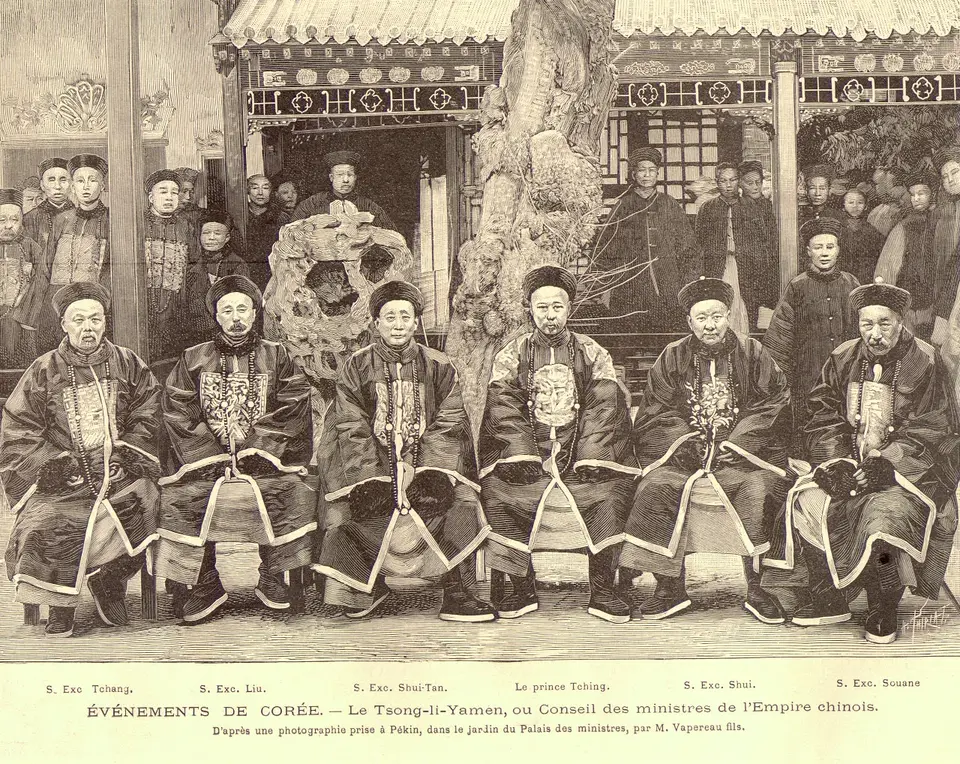
张荫桓
Zhang Yinhuan (张荫桓, February 8, 1837 – July 31, 1900), courtesy name Haoluan (皓峦), art name Qiaoye (樵野), was a native of Nanhai County, Guangdong Province. He was an eminent statesman, diplomat, and leading reformist minister of the late Qing dynasty. Beginning his bureaucratic career through purchase (juanna), Zhang served in the secretariats of Shandong Governors Yan Jingming and Ding Baozhen, and Huguang Governor-General…
Zhang Yinhuan (张荫桓, February 8, 1837 – July 31, 1900), courtesy name Haoluan (皓峦), art name Qiaoye (樵野), was a native of Nanhai County, Guangdong Province. He was an eminent statesman, diplomat, and leading reformist minister of the late Qing dynasty. Beginning his bureaucratic career through purchase (juanna), Zhang served in the secretariats of Shandong Governors Yan Jingming and Ding Baozhen, and Huguang Governor-General Li Hanzhang, distinguishing himself through coastal defense planning and fiscal acumen. In 1884, he entered the Zongli Yamen (foreign office) and was appointed in 1885 as Imperial Envoy to the United States, Spain, and Peru. In Washington, he vigorously defended Chinese immigrants against the virulent anti-Chinese movement, invoking international law to secure nearly 150,000 taels of silver in indemnity from the United States government for victims of the Rock Springs massacre, while establishing schools for overseas Chinese children. Upon returning to China, Zhang held consecutive posts as Director of the Court of Judicature and Revision, Senior Vice Censor-in-Chief, and Senior Vice Minister of Revenue, directing Qing foreign diplomacy and international loan negotiations. Around the First Sino-Japanese War, he was dispatched to Hiroshima as peace commissioner, subsequently negotiated the Sino-Japanese Treaty of Commerce and Navigation, and traveled across Europe as imperial envoy to Queen Victoria's Diamond Jubilee. During the Hundred Days' Reform of 1898, Zhang served as the Guangxu Emperor's closest foreign affairs advisor and a vital patron of reform leaders Kang Youwei and Liang Qichao. Following the conservative coup d'etat, he was banished to Dihua (modern Urumqi), Xinjiang, and was unlawfully executed in 1900 by anti-foreign prince Zaiyi during the Boxer Rebellion. In 1901, the Qing court rehabilitated his name and restored all his posthumous honors under the terms of the Boxer Protocol.
Born on the 4th day of the 1st lunar month in Foshan, Guangdong; demonstrated early intellectual vigor and artistic talent.
Purchased official rank as county magistrate and joined provincial administrative secretariats in Shandong under Yan Jingming and Ding Baozhen.
Recalled to Shandong by Ding Baozhen to plan Northern Seas coastal fortifications; served as acting intendant of the Deng-Lai-Qing Circuit and resisted British jetty duties.
Appointed intendant of the Huining-Chitai-Guang Circuit, eradicating customs fraud and increasing maritime revenue at Wuhu.
Granted imperial audience with Guangxu and Empress Dowager Cixi; awarded third-rank brevet and appointed to the Zongli Yamen.
Appointed Imperial Envoy to the United States, Spain, and Peru; sailed to America to confront the worsening anti-Chinese crisis.
Secured 147,000 US dollars in federal compensation for the Rock Springs massacre; established Chinese schools in Cuba and San Francisco.
Reassigned to the Zongli Yamen; successively promoted to Director of Judicature and Revision, Vice Censor-in-Chief, and Vice Minister of Revenue.
Dispatched alongside Shao Youlian to Hiroshima as peace commissioners during the Sino-Japanese War; Japanese leadership terminated talks prematurely.
Served as plenipotentiary minister to conclude the twenty-nine-article Sino-Japanese Treaty of Commerce and Navigation in Beijing.
Attended Queen Victoria's Diamond Jubilee in Britain; toured Russia, Germany, and France; arranged critical Anglo-German consortium loans.
Actively sponsored the Hundred Days' Reform; arrested following the conservative coup d'etat and exiled to Xinjiang.
Unlawfully executed at Urumqi by reactionary court directives during the Boxer uprising; posthumously rehabilitated in 1901.
Zhang Yinhuan was born on February 8, 1837, in the commercial hub of Foshan Town, Nanhai County, Guangzhou Prefecture, Guangdong Province. His ancestral forebears had migrated from Xiaofanli in Xinhui County to settle in Foshan. From early youth, Zhang showed remarkable intellect, an expansive temperament, and an ardent passion for classical literature, poetry, painting, and epigraphic connoisseurship. When he sat for the county civil service examinations around age twenty, his expressive and free-flowing prose ran counter to the rigid constraints of the eight-legged essay, resulting in repeated exam failures. Confronted by the widespread turmoil of the Taiping Rebellion and the Second Opium War, Zhang resolved to abandon traditional scholastic pursuits in favor of practical administrative statecraft.
In 1864, Zhang purchased the nominal rank of county magistrate and traveled north to Shandong to join the secretariat of his maternal uncle, Li Zongdai. Yan Jingming, then governor of Shandong and renowned for his fiscal integrity, inspected Zhang's administrative drafts and judicial briefs and immediately inducted him into his inner advisory council. When Ding Baozhen succeeded Yan as governor, he similarly relied on Zhang's drafting skills and strategic acumen, remarking that every memorial Zhang drafted hit the exact crux of imperial administration.
In October 1869, Zhang accepted an invitation from Huguang Governor-General Li Hanzhang to move to Wuchang, where he directed the military secretariat and managed provincial troop logistics and water transport finances for five years. In November 1874, following the Japanese expedition to Taiwan that exposed Qing coastal vulnerabilities, Ding Baozhen submitted a special memorial requesting Zhang's urgent return to Shandong to organize Northern Seas defenses.
Upon his return, Zhang conducted exhaustive field surveys along the Bohai Sea coast, presenting Ding Baozhen with strategic proposals for harbor fortifications. He oversaw the modern artillery emplacements at Yantai and Weihaiwei, and was subsequently appointed acting intendant of the Deng-Lai-Qing Circuit. Facing British consular demands to establish a separate foreign concession at Yantai and levy unilateral jetty taxes, Zhang invoked treaty clauses to reject the claims, successfully defending Qing territorial and customs sovereignty.
In 1881, Zhang was appointed circuit intendant of the Huining-Chitai-Guang Circuit in Anhui, with concurrent responsibility over the Wuhu Customs House. Since its opening as a treaty port, Wuhu Customs had suffered from widespread smuggling and collusion between merchants and clerks. Zhang implemented rigorous inspection regimes, abolished intermediate kickbacks, and mandated strict ledger audits, resulting in record annual revenue increases. Simultaneously, when severe flooding struck southern Anhui, he donated his personal salary to establish soup kitchens and relief shelters, winning immense local acclaim. In 1882, he was promoted to judicial commissioner of Anhui.
In May 1884, on the eve of the Sino-French War, the Qing throne urgently sought capable officials with practical foreign affairs knowledge. The Guangxu Emperor and Empress Dowager Cixi granted an audience at the Summer Palace to provincial candidates including Xue Fucheng and Zhang Yinhuan. Zhang delivered a lucid, comprehensive analysis of European geopolitical rivalries, modern naval developments, and tactical diplomacy, greatly impressing the throne. He was granted a third-rank brevet and appointed to serve in the Zongli Yamen.
Because Zhang had risen from a purchased clerkship rather than the prestigious examination system, his rapid ascent to the high metropolitan bureaucracy aroused deep resentment among conservative Hanlin censors. During the height of the Sino-French conflict, Zhang worked closely with Zhili Governor-General Li Hongzhang to explore negotiated settlements that would preserve Qing prestige. When peace talks stalled, conservative ideologues filed vitriolic impeachments against Zhang, labeling him a traitor for employing French intermediary Gustav Detring. Only the steadfast backing of Li Hongzhang and senior Grand Councillors shielded Zhang from imperial censure.
In June 1885, the Qing court issued an imperial rescript naming Zhang Yinhuan Imperial Envoy to the United States, Spain, and Peru, succeeding Zheng Zaoru in Washington. Prior to his departure, Empress Dowager Cixi summoned him twice for personal audiences, reassuring him: "You have always performed your duties with utter seriousness. Those who accomplish real tasks invariably invite jealousy. You must exert yourself with steadfast determination."
In February 1886, Zhang sailed for North America. His arrival coincided with the height of the violent anti-Chinese movement sweeping the American West following the Chinese Exclusion Act of 1882. Chinese miners, laborers, and merchants faced systemic legal disenfranchisement, mob violence, and arson. Most notoriously, during the September 1885 Rock Springs massacre in Wyoming Territory, white mobs burned Chinatown and murdered dozens of Chinese miners. Viceroy Zhang Zhidong cabled Zhang Yinhuan, instructing him to press the United States government for rigorous prosecution and full indemnification.
Upon presenting his credentials in Washington, Zhang departed from traditional passive diplomatic practice by retaining prominent American legal counsel to build an unassailable evidentiary file. In exhaustive diplomatic notes and face-to-face negotiations with US Secretary of State Thomas F. Bayard, Zhang dismantled Washington's defense that the federal government could not interfere in territorial jurisdiction. Invoking the Burlingame Treaty and recognized international law, Zhang insisted that sovereign states could not hide behind domestic legal divisions to evade international treaty obligations. His unwavering stance compelled President Grover Cleveland to send a special message to Congress, which subsequently passed an appropriation bill granting 147,748 US dollars in full indemnity to Chinese victims.
Zhang also directed attention toward the long-term educational welfare of overseas Chinese communities. During a diplomatic visit to Madrid in 1887, he negotiated for the establishment of a Qing consulate in Manila. Furthermore, he memorialized the throne to establish Chinese-language academies in Cuba and founded public schools for Chinese children in San Francisco, helping bridge racial segregation barriers in American municipal education.
In 1888, bilateral negotiations culminated in a proposed new exclusion treaty containing restrictive re-entry conditions. The document ignited fierce protests across Guangdong, and overseas communities accused Zhang of yielding to American coercion. Facing severe domestic criticism, Zhang returned to China in 1889 and withdrew to his Foshan residence, where he compiled his diplomatic observations into the renowned eight-volume Diary of the Three Continents (Sanzhou Riji).
During his nearly four years as minister to the United States, Spain, and Peru, Zhang Yinhuan not only engaged in demanding diplomatic notes and immigrant defense litigation, but also conducted a comprehensive examination of Western political and social institutions. Maintaining a daily journal, he compiled the extensive eight-volume Diary of the Three Continents (Sanzhou Riji). In these writings, he recorded the procedural mechanics of the United States Congress, quadrennial presidential election campaigns, Supreme Court jurisprudence, and municipal infrastructure across New York, Boston, and San Francisco.
Zhang showed immense curiosity regarding modern industrial manufacturing and scientific innovation. He toured locomotive works, shipyards, steel foundries, telegraph offices, and the United States Mint, recording breakthroughs in electric lighting, long-distance communication, and steam power. In higher education, he visited Harvard University and Yale University, observing their curricula, laboratories, and library systems, concluding that Western prosperity rested not merely upon weaponry, but upon widespread education, scientific research, and legal institutions.
In his diary, Zhang reflected on his intellectual philosophy, noting his "three dislikes": shallow people affecting refined tastes, corrupt officials proclaiming administrative accomplishments, and rustic provincials affecting metropolitan jargon. His travel memoirs introduced modern constitutional and technological realities to late Qing scholar-officials, shattering entrenched isolationist mindsets and providing foundational models for the institutional transformations of the Hundred Days' Reform.
In 1890, Zhang was recalled to the capital and reassigned to the Zongli Yamen. He was successively promoted to Director of the Court of Judicature and Revision, Senior Vice Censor-in-Chief, and Senior Vice Minister of Revenue, becoming one of the most indispensable administrators handling national taxation, foreign affairs, and maritime infrastructure under the Guangxu Emperor and Imperial Tutor Weng Tonghe.
In 1894, the First Sino-Japanese War broke out. Following catastrophic Qing defeats at Pyongyang and the Yalu River, imperial authorities sought peace negotiations. The Guangxu Emperor appointed Zhang Yinhuan and Hunan Governor Shao Youlian as plenipotentiary peace commissioners to Japan. Prior to departure, Zhang submitted a memorial advocating simultaneous military vigilance and diplomatic engagement, urging the throne to maintain battlefield preparations while leveraging British and Russian diplomatic influence.
However, when Zhang and Shao arrived in Hiroshima in January 1895, Japanese Prime Minister Ito Hirobumi and Foreign Minister Mutsu Munemitsu, intent on seizing Weihaiwei and expanding territorial demands, seized upon technical phraseology in the Qing imperial credentials to declare the delegation's full powers insufficient. The talks were abruptly terminated and the envoys escorted home. The failure at Hiroshima stemmed not from Zhang's diplomatic conduct, but from Tokyo's calculated strategy to delay peace until decisive military advantages were secured, leading directly to Li Hongzhang's subsequent appointment.
Following the Treaty of Shimonoseki, comprehensive commercial and navigation arrangements remained to be negotiated. In late 1895, the Qing throne named Zhang plenipotentiary minister to negotiate with Japanese Minister Hayashi Tadasu in Beijing. Over months of exhausting sessions, Zhang successfully expunged numerous aggressive Japanese demands regarding unrestricted inland waterway navigation and extraterritorial commercial privileges, ultimately signing the twenty-nine-article Sino-Japanese Treaty of Commerce and Navigation in June 1896.
In 1897, Zhang was appointed Special Imperial Envoy to represent the Qing Empire at Queen Victoria's Diamond Jubilee in London. He continued on diplomatic visits to Russia, Germany, and France. In Saint Petersburg, Tsar Nicholas II conferred upon him the Order of Saint Anne, First Class; in London, Queen Victoria awarded him the Knight Grand Cross of the Order of St Michael and St George. During these European travels, Zhang evaluated competing financial groups, subsequently orchestrating the sixteen-million-pound Anglo-German consortium loan that provided the Qing treasury with essential capital to liquidate wartime indemnities.
Zhang Yinhuan was among the few high metropolitan officials who recognized that superficial technological modernization was inadequate to save China, and that comprehensive institutional and constitutional reform was mandatory. Following the dismissal of Weng Tonghe, Zhang became the Guangxu Emperor's paramount domestic and diplomatic advisor.
During the Hundred Days' Reform of 1898, Zhang utilized his executive positions in the Zongli Yamen and Ministry of Revenue to provide financial support and institutional protection to reformist intellectual groups, including the Qiangxuehui (Society for the Study of National Strengthening) and the Baoguohui (Society to Preserve the Nation). He arranged the Guangxu Emperor's pivotal audience with Kang Youwei and secured Kang's appointment as secretary in the Zongli Yamen. He similarly recommended Liang Qichao to direct the imperial translation bureau, and sponsored reformist figures Tan Sitong, Yang Rui, Lin Xu, and Liu Guangdi.
Throughout the hundred-day period, Zhang assisted the throne in drafting and executing reform edicts, advocating the abolition of the eight-legged civil examination, the establishment of the Imperial University of Peking (modern Peking University), the formation of railway and mining bureaus, and the implementation of a modern state budget.
On September 21, 1898, Empress Dowager Cixi launched a conservative palace coup with the backing of Ronglu and northern military commanders, imprisoning the Guangxu Emperor at Yingtai. Conservative reactionaries immediately targeted Zhang Yinhuan as the emperor's primary reformist confidant.
While court extremists demanded that Zhang be executed alongside the "Six Gentlemen of the Reform," Grand Councillor Ronglu intervened to advocate clemency. Simultaneously, British Minister Sir Claude MacDonald warned the Zongli Yamen that executing a senior diplomat celebrated throughout European capitals would trigger severe international backlash. Yielding to diplomatic pressure, the throne stripped Zhang of all ranks and banished him to Dihua (modern Urumqi) in Xinjiang.
Zhang arrived in Urumqi in April 1899. Accepting his exile with philosophical composure, he took up residence at the Zhifeng Public Garden, establishing his study "Tiehualou" (Iron Painting Studio), composing the renowned frontier poetry collection Hegoji, and funding the restoration of the Jianhu Pavilion for local citizens.
In the summer of 1900, the Boxer Rebellion erupted across northern China, and allied foreign armies marched on Beijing. Anti-foreign princes Zaiyi and Gangyi seized upon the imperial collapse to settle old scores. Falsifying an imperial decree in the Guangxu Emperor's name, Zaiyi telegraphed Xinjiang Governor Rao Yingqi to carry out Zhang's summary execution. On July 31, 1900, Zhang was put to death at Urumqi at the age of sixty-three.
In 1901, following the occupation of Beijing by the Eight-Nation Alliance, foreign powers included the rehabilitation of unjustly executed modernizing ministers as an explicit term of the Boxer Protocol. In April 1901, the Qing court issued an imperial edict exonerating Zhang Yinhuan of all charges and fully restoring his posthumous titles and honours.
Zhang Yinhuan's most significant diplomatic triumph occurred during his tenure as Minister to the United States (1886–1889). Facing widespread anti-Chinese pogroms and municipal boycotts, Zhang bypassed conventional passive protests and mounted an aggressive legal and diplomatic offensive. Following the Rock Springs massacre, he retained leading American constitutional attorneys, gathered sworn affidavits from survivors, and directly confronted US Secretary of State Thomas F. Bayard.
Zhang countered American attempts to evade responsibility through state-federal jurisdictional splits, asserting that sovereign governments cannot cite internal statutory structures to repudiate international treaty commitments. His relentless pressure forced President Cleveland to introduce an emergency bill, resulting in an unprecedented congressional grant of nearly 150,000 silver taels ($147,748) to compensate Chinese victims.
Recognizing education as crucial for community survival, Zhang promoted the founding of Chinese schools in Havana, Cuba, and supported the creation of Chinese community schools in San Francisco. He dismantled racial admission restrictions in local school districts, providing migrant children with modern education while preserving their cultural heritage.
In the aftermath of the Sino-Japanese War, Zhang displayed exceptional tenacity in mitigating imperialist encroachment. As plenipotentiary minister negotiating the 1896 Sino-Japanese Treaty of Commerce and Navigation, Zhang withstood immense pressure from Japanese Envoy Hayashi Tadasu. Across twenty-nine detailed articles, he successfully restricted Japanese vessels from unrestricted navigation along inland rivers and preserved municipal commercial regulation rights for Qing authorities.
During his 1897 European mission, Zhang conducted sophisticated financial diplomacy across London, Berlin, and Paris. With China facing astronomical indemnity payments that threatened fiscal bankruptcy, Zhang evaluated loan conditions from rival banking syndicates. He successfully finalized the sixteen-million-pound Anglo-German consortium loan, securing lower interest rates and preventing foreign territorial hypothecations.
During the transition from technical self-strengthening to institutional transformation, Zhang was the foremost court champion of constitutional and administrative reform. Having observed parliamentary governance and modern universities in the West, he recognized that genuine national rejuvenation required comprehensive overhaul of China's political, legal, and educational structures.
Zhang served as the critical institutional bridge between the Guangxu Emperor and reformist scholars. He facilitated imperial audiences for Kang Youwei, sponsored Liang Qichao's translation projects, and championed the establishment of the Imperial University of Peking and state railway administrations. His administrative mastery provided practical momentum to the visionary ideas of the reformist intelligentsia.
Zhang was also a distinguished scholar and man of letters. His eight-volume Diary of the Three Continents (Sanzhou Riji) offers a meticulous contemporary account of American political mechanisms, industrial manufacturing, technological expositions, and immigrant life, standing as one of the finest late Qing travelogues.
His frontier poetry collection Hegoji, composed during his exile in Xinjiang, combines solemn lyricism with profound patriotic reflection on China's imperial decline. Renowned modern literary critics, including Wang Pixiang, regarded his works as the pinnacle of late Qing frontier poetry. His residence "Tiehualou" in Foshan remains a celebrated historical landmark of Lingnan cultural heritage.
FIGURES ASSOCIATED WITH THIS DYNASTY