Early Mastery
Born in the metropolitan capital region, mastering fine brushwork, portraits, and horses in his youth.
张萱
Zhang Xuan (张萱, dates of birth and death unrecorded) was a native of Jingzhao (modern Xi'an, Shaanxi). He was a preeminent court painter of the High Tang period, active primarily during the Kaiyuan and Tianbao eras under Emperor Xuanzong. In 723 (the eleventh year of the Kaiyuan era), Zhang Xuan was appointed as Painter of the Historiography Institute alongside fellow painter Yang Sheng. Excelling in portraits, court ladies,…
Zhang Xuan (张萱, dates of birth and death unrecorded) was a native of Jingzhao (modern Xi'an, Shaanxi). He was a preeminent court painter of the High Tang period, active primarily during the Kaiyuan and Tianbao eras under Emperor Xuanzong. In 723 (the eleventh year of the Kaiyuan era), Zhang Xuan was appointed as Painter of the Historiography Institute alongside fellow painter Yang Sheng. Excelling in portraits, court ladies, noble equestrians, and palace landscapes, he gained unmatched acclaim for depicting the refined daily life of imperial consorts and noblewomen. In Chinese art history, he is celebrated alongside the mid-Tang master Zhou Fang under the collective moniker "Zhang-Zhou," revered as the founding progenitor of classical Chinese court lady figure painting. Zhang Xuan introduced groundbreaking artistic transformations. Breaking free from the restrictive conventions of Han, Wei, and Six Dynasties art—which largely confined women to moralistic illustrations of filial and chaste paragons—he boldly oriented his brush toward the secular realities of aristocratic women engaged in spring outings, silk beating, needlework competitions, and music. His female figures were distinguished by plump, statuesque proportions, rounded features, and the signature technique of applying red rouge wash behind the ears. Rendered in delicate iron-wire lines and luminous, richly coordinated colors, his work epitomized the confident, flourishing aesthetic of the High Tang. Although his original silk scrolls were lost during dynastic wars, Emperor Huizong's celebrated court copy of Court Ladies Preparing Newly Woven Silk (Daolian Tu, preserved in the Museum of Fine Arts, Boston) and the Song dynasty academy copy of Spring Outing of the Lady of Guo (Guoguo Furen Youchun Tu, preserved in the Liaoning Provincial Museum) survive intact as peerless masterpieces of world art.
Born in the metropolitan capital region, mastering fine brushwork, portraits, and horses in his youth.
Recruited into imperial service alongside Yang Sheng, serving as Painter of the Historiography Institute.
Perfected palace garden scenes and developed the distinctive rouge wash technique behind court ladies' ears.
Observed the grand equestrian processions of Lady Guo, composing Spring Outing of the Lady of Guo.
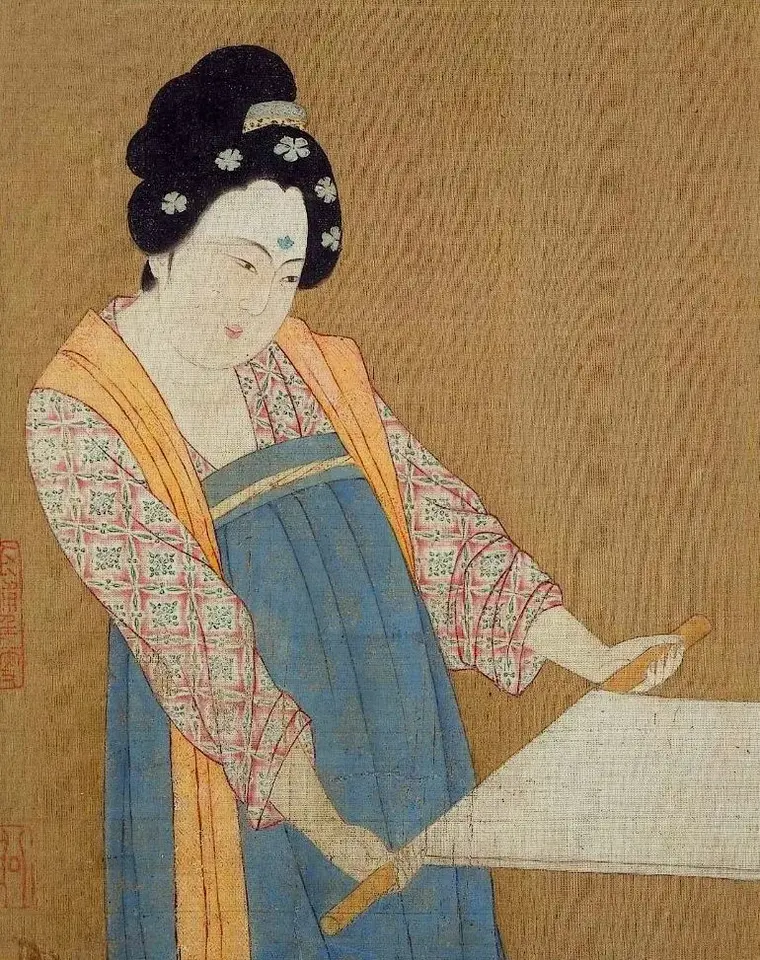
Created Court Ladies Preparing Newly Woven Silk, capturing palace textile labor in elegant narrative groupings.
Emperor Huizong collected forty-seven of Zhang Xuan's works in the Xuanhe Palace and personally copied Court Ladies Preparing Newly Woven Silk.
Zhang Xuan was a native of Chang'an in the Jingzhao metropolitan region (modern Xi'an, Shaanxi). During the Kaiyuan era, as the Tang empire enjoyed domestic peace, agrarian prosperity, and cosmopolitan trade, Chang'an stood as the cultural capital of the medieval world, gathering the realm's finest calligraphers, painters, and artisans. Growing up within this intellectually vibrant environment, Zhang Xuan was nurtured by the legacy of Six Dynasties and early Tang figure painting, displaying prodigious artistic instinct from an early age. He studied the meticulous compositional traditions of Gu Kaizhi and Yan Liben while closely observing the spirited equestrian outings of young aristocrats and the social customs of the imperial capital.
In his formative sketches, Zhang Xuan exhibited extraordinary versatility. He demonstrated particular brilliance in drafting preliminary compositions, arranging complex multi-figure narrative scenes with pavilions, bamboo groves, ornamental rocks, and horses into effortless rhythmic harmony. While earlier figure painters predominantly adhered to the slender, ethereal aesthetic established by Gu Kaizhi in the fourth century, Zhang Xuan embraced the burgeoning vitality of the High Tang, experimenting with full-bodied, dignified forms that captured the spirit of imperial prosperity. His reputation spread rapidly across Chang'an.
In 723 (the eleventh year of the Kaiyuan era), Emperor Xuanzong established the Lizheng Academy and the Jixian Hall to recruit scholars, music masters, and artists into central court service. A passionate connoisseur of music and painting, Emperor Xuanzong ordered high officials to select premier painters from the capital. Zhang Xuan and fellow master Yang Sheng were chosen for their exceptional skill, receiving formal commissions as Painters of the Historiography Institute.
Within the palace, Zhang Xuan enjoyed ideal creative conditions. Serving as an imperial court painter, his duties encompassed illustrating historical archives, painting portraits of meritorious statesmen, and decorating palace screens under imperial command. For decades, he moved freely through the Daming Palace, Xingqing Palace, and the Huaqing Hot Springs on Mount Li, observing the private life, banquets, and rituals of the imperial household at close hand. The sumptuous silks, gold-inlaid implements, ornamental headdresses, and leisurely palace routines provided him with rich visual material and creative inspiration.
Prior to the High Tang, depictions of women in Chinese painting were heavily dominated by didactic moralism. Following the tradition of the Biographies of Exemplary Women (Lienü Zhuan), earlier paintings such as Gu Kaizhi's Admonitions of the Court Instructress focused primarily on reinforcing Confucian ethical virtues of wifely obedience, chastity, and self-sacrifice. These depictions were characterized by sober, moralizing restraint.
Zhang Xuan staged an unprecedented artistic revolution by liberating secular female subjects from dogmatic constraints. He turned his attention to the real experiences and leisure activities of contemporary noblewomen, portraying their spring excursions, winter snow viewings, Qixi needlework festivals, tea preparations, and musical performances. In doing so, he established the definitive aesthetic model for High Tang court ladies: rounded, radiant faces with statuesque, full-figured proportions. He perfected the signature technique of blending red rouge across the cheeks and behind the earlobes, imparting warmth, lifelike vitality, and noble poise to his figures. His depictions of palace children were celebrated for combining playful childhood innocence with sharp, mischievous alertness, earning universal praise as an unprecedented artistic breakthrough.
During the Tianbao era, Emperor Xuanzong lavished favor upon Consort Yang Guifei, whose elder sisters—the Lady of Han, Lady of Guo, and Lady of Qin—attained extraordinary aristocratic prominence. On the annual spring festivals, the Yang clan conducted extravagant equestrian processions across the capital toward the Qujiang Pool. Observing these glittering spectacles, Zhang Xuan painted his monumental masterpiece, Spring Outing of the Lady of Guo. Simultaneously, exploring the domestic life of palace artisans, he composed Court Ladies Preparing Newly Woven Silk, capturing the intricate stages of washing, threading, and ironing woven fabrics.
With the outbreak of the An Lushan Rebellion in 755, Chang'an and Luoyang fell to rebel armies, and the historical record of Zhang Xuan's final years was swallowed by wartime turmoil. However, his stylistic innovations were directly inherited and expanded by the mid-Tang master Zhou Fang, establishing the "Zhang-Zhou" lineage as the orthodoxy of classical figure painting. In the Northern Song, Emperor Huizong's Xuanhe Palace collection held forty-seven of his scrolls, including Emperor Minghuang Enjoying the Cool Breeze and Morning Toilette. Emperor Huizong and academy painters painstakingly copied his works, preserving the majestic artistic spirit of the High Tang across centuries.
Zhang Xuan's greatest historic contribution lay in transforming female figure painting from dogmatic didacticism into an independent genre celebrating secular human grace. He defined the canonical High Tang visual ideal of noblewomen, distinguished by voluptuous physical forms, glowing complexions, subtle rouge blending behind the ears, and harmonious polychrome robes. This visual language became the universal artistic embodiment of the Tang empire's wealth and cosmopolitan confidence, directly inspiring Zhou Fang and shaping court lady painting through the Song and Ming dynasties.
Zhang Xuan's Spring Outing of the Lady of Guo stands as a crowning achievement of Chinese narrative painting. Depicting eight horses and nine riders on a spring excursion, the scroll dispenses entirely with background landscapes, utilizing the measured movement of riders, the angle of steeds, and the placement of riders to evoke spring air and aristocratic majesty. The arrangement of vanguard escorts, the central pair of riding noblewomen in intimate conversation, and the protective rear guard achieved an organic unity of spatial rhythm that represents an enduring peak of narrative composition.
Court Ladies Preparing Newly Woven Silk (Daolian Tu) documents the entire sequence of fabric processing in the Tang palace across twelve female figures divided into three functional groupings: rhythmic pounding of raw silk, delicate untangling and sewing of threads, and careful ironing with heated braziers. From the rolled-up sleeve of an exhausted worker to the playful child crawling under the stretched silk fabric, Zhang Xuan captured natural labor with noble grace. Using resilient iron-wire line drawing and rich mineral pigments, he elevated collective labor into a celebration of feminine dignity.
Although Zhang Xuan's original scrolls perished over centuries of warfare, their compositional genius survives through high-fidelity Northern Song court copies. Emperor Huizong's copy of Court Ladies Preparing Newly Woven Silk (in the Museum of Fine Arts, Boston) and the Song copy of Spring Outing of the Lady of Guo (in the Liaoning Provincial Museum) accurately preserve the pigments, textile weaves, and equestrian bridles of the eighth century, revered worldwide as irreplaceable treasures of East Asian civilization.
FIGURES ASSOCIATED WITH THIS DYNASTY