Early Office
Recruited into imperial service by Emperor Wu of Liang, appointed Attendant of Wuling.
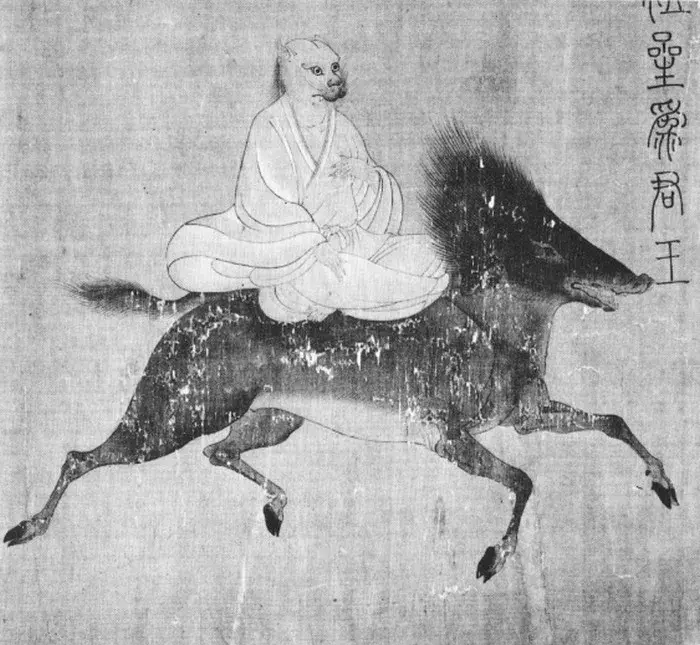
张僧繇
Zhang Sengyao, native to Wuzhong in Wu Commandery (modern Suzhou, Jiangsu Province), was an epochal master painter active during the zenith of the Liang dynasty in the first half of the sixth century, venerated alongside Gu Kaizhi, Lu Tanwei, and Wu Daozi as one of the "Four Ancestors of Chinese Painting." Rising through unremitting dedication from humble origins, Zhang Sengyao excelled in lifelike portraiture and monumental…
Zhang Sengyao, native to Wuzhong in Wu Commandery (modern Suzhou, Jiangsu Province), was an epochal master painter active during the zenith of the Liang dynasty in the first half of the sixth century, venerated alongside Gu Kaizhi, Lu Tanwei, and Wu Daozi as one of the "Four Ancestors of Chinese Painting." Rising through unremitting dedication from humble origins, Zhang Sengyao excelled in lifelike portraiture and monumental temple murals. Under Emperor Wu of Liang, he held appointments including Attendant of the Wuling Princely Domain, Imperial Archivist in the Secret Archive, General of the Right Army, and Grand Administrator of Wuxing. As Emperor Wu commissioned magnificent Buddhist temples across the realm, Zhang Sengyao directed the mural programs of foremost imperial monasteries. In technique, he pioneered the integration of Indian chiaroscuro shading ("concave-convex flowers" / aotu hua) introduced via Buddhist murals at the Yicheng Temple in Jiankang, producing three-dimensional illusions that astonished contemporary society. Transforming Madame Wei's calligraphic brushwork principles into painting, he created the "sparse brushwork" (shuti) style, employing minimal, powerful strokes that rivaled the dense continuous lines of Gu Kaizhi and Lu Tanwei. Zhang Sengyao sculpted a voluptuous, radiant Buddhist figural ideal known as the "Zhang Family Model" (Zhang Jia Xiang), which became the premier template for East Asian Buddhist art. The famous idiom "bringing the dragon to life by painting its eyes" (hualong dianjing) originated from his legendary mural at the Anle Temple. Surviving copies such as the Forms of the Five Planets and Twenty-Eight Constellations preserve his monumental legacy, which directly inspired Tang masters Yan Liben and Wu Daozi.
Recruited into imperial service by Emperor Wu of Liang, appointed Attendant of Wuling.
Appointed Imperial Archivist in the Secret Archive, traveling across regions to paint portraits of imperial princes.
Painted the famous "concave-convex flowers" using Indian shading at the Yicheng Temple, producing optical 3D illusions.
Painted dragons on the walls of Anle Temple in Jinling, dotting the pupils of two dragons that broke the wall and flew into the sky.
Elevated to General of the Right Army and Grand Administrator of Wuxing in recognition of his artistic achievements.
Instructed his sons Zhang Shanguo and Zhang Rutong, formalizing the stylistic lineage of the "Zhang Family Model."
Zhang Sengyao was born into the culturally fertile environment of Wu Commandery. Originating from modest background, he studied painting with unbending discipline at Mount Yunding. Tang accounts record that throughout his life, he worked tirelessly day and night, barely setting his brush aside for decades, acquiring matchless precision in life sketching and structural composition.
In the early Tianjian era of Liang, Emperor Wu of Liang actively patronized artistic talents, recruiting Zhang Sengyao as Attendant of the Wuling Princely Domain. At the time, Emperor Wu's imperial sons were stationed across provincial commands in Jiangxi, Jingzhou, and Xiangzhou. Longing for his sons, Emperor Wu dispatched Zhang Sengyao to regional headquarters to paint their formal portraits. Zhang's brushwork captured their living likenesses and spiritual presence so vividly that when Emperor Wu unfurled the scrolls in the palace, he exclaimed that looking upon the paintings was identical to meeting his sons in person. Consequently, Zhang was appointed to the Secret Archive, overseeing imperial art treasures and court projects.
During the Liang dynasty, Buddhism flourished with unprecedented splendor under imperial sponsorship. Emperor Wu constructed hundreds of monasteries in and around Jinling, selecting Zhang Sengyao to direct the execution of sacred wall paintings. In these projects, Zhang synthesized foreign artistic techniques arriving along Buddhist pilgrimage routes from India.
According to Xu Song's Jiankang Shilu, Prince of Shaoling Xiao Lun founded the Yicheng Temple in Jiankang. On the gateway walls, Zhang Sengyao applied the Indian shading technique (aotu hua), layering vermilion, malachite green, and azurite blue with gradual color grading. Viewed from a distance of dozens of paces, the painted floral motifs appeared intensely sculptural and three-dimensional; yet upon stepping close to touch the wall, the surface was completely flat. Citizens of Jinling flocked to witness the optical marvel, popularly renaming the sanctuary "The Concave-Convex Temple."
At the Anle Temple in Jinling, Zhang painted four white dragons on the white plaster walls, depicting them with soaring dynamism but deliberately leaving their eyes blank. When curious onlookers questioned this omission, Zhang remarked: "The eyes constitute the vital spirit of the dragon; if I dot their pupils, they will break through the wall and soar into heaven." Believing this was rhetorical exaggeration, the monks insisted he paint the eyes. Raising his brush, Zhang dotted the pupils of two dragons. Suddenly, thunder and lightning shook the temple, lightning fractured the plaster walls, and the two dragons soared into storm clouds, leaving only the two un-dotted dragons frozen upon the wall. This famous legend gave birth to the enduring Chinese idiom hualong dianjing ("painting the dragon and dotting the eyes," symbolizing adding the final vital touch).
In brushwork methodology, Zhang Sengyao absorbed the dynamic stroke principles outlined in female calligrapher Madame Wei's Battle Array of the Brush (Bi Zhen Tu), transforming calligraphic energy into pictorial lines.
Whereas earlier masters Gu Kaizhi and Lu Tanwei utilized the "dense style" (miti)—characterized by tight, continuous, spiraling thread-like lines resembling silk spun by silkworms—Zhang Sengyao forged the "sparse style" (shuti). Employing abbreviated, decisive flicking and hacking strokes, he achieved visual completion through minimal lines ("with only one or two strokes, the likeness is fully realized").
Furthermore, Zhang revolutionized the physical ideal of Buddhist and human portraiture. Overturning the emaciated, ascetic figures typical of earlier Six Dynasties art, he created full, radiant, and voluptuous countenances characterized as "short-faced and luscious" (mian duan er yan), an aesthetic christened the "Zhang Family Model" (Zhang Jia Xiang). Critic Zhang Huaiguan celebrated this triadic achievement: "In human beauty, Zhang captured the flesh, Lu captured the bone, and Gu captured the spirit." The Zhang Model became the direct aesthetic progenitor of High Tang Buddhist sculpture and the murals of Dunhuang.
With his artistic renown resounding throughout the realm, Emperor Wu elevated Zhang Sengyao to General of the Right Army and Grand Administrator of Wuxing. In his administrative post, Zhang governed with benevolence, dedicating his spare hours to painting scrolls including the Forms of the Five Planets and Twenty-Eight Constellations, Emperor Wu of Han Shooting the Flood Dragon, and Portrait of Emperor Wu of Liang.
Zhang personally trained his sons, Zhang Shanguo and Zhang Rutong, both of whom inherited his masterly techniques and achieved widespread acclaim as religious painters under the Chen and Sui dynasties. Through this lineage, Zhang Sengyao's sparse brushwork and sculptural figuration were transmitted directly into the High Tang renaissance, shaping the brushwork of Yan Liben and Wu Daozi.
Zhang Sengyao broke free from the restrictive linear density of early Six Dynasties painting, creating the calligraphic "sparse style" that established the foundation for spontaneous literati brushwork.
He established the iconic voluptuous and radiant aesthetic for East Asian Buddhist iconographic art, transforming Buddhist sculpture and mural traditions through the Tang dynasty.
At the Yicheng Temple, he successfully introduced Indian shading and tonal gradation into Chinese architectural painting, creating the earliest systematic integration of Western optical depth on Chinese walls.
His legendary mural at Anle Temple produced the immortal Chinese idiom hualong dianjing, embodying the concept of breathing vital spiritual genius into art.
FIGURES ASSOCIATED WITH THIS DYNASTY