Birth in Jinjiang
Born into an impoverished farming family in Xiahang Village, Jinjiang, Fujian; displayed extraordinary memory and literary precocity from childhood.
张瑞图
Zhang Ruitu (张瑞图, 1570–1644), courtesy names Changong and Wuhua, art names Ershui, Guoting Shanren, and Baihao Anzhu, was a native of Jinjiang, Fujian. He was a distinguished calligrapher, landscape painter, and grand secretary of the late Ming dynasty. In 1607, he achieved third place in the imperial palace examinations (Tanhua) and was appointed Junior Compiler of the Hanlin Academy. During the Tianqi reign, he rose through…
Zhang Ruitu (张瑞图, 1570–1644), courtesy names Changong and Wuhua, art names Ershui, Guoting Shanren, and Baihao Anzhu, was a native of Jinjiang, Fujian. He was a distinguished calligrapher, landscape painter, and grand secretary of the late Ming dynasty. In 1607, he achieved third place in the imperial palace examinations (Tanhua) and was appointed Junior Compiler of the Hanlin Academy. During the Tianqi reign, he rose through the civil bureaucracy to become Minister of Rites and Grand Secretary of the Jianji Hall, concurrently awarded the prestigious honor of Junior Preceptor. Because he drafted imperial edicts and inscribed commemorative stone steles for the living shrines of the powerful eunuch Wei Zhongxian, he was later indicted under the Imperial Register of Treasonous Retainers during the Chongzhen reign, stripped of all official ranks, and permitted to redeem penal exile through a monetary fine before retiring to his home village. In the history of Chinese art, Zhang Ruitu is celebrated as one of the most daring and revolutionary masters of the late Ming dynasty. He was grouped with Dong Qichang, Xing Dong, and Mi Wanzhong as the Four Great Calligraphers of the Late Ming, and alongside Huang Daozhou, Wang Duo, Ni Yuanlu, and Fu Shan as the Five Masters of the Late Ming. Departing sharply from the conventional, rounded grace of Zhao Mengfu and Dong Qichang, Zhang pioneered a sharp, angular, and dynamic style using side-brush techniques and abrupt directional pivots. His wild cursive, semi-cursive, and standard scripts achieved monumental vigor and eccentric visual tension, deeply inspiring the romanticist calligraphic revival of the late Ming. Transmitted to Edo-period Japan by Zen monks of the Obaku school, his art left a profound and lasting imprint on Japanese calligraphy.
Born into an impoverished farming family in Xiahang Village, Jinjiang, Fujian; displayed extraordinary memory and literary precocity from childhood.
Passed the Fujian provincial civil examinations as a provincial graduate (Juren), gaining regional acclaim for his disciplined study habits and quick composition.
Placed third in the imperial palace examinations (Tanhua) and received appointment as Junior Compiler of the Hanlin Academy, launching his civil service career.
Promoted to Director of Studies in the National Guozijian and later Junior Supervisor of the Household, delivering lectures for imperial court seminars and helping compile imperial records.
Appointed Vice Minister of Rites, and in the autumn of the same year promoted to Minister of Rites and Grand Secretary, entering the Grand Secretariat alongside Shi Fenglai.
Advanced to Grand Secretary of the Jianji Hall and bestowed the title of Junior Preceptor; reluctantly drafted cabinet rescripts and inscribed steles for Wei Zhongxian's shrines.
Following the accession of the Chongzhen Emperor and the downfall of the eunuch faction, submitted numerous memorials requesting retirement and was permitted to leave office.
Listed in the Imperial Register of Treasonous Retainers as a secondary associate; sentenced to three years of penal servitude, commuted to a fine, and reduced to commoner status.
Lived in serene retirement near Baihao Hermitage for over a decade, studying Buddhism and producing prolific calligraphy and paintings; passed away quietly at home at seventy-five.
The Longwu regime of the Southern Ming cleared him of factional treason, posthumously restored his titles, and conferred the posthumous name Wenyin.
Zhang Ruitu was born in 1570 in Xiahang Village, Qingyang, Jinjiang County, Fujian Province. His father, Zhang Zhiting, was an honest and frugally living farmer who struggled continuously with rural poverty. From early childhood, Zhang demonstrated unusual intellectual ambition and sharp memory. Under the tutelage of local scholar Lin Tianzhi, he immersed himself in the Confucian classics. Because the family could not afford oil for nocturnal reading lamps, the young Zhang walked every evening to the nearby Buddhist temple known as Baihao Hermitage, utilizing the dim, flickering light before the altar to transcribe and study ancient texts until dawn.
During his years of nocturnal study at the hermitage, Zhang developed a distinctive and rigorous methodology. He believed that merely reading texts silently induced mental distraction and superficiality. Consequently, he chose to copy the Five Classics, the major philosophers, and the Standard Histories by hand repeatedly, simultaneously honing his brushwork and internalizing historical meanings. As a prefectural student, he would compose elaborate essays on classical themes in minutes, causing students across Quanzhou and Jinjiang to eagerly circulate his manuscripts.
In 1603, at thirty-four, Zhang passed the provincial examinations as a provincial graduate. In the spring of 1607, he journeyed to Beijing, passed the metropolitan examinations, and excelled in the palace examinations, earning third place overall (Tanhua). By Ming administrative practice, the third-place finisher was customarily awarded the office of Junior Compiler in the Hanlin Academy. This prestigious entry conferred upon him the duty of drafting imperial pronouncements and compiling national chronicles, establishing him within the imperial civil elite.
Within the Hanlin Academy, Zhang Ruitu performed his scholarly duties with diligence while avoiding factional intrigue. As factional strife between reformist scholars and palace cliques intensified in the late Wanli era, Zhang steadily received promotions, serving as Expositor-in-waiting, Director of Studies in the National Guozijian, and Junior Supervisor of the Household. During these decades, he remained modest in daily habits, spending his leisure time exploring unconventional calligraphy techniques. His idiosyncratic brush style gradually gained widespread acclaim among Beijing literati.
Following the accession of the Tianqi Emperor in 1621, the palace eunuch Wei Zhongxian usurped administrative authority, establishing a reign of terror through the Eastern Depot and purging Donglin partisans like Yang Lian and Zuo Guangdou. In the autumn of 1626, facing widespread cabinet resignations, Wei sought prominent scholars of mild temperament to maintain external governance. Zhang Ruitu, then Vice Minister of Rites, was unexpectedly promoted alongside Shi Fenglai to Minister of Rites and Grand Secretary, entering the Grand Secretariat to oversee court deliberations.
Approaching sixty years of age, Zhang possessed neither personal factional ambition nor taste for political intrigue. However, the Grand Secretariat was heavily dominated and monitored by eunuch supervisors. In 1626 and 1627, regional officials seeking favor erected living shrines for Wei Zhongxian throughout the empire and requested prominent scholars to compose and brush their dedication steles. Wei greatly admired Zhang's calligraphy and insisted that Zhang brush the inscriptions. Caught in an untenable dilemma where defiance meant imprisonment or death, Zhang yielded to fear and complied. In 1627, he was elevated to Grand Secretary of the Jianji Hall and conferred the title of Junior Preceptor.
In the eighth month of 1627, the Tianqi Emperor died and was succeeded by his younger brother, the Chongzhen Emperor. The new sovereign systematically dismantled the eunuch faction, driving Wei Zhongxian to suicide. Imperial censors subsequently launched aggressive impeachments against all cabinet ministers and ministers who had accommodated the eunuch regime. Fully aware of the political retribution awaiting him, Zhang submitted dozens of petitions pleading illness and requesting retirement. Recognizing that Zhang had taken no active part in political purges, the emperor permitted him to retire with his official ranks in 1628.
Nevertheless, public outcry against former eunuch collaborators remained fierce. In the third month of 1629, the Chongzhen Emperor promulgated the Imperial Register of Treasonous Retainers, classifying disgraced officials into several categories. Zhang Ruitu was placed in the sixth category of secondary associates of palace eunuchs. The statutory punishment was three years of penal servitude. However, in consideration of his prime ministerial rank and timely voluntary retirement, the imperial court commuted his prison term to a monetary fine, stripped him of all honors, and relegated him to commoner status.
In 1630, after paying the required redemption penalty, Zhang departed Beijing and returned alone to Jinjiang. Having forfeited his court stature and suffered severe moral censure from orthodox literati, he retreated completely from public life. He adopted the hermitage name Baihao Anzhu, dedicating his remaining years to Buddhist contemplation, scenic nature, and calligraphy, seeking solace from the deep moral and political trauma of his official downfall.
During his fourteen years of rural retirement, Zhang Ruitu devoted himself entirely to artistic creation and Buddhist meditation. He constructed a modest dwelling adjacent to Baihao Hermitage in Qingyang, living on a simple vegetarian diet and chanting Buddhist scriptures. Free from political coercion, his calligraphy attained supreme maturity, characterized by weathered strength, reckless freedom, and spiritual depth. Despite past political controversy, scholars and collectors throughout southern China passionately sought his works. Zhang distributed his writings generously without distinction of social class, frequently using meager remuneration to finance local bridge repairs and aid impoverished relatives.
In the third month of 1644, peasant rebel forces captured Beijing, leading to the suicide of the Chongzhen Emperor, followed closely by the Manchu invasion. Learning of the empire's collapse in his rural retreat, Zhang wept bitterly over the tragic fate of the realm and passed away later that year at seventy-five. He left behind poetry and prose collections, including inner and outer chapters of the Baihao Hermitage writings, articulating his philosophical resignation and artistic thoughts.
Following the fall of the Hongguang court in Nanjing, Prince Tang proclaimed himself the Longwu Emperor in Fuzhou. In 1646, seeking to rally loyalist scholars, the Longwu court reviewed Zhang's case, recognized his integrity during retirement, and posthumously cleared his name. The court restored his former offices and bestowed upon him the posthumous title Wenyin, ordering an honorable reburial with full ministerial rites. His relative and former grand secretary, Lin Yuji, composed a monumental epitaph that meticulously explained the political coercion Zhang had endured and affirmed his spotless artistic conscience.
Zhang Ruitu ranks among the most revolutionary calligraphers in imperial Chinese history. At a time when the late Ming calligraphic scene was dominated by the elegant, round, and gentle standards of Zhao Mengfu and Dong Qichang, Zhang boldly charted an independent path, creating a sharp, precipitous, and muscular style. Contemporaries grouped him with Xing Dong, Mi Wanzhong, and Dong Qichang as the Four Great Calligraphers of the Late Ming, establishing the renowned geographical contrast of Dong in the north and Zhang in the south.
In brush technique, classical running and cursive scripts since Wang Xizhi had strictly prioritized center-tip execution, promoting subtlety and balanced harmony. Zhang radically discarded this ancient dogma, aggressively deploying the side brush, sharp directional pivots, flat slices, and abrupt turns. Holding the brush low with extraordinary wrist strength, he drove the brush with the speed of an unsheathed blade. Instead of smooth circular loops, his turns were rendered as sharp, square corners resembling chisel strokes on stone. Scholar Zhang Zongxiang celebrated this fierce momentum as akin to heavily armed soldiers clashing in a narrow alley.
In spatial composition, Zhang displayed unprecedented structural inventiveness. His characters were horizontally stretched and flattened, with tight internal cores and wildly extended outer strokes reminiscent of archaic clerical script. In spatial distribution, he favored dense character spacing combined with remarkably wide line spacing. This contrast produced tightly interlocking vertical columns that contrasted dynamically with open breathing space between lines, creating immense visual rhythm and monumental energy, earning high praise from modern calligraphic historians like Sha Menghai.
Having frequented Baihao Hermitage from childhood, Zhang delved deeply into Chan Buddhist philosophy during his mature years, maintaining close friendships with eminent Buddhist masters of the Obaku tradition. The radical freedom and intuitive directness of Chan enlightenment directly infused his calligraphic aesthetics. In his late retirement, writing under the Buddhist names Baihao Anzhu and Pingdeng Jushi, he integrated calligraphic practice with Chan meditation, transmuting his early aggressive sharpness into weathered, austere, and profound tranquility.
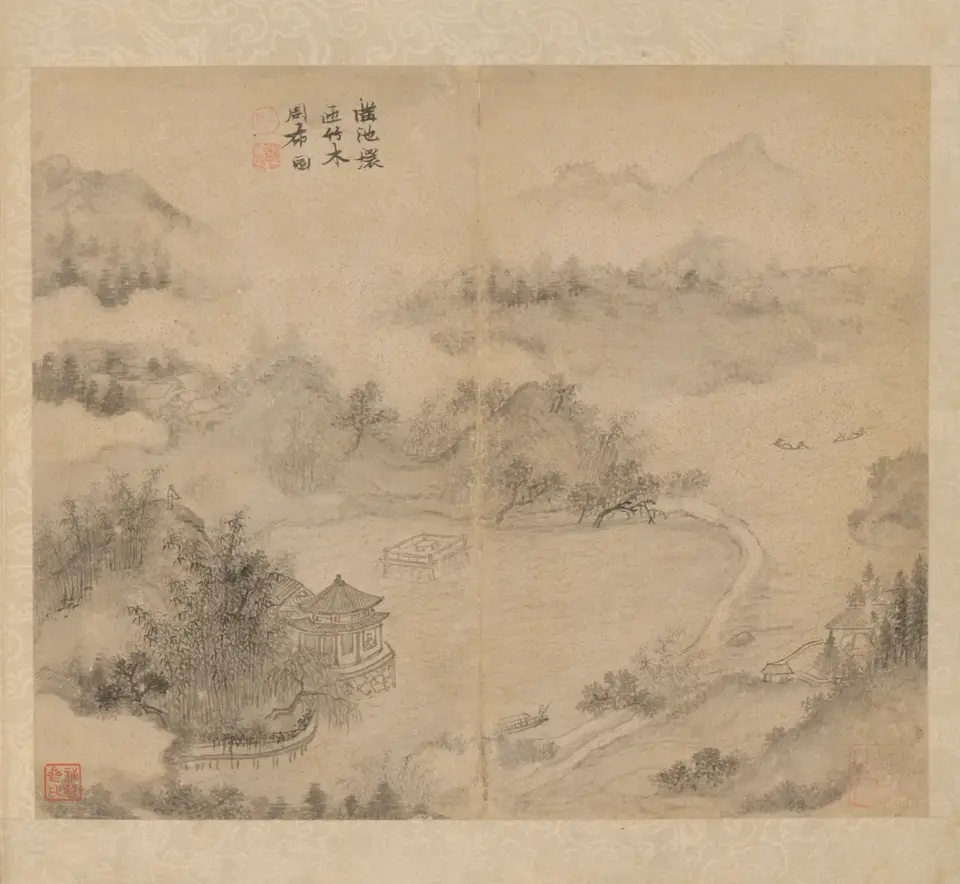
Beyond his peerless calligraphy, Zhang was an accomplished landscape painter and Buddhist figure artist. His landscape style derived from the Yuan dynasty master Huang Gongwang while drawing inspiration from the Five Dynasties masters Jing Hao and Guan Tong, interwoven with elements of the Wu School. His landscapes featured craggy cliffs, towering pines, and cascading waterfalls executed with dry, energetic brushwork and sparse, transcendent ink washes, projecting an aura of lofty reclusion. Surving masterworks like Long Pines under Clear Snow and Soaring Peaks and Hanging Springs reflect a monumentality that rivaled Wang Duo.
Zhang also painted Buddhist icons, creating images of Luohans and Guanyin characterized by archaic, concise lines and serene, compassionate expressions. Late Ming literatus Li Changheng noted in a painting colophon that Zhang combined great magnanimity of spirit with exquisite mastery in both literature, calligraphy, and painting. Because Zhang regarded painting purely as an occasional pastime for personal amusement and rarely sold his paintings, his surviving canvases are exceedingly rare and treasured in major international museums.
Zhang Ruitu's artistic stature extended far beyond the borders of China, exerting an immense and transformative influence on the historical development of Japanese calligraphy. In the turbulent transition between the Ming and Qing dynasties, the revered Chan master Yinyuan Longqi (Ingen Ryuki) from Wanfu Temple on Mount Huangbo in Fujian sailed to Japan to establish the Obaku school of Zen Buddhism. Master Ingen and his disciples, such as Mokuan Shoto and Sokuhi Nyoitsu, carried numerous original scrolls, rubbings, and engraved albums of Zhang Ruitu across the sea.
In Edo-period Japan, the calligraphic world had long been constrained by the repetitive and delicate conventions of classical Wayo calligraphy, leading to artistic stagnation. The importation of Zhang Ruitu's bold, angular, and spiritually charged works caused a profound sensation among Japanese monks and scholars. Japanese connoisseurs worshipped Zhang, reverently referring to him as the Water Star and praising his brushwork for its unyielding internal coherence and independent spirit, enshrining his style as the paramount model of Obaku calligraphic culture.
Zhang's dynamic brushwork provided crucial impetus for the Karayo (Chinese-style) calligraphic revival during the mid-to-late Edo period. Prominent calligraphic monks like Daicho Genko and scholars like Ichikawa Beian studied Zhang's works exhaustively, while powerful daimyo lords competed avidly to collect his authentic scrolls as family heirlooms. In modern times, the Japanese calligraphic community continues to celebrate Zhang Ruitu through major exhibitions and scholarly publications in Tokyo and Kyoto, cementing his role as an enduring cultural bridge between China and Japan.
Zhang Ruitu's inclusion in the Eunuch Faction section of the History of Ming and his indictment under the Chongzhen Treason Register created a long-standing historical dilemma for biographers and art critics. Under the traditional Confucian paradigm where personal morality is inseparable from artistic evaluation, Zhang's willingness to write inscriptions for Wei Zhongxian's shrines provoked harsh condemnation from orthodox scholars, resulting in the temporary suppression of his works during the early Qing dynasty.
However, historical records from the late Ming illustrate that Zhang's entanglement with the eunuch faction occurred under extreme duress. During the Tianqi reign, Wei Zhongxian wielded absolute power, summarily executing officials who resisted his demands. Coming from a humble agricultural background without factional backing, Zhang was prized by Wei solely for his prestigious Tanhua rank and transcendent calligraphy, which Wei sought to exploit for political legitimation. Compelled by survival instincts, Zhang complied. Crucially, during his tenure in the cabinet, Zhang never participated in purges, fabricated accusations, or harmed honest officials, occasionally using his position to quietly shield scholars.
In his comprehensive epitaph, Lin Yuji emphasized that Zhang maintained an innocent conscience amid political adversity and immediately retired upon the Chongzhen Emperor's accession. The Southern Ming Longwu Emperor, having reviewed the full historical record, officially absolved Zhang of treason and conferred the posthumous title Wenyin. In modern scholarship, political and aesthetic evaluations are evaluated with greater objectivity: while Zhang lacked the heroic resolve to become a political martyr, his courageous artistic revolution remains a monumental and enduring contribution to Chinese cultural history.
Throughout his prolific career, Zhang Ruitu produced an extensive body of calligraphic work, encompassing albums, hanging scrolls, handscrolls, and stone steles, which are now preserved in the Palace Museum in Beijing, the National Palace Museum in Taipei, the Shanghai Museum, and major Japanese national collections. Among his running-cursive handscrolls, his transcription of Su Shi's Second Ode on the Red Cliff stands as an undeniable masterwork. The entire scroll surges with stormy dynamism, balanced by dramatic contrasts of wet and dry ink, every stroke striking the paper with crystalline firmness and lasting resonance.
In album formats, the Palace Museum holds his seven-leaf gold-paper album titled Seven Poems for Grandson Yang Kanghou Heading North, brushed in his late years in running-regular script. Each leaf exhibits balanced proportions and tightly disciplined brushwork, blending the solemn weight of ancient stele inscriptions with the playful agility of side-brush technique, stamped with seals such as Baihao Anzhu and This Old Man, revealing the tranquil artistic mind of his retirement.
Furthermore, Zhang achieved extraordinary visual grandeur in large hanging scrolls. Works like Du Fu's Meipi Lake Song and Wang Wei's Music Bureau Poem often reach two to three meters in height. Viewed on high walls, the vertically cascading characters surge like flying dragons, while spacious line intervals allow the composition to breathe dynamically. Even during the Qianlong era of the Qing dynasty, when compilers of the Model Calligraphy of the Three Rarities Hall generally excluded works by politically compromised figures, they nevertheless included Zhang's cursive works, demonstrating his undeniable artistic standing.
In the technical mastery of ink, Zhang Ruitu carved out an artistic domain entirely distinct from his late Ming contemporaries. While the mid-Ming Wu School emphasized light, diluted ink and gentle, watery gradations, Zhang favored dense, deeply concentrated pitch-black ink, boldly experimenting with dry ink and overnight ink. Before writing, he mixed ink to a heavy viscosity, guiding his brush across Xuan paper or silk at breakneck speed. This high-speed friction generated abundant flying-white dry strokes that gave his lines the texture of ancient vines and weathered rocks.
This distinctive interplay between ink and brush technique was grounded in Chan Buddhist aesthetics. Zhang applied the Chan philosophy of sudden enlightenment and direct intuition to his artistic process, maintaining that true creation should transcend rigid technical constraints and express the raw vitality of the spirit. His eccentric forms and archaic awkwardness represented a deliberate aesthetic revolt against the hypocritical decorum and slick conformity of the late Ming civil bureaucracy. Through unyielding angular pivots and dramatic flying-white strokes, Zhang constructed an austere, transcendent realm that brought solace to his personal tribulations and planted an enduring banner of expressive romanticism in Chinese art history.
FIGURES ASSOCIATED WITH THIS DYNASTY