Born in Northern Anhui
Born into a well-off rural family in Zhiheji, later engaging in grain commerce and armed salt-smuggling leagues.
张洛行
Zhang Luoxing (张洛行, 1810–1863), also known as Zhang Lexing, was a native of Zhiheji in Bozhou, Anhui (modern Guoyang County), the supreme leader of the early Nian Rebellion in the Huai River basin, and a distinguished prince of the Taiping Heavenly Kingdom. Originating from a landed family, he operated distilleries and grain stores in his early years, leading salt-smuggling syndicates and organizing peasant self-defense units…
Zhang Luoxing (张洛行, 1810–1863), also known as Zhang Lexing, was a native of Zhiheji in Bozhou, Anhui (modern Guoyang County), the supreme leader of the early Nian Rebellion in the Huai River basin, and a distinguished prince of the Taiping Heavenly Kingdom. Originating from a landed family, he operated distilleries and grain stores in his early years, leading salt-smuggling syndicates and organizing peasant self-defense units ("nian") to resist Qing fiscal exactions. In 1852, he convened the famous "Eighteen Outposts Gathering" at Zhiheji, uniting regional chieftains and assuming supreme leadership of the Yellow Banner. In 1855, he presided over the grand Zhiheji Covenant, proclaiming himself the "Great Han King by Heavenly Mandate" and establishing the Five Banner military organization (Yellow, White, Red, Black, and Blue), enacting unified marching regulations that transformed scattered brotherhoods into a coordinated insurgent army. In 1857, Zhang joined forces with Taiping marshals Chen Yucheng and Li Xiucheng at Huoqui, accepting Taiping authority, cutting their queues, and receiving the rank of Commander-in-Chief of the Northern Expedition. Coordinating with Taiping armies, he fought across Jiangsu, Shandong, Henan, and Anhui, routing elite Xiang Army divisions at the Battle of Sanhe in 1858 and storming the vital Grand Canal transport hub of Qingjiangpu in 1860, which earned him the Taiping title King Wo. In 1863, following protracted counteroffensives by Qing Imperial Commissioner Sengge Rinchen and regional gentry militias, Zhang was betrayed by turncoat chieftain Li Qinbang at Xiyangzhai, captured, and executed by dismemberment, dying with unyielding defiance at age fifty-three.
Born into a well-off rural family in Zhiheji, later engaging in grain commerce and armed salt-smuggling leagues.
Responding to peasant unrest, he mobilized thousands of salt smugglers and destitute farmers in Bozhou to openly resist Qing authorities.
Stormed Yongcheng to liberate prisoners, convening eighteen major Nian chieftains at Zhiheji and being chosen supreme alliance leader.
Rejected Qing amnesties, proclaimed himself Great Han King by Heavenly Mandate at Zhiheji, and established the Five Banner military system.
Captured Sanhejian on the upper Huai River and recaptured Zhiheji, conducting mobile cavalry warfare across Anhui and Henan.
Linked up with Chen Yucheng and Li Xiucheng at Huoqui, adopting Taiping banners and receiving appointment as Commander-in-Chief of the Northern Expedition.
Supported Taiping forces in encircling Xiang Army shock troops at the Battle of Sanhe, defeating general Li Xubin.
Led thirty thousand shock troops to seize Qingjiangpu on the Grand Canal, subsequently elevated to King Wo by Heavenly King Hong Xiuquan.
Led spear divisions into Henan to battle Sengge Rinchen's cavalry; forced to retreat after subordinate commander Dong Zhixin defected.
Betrayed by turncoat Li Qinbang at Xiyangzhai, captured by Qing forces, and executed by slow slicing in Sengge Rinchen's camp at age fifty-three.
In 1810, Zhang Luoxing was born into an affluent rural landowning family at Zhanglaojia near Zhiheji in Bozhou, Anhui Province (modern Guoyang County). In the mid-nineteenth century, the northern Anhui plain along the Huai River basin suffered from chronic Yellow River flooding, soil salinization, official extortion, and agrarian poverty. The local population had long maintained martial traditions, organizing mutual-aid brotherhoods known colloquially as "nian" to protect villages and resist rapacious magistrates.
Reaching adulthood, the tall, athletic, and generous Zhang Luoxing established grain stores, distilleries, and gambling halls at Zhiheji. Concurrently, he formed armed caravans to smuggle salt across the Henan and Anhui frontiers, becoming a prominent regional syndicate chief. Confronting aggressive anti-smuggling patrols dispatched by the Qing government, Zhang deployed armed force to defend his trade. He gained immense local renown by distributing profits to impoverished villagers, protecting distressed tenant farmers, and leading organized food raids against hoarders. In 1837, Zhang led his followers to eliminate Hou Yongqing, an oppressive local tyrant who terrorized the district. In 1850, during a violent land dispute with the wealthy Song lineage, Zhang resisted magistrate arrest, cementing his status as an outlaw chieftain in open opposition to the imperial order.
In 1851, the Taiping Rebellion erupted in Guangxi, destabilizing imperial rule across China. Seizing the historical moment, Zhang Luoxing mobilized several thousand armed smugglers and displaced peasants across Bozhou. In 1852, joining forces with White Banner chieftain Gong Deshu, he led over ten thousand insurgents to storm the walled city of Yongcheng in Henan, liberating imprisoned brotherhood leaders. In November 1852, eighteen prominent Nian chieftains from Anhui and Henan assembled at Zhiheji. Performing ritual blood oaths at the "Eighteen Outposts Gathering," they unanimously elected Zhang Luoxing as supreme alliance leader and commander of the Yellow Banner.
Alarmed by the expansion of the rebellion across the Huai River, the Qing court dispatched Vice Minister of War Zhou Tianjue and Supervising Censor Yuan Jiasan to offer imperial amnesties, all of which Zhang scornfully rejected. In February 1855, representatives from every major insurgent band convened at Zhiheji for a monumental organizational summit. Zhang Luoxing was acclaimed supreme leader and proclaimed the "Great Han King by Heavenly Mandate." He instituted the formal Five Banner military hierarchy—Yellow, White, Red, Black, and Blue—assuming personal command of the Yellow Banner. He promulgated the Articles of War (Xingjun Tiaoli), enforcing strict prohibitions against civilian plunder and transforming fragmented rural bands into a unified, disciplined anti-Qing army.
In 1856, Qing imperial forces under Yuan Jiasan stormed Zhiheji, but Zhang Luoxing broke through the siege. In July, he ambushed Qing forces along the Kui River, killing imperial commander Ren Zhongmian, and proceeded to seize the strategic fortress of Sanhejian on the upper Huai River before recapturing his Zhiheji base in August.
Recognizing that regional isolation limited the rebellion's strategic horizons, Zhang displayed remarkable diplomatic vision. In spring 1857, he marched his veteran cavalry south to Huoqui, establishing a historic military coalition with Taiping marshals Chen Yucheng and Li Xiucheng. Zhang accepted Taiping suzerainty, receiving the commission of Commander-in-Chief of the Northern Expedition; his troops shaved their queues, adopted Taiping regalia, and integrated into a broader anti-Qing front.
In October 1858, when elite Xiang Army regiments under Zhejiang Provincial Treasurer Li Xubin besieged Sanhezhen in central Anhui, Zhang Luoxing led tens of thousands of Nian cavalry south to coordinate with Chen Yucheng. In the decisive Battle of Sanhe, Nian cavalry severed Xiang Army supply routes and spearheaded flanking assaults, annihilating over six thousand veteran troops and slaying Li Xubin in the most crushing defeat suffered by the Xiang Army. In 1860, Zhang conducted a brilliant long-range raid into northern Jiangsu, storming the Grand Canal transportation hub of Qingjiangpu (modern Huai'an), burning Qing grain fleets, and disrupting regional imperial salt revenues. In recognition of this strategic feat, Heavenly King Hong Xiuquan invested Zhang Luoxing with the noble title King Wo.
Following his elevation as King Wo, Zhang Luoxing established his primary base at Yinjiagou, operating in tandem with Zhiheji to mount fluid cavalry warfare across Henan, Shandong, and Jiangsu. In 1861, the Qing court appointed the formidable Mongol general Sengge Rinchen to crush the Nian forces with imperial cavalry. Exploiting the vast expanses of the Central Plains, Zhang launched sweeping mobile strikes into western Shandong, routing imperial units at Heze, killing Chahar Commander Yishenwangbu, and forcing Sengge Rinchen to retreat in disarray to Tangjiakou.
By 1862, Qing authorities shifted tactics, constructing continuous ramparts and deploying gentry militias to implement scorched-earth quarantines across northern Anhui. Undaunted, Zhang led twenty thousand elite spear cavalry westward into Henan, engaging Sengge Rinchen's cavalry in a ferocious multi-day battle at Xugang near Qixian. However, Nian vanguard commander Dong Zhixin succumbed to Qing bribery and defected in mid-battle, leaving Zhang's lines exposed to flank attacks and inflicting devastating casualties on the insurgent army.
By early 1863, Sengge Rinchen's armies had encircled Zhang Luoxing's depleted units in the borderlands between Bozhou and Mengcheng. Deprived of grain and ammunition, Zhang steadfastly rejected imperial summons to surrender, continuing guerrilla resistance along the Guo River.
In February 1863, Qing regiments launched a massive assault on Zhang's bastion at Yinjiagou. Breaking out with his young son Zhang Xi and a handful of bodyguards, Zhang sought temporary refuge at Xiyangzhai with Blue Banner chieftain Li Qinbang. Unbeknownst to Zhang, Li Qinbang had secretly capitulated to Suzhou Magistrate Ying Han. Feigning hospitality, Li welcomed the father and son while dispatching messengers to alert imperial garrisons. At dawn the following day, Ying Han led gentry militias and turncoats to surround the redoubt, capturing Zhang Luoxing and his son after a desperate hand-to-hand struggle.
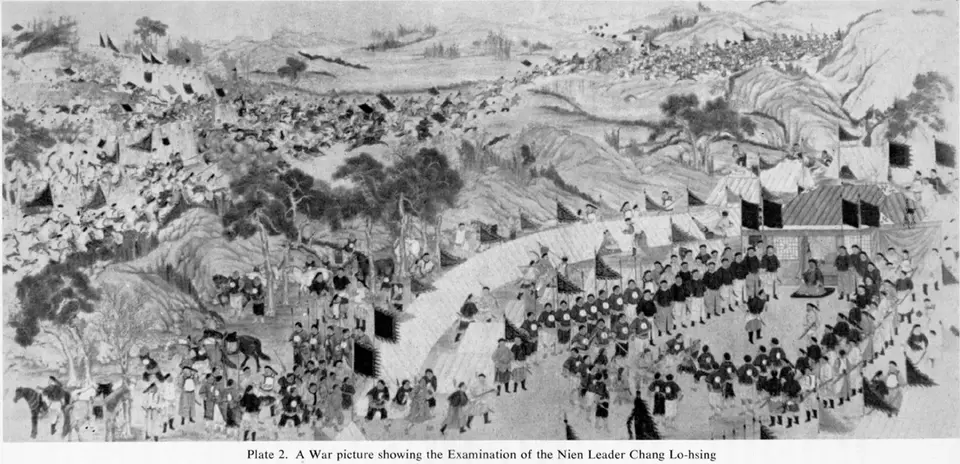
Bound in heavy chains, Zhang was conveyed to Sengge Rinchen's headquarters at Zhoujiakou. Subjected to agonizing torture and repeated offers of clemency in exchange for betrayal, Zhang fiercely denounced the Qing dynasty and steadfastly refused to yield. On April 5, 1863 (17th day of the 2nd month of the Tongzhi era), Zhang Luoxing and his son were executed by slow slicing before the imperial camp, facing death with unyielding bravery at the age of fifty-three.
Zhang Luoxing's paramount legacy in Chinese revolutionary history was transforming the fragmented, clan-based "nian" groups of northern Anhui into an integrated peasant army. At the 1855 Zhiheji Covenant, he mediated between fiercely independent local warlords, relying on personal charisma and political wisdom to forge an unprecedented alliance.
He established the Five Banner system (Yellow, White, Red, Black, and Blue), assigning territorial zones and tactical roles to each banner under a centralized command council. He promulgated the Articles of War, enforcing prohibitions on pillage, regulating scouting protocols, and instituting common pooling of captured provisions. This administrative transformation enabled the Nian Army to conduct fluid, coordinated operations across four provinces for over a decade.
Zhang Luoxing displayed exceptional strategic foresight in overcoming regionalism to align his forces with the broader anti-Qing revolutionary movement. Rejecting petty warlord autonomy, he initiated the 1857 alliance with Chen Yucheng and Li Xiucheng at Huoqui, integrating northern mobile cavalry with southern infantry armies.
During the 1858 Battle of Sanhe, Zhang's cavalry executed vital operational encirclements against Li Xubin's elite Xiang Army divisions. By cutting off Xiang Army supply corridors and mounting coordinated cavalry charges, Zhang's troops facilitated the total annihilation of six thousand enemy troops. This triumph shattered the immediate Qing encirclement of Anhui and stood as one of the most brilliant joint operational victories in late-Qing military history.
In 1860, Zhang personally conceived and executed a daring strategic raid into northern Jiangsu. Detecting that imperial garrisons were concentrated along the middle Yangzi, he led thirty thousand cavalry on a lightning dash across northern Jiangsu, capturing the vital Grand Canal metropolis of Qingjiangpu.
As the seat of the Qing Director-General of Grain Transport and the hub of the Lianghuai salt administration, Qingjiangpu held immense imperial wealth. Zhang's forces opened granaries to relieve starving refugees and set fire to imperial grain barges and salt depots, severing imperial revenue channels vital for financing anti-Taiping operations in the north. This stunning victory directly aided Taiping offensives in Jiangsu and Zhejiang, earning Zhang the title King Wo from Hong Xiuquan.
Throughout his life and final agony, Zhang Luoxing exemplified unyielding dedication to peasant liberation. Confronting imperial encirclements, bribery, and torture, he maintained an uncompromising stance against dynastic oppression. In captivity before Sengge Rinchen, he faced slow slicing with tranquil dignity, fulfilling his oath to fight for his people to the end.
Zhang's decade-long resistance tied down immense imperial field forces, severely weakening the foundations of the Qing dynasty. The cavalry tactics, banner structures, and strategic doctrines he pioneered laid the military foundation for successors like Lai Wenguang and Zhang Zongyu to reconstitute the New Nian Army, which ultimately destroyed Sengge Rinchen's cavalry army in 1865.
FIGURES ASSOCIATED WITH THIS DYNASTY