Birth in Hezhou
Born into an elite scholar-gentry family in Liyang; son of Assistant Grand Councilor Zhang Xiaobo.
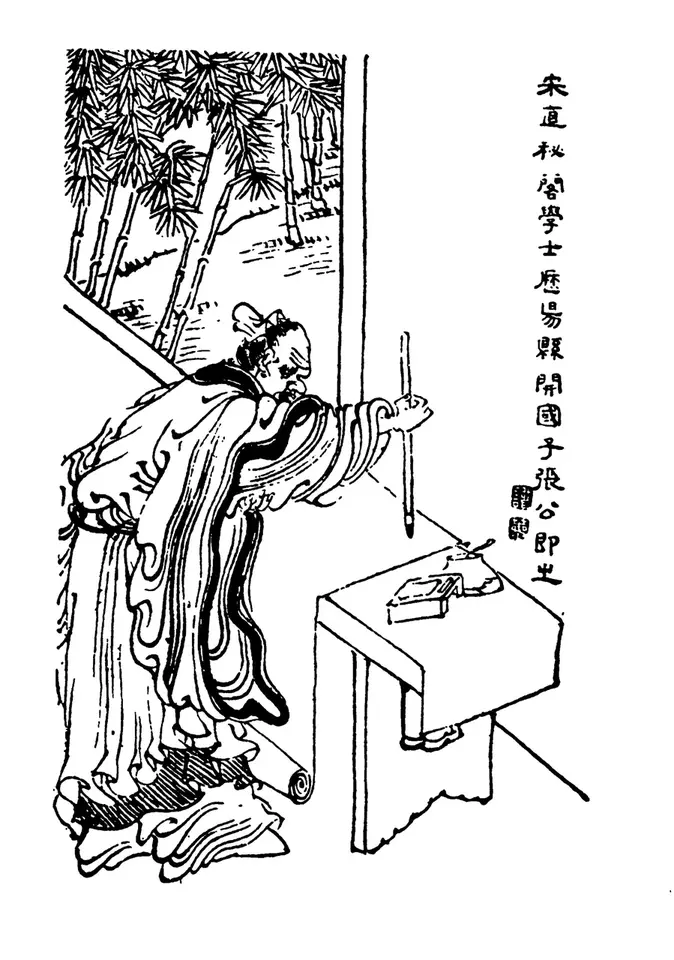
张即之
Zhang Jizhi (张即之, 1186–1263), courtesy name Wenfu, pseudonym Chuliao, native to Liyang in Hezhou, was a preeminent calligrapher and official of the late Southern Song Dynasty, universally hailed as the \"Rearguard of Song Calligraphy.\" Born into an illustrious bureaucratic family, he was the son of Assistant Grand Councilor Zhang Xiaobo and cousin to the patriotic statesman Zhang Xiaoxiang. Entering officialdom through…
Zhang Jizhi (张即之, 1186–1263), courtesy name Wenfu, pseudonym Chuliao, native to Liyang in Hezhou, was a preeminent calligrapher and official of the late Southern Song Dynasty, universally hailed as the \"Rearguard of Song Calligraphy.\" Born into an illustrious bureaucratic family, he was the son of Assistant Grand Councilor Zhang Xiaobo and cousin to the patriotic statesman Zhang Xiaoxiang. Entering officialdom through hereditary privilege, he served in various judicial and financial posts, including Assistant Director of the Court of the National Granaries and Prefect of Jiaxing, ultimately retiring with the honorary rank of Attendant at the Secret Archives. During the Baoyou reign, when general Wang Weizhong was wrongfully executed by court slander, Zhang fearlessly advocated for his posthumous rehabilitation and protected his orphaned family. In art history, Zhang synthesized the techniques of Ouyang Xun, Chu Suiliang, and Yan Zhenqing with the expressive styles of Su Shi and Mi Fu, while integrating Han clerical and Jin-Tang sutra scripts into an idiosyncratic, monumental aesthetic. Master of standard script and monumental placard characters (bangshu), his brushwork was praised for possessing the majestic momentum of braving wind and waves. His works were sought after across China and enthusiastically collected by northern Jurchen elites of the Jin Dynasty. He died in 1263 at seventy-eight.
Born into an elite scholar-gentry family in Liyang; son of Assistant Grand Councilor Zhang Xiaobo.
Entered service through hereditary privilege, passed special examination, and managed provincial grain storage.
Promoted to Assistant Director of the Court of the National Granaries and Directorate of Works; retired before assuming office at Jiaxing.
Resigned from active administration to manage Daoist temples, receiving the title Attendant at the Secret Archives upon retirement.
Campaigned for the posthumous vindication of the framed commander Wang Weizhong, sheltering his orphaned daughter.
Passed away peacefully at his residence in Jiangnan at the age of seventy-eight.
Zhang Jizhi was born in 1186 during the Chunxi era in Liyang, Hezhou. His family was celebrated for statecraft and literary brilliance; his uncle Zhang Xiaoxiang had taken first place in the imperial examinations and stood as a leader of the patriotic faction, while his father Zhang Xiaobo served as Assistant Grand Councilor under Emperor Ningzong. From early youth, Zhang was fastidious, studious, and deeply learned, collating classical scriptures and historical texts into refined domestic editions.
Commencing his official career through parental privilege as Gentleman for Fulfilling Responsibilities, he subsequently passed metropolitan examinations organized by the Liangzhe Fiscal Commission. Throughout his administrative career, he served as supervisor of granaries in Pingjiang, manager of real estate registries in Lin'an, supervisor of liquor monopolies in Ningguo, administrative assistant in Jingmen, vice magistrate of Wucheng, and secretarial supervisor in Liangzhe. He advanced to vice prefect of Yangzhou, Zhenjiang, and Jiaxing, later appointed Director of the Directorate of Works and Assistant Director of the Court of the National Granaries. Throughout his posts, Zhang maintained impeccable integrity. When named Prefect of Jiaxing, he encountered factional remonstrance from censorial officials; refusing to compromise his convictions, Zhang promptly resigned and retired with the prestige title Attendant at the Secret Archives.
Although retired to private life in the Lake Tai region, Zhang Jizhi retained profound moral commitment toward dynastic welfare. In 1256 (Baoyou 4), Commissioner Yu Hui harbored personal grudges against Wang Weizhong, the valiant commander defending Langzhou on the Sichuan frontier against Mongol forces. Yu fabricated treasonous charges against Wang, who was imprisoned, tortured, and sentenced to execution. Facing execution, Wang proclaimed his innocence before heaven, and legends arose of miraculous portents at his death, causing widespread grief across the empire while court officials remained silent out of fear.
Living in retirement, Zhang was deeply outraged by the injustice. Ignoring personal peril, he wrote a passionate memorial to Jia Sidao, then surveillance commissioner of eastern Huai, demonstrating Wang's steadfast loyalty and warning that murdering frontline generals would shatter border morale. Furthermore, Zhang adopted Wang's destitute daughter, arranging for his grand-nephew Zhang Shiqian to marry her, shielding the martyr's family. In 1260 (Jingding 1), spurred by Zhang's persistent advocacy, the imperial court fully rehabilitated Wang Weizhong, restoring his titles, according him state burial honors, and returning his confiscated estates.
In his mature decades, Zhang resided in rustic tranquility near Suzhou, channeling his energy into calligraphic creation and Chan Buddhist meditation. Zhang's fame resounded across the realm. Even across hostile political borders, Jurchen dignitaries and literati of the Jin Dynasty revered his calligraphy, expending immense sums of silver to acquire his original scrolls across smuggling networks, preserving them as priceless family heirlooms.
In 1263 (Jingding 4), Zhang Jizhi passed away serenely in his residence at the age of seventy-eight, mourned by scholar-officials throughout Jiangnan.
In the late Southern Song Dynasty, calligraphic circles had devolved into delicate, effeminate, and mannered conventions devoid of structural vitality. Zhang Jizhi emerged as a heroic reformer who single-handedly revitalized calligraphic dynamism. He synthesized the structural rigor of Ouyang Xun and Chu Suiliang with the expansive gravity of Yan Zhenqing, while assimilating the expressive brushwork of Su Shi and Mi Fu and the ancient, angular momentum of Han clerical scripts.
Ming critic Zhan Jingfeng remarked that Zhang incorporated clerical script structures into Yan Zhenqing's methods, creating an unyielding, archaic, and resolute stroke technique. Zhang achieved supreme distinction in standard script and monumental placard characters. His brushwork was decisive, dry, and jagged, combining sharp pauses with dynamic sweeps likened to aged pine boughs. Historians universally revere him as the \"Rearguard of Song Calligraphy,\" following the Four Northern Song Masters and Emperor Huizong, establishing an expressive bridge that inspired Yuan master Xianyu Shu and early Ming calligraphers.
Imbued with Buddhist contemplation, Zhang hand-copied numerous sacred scriptures and classical essays. His surviving works are held in premier world museums. His standard script masterpiece The Buddha's Bequeathed Teaching Sutra is preserved in the Palace Museum in Beijing, celebrated for its solemn cadence and structural tension. His running script Record of the Waiting for the Dawn Courtyard is held in the Shanghai Museum, while Record of the Wang Family Baoben Hermitage, Avatamsaka Sutra, and Large-Character Du Fu Poems reside in the Liaoning Provincial Museum. These masterpieces harmonize Confucian ethical fortitude with Chan transcendence, standing as enduring treasures of classical Chinese calligraphy.
FIGURES ASSOCIATED WITH THIS DYNASTY