Birth in Wujin
Born into an impoverished scholar's household in Wujin County, Changzhou, descended from an ancestral line from Chuzhou, Anhui.
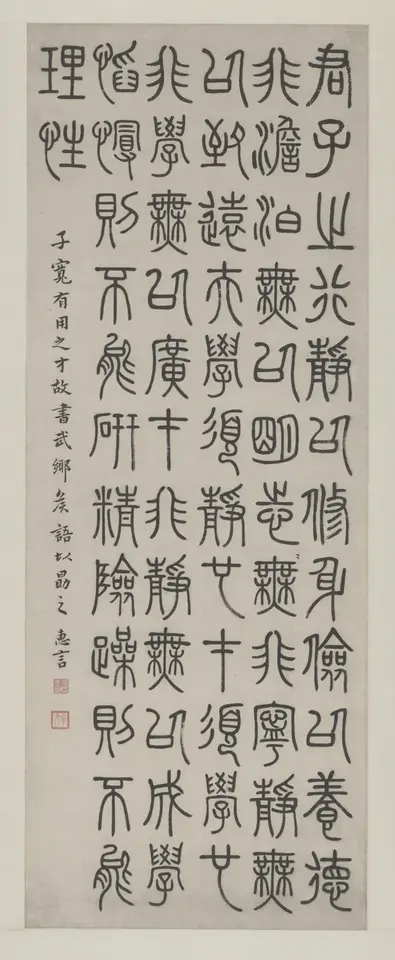
张惠言
Zhang Huiyan (1761–1802), courtesy name Gaowen and art name Mingke, was a native of Wujin (modern Changzhou), Jiangsu Province. He was an outstanding mid-Qing classical philologist, literary master, and poetic theorist, recognized as the founding patriarch of the Changzhou Ci School and co-founder of the Yanghu Prose School alongside fellow townsman Yun Jing. Born into an impoverished household, Zhang lost his father at age…
Zhang Huiyan (1761–1802), courtesy name Gaowen and art name Mingke, was a native of Wujin (modern Changzhou), Jiangsu Province. He was an outstanding mid-Qing classical philologist, literary master, and poetic theorist, recognized as the founding patriarch of the Changzhou Ci School and co-founder of the Yanghu Prose School alongside fellow townsman Yun Jing. Born into an impoverished household, Zhang lost his father at age four and grew up in severe destitution alongside his mother, sister, and posthumously born brother, beginning work as a rural tutor at age fourteen. He earned his provincial juren degree in 1786 and spent eight years teaching in Beijing at the Jingshan Official School, reading voraciously. In 1799, he attained the jinshi degree, was selected as a Hanlin bachelor, and was subsequently retained by Grand Secretary Zhu Gui as a Hanlin compiler and compiler for the Veritable Records Institute. Zhang occupies a transformative position in Chinese classical scholarship and literature. In classical exegesis, he specialized in Han dynasty Xiangshu (image and number) interpretations of the Book of Changes, focusing on Three Kingdoms Wu scholar Yu Fan to compose the nine-volume Zhouyi Yu Shi Yi, deciphering cosmic alternation and cyclical line shifts to reach the pinnacle of Qianlong-Jiaqing evidential learning. In prose, he and Yun Jing broke free from the rigid neo-Confucian dogmatism of the Tongcheng School, integrating pre-Qin philosophical prose and Han-Wei rhetoric to launch the expansive Yanghu School. In song lyrics (ci), his seminal anthology Ci Xuan championed allegorical allusion and moral intent, elevating ci to the sublime poetic lineage of the Classic of Poetry and the Elegies of Chu, eradicating the superficial polish of the Zhexi school and revitalizing premodern Chinese literary thought.
Born into an impoverished scholar's household in Wujin County, Changzhou, descended from an ancestral line from Chuzhou, Anhui.
Lost his father at age four, enduring extreme poverty with his mother Lady Jiang, elder sister, and infant brother Zhang Qi.
Compelled by destitution to work as a village tutor at age fourteen, studying while supporting his family and schooling his brother.
Passed the Jiangnan provincial examination, winning praise from examiners for his profound grasp of canonical texts and archaic prose.
Selected as instructor in the Imperial Household Department's Jingshan School, teaching in Beijing for eight years while mastering the Book of Changes.
Co-compiled the landmark anthology Ci Xuan with his brother Zhang Qi in Changzhou, establishing the theoretical core of the Changzhou Ci School.
Passed the metropolitan and palace examinations, selected as Hanlin bachelor, and assigned to compile the Veritable Records of Qianlong.
Slated for ministerial transfer, but Grand Secretary Zhu Gui successfully petitioned the emperor to retain him as Hanlin compiler.
Succumbed to illness caused by relentless overwork in Beijing at age forty-two; private disciples conferred the posthumous honorific Wenjie.
Zhang Huiyan's ancestral lineage originated in Chuzhou, Anhui, migrating to Wujin County, Changzhou Prefecture, during the early Northern Song dynasty. For generations, the family produced humble rural village schoolmasters, maintaining an impoverished scholarly tradition.
In 1764, when Zhang was only four years old, his father Zhang Chanbin died, leaving the family destitute. His mother, Lady Jiang, nursed an infant son, Zhang Qi, while caring for young Zhang Huiyan and their four-year-old daughter. The household survived entirely on the meager earnings of Lady Jiang and her young daughter, who spun yarn and embroidered linen day and night. In his moving biographical memoir Record of My Deceased Mother, Zhang recalled walking into town at age nine to study under his uncle; returning home one evening to find no grain left to cook, the family went to bed hungry. The next morning, when the starving boy could not rise, his weeping mother comforted him, saying that she, his sister, and brother endured such starvation constantly. This harrowing childhood forged Zhang's unyielding stoicism and profound empathy for human suffering.
Compelled by acute economic necessity, Zhang began serving as a private tutor at age fourteen, using his modest stipends to support his mother and finance the education of his brother Zhang Qi. While teaching, Zhang borrowed books to study through the night, mastering the commentaries on the Thirteen Classics and pre-Qin philosophical literature.
In 1776, at age sixteen, Zhang became a county licentiate, advancing to stipendiary student in 1779. In 1786, he passed the competitive Jiangnan provincial examination as juren. The following year, he traveled to Beijing for the metropolitan examinations and, although missing the final pass list, was selected to serve as instructor at the Jingshan Official School, educating Manchu and Mongol Banner youths. During his eight-year tenure, Zhang endured modest living conditions while gaining access to imperial libraries. In Beijing, he debated classical prose with luminaries such as Sun Xingyan, Lu Yining, Wu Dexuan, and Deng Shiru, while probing mathematical cosmologies of the Changes with Yang Sui'an, establishing nationwide scholarly fame.
In 1794, following his mother's death, Zhang returned south for ancestral mourning. After the mourning period concluded, his close friend Yun Jing, then magistrate of Fuyang, invited him to Zhejiang to assist in compiling the county gazetteer. He subsequently accepted invitations to lecture at private academies in Shexian, Anhui.
In 1797, while residing in Jiangnan, Zhang collaborated with his brother Zhang Qi to edit and publish Ci Xuan, an anthology that transformed premodern Chinese poetics. In his extended preface, Zhang attacked contemporary lyric writing for trivial ornamentation, establishing allegorical allusion and moral gravity as the true purpose of the genre. Concurrently, he immersed himself in canonical research, dedicating more than a decade to writing Zhouyi Yu Shi Yi and Zhouyi Yu Shi Xiaoxi, cementing his reputation as an authoritative master of the Book of Changes.
In 1799, sitting for the metropolitan examinations for the seventh time, Zhang earned the jinshi degree, receiving appointment as a bachelor in the Hanlin Academy and serving as compiler for the Veritable Records of Emperor Gaozong (Qianlong).
In April 1801, upon completing his Hanlin internship, Zhang was slated for reassignment to standard ministerial secretariats. Recognizing his towering erudition, Assistant Grand Secretary and Minister of Rites Zhu Gui submitted a special memorial urging the Jiaqing Emperor to retain him for scholarly statecraft. The emperor issued a special edict retaining Zhang as Hanlin compiler. Stationed within the imperial archives, Zhang collated historical records day and night until relentless exhaustion provoked severe illness. In June 1802, the brilliant scholar died in his capital quarters at the age of forty-two. Scholars across the empire, including Ruan Yuan, Zhu Gui, and Yun Jing, wept openly, lamenting the untimely loss of a rare master.
Zhang Huiyan's most monumental contribution to Chinese literary criticism was founding the Changzhou Ci School, the most influential poetic movement of the late Qing dynasty.
Since the late Ming, the lyric genre had been dominated by the Zhexi School under Zhu Yizun and the Yangxian School under Chen Weisong. By the mid-Qing, the Zhexi tradition had degenerated into sterile wordplay devoid of substantive emotion, while the Yangxian style had lapsed into noisy bravado. In response, Zhang and his brother Zhang Qi compiled the two-volume Ci Xuan, selecting 116 lyric masterworks by 44 Tang, Five Dynasties, and Song poets. In his preface, Zhang forcefully asserted the dignity of the lyric genre, insisting that it was not a frivolous vehicle for romantic entertainment, but directly inherited the moral lineage of the Classic of Poetry and Qu Yuan's Li Sao. He formulated the doctrine of allegorical allusion, demanding that poets explore subtle nuances of human experience to express deep geopolitical anguish and moral conscience. Inherited and deepened by his disciple Zhou Ji—who formulated the dialectical rule of entering through allegory and compiled Song Sijia Cixuan—the Changzhou School became the dominant poetic force across the late Qing and early modern eras.
In classical prose, Zhang co-founded the influential Yanghu School alongside fellow townsman Yun Jing, marking a critical turning point in Qing prose history.
At that time, the Tongcheng School under Fang Bao and Yao Nai dominated the literary scene, but its strict adherence to Song neo-Confucian dogmatism and rigid stylistic formulas had rendered prose increasingly timid and conventional. Residing in Yanghu and Wujin within Changzhou Prefecture, Zhang and Yun advocated expanding stylistic models beyond neo-Confucian tracts to embrace the imaginative power and argumentative vigor of pre-Qin philosophers like Zhuangzi, Mozi, and Han Feizi, as well as the bold historical narratives of the Han and Wei dynasties. Zhang's prose, exemplified by Record of My Deceased Mother, Seven Laments, and Mingke Wenbian, combined rigorous classical structure with harrowing emotional sincerity and profound philosophical depth, earning him and Yun recognition as the twin founders of the Yanghu School.
In pure classical scholarship, Zhang stood as the foremost synthesizer of Xiangshu (image and number) interpretations of the Book of Changes during the height of the Qianlong-Jiaqing evidential movement.
While Hui Dong had founded the Wu School to revive Han canonical traditions, he had failed to fully deconstruct the complex exegesis of Three Kingdoms Wu scholar Yu Fan. Zhang devoted more than a decade to collating fragmented texts, producing monumental works such as Zhouyi Yu Shi Yi, Zhouyi Yu Shi Xiaoxi, Yi Shuo, and Yiwei Lüeyi. Zhang argued that Wang Bi's Wei dynasty commentary had stripped away essential astronomical and calendrical images to replace them with Daoist metaphysics, obscuring ancient Han exegetical truths. Through rigorous philological collation, Zhang reconstructed Yu Fan's doctrines of yin-yang alternation and six-line movement with transparent clarity, correcting centuries of speculative Song dynasty readings. Philological grandee Ruan Yuan marveled at his scholarship, praising him as the foremost master of Han canonical exegesis.
Beyond his critical treatises, Zhang was an extraordinary lyric poet in his own right, compiling his verses into the collection Mingke Ci.
Zhang rigorously practiced his own aesthetic doctrines of internal meaning and external resonance. His celebrated suite of five lyrics to the tune Shuidiao Getou (Composed on a Spring Day for Scholar Yang Ziyan) utilized spring winds, willow catkins, and fallen blossoms to articulate poignant anxieties regarding national governance, political factionalism, and the tragic isolation of intellectuals. Modern literary master Wang Guowei praised Zhang's lyrics in Renjian Cihua, asserting that while Zhang admired Wen Tingyun's poetry for profound beauty and rigorous concision, those exact four words applied perfectly to Zhang's own Mingke Ci. Fusing the delicate elegance of Tang poets with the tragic grandeur of Su Shi and Xin Qiji, Zhang achieved complete harmony between critical theory and artistic practice.
FIGURES ASSOCIATED WITH THIS DYNASTY