Remonstrance against Changyi
Severely admonished the newly enthroned Prince He of Changyi; gained renown following Liu He's deposition.
张敞
Zhang Chang (张敞, ? – 48 BCE), courtesy name Zigao, originally hailed from Pingyang in Hedong Commandery (modern Linfen, Shanxi), whose grandfather Zhang Ru relocated the household to Maoling in Fufeng (modern Xingping, Shaanxi). He was a distinguished statesman, administrator, and legalist magistrate of the mid-to-late Western Han Dynasty. Rising from minor local township offices to Assistant Minister of the Imperial Stud,…
Zhang Chang (张敞, ? – 48 BCE), courtesy name Zigao, originally hailed from Pingyang in Hedong Commandery (modern Linfen, Shanxi), whose grandfather Zhang Ru relocated the household to Maoling in Fufeng (modern Xingping, Shaanxi). He was a distinguished statesman, administrator, and legalist magistrate of the mid-to-late Western Han Dynasty. Rising from minor local township offices to Assistant Minister of the Imperial Stud, Zhang Chang combined rigorous administrative discipline with classical Confucian scholarship, serving under Emperor Xuan of Han in key posts including Inspector of Yuzhou, Administrator of Shanyang, Chancellor of Jiaodong, Governor of the Capital (Jingzhaoyin), Inspector of Jizhou, and Administrator of Taiyuan. Following the death of Emperor Zhao of Han, when Prince He of Changyi was elevated to the throne and engaged in reckless improprieties, Zhang Chang bravely submitted memorials of remonstrance, winning nationwide fame for moral courage. Upon the accession of Emperor Xuan, Zhang Chang was appointed Administrator of Shanyang to closely surveil the deposed prince Liu He, accurately reporting that Liu He was physically crippled and mentally deranged, thereby dispelling court suspicions. Volunteering to restore order in bandit-ridden Jiaodong, he implemented strict reward systems that pacified the kingdom. Appointed Governor of the Capital, Zhang Chang presided over the metropolitan district of Chang'an for nine years; confronting entrenched banditry, he covertly co-opted bandit ringleaders, marked thieves with red ochre during an official feast, and captured hundreds of criminals in a single day, establishing legendary renown for crime suppression. In governance, Zhang Chang balanced leniency with firm enforcement, famously counseling cruel magistrate Yan Yannian against excessive capital executions. Personally unconventional, he often strolled through Chang'an in civilian attire and affectionately painted his wife's eyebrows each morning; when censured before the throne, he unabashedly responded that intimacy within the private chambers exceeds the mere painting of eyebrows, winning the emperor's amused forbearance. Before leaving office over political ties to the executed Yang Yun, he executed the insolent petty officer Xu Shun, giving rise to the famous idiom "Five-Day Governor of the Capital." He was subsequently recalled as Inspector of Jizhou, where he deployed war chariots to surround the royal palace of Guangchuan to eliminate royal kinsmen harboring bandits, and later pacified Taiyuan. Upon Emperor Yuan's accession, the court prepared to appoint him Governor of Zuo Fengyi, but he died of illness before taking office.
Severely admonished the newly enthroned Prince He of Changyi; gained renown following Liu He's deposition.
Appointed Administrator of Shanyang to monitor the deposed Liu He, reporting his disability to ensure dynastic stability.
Volunteered to pacify widespread banditry in Jiaodong, receiving thirty catties of gold from Emperor Xuan to serve as Chancellor.
Appointed Governor of the Capital (Jingzhaoyin) after predecessors failed to curb crime in the metropolitan district.
Recruited bandit chieftains as deputies and marked thieves with ochre dye at a banquet, capturing hundreds in a single day.
Sent an epistle to his friend Yan Yannian, citing classical fables to urge restraint in applying capital punishment.
Implicated in the Yang Yun affair; executed defiant subordinate Xu Shun before fleeing into brief exile.
Recalled by Emperor Xuan to serve as Inspector of Jizhou, deploying chariots to surround Guangchuan Palace and execute criminal nobles.
Transferred to Administrator of Taiyuan, restoring public order and civil virtue within one year.
Emperor Yuan sought to promote him to Governor of Zuo Fengyi, but Zhang Chang passed away from illness before assuming office.
Zhang Chang began his career as a minor rural township official before being promoted to commandery clerk. Recognized for his incorruptibility and diligence, he became Granary Chief of Ganquan and subsequently Assistant Minister of the Imperial Stud. Senior statesman Du Yannian, the Minister of the Imperial Stud, admired Zhang Chang's sharp intellect and profound comprehension of classical scriptures and legal statutes, regarding him as a talent capable of grand governance.
In 74 BCE, Emperor Zhao died without heirs, and General-in-Chief Huo Guang enthroned Prince He of Changyi. Entering the capital, Liu He engaged in extravagant debauchery, ignoring mourning rituals and promoting Changyi sycophants over elder ministers. Zhang Chang risked his life to submit an uncompromising memorial: "The late Emperor Zhao passed away young without progeny, plunging the realm into profound sorrow. When ministers went east to welcome Your Majesty, they feared only that the carriage traveled too slowly. Now Your Majesty has ascended the throne in youth, and all under Heaven look forward with eager eyes. Yet state-supporting ministers receive no honors while personal palanquin-bearers obtain rapid promotion—this is a momentous governance error!"
A little over ten days later, Huo Guang and ministers deposed Liu He, installing Emperor Xuan. Zhang Chang achieved nationwide renown for his outspoken candor, being promoted to Inspector of Yuzhou and later Imperial Counselor in the capital, joining Yu Dingguo in deliberating state affairs. However, Zhang Chang's unyielding integrity clashed with Huo Guang's dominance; Huo Guang assigned him to supervise military transport economies before reassigning him outward as Commandant of Hangu Pass.
Upon ascending the throne, Emperor Xuan felt persistent unease regarding the deposed Liu He, who had been returned to reside in his former appanage of Shanyang (modern Jinxiang, Shandong). Fearing conspiracies among Changyi loyalists, Emperor Xuan appointed the shrewd Zhang Chang as Administrator of Shanyang to surveil Liu He. Zhang Chang maintained vigilant oversight, dispatching clerks and personally visiting Liu He's mansion. He observed Liu He to be emaciated, crippled in both legs, dressed in peasant garb, and babbling disjointedly. When Zhang Chang tested him by remarking that owls were abundant in the district, Liu He replied casually: "When I traveled to Chang'an, I heard no owls; returning here, I constantly hear them again." Seeing Liu He utterly broken, addicted to wine, and terrified of punishment, Zhang Chang accurately reported that the deposed ruler possessed neither the will nor the ability to rebel, completely relieving Emperor Xuan of his anxiety.
Zhang Chang governed Shanyang with tranquil efficiency. In 67 BCE, severe famine struck the Kingdom of Jiaodong in Shandong, driving impoverished peasants into rampant banditry, while the Queen Dowager of Jiaodong neglected state business to indulge in hunting excursions. Zhang Chang petitioned the throne: "Your servant requests to be sent to Jiaodong to suppress the bandits and pacify the displaced!" Delighted, Emperor Xuan awarded him thirty catties of gold and appointed him Chancellor of Jiaodong. Upon arriving, Zhang Chang announced generous bounties allowing outlaws to capture one another to expiate guilt, while rewarding successful officers. He also remonstrated with the Queen Dowager to cease disruptive hunts. Within months, public order was completely restored.
Meanwhile, social order in the imperial capital Chang'an had severely deteriorated. Gangs of outlaws roamed the streets, terrorizing merchants and citizens alike. Following the execution of Zhao Guanghan, several successive governors, including Huang Ba, had failed to quell metropolitan crime. Summoned before Emperor Xuan to discuss remedies, Zhang Chang declared with confidence: "Your servant can certainly eliminate these thieves for Your Majesty!" Emperor Xuan immediately appointed him Governor of the Capital (Jingzhaoyin).
Upon assuming office, Zhang Chang refrained from hasty crackdowns, instead conducting discreet inquiries among village elders. He made the astonishing discovery that the supreme bosses of Chang'an's organized theft networks were respected, wealthy community figures who rode carriages attended by retinues. Zhang Chang summoned these ringleaders to his private chambers, presented evidence of their crimes, and offered them pardon if they delivered their subordinates. The ringleaders agreed, requesting temporary official badges to avert suspicion.
Returning home, the ringleaders hosted lavish banquets for local thieves to celebrate their new appointments. Unaware of the trap, the outlaws drank heavily. As the guests fell into a drunken stupor, the ringleaders secretly marked their coat hems with red ochre dust. Constables pre-positioned by Zhang Chang at lane entrances arrested anyone bearing red markings, apprehending several hundred thieves in a single day. Zhang Chang investigated their past crimes and punished them in accordance with law, completely dismantling Chang'an's underground networks. From that point forward, alarm gongs ceased, thievery vanished, and the commercial markets flourished in safety.
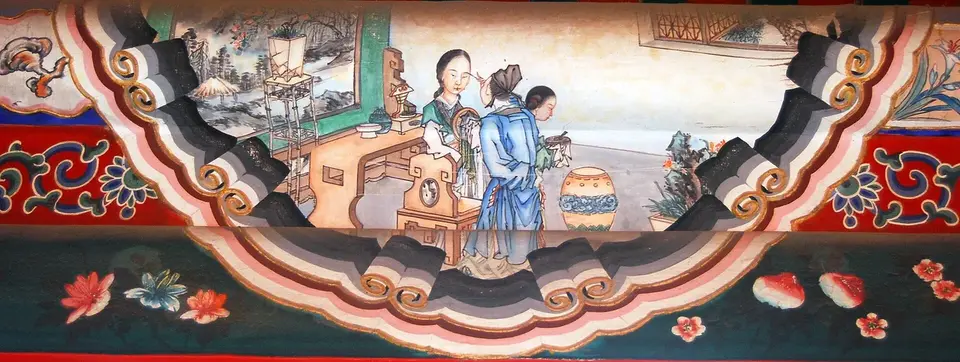
While rigorous and uncompromising in his official duties, Zhang Chang possessed a remarkably cultured, uninhibited personal temperament. Leaving the palace, he disdained rigid bureaucratic formalities, often walking through the vibrant shopping avenues of Zhangtai Street in simple civilian clothing, waving an ordinary feather fan. Most famously, because his wife had suffered a childhood injury that left a small scar on her eyebrow, Zhang Chang personally picked up a cosmetic brush each morning before attending court to delicately paint her eyebrows, giving rise to the popular saying: "Governor Zhang paints charming eyebrows."
Puritanical censors and conservative ministers condemned his behavior as undignified, submitting formal impeachments to Emperor Xuan. When the emperor questioned him in open court, Zhang Chang responded with composure: "Your servant has heard that within the bedchamber, the intimacies between husband and wife far exceed the mere painting of eyebrows. If Your Majesty evaluates my performance, let it be on whether I govern the capital effectively; why should Your Majesty concern yourself with private domestic trivialities?" Emperor Xuan laughed heartily, admiring his wit and competence, and declined to reprimand him.
However, amidst the intense factional purges of Western Han, Zhang Chang's close friend Yang Yun was condemned and executed for treason, and his associates were systematically dismissed. Reluctant to lose such an able administrator, Emperor Xuan delayed acting on Zhang Chang's impeachment. At this juncture, Xu Shun, an officer responsible for arresting thieves in the capital, assumed Zhang Chang's dismissal was imminent, refusing orders and returning home to sleep. When colleagues criticized him, Xu Shun sneered: "I have labored enough for this master; he is merely a 'Five-Day Governor,' what cases can he possibly manage now?"
Enraged by this insubordination, Zhang Chang had Xu Shun arrested and sentenced him to death under Han statutes for contempt of commanding authority. On the final day of winter preceding the arrival of spring, Zhang Chang dispatched a clerk to inform Xu Shun: "How is the Five-Day Governor now? Today winter has ended; do you still expect to see the light of life?" With that, Xu Shun was executed. Following standard procedure, Emperor Xuan soon issued an edict stripping Zhang Chang of office; understanding the sovereign's protective intent, Zhang Chang surrendered his seal and slipped quietly into rural exile.
A few months after Zhang Chang's departure, public order in Chang'an collapsed once more, while widespread bandit gangs surged across Jizhou, killing local officials. Realizing that only Zhang Chang could restore order, Emperor Xuan sent imperial couriers to summon him back to court. When the emissaries arrived, Zhang Chang's terrified family wept, fearing he was being arrested for executing Xu Shun. Zhang Chang laughed and consoled them: "I am currently an ordinary commoner; if the court wished to arrest me, a local bailiff would suffice. That the Emperor's imperial carriage and envoys have come in person signifies that His Majesty intends to employ me once more!"
Appearing before the emperor, Zhang Chang was warmly received and immediately appointed Inspector of Jizhou. Arriving in Jizhou, he discovered that Liu Haiyang, King of Guangchuan, was harboring outlaws, with his brother-in-law Liu Diao operating the royal palace as a clearinghouse for stolen goods. Undaunted by royal status, Zhang Chang mobilized hundreds of war chariots to surround the royal palace, arrested Liu Diao and his gang, and executed them on the spot, hanging their severed heads outside the palace gates. Within a year, banditry in Jizhou was extinguished.
Recognizing his peerless administrative mastery, Emperor Xuan appointed him Administrator of Taiyuan. In Taiyuan, Zhang Chang shifted his governance style toward classical education, honoring worthy elders and cultivating civil morality. Within a single year, Taiyuan was completely pacified. In 48 BCE, Emperor Yuan ascended the throne and sought to elevate Zhang Chang to Governor of Zuo Fengyi, head of the three metropolitan commanderies. However, before the imperial decree arrived, Zhang Chang died of chronic illness at his post, mourned deeply by officials and commoners alike.
During his nine years as Governor of the Capital, Zhang Chang's crowning achievement was the complete suppression of entrenched criminal syndicates in Chang'an. Avoiding crude violence, he scrutinized the social hierarchy of the underworld, co-opting elite bandit chiefs and employing the ingenious "ochre-marked robes" tactic at a private feast to capture hundreds of outlaws simultaneously. His governance established a golden era where markets experienced neither theft nor disturbance, serving as an enduring case study in ancient Chinese municipal policing.
Upon Emperor Xuan's accession, the presence of the deposed Prince He of Changyi represented a perilous source of dynastic instability. Stationed in Shanyang, Zhang Chang conducted nuanced psychological and physical observation of Liu He, verifying that the deposed monarch was severely incapacitated and lacked both the will and capacity for insurrection. His objective and delicate reports dispelled imperial suspicions, stabilizing the throne while preserving Liu He's life, demonstrating consummate political statesmanship.
Throughout his career, Zhang Chang displayed extraordinary moral courage, confronting powerful elites without hesitation. As a junior officer, he risked execution to remonstrate against Prince Liu He's improprieties; as Imperial Counselor, he refused to bow to Grand General Huo Guang; as Inspector of Jizhou, he deployed hundreds of war chariots to surround the royal palace of Guangchuan, summarily executing criminal royal kinsmen. His fearless defense of dynastic law curbed aristocratic lawlessness across the empire.
Zhang Chang transcended the sterile dichotomy between rigid Confucian moralizers and bloodthirsty legalist magistrates, pioneering the philosophy of governing through balanced leniency and strictness. A master of the Spring and Autumn Annals, he articulated historical precedents in imperial court debates to the admiration of all ministers; as a regional administrator, he enforced laws with decisive speed while privately counseling colleagues like Yan Yannian against wanton bloodshed. In his private life, his affectionate painting of his wife's eyebrows modeled authentic emotional humanity, establishing a timeless ideal for Han scholar-officials.
FIGURES ASSOCIATED WITH THIS DYNASTY