Born in Yifeng
Born into a scholarly family in Yifeng, Henan; mastered the Four Books and Five Classics by age thirteen, studying Cheng-Zhu orthodoxy.
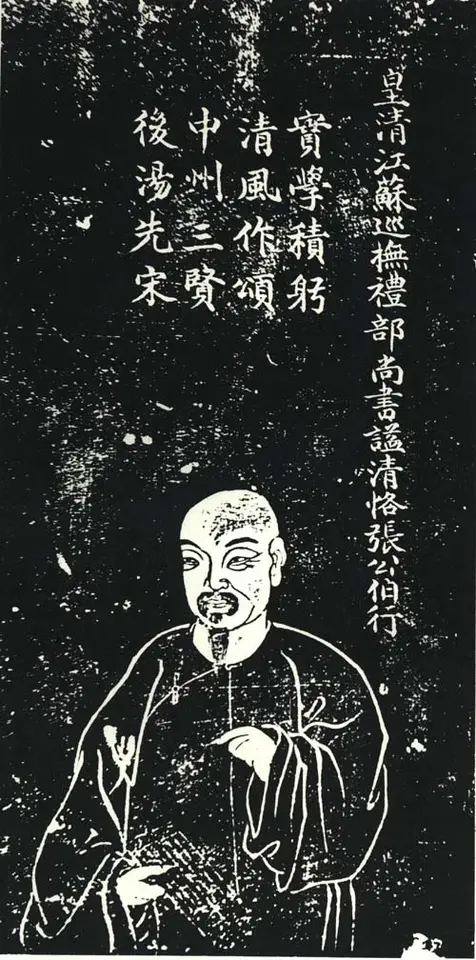
张伯行
Zhang Boxing (张伯行; 1651–1725), courtesy name Xiaoxian and art names Jie'an and Jing'an, was a native of Yifeng County (present-day Lankao, Henan Province). He was an illustrious statesman, Neo-Confucian philosopher, and moral exemplar of the Qing Dynasty, celebrated by the Kangxi Emperor as "The Foremost Incorruptible Official of the Realm." Passing the metropolitan examinations in 1685, he was appointed Secretary in the…
Zhang Boxing (张伯行; 1651–1725), courtesy name Xiaoxian and art names Jie'an and Jing'an, was a native of Yifeng County (present-day Lankao, Henan Province). He was an illustrious statesman, Neo-Confucian philosopher, and moral exemplar of the Qing Dynasty, celebrated by the Kangxi Emperor as "The Foremost Incorruptible Official of the Realm." Passing the metropolitan examinations in 1685, he was appointed Secretary in the Grand Secretariat. Following his successful defense of river levees during the catastrophic Yellow River flooding in Yifeng, Director General of Waterways Zhang Penghe recommended his engineering talents, commissioning him to oversee the construction of over two hundred li of dykes along the southern bank of the Yellow River. Appointed Intendant of the Jining Circuit in Shandong during a severe famine, he donated personal family resources to provide grain and clothing, boldly opening imperial granaries to preserve over twenty thousand famine victims. Promoted to Judicial Commissioner of Jiangsu in 1706, Zhang issued a celebrated public proclamation vowing not to extract a single copper from the populace and completely abolishing customary bureaucratic gratuities. During his southern inspection tour, the Kangxi Emperor reprimanded provincial leadership for failing to recommend Zhang, personally bypassing seniority to promote him to Governor of Fujian and bestowing the imperial plaque "Pure Favor Proclaiming Virtue." In Fujian, Zhang stabilized food prices, established the renowned Aofeng Academy, and compiled the Zhengyitang Collectanea to propagate Cheng-Zhu Neo-Confucianism. Transferred to Governor of Jiangsu in 1709, he clashed directly with the corrupt and tyrannical Manchu Governor-General Gali over the 1711 Jiangnan Examination Scandal, initiating a sensational imperial impeachment struggle. The Kangxi Emperor dismissed factional accusations, intervened decisively to "preserve the clean minister," stripped Gali of office, and restored Zhang. In his later years, Zhang was summoned to Beijing to attend the Southern Study, managing national granaries and the Ministry of Revenue with scrupulous impartiality. Upon his accession, the Yongle Emperor elevated Zhang to Minister of Rites and granted him the honorific plaque "Minister of Rites and Music." Zhang passed away in office in 1725 at age seventy-five; he was posthumously granted the title of Grand Guardian of the Heir Apparent and canonized as "Qingke." During the Guangxu reign, he was granted the rare supreme distinction of being enshrined in the Confucian Temple.
Born into a scholarly family in Yifeng, Henan; mastered the Four Books and Five Classics by age thirteen, studying Cheng-Zhu orthodoxy.
Succeeded in the metropolitan examinations; appointed Secretary in the Grand Secretariat and later conducted philosophical lectures in his homeland.
Recruited laborers to repair the Yifeng levee breach; recommended by Zhang Penghe to supervise two hundred li of southern dykes.
Appointed Circuit Intendant of Jining; expended personal fortunes and disbursed over twenty-two thousand shi of state grain to save famine victims.
Promoted to Judicial Commissioner of Jiangsu; refused four thousand taels of routine customary bribes, swearing to take not a coin from the people.
Discovered by the Kangxi Emperor during his southern tour; elevated directly to Governor of Fujian with imperial plaques.
Established the Aofeng Academy and published the Zhengyitang Collectanea, stabilizing regional rice markets through interprovincial purchases.
Transferred to Jiangsu; defended public finances against the exploitative demands of Governor-General Gali.
Exposed systematic bribery in the Jiangnan civil examinations; traded sensational mutual impeachments with Governor-General Gali.
Exonerated by the Kangxi Emperor, who dismissed Gali; transferred to the Southern Study and appointed Vice Minister of Revenue.
Elevated to Minister of Rites by the Yongzheng Emperor and awarded the imperial plaque "Minister of Rites and Music."
Passed away in office on November 19; granted posthumous honors as Grand Guardian of the Heir Apparent and canonized as Qingke.
Zhang Boxing was born into an illustrious Confucian scholarly family in Yifeng, Henan Province. Guided by his grandfather and father, he mastered the Four Books and Five Classics at the age of thirteen, dedicating himself to the strict moral tenets of Song Neo-Confucianism. In 1681, he earned his provincial degree, followed by success in the metropolitan examinations in 1685. In 1692, he was formally commissioned as a Secretary in the Grand Secretariat. Following his father's death, Zhang observed ritual mourning in his native county, establishing the Qingjian Academy to lecture on classical philosophy.
In June 1699, torrential rains breached the northern embankments of the Yellow River at Yifeng, threatening to overwhelm the regional population. Zhang volunteered immediately, mobilizing laborers with sandbags to seal the breach. When Director General of Waterways Zhang Penghe inspected the defenses, he was deeply impressed by Zhang’s hydro-engineering mastery and submitted an urgent memorial recommending him to the imperial throne. The Kangxi Emperor ordered Zhang assigned to river conservancy, where he successfully supervised the fortification of over two hundred li of dykes along the Yellow River's southern shore, alongside major hydraulic installations at Majiagang, Dongba, and Gaojiayan.
In 1703, Zhang was appointed Circuit Intendant of Jining in Shandong. Confronting severe regional famine, he transported private grain and funds from his family estate in Henan and hired local women to sew thousands of wadded coats for destitute peasants. When the Kangxi Emperor ordered circuit intendants to disburse emergency relief, Zhang immediately released 22,600 shi of official granary grain to feed starving populaces across Wenshang and Yanggu counties. The Shandong Provincial Administration Commissioner accused him of acting unilaterally without superior authorization, preparing formal impeachment. Zhang rebuffed the threat: "The Son of Heaven prioritizes the welfare of the people; saving lives is not unilateral self-will! Does the court value grain sacks above human lives?" Shamed by his argument, the commissioner dropped the impeachment.
In 1706, Zhang was elevated to Judicial Commissioner of Jiangsu. Under customary administrative conventions, new appointees were expected to pay senior governors and governors-general lavish courtesy gifts totaling approximately four thousand taels of silver. Zhang despised this institutionalized venality, proclaiming: "Serving the sovereign, I swear never to take a single coin from the people; how could I procure such bribery!" In his judicial post, he cleared backlogs, disciplined predatory clerks, and overturned wrongful convictions, earning the bitter jealousy and isolation of entrenched provincial elites.
In early 1707, the Kangxi Emperor arrived in Suzhou during his imperial southern inspection tour, ordering provincial leadership to present lists of virtuous and capable officials. Noting Zhang's omission from the recommendations, the emperor rebuked the governors: "I have long heard of Zhang Boxing’s absolute incorruptibility as a rare pillar of state; why have you deliberately excluded him?" Turning directly to Zhang, the emperor declared: "They will not recommend you, so I shall recommend you myself! If you remain upright and perform admirable deeds, the realm will know I recognize genuine virtue; if you succumb to corruption, the realm will mock me for failing to judge good and evil." The emperor promoted him directly to Governor of Fujian, presenting him with the imperial calligraphic plaque "Pure Favor Proclaiming Virtue."
In Fujian, Zhang governed with profound paternal benevolence. Facing soaring rice prices driven by poor harvests, he drew 50,000 taels of treasury silver to purchase surplus grain from Huguang, Jiangxi, and Guangdong, selling it at stabilized prices to suppress speculative monopolies. He ordered the eradication of local shrines dedicated to demonic plague deities, converting them into free public academies dedicated to Zhu Xi. Furthermore, finding that impoverished families frequently sold daughters into nunneries, he commanded parents to redeem their daughters, using official funds to assist indigent households. He founded the renowned Aofeng Academy in Fuzhou, donating his private library and editing the Zhengyitang Collectanea to cultivate generations of ethical scholars.
In 1709, Zhang was transferred to Governor of Jiangsu. At the time, Two Jiang Governor-General Gali—an arrogant Manchu nobleman—ruled the region with extortionate greed, demanding that Zhang join him in spreading provincial budgetary deficits across local magistracies. Zhang adamantly refused to impose illegal surcharges on the people, repeatedly submitting memorials that exposed administrative irregularities and provoking bitter hostility from Gali.
In the autumn of 1711, the Jiangnan provincial civil examinations triggered a massive public crisis. Official laureate lists were packed with wealthy salt merchants' sons, while accomplished scholars were rejected. Outraged candidates carried an idol of the God of Wealth into the Confucian temple in mass protest. Zhang initiated immediate investigations, discovering that Deputy Examiner Zhao Jin had accepted massive bribes. When interrogated, laureates testified that Governor-General Gali had accepted secret kickbacks. Zhang submitted an emergency memorial demanding Gali’s immediate suspension and trial. Panicked, Gali retaliated with seven fabricated counter-charges against Zhang.
The Kangxi Emperor ordered both officials suspended and dispatched imperial commissioners led by Zhang Penghe to investigate. Intimidated by Gali’s aristocratic connections, Zhang Penghe reported that Zhao Jin was guilty but Gali was blameless, recommending that Zhang Boxing be dismissed. Reading the report, the Kangxi Emperor angrily accused the commissioners of covering up for Gali: "Zhang Boxing’s incorruptibility is recognized across the realm! Gali possesses executive talent, but is dark, greedy, and devoid of clean fame. Without Zhang in Jiangnan, half of the province would have been devoured! You must understand my earnest desire to preserve upright ministers!" The emperor stripped Gali of all official rank and restored Zhang to his governorship. When provincial enemies later fabricated treason charges against Zhang, the emperor intervened again, clearing him of all penalties and summoning him to Beijing to serve in the Southern Study and Ministry of Revenue.
In 1723, the Yongzheng Emperor ascended the throne and immediately promoted Zhang to Minister of Rites, presenting him with the imperial plaque "Minister of Rites and Music." In 1724, the emperor selected Zhang to represent the sovereign in conducting imperial sacrifices at the ancestral Confucian temple in Qufu.
On November 19, 1725, Zhang passed away in office at the age of seventy-five. His final testamentary memorial urged the throne to champion Cheng-Zhu Neo-Confucianism and cherish outspoken remonstrators. Grieving his passing, the Yongzheng Emperor bestowed state funeral honors, granted the title of Grand Guardian of the Heir Apparent, and conferred the posthumous name "Qingke." During the Guangxu reign, imperial sanction was granted to enshrine Zhang in the Confucian Temple, honoring him among the timeless sages of Chinese civilization.
Throughout his life, Zhang Boxing regarded the defense and transmission of Cheng-Zhu Neo-Confucian orthodoxy as his personal mission. Combining moral integrity in governance with deep scholarly contemplation, he established the Aofeng Academy along the shaded slopes of Mount Aofeng during his tenure as Governor of Fujian. He recruited prominent regional scholars as lecturers, instituting rigorous daily curricula emphasizing filial piety, social righteousness, and classical philology.
To propagate orthodox Confucian principles, Zhang contributed personal stipends to establish a printing bureau, gathering rare and scattered treatises across China to produce the monumental Zhengyitang Collectanea. Spanning over sixty foundational works by masters such as Zhou Dunyi, the Cheng brothers, Zhang Zai, Zhu Xi, Xu Heng, and Xue Xuan, this vast compendium was hailed by contemporary intellectuals as a masterwork of Neo-Confucian synthesis. When serving in provincial governance, Zhang famously inscribed his Proclamation Prohibiting Gifts outside the provincial yamens: "A single grain or thread touches my moral integrity; a single copper coin drains the people's lifeblood. To forgive one coin brings more than one coin of mercy to the people; to take one coin reduces my honor to less than a coin!" This declaration was celebrated throughout China as an enduring monument to incorruptible governance.
Zhang Boxing rose through classical scholarship and hydraulic mastery, living with austere simplicity while exercising fearless integrity in high office. Resisting entrenched corruption at the risk of his life, he embodied the highest ideals of Confucian statecraft, standing as the preeminent exemplar of administrative incorruptibility during the Qing Dynasty.
"Zhang Boxing’s official conduct is pure and upright, his moral integrity the foremost in the realm. The world recognizes his immaculate character. If I do not preserve him with my utmost power, how can the realm have faith in righteous ministers!" — Kangxi Emperor (Xuanye), Veritable Records of the Qing Dynasty
"Serving across two imperial reigns with unbending austerity, Zhang Boxing's moral influence commanded the reverence of court and commoners alike. He took not a single copper in office and lived with the frugality of a humble scholar. Defending the orthodox principles of Neo-Confucianism and defying arrogant magnates, he was truly an unyielding minister of antiquity." — Zhao Erxun, Chief Editor, Draft History of Qing (Qing Shi Gao), Volume 265, Biographies 52
FIGURES ASSOCIATED WITH THIS DYNASTY