Birth in Bohai
Zhan Ziqian is born in Yanzi County, Bohai Commandery, displaying precocious artistic talent and devotion to brush and ink from early youth.
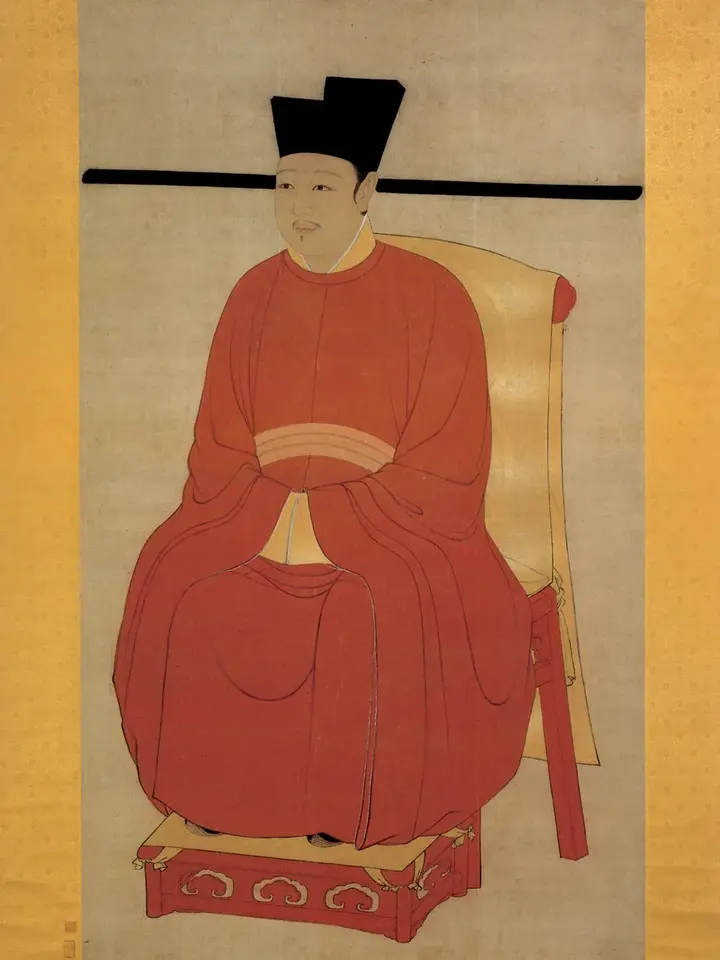
展子虔
Zhan Ziqian (展子虔) was the preeminent master painter of the Sui Dynasty, celebrated throughout Chinese art history as the father of Tang painting and the pioneering founder of independent blue-and-green landscape painting. Having served successively across three dynasties—Northern Qi, Northern Zhou, and the Sui—he was summoned to the imperial capital of Chang'an at the beginning of the Kaihuang reign by Emperor Wen of Sui. He…
Zhan Ziqian (展子虔) was the preeminent master painter of the Sui Dynasty, celebrated throughout Chinese art history as the father of Tang painting and the pioneering founder of independent blue-and-green landscape painting. Having served successively across three dynasties—Northern Qi, Northern Zhou, and the Sui—he was summoned to the imperial capital of Chang'an at the beginning of the Kaihuang reign by Emperor Wen of Sui. He was appointed Grand Master for Court Audiences, Commander of the Tent Guards, and General of the Middle Cavalry, serving as a foremost court painter and producing monumental Buddhist and Daoist wall paintings in state monasteries across Chang'an, Luoyang, Jiangdu, and Zhenjiang. Zhan Ziqian was a universal master whose artistic range encompassed human figures, horses, carriages, grand architectural pavilions, and landscapes with supreme delicacy. His masterpiece Strolling About in Spring (Youchun Tu), now preserved in the Palace Museum in Beijing, is the earliest surviving independent landscape scroll in Chinese painting history. In this work, Zhan pioneered the revolutionary method of pure contour linework without interior texturing, combined with opaque azurite and malachite pigments and delicate gold outlining. By establishing accurate spatial proportions and distance recession, he brought an end to the archaic Six Dynasties tradition where human figures dwarfed mountains, establishing the mature panoramic paradigm praised as "a thousand leagues within a single foot" (zhichi qianli) and directly inspiring the golden-green landscapes of Li Sixun and Li Zhaodao in the Tang Dynasty.
Zhan Ziqian is born in Yanzi County, Bohai Commandery, displaying precocious artistic talent and devotion to brush and ink from early youth.
Reaching adulthood, he earns wide renown across the Northern Qi artistic community through rigorous assimilation of ancient masters.
Following the Northern Zhou conquest of Northern Qi, he enters imperial service in Chang'an, refining his murals and portraiture.
Emperor Wen unifies China and summons Zhan to Chang'an, appointing him Grand Master for Court Audiences and Commander of the Tent Guards.
Serving alongside southern master Dong Boren, the two painters overcome regional prejudices and collaborate closely, celebrated as "Dong and Zhan."
He paints the monumental scroll Strolling About in Spring (Youchun Tu), establishing the foundational benchmark of classical panoramic landscape art.
Retiring from court administration to concentrate on studio painting, he passes away peacefully in Chang'an, revered by subsequent generations.
Full Name: Zhan Ziqian; Native Place: Yanzi County, Bohai Commandery (Modern Huimin, Shandong); Highest Office: Grand Master for Court Audiences (朝散大夫); Major Offices: Commander of the Tent Guards (帐内都督), General of the Middle Cavalry (中骑将军), Grand Master for Court Audiences (朝散大夫); Principal Identity: Master Painter of the Sui Dynasty, Progenitor of Blue-and-Green Landscape Painting, Court Artist;
Zhan Ziqian lived through the turbulent decades of political fragmentation during the late Northern Dynasties. Born in Yanzi County in Bohai Commandery (modern Huimin, Shandong Province), he exhibited an innate sensitivity to natural scenery from early childhood, spending his days sketching mountain contours, trees, animal forms, and human figures. Endowed with extraordinary perceptual acuity, he achieved prominent professional standing in the Northern Qi artistic world while still a young man. He assiduously analyzed the linear techniques of Southern Dynasties masters like Gu Kaizhi and Lu Tanwei, while simultaneously absorbing the rugged vigor and expansive spatial rhythms native to northern borderland culture.
In 577, Emperor Wu of Northern Zhou marched eastward to eradicate Northern Qi, bringing the northern plains under Guanzhong dominion. Zhan Ziqian relocated westward to Chang'an, entering bureaucratic service in the new regime. Serving in both Northern Qi and Northern Zhou regimes provided Zhan with a firsthand perspective on how regional cultural divisions shaped artistic expression. He consciously sought to synthesize the monumental structural gravity of northern rockscapes with the fluid, lyrical brushwork characteristic of southern literati traditions, establishing the versatile technical repertoire that defined his mature career.
In 581, Emperor Wen of Sui (Yang Jian) established the Sui Dynasty and subsequently brought the Southern Chen regime to an end, terminating almost three centuries of division. To adorn the palaces of the newly built metropolis of Daxing and celebrate dynastic reunification, Emperor Wen summoned the empire's greatest artistic talents. As the preeminent painter of the north, Zhan Ziqian was called to the court and appointed Grand Master for Court Audiences, Commander of the Tent Guards, and General of the Middle Cavalry, entrusted with directing major palace artistic commissions.
Around the same time, the eminent painter Dong Boren from the conquered southern realm arrived at court. Initially, both masters viewed each other with defensive rivalry: Dong teasingly remarked that Zhan was proficient solely in rigid northern landscapes and draft horses, lacking southern atmospheric subtlety. Rather than taking offense, Zhan Ziqian acknowledged the merit in Dong's observation and personally visited him to study the delicate washes and emotive linework of the southern school. Deeply moved by Zhan's magnanimity, Dong Boren in turn embraced Zhan's solid structural discipline and equine naturalism. The two artists became lifelong friends and intellectual partners, universally acclaimed by court society as "Dong and Zhan," symbolizing the harmonious fusion of northern and southern aesthetic cultures.
Throughout his imperial service, Zhan Ziqian frequently accompanied the imperial progresses of Emperor Wen and Crown Prince Yang Guang across China. With imperial patronization of Buddhism reaching unprecedented heights under the Sui, the throne commissioned magnificent temples across major administrative hubs. Zhan was repeatedly selected to design and execute monumental narrative murals on monastic walls throughout Chang'an, Luoyang, Jiangdu (Yangzhou), Zhenjiang, and Chengdu.
At major imperial temples—including Guangming Temple, Lingbao Temple, and Tiannü Temple in Chang'an, as well as Longxing Temple and Yunhua Temple in Luoyang—Zhan painted monumental scriptural transformations (jingbian) and historical tableaux, such as The Eight Kings Distributing Sacred Relics. In these murals, he discarded archaic stiffness, utilizing continuous "iron-wire" linework as fine as a hair to contour divine figures before laying down translucent color washes that imparted lifelike vitality. His horses were rendered with dynamic tension, whether depicted standing in poised anticipation or galloping with untamed velocity.
During the middle and late Kaihuang era, the Sui Empire enjoyed unprecedented material prosperity and peace. Having accumulated decades of technical mastery through extensive travels and court commissions, Zhan Ziqian reached the zenith of his creative powers. To liberate himself from administrative obligations, he retired from official duties in his later years and retreated to his private estate in Chang'an, dedicating his full attention to scroll painting.
It was during this fruitful retirement that Zhan created his enduring masterpiece Strolling About in Spring (Youchun Tu). In this panoramic handscroll, he elevated natural landscape into the primary vehicle of aesthetic contemplation, integrating aristocratic figures naturally into a majestic cosmic setting. Around 604, this foundational master passed away in Chang'an. His aesthetic principles and compositional methods directly nurtured the early Tang court artists Yan Liben and Yan Lide, establishing the primary reservoir from which high Tang visual culture developed.
Zhan Ziqian's foremost contribution to the history of world art was the creation of Strolling About in Spring (Youchun Tu), the earliest surviving independent landscape painting scroll in China. Throughout the Wei, Jin, and Northern and Southern Dynasties, landscape imagery was relegated to serving as subordinate background decoration for narrative human figures, characterized by an archaic lack of scale wherein humans were larger than mountains and waterways could not accommodate boats.
In Strolling About in Spring, Zhan Ziqian overturned this primitive convention, placing nature itself at the very heart of the aesthetic experience. The upper right section displays towering mountain peaks rising in rhythmic sequence; the lower right features gentle earth mounds and winding pathways; across the water, low hills provide balanced counterpoint, while an open expanse of rippling lake unfolds in the center carrying a pleasure boat with sightseers. Utilizing a high-angle panoramic vantage point, an expansive diagonal layout, and vast open water passages, Zhan attained a profound illusion of atmospheric depth. The Northern Song imperial catalogue Xuanhe Huapu celebrated his ability to capture "the momentum of rivers and mountains from near to far, realizing a thousand leagues of distance within a single foot," marking the true birth of mature Chinese landscape art.
In technical execution, Zhan Ziqian formulated the definitive aesthetic and physical rules for blue-and-green landscape painting (qinglü shanshui). In outlining geological formations and vegetation, he employed the method of "outline without texture strokes" (konggou wucun), relying on firm, continuous linear contours without internal descriptive hatching, thus preserving visual purity and structural clarity.
In his coloring, Zhan introduced rich mineral pigments, applying heavy azurite and malachite to peak crests while highlighting base contours with pulverized gold mud (jinni). Tree trunks were brushed with warm umber, foliage was dotted with deep verdigris, and spring blossoms were enlivened with mineral white and pale carmine. Robes of human figures were brushed in opaque white before being outlined with deep primary colors. This lavish yet exquisitely disciplined color system provided the direct foundation for the golden-green landscapes of Tang masters Li Sixun and Li Zhaodao, serving as an enduring technical standard for later Song and Ming court painters like Zhao Boju and Qiu Ying.
Operating at the critical dynastic junction between the Northern and Southern Dynasties and the Sui-Tang Empire, Zhan Ziqian acted as the vital stylistic bridge that unified divided regional aesthetics. Prior to his work, northern painting emphasized vigorous, monumental silhouettes with relatively plain coloring, whereas southern painting prioritized calligraphic elegance, introspective mood, and lyrical charm within more intimate formats.
Through sustained technical exchange with southern master Dong Boren, Zhan integrated the delicate linear sensitivity and expressive nuance of the south into the grand, heroic spatial vision of the north. He moved with equal facility between the formal solemnity of court regalia and the spontaneous vitality of natural landscapes. This harmonious synthesis mirrored the grand geopolitical consolidation of the Sui-Tang era, providing the stylistic template that defined the classical Chinese painting tradition.
FIGURES ASSOCIATED WITH THIS DYNASTY