Birth in Nanhai
Born on April 26 in Lizhiwan, Nanhai County, Guangzhou Prefecture, Guangdong; showed exceptional diligence in childhood schooling.
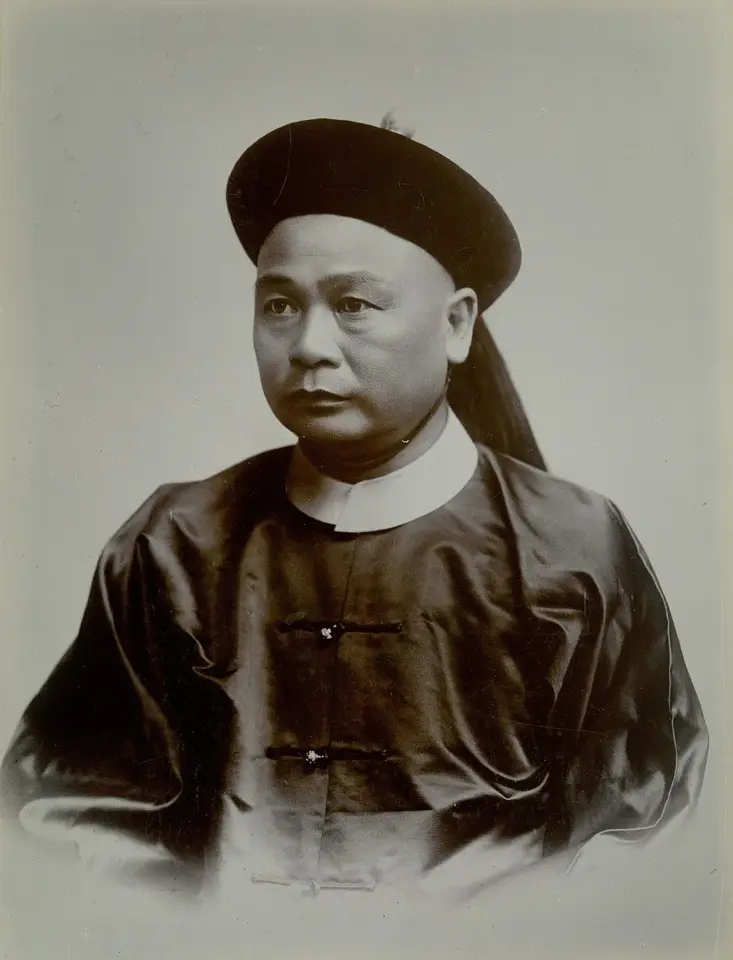
詹天佑
Zhan Tianyou (詹天佑, April 26, 1861 – April 24, 1919), courtesy name Juancheng and pseudonym Dachao, was a native of Nanhai County, Guangzhou Prefecture, Guangdong (with ancestral roots in Wuyuan, Jiangxi). He was a towering pioneer of modern Chinese science and engineering, the first Chinese engineer to direct the construction of a major trunk line, and is universally venerated as the "Father of China's Railways." In his…
Zhan Tianyou (詹天佑, April 26, 1861 – April 24, 1919), courtesy name Juancheng and pseudonym Dachao, was a native of Nanhai County, Guangzhou Prefecture, Guangdong (with ancestral roots in Wuyuan, Jiangxi). He was a towering pioneer of modern Chinese science and engineering, the first Chinese engineer to direct the construction of a major trunk line, and is universally venerated as the "Father of China's Railways." In his youth, Zhan was selected among the first cohort of the Chinese Educational Mission to study in the United States, graduating with honors in civil and railway engineering from the Sheffield Scientific School at Yale University, acquiring state-of-the-art technological mastery. Returning to China, Zhan Tianyou dedicated his life to breaking foreign monopolies over modern Chinese infrastructure. In an era when foreign powers dominated Chinese railway concessions, he first distinguished himself by deploying the pneumatic caisson method to overcome treacherous quicksand foundations on the Luanhe Bridge. In 1902, he directed the construction of the Xinyi Railway, completing it in four months as the first railway designed and built independently by Chinese engineers. In 1905, Zhan was entrusted by the Qing court with the monumental task of surveying, designing, and constructing the Beijing-Zhangjiakou (Jingzhang) Railway without foreign loans or foreign engineers. In the rugged Yan Mountains around Badaling, he engineered an ingenious zigzag switchback line and employed vertical shaft excavation for the Badaling Tunnel. The railway was completed two years ahead of schedule and substantially under budget, shattering Western assertions that Chinese engineers could never master the mountain pass. During the Republic of China, Zhan Tianyou served as Technical Supervisor of the Ministry of Communications and Director-General of the Hankou-Guangdong-Sichuan Railway, advocating for unified railway standards and national sovereignty over transport networks. He founded the Chinese Institute of Engineers, authored China's first engineering technical lexicon, and promoted national adoption of the standard track gauge (1.435 meters), automatic knuckle couplers, and Westinghouse air brakes. In April 1919, while fiercely defending Chinese sovereignty over the Chinese Eastern Railway at the Inter-Allied Railway Conference in the Russian Far East, Zhan succumbed to illness and exhaustion in Hankou at age fifty-seven, leaving an enduring legacy of technological self-reliance and patriotic devotion.
Born on April 26 in Lizhiwan, Nanhai County, Guangzhou Prefecture, Guangdong; showed exceptional diligence in childhood schooling.
Recruited by reformer Rong Hong (Yung Wing) into the first cohort of government-sponsored students sent to the United States at age eleven.
Graduated second in his class from Hillhouse High School in New Haven; admitted to the Sheffield Scientific School at Yale University to study civil and railway engineering.
Earned his Bachelor of Philosophy degree from Yale; recalled prematurely by the Qing court, assigned to the Fuzhou Navy Yard School to study navigation and marine torpedoes.
Served aboard the cruiser Yangwu during the Sino-French War; subsequently taught at the Guangdong Naval Academy and surveyed coastal sea charts.
Recommended by Yale classmate Kuang Sunmou to join the China Railway Company in Tianjin as an assistant engineer, beginning thirty years of railway service.
Pioneered the pneumatic caisson method to build foundation piers through quicksand on the Luanhe Bridge, elected as an Associate Member of the Institution of Civil Engineers in London.
Appointed Chief Engineer of the Xinyi Railway, completing the entire forty-three-kilometer line in four months without foreign assistance.
Commissioned as Chief Engineer and Managing Director of the Beijing-Zhangjiakou Railway, designing the route across the rugged Yan Mountains.
The Beijing-Zhangjiakou Railway opened to traffic two years ahead of schedule; awarded the degree of Jinshi in Engineering and appointed advisor to the Ministry of Posts and Communications.
Sun Yat-sen inspected the Jingzhang Railway and praised Zhan's work; Zhan established the Chinese Institute of Engineers and served as its inaugural president.
Appointed Technical Supervisor of the Ministry of Communications and Director-General of the Hankou-Guangdong-Sichuan Railway.
Defended Chinese sovereignty at the Inter-Allied Railway Conference in Siberia and Harbin; died of exhaustion in Hankou on April 24 at age fifty-seven.
Zhan Tianyou was born on April 26, 1861, in Lizhiwan, Nanhai County, Guangzhou Prefecture, Guangdong. His great-grandfather Zhan Wanbang had migrated from Wuyuan County in Huizhou Prefecture to Guangzhou for commerce. By the generation of his father, Zhan Xinghong, the family had settled permanently in Nanhai, earning a modest living through letter-writing and seal-engraving. Zhan Tianyou exhibited a quiet, disciplined disposition and studied traditional Confucian classics in private academies during his early childhood.
In 1872, pioneer educator Rong Hong (Yung Wing) persuaded Qing reformist ministers Zeng Guofan and Li Hongzhang to sponsor young Chinese students for studies in the United States to acquire modern science and industry. When examination centers opened in Hong Kong and Guangdong, Zhan Xinghong hesitated to send his young son abroad, but family friend Tan Bo convinced him of the immense national benefits. Eleven-year-old Zhan Tianyou passed the entrance examinations and entered the preparatory academy in Shanghai, studying Chinese under Chen Lanbin and English under Rong Hong. In the autumn of 1872, Zhan joined the first cohort of thirty students on a steamship voyage across the Pacific to Connecticut.
In America, Zhan resided with school principal Northrop in West Haven, mastering English and adapting to American education. In 1877, he enrolled in Hillhouse High School in New Haven, excelling in mathematics, natural sciences, and athletics. In 1878, he graduated second in his class and entered the Sheffield Scientific School at Yale University, choosing civil and railway engineering.
At Yale, Zhan's academic performance was stellar, winning first-place mathematics prizes for two consecutive years. Recognizing that railway transport was the lifeblood of modern industry, he immersed himself in route surveying, structural bridge engineering, and locomotive mechanics. Zhan also organized the "Orientals Baseball Club" among Chinese students, pioneering modern athletics for Chinese youth. In 1881, he earned his degree in civil engineering and was inducted into the honorary scholastic society. His graduation thesis, A Study of Pier Cranes, reflected his rigorous command of mechanical theory and engineering application.
Just as Zhan prepared to undertake practical railway apprenticeships in the United States, conservative Qing officials petitioned the throne to recall the students, alleging that Western schooling eroded Confucian orthodoxy. In the autumn of 1881, Zhan Tianyou was compelled to return to China.
Lacking understanding of modern specialized disciplines, Qing authorities failed to utilize Zhan's railway training, instead assigning him to the Fuzhou Navy Yard School to study marine navigation and torpedo warfare. Displaying scientific discipline, Zhan completed naval courses within a year, graduating at the top of his class. In late 1882, he was posted to the Fujian Fleet flagship Yangwu as a navigation officer.
In July 1884, during the Sino-French War, a French naval squadron launched a surprise attack in the Battle of Fuzhou. Stationed on the forward battery of Yangwu, Zhan directed artillery fire against heavy French ironclads until his cruiser was sunk by a spar torpedo. Though the fleet was defeated, Zhan's courage in battle steel-plated his resolve to dedicate his technical training to national defense.
Following the war, Governor-General Zhang Zhidong transferred Zhan to Guangzhou to teach surveying and mathematics at the Guangdong Naval Academy and Broad Learning Institute. For four years, Zhan instructed military students and led teams across the Pearl River estuary and Humen forts, drafting the comprehensive Naval Defense Atlas of Guangdong, rendering critical service to coastal fortifications.
Throughout his naval service, Zhan remained committed to railway development. In 1888, his Yale classmate Kuang Sunmou recommended him to the China Railway Company in Tianjin, where he was appointed assistant engineer, finally returning to his chosen profession.
At that time, Chinese railway construction was dominated by foreign engineers under British Chief Engineer Claude W. Kinder, who routinely relegated Chinese personnel to secondary tasks. Undeterred, Zhan worked on the frontlines alongside laborers through harsh weather, surveying and laying track along the Tangshan-Lutai and Tangshan-Guye extensions with meticulous precision, winning the respect of British foremen.
In 1893, construction of the Imperial Railways of North China advanced toward Shanhaiguan, encountering the turbulent Luan River. The riverbed was covered by unstable quicksand, prone to seasonal flash floods. British engineers attempted pile-driving, but iron pilings buckled and sank into the silt. Japanese contractors subsequently attempted floating caissons, which were swept away by currents. Foreign observers declared the river impossible to bridge without Western engineering consortiums.
Facing indefinite delay, Qing authorities entrusted the Luanhe Bridge to Zhan Tianyou. Rejecting failed methods, Zhan surveyed the riverbed and introduced the pneumatic caisson method, which was then the most advanced underwater foundation technique in international civil engineering. Zhan personally entered the high-pressure caisson chambers with diving crews, clearing quicksand to sink bridge piers directly onto bedrock. The Luanhe Bridge was successfully completed, securing the railway to Shanhaiguan. In recognition of this feat, thirty-three-year-old Zhan was inducted in 1894 into the Institution of Civil Engineers in London, becoming its first Chinese member.
Following the Boxer Uprising and the foreign occupation of Beijing in 1900, the Qing court returned from Xi'an. In the autumn of 1902, Empress Dowager Cixi announced plans to visit the Western Qing Tombs in Yixian the following spring, ordering railway minister Yuan Shikai to construct the forty-three-kilometer Xinyi Railway connecting Gaobeidian to Lianggezhuang within six months.
British and French consortia vied aggressively for the concession, threatening diplomatic crises if either was favored. Recognizing that foreign contractors could not meet the deadline, Yuan Shikai appointed Zhan Tianyou as Chief Engineer, charging him with building China's first completely self-reliant railway line.
Confronting northern winter blizzards and extreme time pressure, Zhan led an all-Chinese engineering team, working day and night to survey the alignment, simplify secondary station architecture, and enforce quality control. The Xinyi Railway was completed in four months and three days at a cost under six hundred thousand taels of silver, substantially under budget.
The royal train ran smoothly, astonishing foreign observers. The success of the Xinyi Railway proved that Chinese engineers could build modern rail transport independently and gave the Qing administration the confidence to entrust the formidable Beijing-Zhangjiakou Railway entirely to domestic talent.
Following the Xinyi project, Imperial Railway Commissioner Sheng Xuanhuai required rapid rail transport to convey coking coal from the Pingxiang Colliery in Jiangxi to the Hanyang Iron Works in Hubei. In 1901, Sheng invited Zhan to serve as Chief Engineer for the thirty-nine-kilometer Pingli Railway from Pingxiang to Liling. Traversing rugged sandstone hills prone to landslides, Zhan surveyed line radii and bridge culverts, employing masonry reinforcement to complete the line in a year, securing the logistical artery for China's early modern steel industry.
Returning north, Zhan served as assistant director of the Imperial Railways of North China, supervising the construction of the Yingkou branch and extensions outside Shanhaiguan. On the eve of the Russo-Japanese War, Russian and Japanese troops occupied territory and obstructed construction. Zhan negotiated resolutely with foreign garrisons while leading crews in blizzard conditions to finish the seventy-three-kilometer Yingkou branch, preserving railway rights in the contested border region.
In 1905, the Qing government resolved to construct the two-hundred-kilometer Beijing-Zhangjiakou (Jingzhang) Railway, linking the capital with the northern trade hub of Zhangjiakou, a gateway to Mongolia and the Russian border. For years, Britain and Tsarist Russia had engaged in diplomatic intrigue over the route, entering into a mutual agreement that neither power would permit the other to construct it. When China announced it would finance and construct the line independently, Western observers responded with derision, with foreign journals proclaiming that "the Chinese engineer capable of building the Jingzhang line has not yet been born."
Accepting the appointment as Chief Engineer and Managing Director at age forty-four, Zhan faced daunting geographic barriers. Between Nankou and Badaling, the railway traversed the Guan Gorge, where sheer granite precipices and steep gradients made standard alignments impossible. Western engineers had insisted that only costly multi-kilometer looping tunnels could overcome the elevation.
Determined to vindicate national dignity, Zhan personally carried surveying instruments across mountains and gorges through sandstorms and snow, evaluating three candidate routes. He devised revolutionary engineering solutions:
First, at the steep Qinglongqiao valley, he designed the famous switchback zigzag line. By reversing train direction via a track shaped like an inverted Y, the gradient was reduced to thirty-three per thousand. Two powerful steam locomotives worked in tandem, one pulling and the other pushing, eliminating the need for expensive looping tunnels and shortening track length.
Second, for the 1,091-meter Badaling Tunnel, Zhan introduced the vertical shaft excavation technique. Sinking two deep vertical shafts from the mountain summit to the tunnel floor, crews excavated outward in both directions while tunnel ends advanced toward the center. This provided six simultaneous working faces, accelerating progress multifold while natural gravity facilitated ventilation and spoil removal. When the tunnel headings met underground, alignment discrepancies were measured in millimeters.
Third, Zhan utilized local concrete for culverts and piers, refined explosive blasting techniques, and constructed the Huailai River bridge using improved pneumatic caissons at minimal cost. He also established locomotive repair shops at Nankou, training China's first generation of maintenance technicians.
On October 2, 1909, the Beijing-Zhangjiakou Railway opened to traffic amid celebrations at Nankou. Constructed two years ahead of schedule, the railway cost 350,000 taels less than its original budget. When the inaugural train traversed the Badaling Tunnel, Chinese citizens cheered and foreign diplomats expressed admiration. The Qing court awarded Zhan the degree of Jinshi in Engineering and appointed him advisor to the Ministry of Posts and Communications.
Following the opening of the Jingzhang Railway, Zhan became China's foremost engineering authority, advising on the Zhangjiakou-Suiyuan Railway, Sichuan-Hankou Railway, and Guangdong-Hankou Railway.
Following the 1911 Revolution and the founding of the Republic of China, Sun Yat-sen inspected the Jingzhang Railway in 1912, meeting Zhan at Qinglongqiao Station and commending him as the vanguard of Chinese industrial development.
In late 1912, the Republican Ministry of Communications appointed Zhan Technical Supervisor of the ministry and Director-General of the Hankou-Guangdong-Sichuan Railway. Balancing regional political rivalries and foreign concession pressures, Zhan relocated his headquarters to Wuhan, managing surveys across three provinces and opening the Wuchang-Changsha section of the Guangdong-Hankou Railway to traffic in 1918.
Throughout his career, Zhan recognized that fragmented engineering standards crippled national transport. Provincial railways utilized disparate gauges, incompatible braking systems, and discordant technical terminology introduced by competing foreign syndicates.
In 1912, Zhan founded the Chinese Engineering Association in Guangzhou, merging it with Shanghai societies in 1913 to create the Chinese Institute of Engineers, serving as president for six years.
Under his leadership, the institute published China's first modern technical lexicon, Railway Terminology, standardizing translated engineering nomenclature. Most significantly, Zhan mandated the national adoption of the standard 1.435-meter track gauge, automatic knuckle couplers, and Westinghouse air brakes, establishing the technical foundation for an integrated national railway network. He also mentored young engineers at the Tangshan Railway and Mining College, training figures such as Mao Yisheng who would shape modern Chinese civil engineering.
Following World War I, Allied powers convened the Paris Peace Conference in January 1919. Simultaneously, Russian revolutionary turmoil led Western powers and Japan to attempt joint control over the Chinese Eastern Railway in Manchuria through an Inter-Allied supervisory committee.
The Chinese government dispatched Zhan Tianyou as plenipotentiary technical expert to Harbin and Vladivostok. Despite severe chronic abdominal illness, fifty-seven-year-old Zhan traveled to the freezing northern frontier. Over two months of negotiations, Zhan defended Chinese territorial sovereignty and administrative control over the railway, using technical documentation and international legal precedents to secure Chinese supervisory participation.
The extreme cold and diplomatic strain exhausted his remaining strength. Returning south, Zhan fell critically ill and was hospitalized in Hankou on April 20. In his final hours, he dictated instructions urging colleagues to prioritize national trunk line completion and youth technical education.
On April 24, 1919, Zhan Tianyou passed away at Hankou Renji Hospital at age fifty-seven. Memorial services were held across Beijing, Shanghai, Guangzhou, Hankou, and Tianjin, while the Inter-Allied Railway Conference in Vladivostok stood in silent tribute. President Xu Shichang issued a national eulogy and granted a state funeral, interring him near Qinglongqiao Station beside the Badaling mountains he conquered.
Zhan Tianyou's crowning achievement was the independent design and construction of the Beijing-Zhangjiakou Railway. Confronting Western technological boycotts, he conquered the steep slopes of the Guan Gorge with scientific ingenuity.
His zigzag switchback track design at Qinglongqiao utilized dual locomotives pulling and pushing to ascend steep gradients safely, while vertical shaft techniques doubled tunneling speed through the Badaling granite. Completed ahead of schedule and under budget, the railway became a monument to Chinese engineering independence.
During the construction of the Luanhe Bridge in 1893, turbulent currents and shifting sands defeated repeated pile-driving attempts by British and Japanese engineers.
Zhan introduced the pneumatic caisson method, directing underwater excavation to anchor bridge piers into deep bedrock. The triumph established his international reputation and led to his election as the first Chinese member of the Institution of Civil Engineers in London.
Commissioned in 1902 to construct the Xinyi Railway under strict royal deadlines, Zhan completed the entire forty-three-kilometer line in four months without foreign personnel or funding.
The achievement established that Chinese engineers could survey, design, and manage modern railway systems independently, providing the administrative precedent that enabled China to commission the Jingzhang line to domestic leadership.
Zhan established the Chinese Institute of Engineers and served as its inaugural president, institutionalizing professional ethics and scientific standards in China.
He compiled China's first standard railway dictionary, mandated the 1.435-meter international track gauge, and introduced automatic couplers and compressed-air braking systems nationwide, preventing infrastructural fragmentation across provinces.
Zhan contributed extensively to engineering pedagogy, revising curricula and mentoring students at the Shanhaiguan Railway School and Tangshan Railway and Mining College.
By emphasizing mathematical precision and practical field experience, he educated a generation of domestic bridge and railway specialists, including renowned engineer Mao Yisheng, ensuring the long-term vitality of Chinese civil engineering.
In 1919, Zhan represented China at the Inter-Allied Railway Conference in Harbin and Vladivostok, resisting attempts by foreign powers to internationalize the Chinese Eastern Railway.
Arguing with technical precision and international law, he preserved China's administrative oversight along the northeastern frontier, demonstrating selfless dedication to sovereign rights until his final days.
FIGURES ASSOCIATED WITH THIS DYNASTY