Birth in Lingnan
Born into a scholarly gentry family in Shadi Village, Zengcheng County.
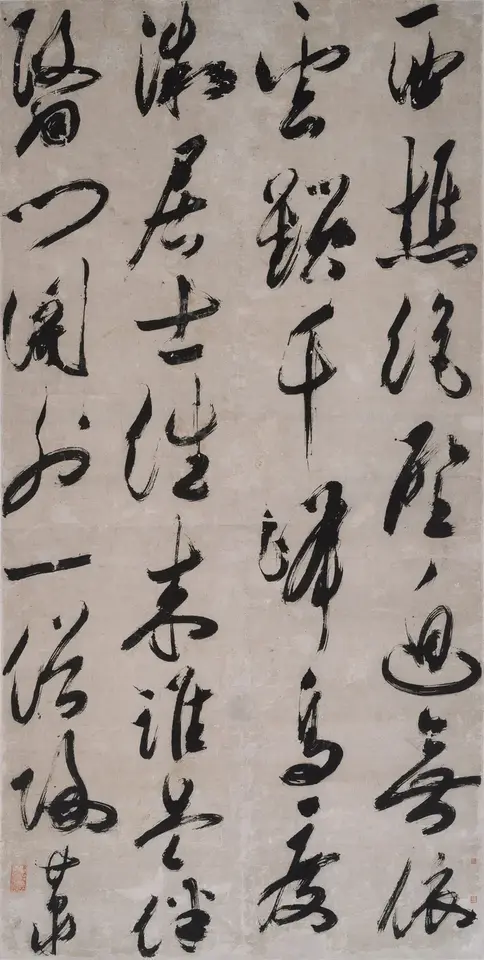
湛若水
Zhan Ruoshui (湛若水, 1466–1560), courtesy name Yuanming, literary name Ganquan, posthumously titled Wenjian, was a native of Zengcheng in Guangzhou Prefecture and one of the most celebrated Neo-Confucian philosophers, educators, and high officials of the Ming dynasty. In his youth, Zhan studied under Chen Xianzhang (Master Baisha), the pioneer of the Jiangmen School, becoming his designated spiritual successor. In 1505, he…
Zhan Ruoshui (湛若水, 1466–1560), courtesy name Yuanming, literary name Ganquan, posthumously titled Wenjian, was a native of Zengcheng in Guangzhou Prefecture and one of the most celebrated Neo-Confucian philosophers, educators, and high officials of the Ming dynasty. In his youth, Zhan studied under Chen Xianzhang (Master Baisha), the pioneer of the Jiangmen School, becoming his designated spiritual successor. In 1505, he attained the jinshi degree and was selected as a compiler in the Hanlin Academy. In 1506, he and Wang Shouren (Wang Yangming) forged a lifelong intellectual bond in Beijing, jointly reviving the Confucian philosophy of the mind, which contemporaries celebrated as the "Wang-Zhan Learning." During the Jiajing reign, Zhan served as Chancellor of the National University in Nanjing, Vice Minister of Rites, Vice Minister of Personnel, Minister of Rites, Minister of Personnel, and Minister of War in the southern capital. Serving across three decades with incorruptible simplicity, he was held in supreme esteem by the imperial court. As a philosophical innovator, Zhan founded the Ganquan School, introducing the core proposition of "realizing Heavenly Principle in every situation," which stood in creative dialogue alongside Wang Yangming's doctrine of "extending innate moral knowledge." Dedicating his life to pedagogy across northern and southern China, Zhan constructed over forty academies and instructed thousands of disciples. Passing away peacefully at the age of ninety-five, he was posthumously granted the title of Junior Guardian of the Heir Apparent.
Born into a scholarly gentry family in Shadi Village, Zengcheng County.
Attained the juren degree in the Guangdong provincial examinations.
Traveled to Baisha Village to study under Chen Xianzhang, burning his travel permits to signify total commitment to the Dao.
Master Baisha on his deathbed bequeathed his personal zither, ancient portraits, and fishing terrace to Zhan as lineage tokens.
Passed the imperial palace examinations with top honors, entering the Hanlin Academy as a compiler.
Formed an illustrious intellectual alliance with Wang Shouren in Beijing to restore Confucian teaching.
Dispatched as imperial commissioner to invest the monarch of Vietnam, demonstrating flawless incorruptibility.
Appointed Chancellor of the National University in Nanjing, subsequently promoted to Vice Minister of Rites.
Elevated to Minister of Rites in Nanjing and subsequently transferred to Minister of Personnel.
Appointed Minister of War in Nanjing; later petitioned for retirement due to advanced age.
Retired to Mount Luofu and Mount Ganquan, establishing dozens of academies across southern provinces.
Died peacefully at the age of ninety-five; posthumously honored as Junior Guardian of the Heir Apparent.
Zhan Ruoshui was born in the second year of the Chenghua reign (1466) in Shadi Village of Zengcheng County into a family of hereditary scholars. His father Zhan Ying died early, and his mother Madam Chen reared him with strict discipline, instilling deep moral virtue and dedication to the classics. Endowed with rare memory, Zhan enrolled in the Guangzhou prefectural school at sixteen, distinguishing himself in classical exegesis. In 1492, at twenty-seven, he passed the provincial examinations as a juren.
While contemporaries pursued examination success to secure official wealth, Zhan was disillusioned by rote philology. Learning that Master Chen Xianzhang (Chen Baisha) was teaching the spiritual learning of the mind in Jiangmen, Zhan journeyed to Baisha Village in 1494.
To prove his unyielding dedication to sagely learning, Zhan publicly burned his examination travel permits at the ferry crossing, swearing never to enter civil examinations until he grasped the root of the Dao. Deeply moved, Chen Baisha accepted him as an intimate disciple. Under Baisha's guidance, which emphasized natural self-realization and internal stillness, Zhan meditated and reflected for years. In 1498, Master Baisha praised him in a letter: "Your writings are admirable; in daily affairs, realizing Heavenly Principle in every situation is like applying the whip to a swift horse—you will surely reach the sublime heights of the ancients!"
In 1500, sensing his approaching death, Chen Baisha bequeathed his cherished retreat, the Jiangmen Fishing Terrace, to Zhan, writing an inscription that declared: "Bodhidharma came from the west, transmitting the robe as proof. The Jiangmen Fishing Terrace is this sick man's mantle! I now commit it to your stewardship with boundless blessings. Cherish it!" Zhan thus became the recognized successor of the Jiangmen School.
After observing three years of filial mourning for Master Baisha, Zhan entered the National University in Nanjing at his mother's behest. In 1505, at thirty-nine, he took the metropolitan examinations in Beijing. Chief examiners Zhang Yuanzhen and Yang Tinghe were stunned by his papers, remarking: "This essay illuminates the subtle essence of the mind; none but a true disciple of Master Baisha could write such profound discourse!" Zhan placed second overall, was awarded the jinshi degree, selected as a Shujishi in the Hanlin Academy, and commissioned as a compiler.
In 1506, Zhan met Wang Yangming (Wang Shouren) in Beijing. Recognizing each other's profound dedication to sagehood, they became sworn intellectual brothers, pledging to overthrow mechanical Cheng-Jhu commentary and restore pristine Confucian spiritual practice.
Wang Yangming declared: "Since forming this bond with Yuanming, I know that my quest is no longer lonely!" Intellectual circles acclaimed their alliance as the "Wang-Zhan Learning." During the ascendancy of corrupt eunuch Liu Jin, while Wang was banished to Guizhou, Zhan maintained rigid integrity in Beijing. In 1515, he served as imperial commissioner to invest the king of Vietnam, strictly forbidding his retinue from accepting gifts and winning immense diplomatic respect.
Upon his mother's death, Zhan returned to Zengcheng to observe three years of mourning by her grave. He erected Dake Academy on Mount Xiqiao, requiring prospective students to practice ritual propriety before attending philosophical lectures, establishing a unique pedagogical tradition of combining ethical decorum with quiet contemplation.
In the early Jiajing reign, Zhan was recalled to Beijing as Reader Academician in the Hanlin Academy. He presented the Memorial on Imperial Classical Lectures, asserting that sagely learning centers upon humaneness. Observing the young emperor falling into Daoist alchemical pursuits while righteous ministers like Lin Jun and Sun Jiao were driven from office, Zhan submitted an unyielding remonstrance: "Your Majesty's early governance falters; favorites seduce your heart with sensory distractions. When righteous ministers withdraw, the state trembles! We urge Your Majesty to keep close to worthy men and study universal principle."
In 1524, Zhan was appointed Chancellor of the National University in Nanjing. To combat superficial literary habits among scholars, he authored the Dake Disciplinary Code and lectured daily, transforming the intellectual climate of southern academia.
In 1526, he advanced to Vice Minister of Rites and subsequently Vice Minister of Personnel in Nanjing. In 1533, he was elevated to Minister of Rites, soon transferring to Minister of Personnel. In the personnel ministry, he conducted evaluations with strict impartiality, closing doors to nepotism and bribery while promoting virtuous scholars. In 1539, he became Minister of War in Nanjing.
Throughout thirty years of ministerial office, Zhan maintained absolute personal simplicity. He subsisted on coarse vegetables, dedicating his official salaries entirely to constructing academies, acquiring educational endowment lands, and supporting destitute students, leaving his own household bare of luxuries.
Throughout his public career and subsequent retirement, Zhan developed an expansive philosophical system. Building upon Chen Xianzhang's emphasis on naturalness while correcting its tendency toward passive quietism, Zhan synthesized the Doctrine of the Mean and the Great Learning to articulate his central thesis: "realizing Heavenly Principle in every situation."
Zhan asserted that the mind is not confined within the physical body, but is an all-embracing reality that embodies all things without exclusion. In his intellectual exchanges with Wang Yangming, Zhan authored a famous epistle to Yang Shaomo clarifying their differences, noting: "The mind of which I speak embodies all things without exclusion, hence possessing neither inner nor outer; the mind of which Yangming speaks refers merely to that inside the physical torso, hence regarding my doctrine as external." He contended that restricting the mind within the body risked drifting into Buddhist quietism, whereas sagehood required realizing oneness with all things.
Based on this expansive vision, Zhan formulated an integrated doctrine harmonizing mind, matter, inner virtue, and outer action. He defined the investigation of things (gewu) as "attaining the principle" and "actualizing the Dao." Moral cultivation could not be detached from concrete matters; rather, it had to be pursued across every sphere—in thoughts, bodily deeds, family governance, statecraft, and global affairs—grounded continuously in inner reverence.
Zhan defined the investigation of things (gewu) as "attaining the principle" and "actualizing the Dao." He advocated reverence (jing) as the unifying spiritual discipline, asserting that "reverence must govern both movement and stillness." His holistic unity of mind and matter, principle and vital force, knowledge and action formed the cornerstone of the Ganquan School.
In 1540, at seventy-five, Zhan retired from public service to dedicate his remaining two decades to education. Convinced that academies were the foundation of civil transformation, he funded the construction of educational centers throughout southern China.
He founded the Tianlu and Ganquan academies in Zengcheng, Mingde Academy on Mount Luofu, Dake Academy on Mount Xiqiao, and Baisha Academy in Guangzhou. His influence expanded across southern and central China, with academies founded in Nanjing, Mount Lu in Jiangxi, Chizhou in Anhui, Mount Wuyi in Fujian, and Mount Heng in Hunan, totaling over forty academies.
Whenever Zhan opened a lecture session, he first led students in reverently bowing before the portrait of Confucius, followed by thorough exegesis of the Four Books. He earnestly admonished his disciples that true learning requires steadfast ethical practice in daily life—practicing filial piety in the household and executing benevolent care for the people in official appointments. Deeply moved by his warm pedagogical wisdom, followers committed themselves to moral integrity. He lectured daily from morning platforms to thousands of followers.
In developing his academies, Zhan established rigorous organizational regulations. At Dake Academy on Mount Xiqiao he formulated the Dake Disciplinary Code, and at Mount Luofu he instituted the Academy Statutes, requiring students to combine ritual performance with inner moral reflection. To assist impoverished scholars, Zhan invested his lifetime official earnings to purchase extensive academic endowment lands, utilizing agricultural rents to provide continuous stipends, grain supplies, and book printings. His personal donations established and supported over forty academies across Guangdong, Nanjing, Yangzhou, Chizhou, Huizhou, and Mount Wuyi, instructing more than four thousand disciples.
In the fourth month of 1560, at ninety-five, Zhan Ruoshui passed away peacefully in the Tianlu Academy in Zengcheng. The Jiajing Emperor suspended court for a day, granted state sacrifices, posthumously promoted him to Junior Guardian of the Heir Apparent, and conferred the posthumous title of Wenjian. In 1563, the emperor issued two imperial edicts ordering Left Administration Commissioner Du Zheng to conduct a state burial, praising Zhan as an eminent scholar whose upright conduct, extensive service in southern ministries, and moral integrity served as a timeless model for later generations.
Zhan Ruoshui independently founded the influential Ganquan School, which advocated "realizing Heavenly Principle in every situation." His philosophy avoided the rigid scholasticism of traditional Cheng-Jhu learning while countering the radical subjectivism and Zen-like tendencies of later Yangming followers.
Zhan authored hundreds of volumes of theoretical treatises, including Comprehensive Guide to the Investigation of Things (Shengxue Gewu Tong in one hundred scrolls), Illustrations of Mind and Nature, and Orthodox Commentary on the Spring and Autumn Annals. His school flourished alongside Yangming thought, prompting Huang Zongxi to declare in the Records of Ming Scholars that "scholars across the empire followed either Wang or Zhan."
Zhan stands as one of the most prolific academy founders in Chinese educational history. He dedicated his life savings and private contributions to constructing over forty academies spanning Guangdong, Jiangnan, Huguang, and Jiangxi.
He formulated the Dake Disciplinary Code, pioneering an institutional model that integrated daily study, philosophical debate, ancestral commemoration, printing, and land endowments. Emphasizing egalitarian dialogue and filial practice, his academies educated hundreds of eminent statesmen, elevating Guangdong from an intellectual periphery into a leading center of Chinese Confucian thought.
Beyond his stature as a Confucian thinker, Zhan demonstrated exceptional administrative capability in high government posts. During the Jiajing reign, he served as Chancellor of the National University, Minister of Rites, Minister of Personnel, and Minister of War in Nanjing.
In the National University, he restored rigorous academic discipline; in the Ministry of Personnel, he eradicated bureaucratic bribery and promoted capable scholars; in the Ministry of War, he strengthened coastal fortifications and retired unfit garrisons. Throughout his service, he exemplified the harmonious unity between inner moral cultivation and pragmatic statecraft.
FIGURES ASSOCIATED WITH THIS DYNASTY