Imperial Birth
Born in Beijing as the second son of Prince Dun (Yicong), fifth son of Emperor Daoguang.
载漪
Aisin Gioro Zaiyi (爱新觉罗·载漪, 1856–1922), formally Prince Duan (端郡王), was an imperial prince of the Qing Dynasty, a grandson of the Daoguang Emperor, and the second son of Prince Dun (Yicong). Adopted into the princely household of Prince Rui (Yizhi), he inherited the title of Prince Duan. Lacking formal classical education and gifted only in horsemanship and archery, Zaiyi possessed a volatile, arrogant temperament. In late…
Aisin Gioro Zaiyi (爱新觉罗·载漪, 1856–1922), formally Prince Duan (端郡王), was an imperial prince of the Qing Dynasty, a grandson of the Daoguang Emperor, and the second son of Prince Dun (Yicong). Adopted into the princely household of Prince Rui (Yizhi), he inherited the title of Prince Duan. Lacking formal classical education and gifted only in horsemanship and archery, Zaiyi possessed a volatile, arrogant temperament. In late 1899, following Empress Dowager Cixi's suppression of the Hundred Days' Reform and her determination to dethrone Emperor Guangxu, Zaiyi orchestrated the "Jihai Succession," securing the designation of his fourteen-year-old second son Pujun as the "Big Prince" (heir presumptive). Escalating his power, Zaiyi took command of the Shenjiying (Peking Field Force) and was appointed Minister of the Zongli Yamen. To force foreign powers to accept Pujun's enthronement, Zaiyi courted the xenophobic Boxers, promising Cixi that the mystic militia could annihilate foreign garrisons. He forged an ultimatum demanding Cixi's abdication to Guangxu, precipitating the imperial declaration of war against eleven nations and the Boxer catastrophe of 1900. After the Eight-Nation Alliance captured Beijing, Zaiyi fled with the imperial court. Under the 1901 Boxer Protocol, international powers demanded his execution as chief war criminal; Cixi spared his life, banishing him to Xinjiang for perpetual imprisonment. Returning to Beijing in his twilight years, he died in poverty in 1922 at the age of sixty-seven.
Born in Beijing as the second son of Prince Dun (Yicong), fifth son of Emperor Daoguang.
Adopted into the Rui princely lineage, inheriting the noble rank of Beile.
Plotted the succession that named his son Pujun heir presumptive, reaching the height of power.
Mobilized the Boxers, forged the foreign ultimatum, and commanded assaults on foreign legations.
Declared chief war criminal under the Boxer Protocol; sentenced to death and commuted to perpetual exile in Xinjiang.
Returned clandestinely to Beijing to support Zhang Xun's failed Qing restoration.
Passed away in penury in a Beijing tenement at the age of sixty-seven.
Aisin Gioro Zaiyi was born in July of the sixth year of the Xianfeng reign (1856). He was an imperial grandson of Emperor Daoguang, his father being Prince Dun (Yicong), the emperor's fifth son, famed for his eccentric, rough-hewn personality. As Prince Dun was a half-brother to both Emperor Xianfeng and Prince Gong (Yixin), Zaiyi was positioned within the most intimate royal circle of the late Qing dynasty.
In 1860, as the direct lineage of Emperor Daoguang's fourth brother Prince Rui (Mianxin) faced extinction, Emperor Xianfeng decreed that Zaiyi be adopted as heir to Prince Rui's son, Prince Rui (Yizhi). Zaiyi inherited the princely title of Beile. Reared within pampered palace compounds, Zaiyi detested classical Confucian literature, preferring archery, swordsmanship, and Mongolian wrestling. Ignorant of modern global politics and western scientific development, he developed an obstinate, volatile arrogance.
During the Tongzhi and early Guangxu eras, Zaiyi held military commands, including Grand Minister of the Imperial Presence and Commander of the Hushenying (Tiger and Divine Battalion), a specialized capital firearms unit. In 1889, on the occasion of Emperor Guangxu's royal marriage, Zaiyi was created Prince of the Second Rank (Prince Duan). In 1894, during Empress Dowager Cixi's sixtieth birthday celebrations, an imperial edict elevated him to Prince Duan of the Blood, establishing his presence among the high nobility.
In 1898, Emperor Guangxu launched the Hundred Days' Reform, attempting to institute institutional, military, and educational overhauls along constitutional monarchical lines. These reforms threatened the ancestral privileges of conservative Manchu aristocrats. Empress Dowager Cixi crushed the movement through a palace coup, confining Guangxu to Yingtai Island, executing the Six Gentlemen of Wuxu, and reassuming personal control of state affairs.
Deeply embittered by Guangxu's perceived treachery, Cixi resolved to depose the sovereign and install a compliant imperial youth. However, her intention faced unanimous opposition from influential Han viceroys—including Li Hongzhang, Liu Kunyi, and Zhang Zhidong—while foreign diplomatic legations indicated that they would not recognize a puppet sovereign.
Perceiving a golden opportunity to seize supreme control, Prince Duan stepped into the political arena. Zaiyi was married to the younger sister of Empress Dowager Longyu (the daughter of Cixi's brother Guixiang), binding him intimately to Cixi by clan kinship. Collaborating with reactionary ministers such as Gangyi and Zhao Shuqiao, Zaiyi aggressively stoked Cixi's hatred of Guangxu, proposing that his fourteen-year-old son, Pujun, be designated imperial heir.
On January 24, 1900, Cixi succumbed to Zaiyi's machinations and issued an imperial decree adopting Pujun into the lineage of Emperor Tongzhi as "Big Prince" (heir presumptive), scheduling the formal enthronement for the coming Chinese New Year. This event was known as the "Jihai Succession."
Following the proclamation, Zaiyi functioned virtually as imperial regent. Cixi appointed him Commander of the Shenjiying (Peking Field Force) and Minister of the Zongli Yamen, placing capital military forces and foreign diplomacy squarely under his control. However, foreign ministers in Beijing refused to attend court receptions honoring Pujun, while commercial associations in Shanghai cabled vehement protests. The cancellation of the dethronement plan left Zaiyi consumed by venomous fury toward western nations.
Determined to eliminate Emperor Guangxu and crown his son, Zaiyi concluded that inciting an armed confrontation between China and the foreign powers was the fastest way to force Cixi's hand. In the spring of 1900, the anti-foreign Boxer movement erupted across Shandong and Zhili, demolishing telegraph lines, burning churches, and killing foreign missionaries and Chinese Christians under the banner "Support the Qing, Exterminate the Foreigners."
At court, a fierce policy struggle broke out. Pragmatic ministers like Grand Secretary Ronglu, Yuan Shikai, and Xu Jingcheng warned that Boxer claims of invulnerability to bullets were dangerous superstitions that would provoke foreign military intervention. In contrast, Zaiyi, Gangyi, and Xu Tong championed the Boxers as divine righteous patriots. Zaiyi opened his own princely palace as a Boxer shrine, performing rituals and fraternizing with Boxer ringleaders.
Zaiyi assured Cixi that millions of divinely protected Boxers could purge China of foreign influence. Persuaded by these assurances, Cixi issued orders welcoming the Boxers into the capital, plunging Beijing into anarchy.
On June 16, 1900, to overcome Cixi's lingering hesitation, Zaiyi engineered the ultimate provocation: he and his conspirators fabricated a fake ultimatum purportedly delivered by foreign diplomats. The forged document contained four demands, the most inflammatory requiring Empress Dowager Cixi to surrender supreme imperial authority to Emperor Guangxu immediately.
The forged document infuriated Cixi. Summoning an imperial council, she declared in tears that the foreigners had insulted imperial honor beyond endurance and resolved upon total war. Zaiyi drew his sword, demanding vengeance. When courageous ministers Xu Jingcheng, Yuan Chang, and Xu Yongyi protested that attacking foreign envoys violated international law and guaranteed imperial ruin, Zaiyi had them dragged to Caishikou and beheaded.
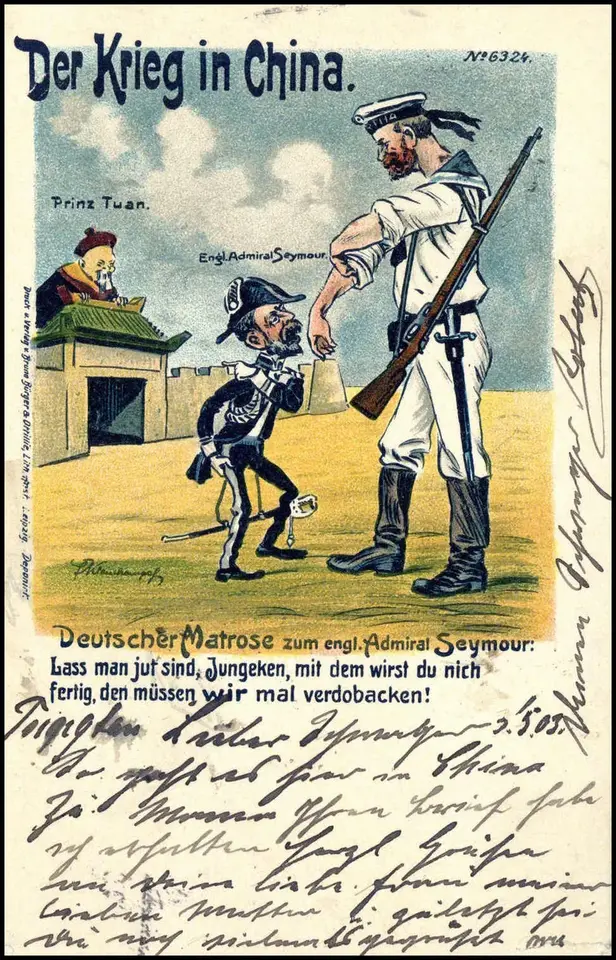
On June 21, 1900, the Qing Empire issued a declaration of war against eleven foreign powers. Zaiyi assumed unified command over the Shenjiying, the Hushenying, and tens of thousands of Boxers, launching sustained assaults against the Legation Quarter and the Beitang (Xishiku Cathedral). However, the Boxers' supposed invulnerability dissolved before modern magazine rifles and artillery; for two months, massive human-wave assaults failed to penetrate the small diplomatic perimeter.
In August 1900, the twenty-thousand-strong expeditionary force of the Eight-Nation Alliance broke through Tianjin and captured Beijing. The allied troops plundered the capital, burning princely mansions and demanding the arrest of Zaiyi.
On the morning of August 15, Cixi and Emperor Guangxu fled the capital in peasant disguise, escorted by Zaiyi and Pujun. As the Boxers evaporated and foreign troops pressed their pursuit, Cixi's martial delusions collapsed. To save her own life and dynastic rule, Cixi repudiated the pro-war faction, stripping Zaiyi of all administrative and military offices.
In September 1901, Prince Qing and Li Hongzhang signed the humiliating Boxer Protocol under allied gunboat diplomacy. The allied powers singled out Prince Duan as the chief war criminal, demanding his immediate decapitation. Fearing that executing an imperial prince would trigger resistance among Manchu bannermen, Cixi commuted the death sentence: Zaiyi was stripped of his princely rank and banished to Xinjiang for perpetual imprisonment. Concurrently, Pujun's status as heir presumptive was annulled.
In Xinjiang, local administrators accommodated Zaiyi in official guesthouses, where he lived in comfortable exile, indulging in opium smoking. Following Cixi's death in 1908, Zaiyi slipped away to Lanzhou, living under the protection of his old friend Mao Qingfan.
Following the 1911 Revolution that toppled the Qing dynasty, Zaiyi participated in Zhang Xun's twelve-day monarchical restoration in 1917, hoping to revive Pujun's imperial prospects, but the coup collapsed immediately. Impoverished and shunned by the former imperial clan, Zaiyi spent his final years in a dilapidated temple compound in Beijing, passing away in obscurity in 1922 at the age of sixty-seven.
In 1899, Prince Duan exploited Empress Dowager Cixi's paranoia regarding Emperor Guangxu to engineer the Jihai Succession. By elevating his son Pujun as the Big Prince, Zaiyi monopolized the capital's military forces through the Shenjiying and held the reins of foreign relations through the Zongli Yamen. This palace coup created the domestic power configuration that catalyzed the Boxer War.
In 1900, Zaiyi's reckless political adventurism caused the greatest geopolitical catastrophe in late imperial Chinese history. By introducing the fanatical Boxer militia into the capital and fabricating the fraudulent diplomatic ultimatum demanding Cixi's abdication, he intentionally forced the Qing empire into declaring war against eleven world powers. His ruthless execution of moderate ministers Xu Jingcheng and Yuan Chang and his leadership during the siege of the foreign legations directly precipitated the sack of Beijing, the signing of the Boxer Protocol, and the collapse of the dynasty's remaining international legitimacy.
FIGURES ASSOCIATED WITH THIS DYNASTY