Birth in Wujin
Born into a scholarly family in Yanghu, Wujin County, Changzhou; his father Yun Richu was a disciple of Liu Zongzhou.
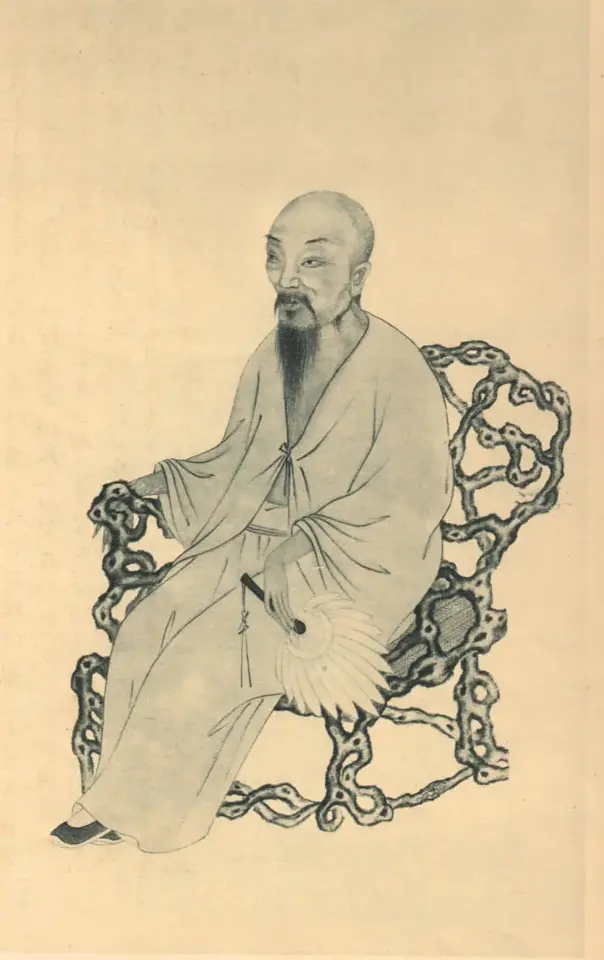
恽寿平
Yun Shouping (1633–1690), originally named Ge, courtesy name Shouping (later adopting Zhengshu), art name Nantian, and alternate sobriquet Baiyun Waishi, was a native of Wujin (modern Changzhou), Jiangsu Province. He was an outstanding master of painting, calligraphy, and poetry in the early Qing dynasty, renowned as one of the Six Masters of the Early Qing (alongside the Four Wangs and Wu Li), the founding patriarch of the…
Yun Shouping (1633–1690), originally named Ge, courtesy name Shouping (later adopting Zhengshu), art name Nantian, and alternate sobriquet Baiyun Waishi, was a native of Wujin (modern Changzhou), Jiangsu Province. He was an outstanding master of painting, calligraphy, and poetry in the early Qing dynasty, renowned as one of the Six Masters of the Early Qing (alongside the Four Wangs and Wu Li), the founding patriarch of the Changzhou School of Painting (the Nantian School), and the supreme titan of Chinese boneless bird-and-flower painting. Born into an illustrious scholar-gentry lineage, he joined the anti-Qing resistance alongside his father and elder brother following the fall of the Ming dynasty, was captured at the siege of Jianning, and eventually reunited with his father—who had taken Buddhist vows—at Lingyin Temple in Hangzhou. Unyielding in his loyalist resolve, Yun refused to sit for the Qing civil service examinations or use Qing reign titles, spending his life as a commoner dedicated to poetry, calligraphy, and painting. Recognizing the peerless landscape mastery of his close friend Wang Hui, he proclaimed that he refused to rank second in landscape art, pivoting his creative energies toward reviving the Northern Song boneless (mogu) technique established by Xu Chongsi. He pioneered an original boneless flower-and-bird style characterized by color saturation, watery washes, and freedom from ink outlines, revolutionizing the stagnant academic and calligraphic conventions of Ming painting. His works swept the nation, prompting the contemporary saying that every household possessed paintings by Nantian. Equally skilled in landscape painting, his verse, calligraphy, and painting were celebrated as the Three Perfections of Nantian. His refined Yun calligraphic style and his art treatises in Nantian Huaba deeply influenced the Eight Eccentrics of Yangzhou, the Shanghai School, and the Lingnan School of Painting. He passed away at the Ouxiang Hall in Changzhou in 1690.
Born into a scholarly family in Yanghu, Wujin County, Changzhou; his father Yun Richu was a disciple of Liu Zongzhou.
Joined southern Ming loyalist forces alongside his father and brother as Qing armies advanced south, enduring mountain warfare.
Captured at the siege of Jianning in Fujian where his elder brother fell in battle; adopted as foster son by Qing governor-general Chen Jin due to his youthful grace.
Following Chen Jin's death, accompanied his adoptive mother's cortege to Hangzhou and was reunited with his father through the intervention of Abbot Jude.
Returned with his father to Wujin, living in quiet seclusion and refusing Qing civil exams to support his family through painting.
Formed a lifelong bond with landscape master Wang Hui in Suzhou, yielding landscape primacy to him and focusing on boneless floral painting.
Resided for three years at Wang Shimin's Xitian Villa in Taicang, studying centuries of collected Song and Yuan masterpieces.
Constructed the Ouxiang Hall in Changzhou, exchanging poetry with scholars and painting tirelessly to finance the reburial of his father.
Died of exhaustion at the Ouxiang Hall at age fifty-eight; left in extreme poverty, his funeral was organized by his close friend Wang Hui.
Yun Shouping was born in 1633 into the prominent Piling Yun lineage of Wujin, Changzhou. His great-grandfather Yun Shaofang was an imperial jinshi graduate of the Jiaqing reign of the Ming dynasty, his grandfather Yun Yinghou was a student at the Imperial Academy, and his father Yun Richu (art name Xun'an) was a disciple of neo-Confucian philosopher Liu Zongzhou, renowned for loyalist integrity across southern China.
Following the dynastic transition of 1644 and the Qing crossing of the Yangzi River, Jiangnan was engulfed in warfare. Possessing unwavering loyalty to the fallen Ming dynasty, Yun Richu mobilized his entire family to resist the invasion, traveling to Fujian to join Ming loyalist commander Wang at Jianning. At only fifteen years of age, Yun Shouping accompanied his father and brothers across the rugged mountains of Fujian and Zhejiang, enduring the harrowing trials of civil war. In 1648, Qing armies laid siege to Jianning; when the city fell, Yun's eldest brother Yun Yunzhong died fighting on the walls, his father fled in disguise, and young Yun was captured amidst the chaos and imprisoned.
Impressed by his refined classical literacy and courtly demeanor, Chen Jin, the Qing Governor-General of Fujian and Zhejiang, and his wife took pity on the captive youth. Childless, they adopted Yun as their foster son, raising him within the governor-general's yamen in Fuzhou. In 1652, Chen Jin was assassinated in his military encampment by rebellious retainers. Grief-stricken, his widow escorted his casket north toward Beijing for burial.
When the funeral procession halted in Hangzhou, the widow arranged grand Buddhist memorial services at Lingyin Temple. By extraordinary coincidence, Yun's biological father, Yun Richu, was living in the temple as a tonsured monk and recognized his son through the clouds of incense. Overwhelmed with emotion, Yun Richu confided in the temple abbot, Jude Hongli. The compassionate abbot advised the widow that the youth's facial physiognomy indicated a celestial calling toward the monastic life, warning that transporting him north would invite misfortune. Persuaded by the abbot's counsel, the widow left Yun at the temple. Under the abbot's protection, father and son were miraculously reunited after years of separation. In 1654, they slipped away from Hangzhou and returned to their ancestral home in Wujin, Changzhou, to live as recluses.
Returning to his native land, Yun adhered faithfully to his father's injunction never to serve the conquerors or take the imperial civil examinations, choosing to live as an uncompromised commoner. To support his aging father, he lived in urban obscurity, exchanging paintings and calligraphic scrolls for grain and salt. In his signatures, he never inscribed Qing imperial reign titles, utilizing only traditional sexagenary cyclical characters and calendar dates, preserving his unwavering loyalist conscience.
In his early artistic development, Yun possessed a passion for landscape painting, drawing from the classical lineages of Dong Yuan, Juran, and Ni Zan to produce sparse, transcendent compositions admired throughout Jiangnan. Around 1670, he became closely acquainted with the great landscape master Wang Hui (art name Shigu). Inspecting Wang's sweeping panoramic landscapes, Yun recognized that Wang had achieved unsurpassed mastery in structural grandeur and dense brushwork. With sincere modesty, Yun remarked to Wang that in landscape painting he yielded absolute primacy to his friend, declaring that he refused to be the second-best painter in the world. He resolved to abandon specialized landscape painting to revive the long-neglected boneless bird-and-flower technique of the Song and Yuan, vowing to create original artistic meaning within classical discipline.
In 1679, Wang Shimin, the revered patriarch of early Qing orthodox painting, invited Yun to reside as an honored guest at his Xitian Villa in Taicang for three years. Wang opened his family's ancestral collections of authentic Song and Yuan masterworks, allowing Yun to study and copy them day and night. During this period, Yun closely examined the paintings of Northern Song masters Xu Chongsi and Zhao Chang alongside Yuan dynasty painter Qian Xuan, bringing his boneless floral techniques to full perfection.
In his final years, Yun settled at the Ouxiang Hall east of Changzhou, supporting his ailing father through artistic commissions. Before passing away, his father expressed a dying wish to be buried beside his beloved West Lake in Hangzhou. Following his father's death, Yun strained his failing health, painting day and night to accumulate funds to relocate his father's grave. Exhausted by overwork and poverty, he died before the relocation could be realized. In 1690, the great master passed away at the Ouxiang Hall at age fifty-eight. Living in ascetic purity, he left behind an empty household unable to afford a burial. Hearing of his death, his close friend Wang Hui rushed to Changzhou, financing his funeral and gathering his surviving manuscripts in an enduring demonstration of artistic brotherhood.
Yun Shouping's supreme historical contribution was resurrecting and elevating the ancient boneless (mogu) bird-and-flower method founded by Northern Song master Xu Chongsi, dismantling the rigid ink-outline conventions of Ming and Qing painting to establish the Changzhou School of Painting.
Since the rise of court painting under Lin Liang and Lü Ji and the literati styles of Shen Zhou, Wen Zhengming, Chen Chun, and Xu Wei, flower-and-bird painting had polarized between stiff double-outlined coloring and ink-splashed wildness. Xu Chongsi's ancient technique of applying pure color washes without ink outlines had been virtually forgotten for centuries. Seeking to capture the inner life of nature through precise verisimilitude, Yun avoided both vulgar gaudiness and coarse distortion, inventing original techniques of color saturation and water-infusion. Directing mineral colors and water from the belly of his brush onto raw Xuan paper, he exploited spontaneous fluid diffusion to produce petals and foliage that appeared dewy, translucent, and alive with morning light. His elegant, luminous aesthetic swept the nation, prompting the phrase that every household possessed paintings by Nantian, establishing the Changzhou School as a dominant force in Qing art.
Beyond his painterly genius, Yun's poetic voice and calligraphic elegance reached the highest levels of classical accomplishment, celebrated by contemporaries as the Three Perfections of Nantian.
In poetry, Yun combined the serene naturalism of Tao Yuanming with the recluse melancholy of Meng Haoran, using natural imagery to express loyalist grief and winning renown as the foremost among the Six Recluses of Piling. In calligraphy, he studied under his father before mastering Tang master Chu Suiliang's Yanta Shengjiao Xu and Song master Mi Fu's Shusu Tie. Discarding the rigid constraints of standard Tang script, he incorporated Mi Fu's dynamic angled momentum, creating a clean, buoyant running-standard script celebrated as the Yun style. Yun personally inscribed original poems onto every painting, achieving a natural synthesis of poetic sentiment, calligraphic rhythm, and painterly imagery that redefined the literati colophon.
Although Yun yielded landscape primacy to Wang Hui to focus on floral painting, his surviving landscape works remain transcendent masterpieces of premodern literati art.
Yun's landscapes drew directly from Five Dynasties masters Dong Yuan and Juran, alongside Yuan recluses Ni Zan and Huang Gongwang. Utilizing sparse brushstrokes, diluted washes, and expansive void spaces, he evoked vast, cold mountain landscapes. Painting with extreme economy of ink, his compositions depicted solitary skiffs drifting across vast waters, withered pines, and desolate riverbanks, embodying the aloof moral independence of the Ming loyalist hermit. Connoisseur Qin Zuyong noted in Tongyin Lunhua that Yun's landscapes combined the subtle graces of Dong, Ju, Ni, and Huang, possessing an untrammeled elegance that even Wang Hui's monumental compositions could not surpass.
Yun was an acute art theorist whose treatises, scattered across colophons and letters, were gathered by later scholars into Nantian Huaba and Ouxiangguan Ji.
Yun formulated the celebrated theory of capturing sentiment (sheqing), asserting that artists must look beyond external physical likeness to capture the spiritual essence of nature. He argued that painting must capture the living soul of flora and the transcendent vitality of the cosmos, maintaining that only through supreme naturalism can an artist transmit the true spirit of blossoms. Aesthetically, he championed untrammeled freedom (yi) and pure naturalness, asserting that artistic quality was inseparable from moral character. Yun's theoretical doctrines nurtured subsequent generations: Li Shan and Hua Yan of the Eight Eccentrics of Yangzhou drew from his techniques, the Two Jus and Gao Jianfu of the Lingnan School developed his boneless methods into water-and-powder infusion, and modern connoisseur Wu Hufan lauded him as the supreme bird-and-flower painter in Chinese history.
FIGURES ASSOCIATED WITH THIS DYNASTY