Born in the Forbidden City
Born on the second day of the third month, seventeenth son of the Kangxi Emperor and Consort Chunyu Qin.
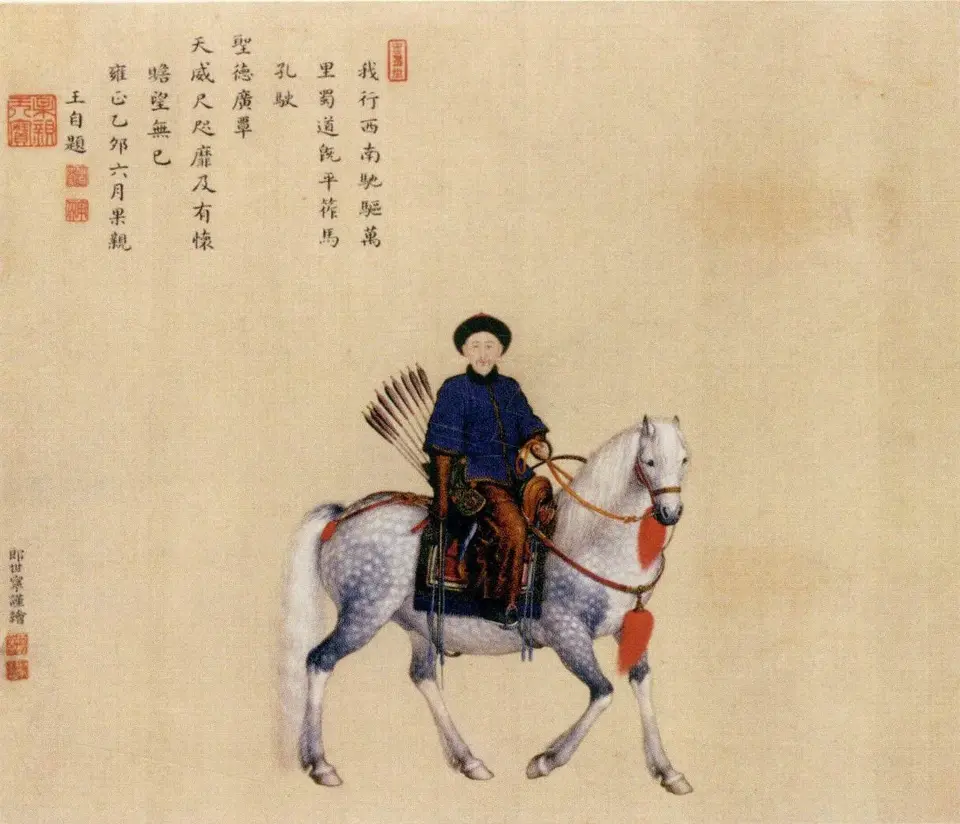
允礼
Aixin Jueluo Yunli (爱新觉罗·允礼, March 24, 1697 – March 21, 1738), originally named Yinli and renamed Yunli to observe the naming taboo of the Yongzheng Emperor, styled Zide Jushi and Chunhe Zhuren, was the seventeenth son of Emperor Shengzu (Kangxi) and Consort Chunyu Qin. Educated in Manchu and Chinese classical learning under the scholar Shen Deqian, Yunli demonstrated a prudent, upright character, remaining scrupulously…
Aixin Jueluo Yunli (爱新觉罗·允礼, March 24, 1697 – March 21, 1738), originally named Yinli and renamed Yunli to observe the naming taboo of the Yongzheng Emperor, styled Zide Jushi and Chunhe Zhuren, was the seventeenth son of Emperor Shengzu (Kangxi) and Consort Chunyu Qin. Educated in Manchu and Chinese classical learning under the scholar Shen Deqian, Yunli demonstrated a prudent, upright character, remaining scrupulously detached from the intense succession conflicts among the elder princes in the late Kangxi era. In 1723, following his diligent supervision of construction at the Jingling Mausoleum, the Yongzheng Emperor created him Prince Guo of the Second Rank and placed him in charge of the Court of Colonial Affairs (Lifan Yuan) while appointing him to lead four separate banner lieutenant-general commands. Elevated to Prince Guo of the First Rank in 1728, he successively directed the Ministry of Works, the Three Vaults of the Ministry of Revenue, and the Imperial Clan Court. In 1734, he was dispatched to Taining in Sichuan to oversee the safe return of the Seventh Dalai Lama Kelzang Gyatso to Lhasa while inspecting provincial Green Standard garrisons. Appointed one of the regency ministers in Emperor Shizong's deathbed decree alongside Prince Zhuang (Yunlu), Ortai, and Zhang Tingyu, he served as Grand Minister Managing State Affairs and directed the Ministry of Punishments under the young Qianlong Emperor before dying in 1738 at age forty-two.
Born on the second day of the third month, seventeenth son of the Kangxi Emperor and Consort Chunyu Qin.
Began accompanying the Kangxi Emperor on tours to the northern steppes and southern provinces at age nine, studying classics and calligraphy.
Awarded the princely title after overseeing the Jingling Mausoleum works and placed in charge of the Court of Colonial Affairs and various banner commands.
Promoted to Prince Guo of the First Rank for exemplary loyalty, unswerving integrity, and administrative diligence.
Assigned to control the Ministry of Works in 1729 and the Three Vaults of the Ministry of Revenue in 1730 following the death of Prince Yi (Yinxiang).
Appointed to manage the Imperial Clan Court, supervising genealogies and conduct of imperial clansmen.
Traveled to Huiyuan Temple in Taining, Sichuan, to deliver imperial decrees and escort the Seventh Dalai Lama toward Tibet while reviewing regional armies.
Appointed regency minister in the Yongzheng Emperor's final testament, serving the Qianlong Emperor as Grand Minister Managing State Affairs.
Died in Beijing on the second day of the second month at age forty-two; posthumously canonized as Yi, with the emperor's brother Hongyan adopting his lineage.
Yunli was born in Beijing on March 24, 1697. His birth mother was Consort Chunyu Qin of the Han Martial Chen clan, daughter of Chen Ximin. In accordance with dynastic tradition, he entered the Palace School for Princes (Shangshufang) at a young age, studying Confucian classics and historical treatises under the prominent literary master Shen Deqian. Endowed with exceptional cultural aptitude, he excelled in calligraphy and finger painting and maintained intellectual exchanges with eminent literati such as Fang Bao.
Beginning in 1705 at the age of nine, Yunli regularly accompanied his father on northern inspections and military reviews. As the fierce struggle over the imperial succession erupted among the elder princes after 1708, Yunli avoided court factions, focusing on literary pursuits, landscape travels, and Buddhist scholarship. By the time the Kangxi Emperor died in 1722, although Yunli held no formal princely title, his modest conduct earned him the complete trust of his elder brother Yinzhen (the Yongzheng Emperor).
Upon ascending the throne in late 1722, the Yongzheng Emperor changed his brothers' name prefix from Yin to Yun and entrusted Yunli with repairing the Jingling Mausoleum of the late emperor. Satisfied with his meticulous devotion, the emperor created him Prince Guo of the Second Rank (Duoluo Guo Junwang) in the fourth month of 1723 and placed him in charge of the Court of Colonial Affairs (Lifan Yuan). Shortly thereafter, Yunli was appointed acting Right Wing Vanguard Commander, and subsequently directed the Plain Yellow Mongol Banner and Bordered Blue Han Martial Banner garrisons.
In 1724, Yunli was transferred to lead the Bordered Red Manchu Banner while retaining command of the Bordered Blue Han Martial Banner, frequently serving as the emperor's personal proxy in state sacrifices at the Altars of Land and Grain and the Temple of Confucius. In the eighth month of 1724, the emperor ordered that Yunli receive the stipend and grain allowances of a Prince of the First Rank. In 1726, he was concurrently charged with supervising the Bordered Blue Mongol Banner and auditing the Imperial Academy (Guozijian).
In the second month of 1728, the Yongzheng Emperor issued a lavish praise edict declaring that Yunli had managed colonial and banner affairs with complete devotion, absolute selflessness, and strict impartiality, officially promoting him to Prince Guo of the First Rank (Heshuo Guo Qinwang). In 1729, Yunli was appointed to direct the Ministry of Works. Following the death of the emperor's closest brother Prince Yi (Yinxiang) in 1730, Yunli took over management of the Three Vaults of the Ministry of Revenue, and in 1733 was appointed Controller of the Imperial Clan Court.
In the summer of 1734, as western frontier tensions eased, the Qing court resolved to escort the Seventh Dalai Lama Kelzang Gyatso—who had been residing under imperial protection at Huiyuan Temple in Taining, western Sichuan—back toward Lhasa. The Yongzheng Emperor designated Prince Guo as principal imperial envoy, accompanied by the Changkya Khutukhtu, to convey royal greetings and inspect border garrisons throughout Zhili, Shanxi, Shaanxi, and Sichuan. Crossing the rugged terrain of the southwest, Yunli celebrated the Tibetan New Year with the Dalai Lama at Huiyuan Temple, solidifying imperial ties with Tibetan religious authorities and recording his expedition in a poetry collection.
Returning to Beijing in 1735, Yunli was immediately appointed alongside Prince Bao (Hongli) and Prince He (Hongzhou) to manage military operations along the Guizhou Miao frontier. On the twenty-second day of the eighth month of 1735, the dying Yongzheng Emperor summoned Prince Zhuang (Yunlu), Prince Guo (Yunli), and Grand Secretaries Ortai and Zhang Tingyu to his bedside, naming them the four regency councilors to assist the accession of the twenty-five-year-old Qianlong Emperor.
Under the young Qianlong Emperor, Yunli served at the head of the Board of Regents (Zongli Shiwu Chuwang Dachen), superintending both the Imperial Clan Court and the Ministry of Punishments. He directed the compilation of the late emperor's edicts and petitioned for clear statutes punishing bureaucratic embezzlement. In the autumn of 1736, the Qianlong Emperor granted Yunli's mother the title of Dowager Consort Chunyu Qin and awarded Yunli permanent double princely stipends, exempting him from prostrating during informal imperial audiences due to a chronic leg ailment.
Worn down by relentless administrative duties, Yunli died on March 21, 1738, at his palace in Beijing at the age of forty-two. Deeply saddened, the Qianlong Emperor visited the prince's residence to weep, assigned his eldest son Yonghuang to observe mourning attire, and bestowed the posthumous name Yi. Because Yunli's biological children had died in infancy, the Qianlong Emperor ordered his youngest half-brother Hongyan (the Yongzheng Emperor's sixth son) to be adopted into Yunli's line to inherit the Prince Guo princely title.
Throughout the Yongzheng and early Qianlong reigns, Yunli managed the Court of Colonial Affairs, Ministry of Works, Three Vaults of Revenue, Imperial Clan Court, and Ministry of Punishments. Stepping into the administrative vacuum left by Prince Yi's death in 1730, he strictly curbed procurement padding in state construction and halted fraudulent deductions in treasury grain and bullion vaults. Emperor Shizong ranked Yunli alongside Prince Yi as a model statesman of pure integrity and relentless dedication to the realm.
Yunli possessed a profound knowledge of Tibetan Buddhist scriptures and Mongolian frontier diplomacy, organizing the translation and printing of canonical Tibetan treatises during his supervision of the Court of Colonial Affairs. His 1734 mission to Taining effectively reconciled regional grievances and paved the way for the Dalai Lama's peaceful governance in Lhasa. A distinguished connoisseur of literature and arts, he compiled Guwen Yuexuan (Selected Ancient Prose), authored Chunhetang Ji, and achieved renown as one of the premier royal calligraphers and painters of the High Qing era.
FIGURES ASSOCIATED WITH THIS DYNASTY