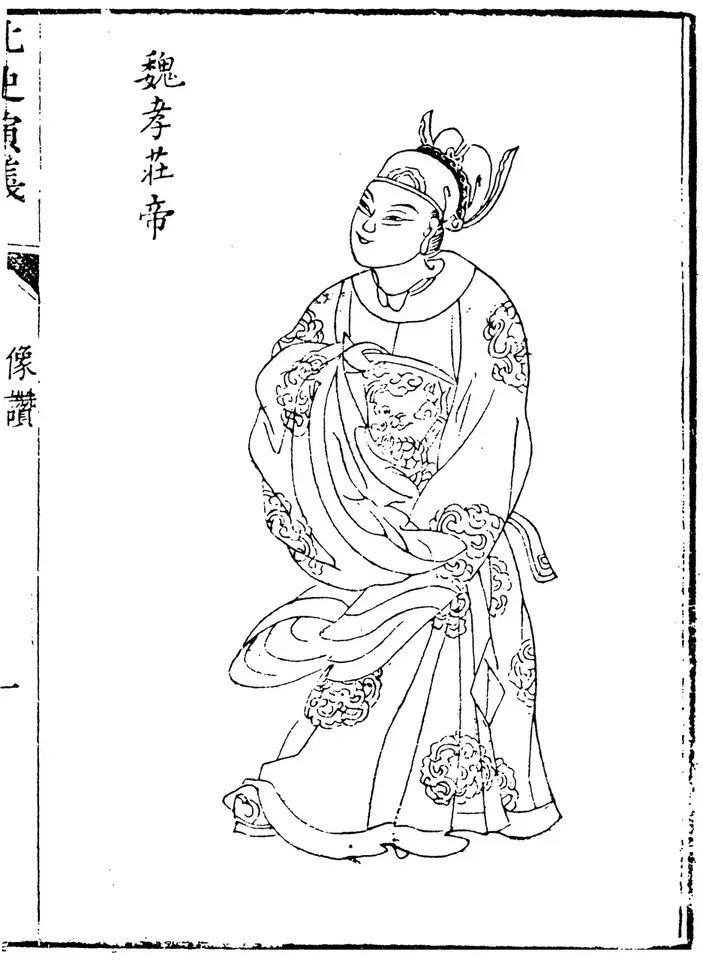
Biography
Imperial Lineage and Youthful Brilliance
Yuan Ziyou was a grandson of Emperor Xianwen (Tuoba Hong) and the third son of Pengcheng King Yuan Xie, one of the most revered and virtuous imperial princes of the Northern Wei. His mother, Lady Li Yuanhua, belonged to the prominent Longxi Li clan, and his maternal grandfather Li Chong was the premier architect of Emperor Xiaowen's sinicization reforms. Yuan Ziyou thus united the martial charisma of the Northern Wei imperial house with the classical learning of the Central Plains aristocracy.
From childhood, Yuan Ziyou possessed an extraordinary intellect, grace, and physical beauty. Dynastic chronicles recorded that he was "intellectually precocious, extraordinarily handsome in countenance, solemn in bearing, and radiant in spirit," naturally commanding regal dignity. In 515 CE (the first year of Xiping), nine-year-old Yuan Ziyou was enfeoffed as the Founding Duke of Wucheng County in honor of his father's decisive role in securing the succession of Emperor Xuanwu. He was chosen to serve inside the forbidden palace as study companion to the young Emperor Xiaoming (Yuan Xu).
During his imperial service, Yuan Ziyou mastered classical canons and historical chronicles while excelling in martial arts, able to shoot arrows with either hand while galloping on horseback. Emperor Xiaoming placed immense trust in him. In August 526 CE (the second year of Xiaochang), twenty-year-old Yuan Ziyou was promoted to King of Changle, serving as Palace Attendant, Director of the Palace Secretariat, and Commander of the Left Guards. When Yongning Temple was constructed in Luoyang, his commemorative statue was praised by contemporaries as "possessing complete spiritual illumination, majestic and serene," reflecting his widespread esteem.
The Dynastic Crisis and the Heyin Massacre
During the late Xiaochang era, northern frontier rebellions erupted across the empire, destabilizing the Central Plains. In the capital Luoyang, Empress Dowager Hu ruled despotic and corrupt, indulging male favorites and perverting imperial administration. In February 528 CE, Emperor Xiaoming secretly summoned Erzhu Rong, Grand Commander of Bingzhou, to march on the capital to suppress the dowager's faction. When the plot leaked, Empress Dowager Hu and her confidants poisoned the nineteen-year-old sovereign in the Xianyang Hall, enthroning an infant prince to maintain her regency.
Outraged by the Emperor's murder, Erzhu Rong mobilized tens of thousands of northern cavalry and crossed the Yellow River to seize Luoyang. Seeking to establish a new sovereign under divine sanction, Erzhu Rong melted copper to cast divination statues of various imperial princes. While statues of other princes cracked during casting, the statue of King of Changle Yuan Ziyou emerged flawless and radiant. Remembering the enduring public affection for Yuan Ziyou's father Yuan Xie, Erzhu Rong dispatched envoys to Luoyang to escort Yuan Ziyou to the northern military camp at Heyin.
On the eleventh day of the fourth month in 528 CE, Yuan Ziyou ascended the throne north of Mengjin, proclaiming the Jianyi era as Emperor Xiaozhuang. However, his coronation was immediately followed by a catastrophe that shook the empire.
On the thirteenth day of the fourth month, Erzhu Rong summoned over two thousand ministers and princes to the Heyin traveling palace under the pretext of an imperial audience. As the assembly knelt, Erzhu Rong rode onto the terrace, denouncing the court gentry for corruption and misrule. He gave the signal, and thousands of cavalry ambushed the unarmed gathering. Chancellor Yuan Yong, Minister of Works Yuan Qin, Li Chong's sons, and Yuan Ziyou's brothers Pengcheng King Yuan Shao and Bachenggong Yuan Zizheng were slaughtered. The riverbank was strewn with corpses, and the river ran red with blood. Erzhu Rong then placed Empress Dowager Hu and the infant emperor into bamboo cages, casting them into the Yellow River to drown. Witnessing the murder of his brothers and ministers, twenty-two-year-old Yuan Ziyou stood in agony. Confronted by Erzhu Rong's naked threats, he declared with composure: "If the Grand Pillar finds me lacking in virtue, you may ascend the throne yourself; but if you seek to preserve the state, you must honor the duties of sovereign and subject!" Awed by his dignity, Erzhu Rong escorted Yuan Ziyou into the capital.
Solitary Rule and Conscientious Governance
The Heyin Massacre emptied the administrative apparatus of Luoyang, driving the frightened population into flight. Although Erzhu Rong harbored ambitions to seize the throne, the repeated failure of his personal gold statues and the warnings of general Haba Yue persuaded him to withdraw to his military bastion at Jinyang, leaving the devastated capital under Yuan Ziyou's governance.
To placate the powerful warlord, Yuan Ziyou was forced to marry Erzhu Rong's daughter, Erzhu Ying'e, establishing her as Empress. Despite his position as a captive sovereign, Yuan Ziyou worked tirelessly to rebuild the realm.
He issued an imperial amnesty, granting posthumous honors and official burials to the victims of Heyin, while exempting their surviving families from taxes and corvee labor. He reviewed the judicial atrocities committed during Empress Dowager Hu's regency, releasing thousands of wrongfully detained commoners. In central administration, he established "Rectifiers of Administration" (Sizhi) within the judiciary, appointing upright scholars to investigate official corruption and curb aristocratic extortion. When Palace Censor Gao Daomu flogged imperial relatives for violating traffic laws, Yuan Ziyou commended his integrity.
Furthermore, when severe drought induced famine across Guangzhou and Qingzhou, Regional Inspector Yang Yi opened state granaries without prior authorization to feed the starving population. When court conservatives demanded Yang Yi's punishment, Yuan Ziyou overruled them, commending Yang Yi's compassion and awarding him bolts of silk, saving hundreds of thousands of lives. Through his benevolence, Yuan Ziyou won the loyalty of the Central Plains populace.
Southern Invasion and Flight to Changzi
In April 529 CE (the second year of Yong'an), the self-proclaimed Northern Wei claimant Yuan Hao marched northward under the patronage of Emperor Wu of Liang, escorted by Liang general Chen Qingzhi and his seven thousand white-robed troops.
Chen Qingzhi's forces captured thirty-two fortresses, shattering Northern Wei field armies and advancing to Xingyang near Luoyang. In May, recognizing that Luoyang's fortifications were compromised and Erzhu Rong's reinforcements at Jinyang were distant, Yuan Ziyou led an escort out of Luoyang, crossing the Yellow River to establish a temporary court at Changzi in Shanxi.
Yuan Hao entered Luoyang and assumed the imperial title, but quickly alienated northern society through indulgence and factionalism. In Changzi, Yuan Ziyou shared rations and coarse quarters with his soldiers, preserving army morale. In July, Erzhu Rong mobilized a hundred thousand cavalry to join Yuan Ziyou in counterattacking Luoyang.
The decisive battle erupted at Mengjin along the Yellow River. Sudden torrential rains flooded the river, destroying the Liang fortifications and severing their supply lines. Erzhu Rong routed Yuan Hao's forces. Yuan Hao fled and was killed by local villagers, while Chen Qingzhi shaved his head to escape as a Buddhist monk. Yuan Ziyou returned in triumph to Luoyang. When surrendered officers like Xin Zuan knelt in terror, Yuan Ziyou raised them with his own hands, declaring: "When the capital fell, I was forced to seek refuge north; that you surrendered to preserve the people from slaughter was due to my own inadequacy, not your fault!" His magnanimity restored order to the capital.
Warlord Tyranny and the Imperial Vow
Following his return to Luoyang, the conflict between Yuan Ziyou and Erzhu Rong reached an impasse. Celebrating his victories over Ge Rong, Xing Gao, and Yuan Hao, Erzhu Rong received the title of Grand Pillar of State, Supreme Mentor, and King of Taiyuan. He governed imperial affairs from his headquarters in Jinyang and demanded the bestowal of the Nine Distinctions, making his usurpation evident.
Erzhu Rong's daughter Empress Erzhu treated Yuan Ziyou with contempt, boasting: "Why revere an emperor? Had my father's gold statue succeeded, the empire would belong to the Erzhu clan; your position today is entirely my father's gift!" Erzhu Rong stationed agents inside the palace to monitor Yuan Ziyou's every move, rendering him a prisoner in his own halls.
Faced with this threat, Yuan Ziyou adopted a calculated posture of total submission. He received Erzhu Rong with elaborate honors at the palace gates, rewarded his kinsmen, and endured the Empress's insults without anger, successfully lulling the warlord into complacency.
When loyal ministers such as King of Chengyang Yuan Hui, Attendant Li Miao, and Gentleman Yang Kan urged him to eliminate Erzhu Rong before he executed a coup, Yuan Ziyou made his celebrated vow: "Duke of Gaoguixiang Cao Mao fell beneath Chen Ji's spear, yet history honors him as a hero; Emperor Xian of Han Liu Xie survived in disgrace, earning the contempt of posterity. I would rather die fighting like Duke of Gaoguixiang than live like Emperor Xian of Han!"
The Mingguang Hall Ambush and Slaying of Erzhu Rong
In November 530 CE (the ninth month of the third year of Yong'an), Erzhu Rong arrived in Luoyang with several thousand cavalry under the pretext of visiting his pregnant daughter. Yuan Ziyou and his conspirators resolved to strike inside the palace.
On the twenty-fifth day of the ninth month, Empress Erzhu gave birth to a prince. Yuan Ziyou sent couriers to Erzhu Rong's residence announcing the birth and inviting him and Situ Yuan Tianmu to the palace to receive imperial rewards and deliberate state affairs.
Confident that the mild sovereign posed no danger, Erzhu Rong walked into the eastern chamber of Mingguang Hall accompanied by his eldest son Erzhu Puti, Yuan Tianmu, and thirty retainers. Armed guards under Lu An and Li Kan remained concealed behind the tapestries.
As Erzhu Rong and Yuan Tianmu bowed before the throne, Lu An and Li Kan burst from the tapestries with drawn swords. Reacting instantly, Erzhu Rong shouted "The Emperor is rebelling!" and leaped toward the throne to seize Yuan Ziyou as a human hostage.
At this decisive moment, twenty-four-year-old Yuan Ziyou drew an imperial sword concealed beneath his seat and lunged forward, thrusting the blade directly through Erzhu Rong's chest. The tyrant collapsed dead at the foot of the throne. Simultaneously, Li Miao and concealed guards attacked, slaying Yuan Tianmu and Erzhu Puti in the hall.
News of Erzhu Rong's death ignited jubilation throughout Luoyang, with citizens dancing in the streets and burning incense in celebration. Yuan Ziyou issued an imperial amnesty to reconcile the warlord's remaining forces.
Clan Counteroffensive, Imprisonment, and Martyrdom
However, the Erzhu clan possessed vast military forces across northern garrisons. Erzhu Rong's cousins Erzhu Shilong and Erzhu Dulu rallied four thousand cavalry outside Luoyang, while Erzhu Zhao mobilized tens of thousands of veteran cavalry from Fen and Jin provinces to march south.
Yuan Ziyou mounted the capital walls to direct the defense, issuing appeals for regional armies to support the throne. Attendant Li Miao led volunteers in fire ships up the Yellow River, burning the pontoon bridges and halting the rebel advance for weeks.
However, provincial commanders withheld their troops to protect their private interests. In mid-November, an unprecedented blizzard froze the Yellow River solid. Seizing this opportunity, Erzhu Zhao rode his cavalry across the thick ice, breaching the western gates of Luoyang. The city fell, and Erzhu Zhao's troops sacked the palace, killing Yuan Ziyou's infant son on the palace steps. Yuan Ziyou was captured in the Taiji Hall, bound in chains, and imprisoned in the freezing tower of Yongning Temple.
Deprived of warm clothing amidst winter blizzards, Yuan Ziyou remained steadfast, rebuking Erzhu Zhao for treason. Fearing that the citizens of Luoyang would liberate the sovereign, Erzhu Zhao had Yuan Ziyou transferred in a cage cart to Jinyang. During the journey, Yuan Ziyou composed his farewell poem: "Power departed, the path of life grows brief; sorrow arriving, white hairs lengthen. The secluded courtyard will never see dawn; the subterranean road remains forever dark."
In January 531 CE (the twelfth month of the third year of Yong'an), Erzhu Zhao ordered his executioners to strangle Yuan Ziyou inside the Sanji Temple in Jinyang. Facing death, Yuan Ziyou remained calm. He washed his face, straightened his prison garments, and knelt toward the western hall of the Buddha, offering his final prayer: "Born into chaos, my life was not my own; I pray that from this life forward, throughout all future rebirths, I may never again be born into an imperial family!" Having completed his devotions, he offered his neck to the executioner, dying at the age of twenty-four.
Following Gao Huan's destruction of the Erzhu clan, the Northern Wei court retrieved Yuan Ziyou's remains from Jinyang, conducting a magnificent imperial funeral. He was granted the temple name Jingtong, the posthumous title Emperor Xiaozhuang, and interred in Jingling, leaving an immortal legacy of heroic resistance against tyranny.
Major Achievements
The Assassination of Erzhu Rong
Yuan Ziyou's execution of Erzhu Rong in Mingguang Hall in 530 CE stands as one of the most daring imperial counter-coups in Chinese history. Facing a warlord who commanded hundreds of thousands of iron cavalry and dictated dynastic succession at will, Yuan Ziyou demonstrated peerless audacity.
Exploiting the celebration of his son's birth, he arranged the ambush inside the inner palace. When Erzhu Rong lunged for the throne, Yuan Ziyou personally drew his sword and struck down the tyrant. This act eliminated the perpetrator of the Heyin Massacre, avenged his murdered family, and shattered the illusion of warlord invincibility.
Reorganizing Administration and Relief of Famine
During his two years of rule under warlord intimidation, Yuan Ziyou demonstrated exceptional administrative ability and deep humanitarian concern. Confronting the vacuum left by the Heyin Massacre, he promulgated amnesties to reassure the populace, rehabilitated the deceased ministers, and instituted the office of Rectifiers of Administration to oversee bureaucratic integrity.
In economic affairs, he broke through rigid administrative protocols to support local officials like Yang Yi in opening granaries to relieve starving populations across Guangzhou and Qingzhou, preserving stability and saving hundreds of thousands of lives amidst widespread warfare.
Preserving Dynastic Legitimacy at Changzi
During the 529 CE southern invasion by Chen Qingzhi and Yuan Hao, Yuan Ziyou preserved dynastic continuity through strategic resolve. Refusing to submit to the Liang-backed puppet regime, he retreated to Changzi, establishing a wartime administration that maintained Northern Wei legitimacy.
Sharing harsh rations and hardships with his frontier troops, he rallied northern loyalists, coordinated with field armies to retake Luoyang, and implemented generous amnesties that reintegrated surrendered officials, restoring cohesion to the imperial court.
Unyielding Imperial Dignity and Martyrdom
Yuan Ziyou's ultimate legacy lies in his steadfast moral dignity in the face of violent oppression. Rejecting compromise with Erzhu Rong, he proclaimed the oath to die fighting like Duke of Gaoguixiang rather than endure humiliation like Emperor Xian of Han.
Imprisoned, frozen in chains, and led to his execution at Sanji Temple in Jinyang, he met death with serene composure, composing poetry and praying never to be reborn into an imperial family. His sacrifice established him as one of the most heroic figures in medieval Chinese historiography.