Birth in the Capital
Born in Chang'an in the second lunar month, as a fifteenth-generation descendant of Emperor Zhaocheng of Northern Wei (Tuoba Shiyiqian).
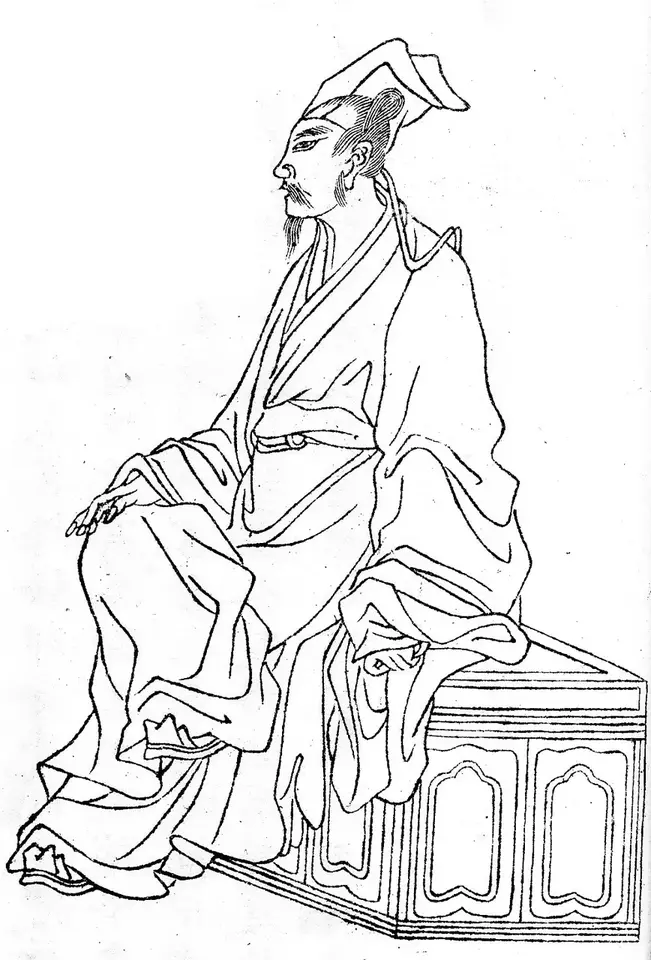
元稹
Yuan Zhen (元稹, March 779 – September 3, 831), courtesy name Weizhi and alternate courtesy name Weiming, was a native of Luoyang County, Henan Superior Prefecture (modern Luoyang, Henan Province), born in the imperial capital Chang'an. He was a celebrated statesman, Grand Councilor, eminent literary master, poet, and novelist of the mid-Tang dynasty. A descendant of the Tuoba royal clan of Northern Wei, Yuan served four…
Yuan Zhen (元稹, March 779 – September 3, 831), courtesy name Weizhi and alternate courtesy name Weiming, was a native of Luoyang County, Henan Superior Prefecture (modern Luoyang, Henan Province), born in the imperial capital Chang'an. He was a celebrated statesman, Grand Councilor, eminent literary master, poet, and novelist of the mid-Tang dynasty. A descendant of the Tuoba royal clan of Northern Wei, Yuan served four successive emperors—Xianzong, Muzong, Jingzong, and Wenzong. Renowned for his moral courage and forthright criticism in central politics, he rose to the pinnacle of political power as Grand Councilor, and later governed Zhedong and Wuchang, earning broad acclaim for his incorruptibility, benevolent administration, and large-scale hydraulic construction. In the history of Chinese literature, Yuan Zhen and his lifelong intimate companion Bai Juyi formed an indissoluble literary partnership celebrated as "Yuan-Bai." Together they spearheaded the momentous New Yuefu Movement, championing the realist dictum that "prose should be written to serve contemporary needs, and songs and poems should be composed to address real affairs." They pioneered the Yuanhe Style, noted for its lucid, accessible diction, rigorous tonal counterpoint, and evocative narrative nuance, which transformed mid-Tang poetry and swept both central court circles and East Asian neighbors. Furthermore, Yuan Zhen's elegiac verses mourning his deceased wife remain among the most touching in classical literature, yielding the timeless couplet: "Having once sailed the vast ocean, no other water can suffice; having once beheld the clouds over Mount Wu, no other mist compares." In classical narrative prose and romance fiction, Yuan Zhen authored the towering masterpiece The Story of Yingying (also known as Encountering a True Immortal), which delicately chronicles the love tragedy of Scholar Zhang and Cui Yingying. Celebrated for its intricate psychological insight and exquisite prose, it became the quintessential foundational source for Wang Shifu's Yuan drama Romance of the Western Chamber and subsequent operatic traditions. A prolific writer of monumental edicts and statecraft treatises, his literary works were compiled into the sixty-volume Collected Works of Mr. Yuan of the Changqing Era. In September 831, Yuan Zhen passed away in office at Wuchang at age fifty-two, mourned deeply across the empire and eulogized by Bai Juyi in an immortal epitaph.
Born in Chang'an in the second lunar month, as a fifteenth-generation descendant of Emperor Zhaocheng of Northern Wei (Tuoba Shiyiqian).
Lost his father at age eight; under severe poverty, moved with his mother Lady Zheng to maternal kin in Fengxiang, where his mother personally instructed him in the Confucian classics and poetry.
Passed the Classicist (Mingjing) examination at the youthful age of fifteen; lacking immediate substantive office, engaged in extensive private scholarship on the classics, Chen Zi'ang, and Du Fu.
Sat for the Ministry of Personnel evaluation examinations and passed the Distinguished Judgment Examination alongside Bai Juyi; the two formed an unbreakable lifelong friendship.
Appointed Collator in the Palace Library and wed Wei Cong, the youngest daughter of Mayor of Jingzhao Wei Xiaqing, beginning a devoted poetic marriage.
Placed first in the Imperial Decree Examination on Talent and Statecraft with sharp criticisms of contemporary abuses; elevated to Reminder of the Left.
Promoted to Investigating Censor; dispatched as Special Commissioner to Eastern Jiannan, vigorously impeaching the late Regional Commander Yan Li for extortion and corruption.
Impeached Henan Prefect Fang Shi; incurred the vengeance of powerful palace eunuchs, resulting in imperial reprimand and exile as Staff Officer of Jiangling.
Reassigned to remote Tongzhou as Vice Prefect, harmonizing extensive verses with Bai Juyi in Jiangzhou, and composing the renowned Lianchang Palace Ballad.
Following Xianzong's demise and Muzong's ascension, recalled as Vice Director of Food Provision, Drafter of Imperial Edicts, and Hanlin Academician, receiving supreme imperial favor.
Appointed Vice Director of the Secretariat and Grand Councilor (Chief Minister) in the second month; ousted four months later amid intense court partisan rivalry and reassigned to Tongzhou.
Served as Surveillance Commissioner of Zhedong and Prefect of Yuezhou for seven years, leading seven prefectures in constructing dikes, reservoirs, and drainage canals.
Transferred as Military Commissioner of Wuchang; passed away suddenly on the twenty-second day of the seventh lunar month at age fifty-two; posthumously honored as Right Vice Director of State Affairs.
Yuan Zhen hailed from the illustrious Tuoba imperial clan of Northern Wei. In his Epitaph for Master Yuan of Henan, Bai Juyi explicitly verified that Yuan Zhen was the "fifteenth-generation descendant of Emperor Zhaocheng of Northern Wei, Tuoba Shiyiqian." During the reign of Emperor Xiaowen of Northern Wei, following the relocation of the capital to Luoyang and extensive Sinicization reforms, the royal surname Tuoba was changed to Yuan, and his forebears took up residence in Luoyang, Henan Superior Prefecture. From the early Tang dynasty, successive generations of the Yuan family served as prefects and ministers. However, by the generation of Yuan Zhen's father, Yuan Kuan, family fortunes had significantly waned; Yuan Kuan served only as an Administrative Advisor to the Prince of Shu, residing in Chang'an.
In the second month of the fourteenth year of Dali (March 779), Yuan Zhen was born in Jing'an Ward in southern Chang'an. When Yuan Zhen was only eight years old (786), his father died of illness, leaving behind a widow and young children plunged into extreme impoverishment. His mother, Lady Zheng, came from the distinguished Zheng lineage of Xingyang, possessing profound virtue and deep classical erudition. Confronted with bare walls, Lady Zheng took young Yuan Zhen and his elder brother Yuan Ji to seek refuge with their maternal relatives in Fengxiang. Unable to hire private tutors, Lady Zheng sat beside the oil lamp, personally teaching Yuan Zhen the Confucian classics, historical texts, and prosody.
Young Yuan Zhen was remarkably precocious and intensely filial toward his mother. Fully aware of his family's vulnerability, he dedicated himself to unremitting study as the sole avenue to revive his ancestral household. During bitter winter nights, he persisted in writing even when the water in his inkstone froze solid. In 793, at the youthful age of fifteen, Yuan Zhen traveled to Chang'an and passed the Classicist Examination (Mingjing). Under the Tang civil examination structure, however, the Classicist degree carried far less prestige than the Advanced Scholar (Jinshi) degree and did not confer immediate substantive appointments. Remaining in the capital as a commoner, Yuan immersed himself in canonical exegesis while systematically devouring the poetry of early Tang master Chen Zi'ang and High Tang giant Du Fu, laying an unshakeable bedrock for his subsequent literary achievements.
In the winter of the eighteenth year of Zhenyuan (802), at age twenty-four, Yuan Zhen entered the Ministry of Personnel's highly demanding Distinguished Judgment Examination (Shupan Bacui Ke). This evaluation tested candidate mastery of imperial legal codes, administrative statutes, and the ability to draft rigorous, elegant judicial decisions. In this intensely competitive arena, Yuan Zhen finished among the foremost candidates and was officially appointed Collator in the Palace Library (Bishu Sheng Xiaoshulang).
During this examination process, Yuan Zhen encountered twenty-seven-year-old fellow successful candidate Bai Juyi. Though strangers prior to this meeting, their very first conversation revealed complete intellectual harmony regarding literary aesthetics, political aspirations, social compassion, and their shared determination to revitalize the declining dynasty. They forged a profound pact of brotherhood in Chang'an, initiating the celebrated "Yuan-Bai" literary alliance that would endure for three decades and shape Chinese cultural history.
While serving as Collator, Yuan Zhen's prodigious scholarship caught the attention of prominent court figures. Wei Xiaqing, then Mayor of Jingzhao and an eminent aristocrat, deeply admired Yuan Zhen's erudition and character, disregarding the Yuan family's humble economic standing to betroth his youngest daughter, Wei Cong, to him. Following their marriage, the couple lived in frugal simplicity, with Wei Cong embracing modest domestic life with devoted grace. Their mutual devotion became Yuan Zhen's warmest spiritual anchor during his early career.
In the fourth lunar month of the first year of Yuanhe (806), Emperor Xianzong, newly enthroned and determined to centralize authority and suppress regional warlords, promulgated an imperial decree for the Special Palace Examination on Talent and Statecraft (Caishi Jianmao Mingyu Tiyong Ke). Personally presided over by the emperor, this examination sought exceptional statecraft talents across the realm. Yuan Zhen and Bai Juyi entered the competition together. In his examination memorial, Yuan Zhen offered an unvarnished critique of systemic imperial ills, attacking palace eunuch domination, regional warlord separatism, unequal land taxation, and bureaucratic corruption, while detailing actionable strategies for fiscal stabilization and legal rectitude.
When the rankings were unveiled, examiners were stunned by Yuan Zhen's formidable argumentative power and moral daring, unanimously placing his policy memorial first. Emperor Xianzong commended him warmly and broke precedent by appointing him Reminder of the Left (Zuo Shiyi). Bai Juyi also passed and received an appointment as Reminder of the Left. Placed in an active remonstrance role at age twenty-eight, Yuan Zhen considered correcting the monarch's conduct and rooting out systemic vice his sacred duty.
Within a span of only a few months, Yuan Zhen submitted dozens of memorials to the throne. He opposed improper enfeoffments and rewards granted to imperial in-laws, impeached redundant central officials, and vigorously advocated checking the arrogant overreach of eunuch army supervisors. His unrelenting rectitude swiftly provoked the resentment of vested aristocratic interests and entrenched court elites. Viewing his remonstrances as excessively aggressive, Emperor Xianzong had him transferred out of the capital as Assistant Magistrate of Henan County in September 806. Shortly after leaving the capital, Yuan Zhen's mother Lady Zheng passed away, and he retired to Luoyang to observe the mandatory three-year filial mourning period, during which he secluded himself to master historical archives and canonical literature.
In the spring of 809, upon concluding his mourning period, Yuan Zhen returned to court, where Emperor Xianzong reinstated him as Investigating Censor (Jiancha Yushi). Rejoining the Censorate, he was appointed Special Judicial Commissioner (Xiangfu Shi) and dispatched to inspect Eastern Jiannan. Situated on the rugged southwestern frontier, Eastern Jiannan had suffered under former Regional Commander Yan Li, who had extorted hundreds of thousands of strings of cash, seized civilian lands, and wrongfully imprisoned hundreds of officials and commoners.
Upon arriving in Shu, Yuan Zhen conducted clandestine investigations into civilian grievances, scrutinized accounts, and acted decisively regardless of Yan Li's prestigious military status. He drafted an unsparing memorial demanding accountability, recovering more than one hundred thousand strings of illicit assets to return to the populace, and systematically stripping seven corrupt prefects and aides of their titles. His fearless enforcement electrified the imperial bureaucracy, and the people of Sichuan hailed him as an upright celestial envoy riding a gray horse.
In 810, Yuan Zhen was reassigned to the eastern branch of the Censorate in Luoyang. There, he strictly investigated Henan Prefect Fang Shi for financial wrongdoing, confiscating his official seals and suspending him from office. However, Fang Shi was a descendant of founding chancellor Fang Xuanling, commanding formidable central patronage and close ties to powerful palace eunuchs. The eunuch faction slandered Yuan Zhen to Emperor Xianzong, alleging that as a seventh-rank censor he had committed overreach by restraining a regional official of the third rank.
Emperor Xianzong yielded to factional pressure and docked Yuan Zhen's salary. In the third month, while traveling back to Chang'an through Fushui Courier Station in Huayin, Yuan Zhen encountered powerful eunuch official Qiu Shiliang and his retinue. The eunuchs aggressively demanded that Yuan vacate the main quarters; when Yuan staunchly refused, an enraged eunuch struck Yuan across the face with a horsewhip, inflicting severe lacerations. Although upright court ministers such as Censor-in-Chief Li Yijian protested furiously against eunuch violence, Emperor Xianzong shielded his favorites and banished the injured Yuan Zhen to Jiangling Superior Prefecture as a Staff Officer (Shicao Canjun). This notorious Fushui Station Incident marked the beginning of a decade-long political wilderness for Yuan Zhen.
In the summer of 810, Yuan Zhen took up his desolate posting in Jiangling. Stripped of his censorate standing and relegated to an idle provincial staff appointment, his political setbacks compounded the searing sorrow of his wife Wei Cong's recent demise. Yet this profound adversity catalyzed his literary brilliance. In Jiangling, he walked among urban alleys and countryside lanes, witnessing the immense hardships inflicted by floods, droughts, and warlord exactions, inspiring him to initiate, through courier correspondence with Bai Juyi, a systematic poetic reform to expose civilian misery and critique contemporary governance.
During his tenure in Jiangling, Yuan Zhen's poetic reputation soared across the middle and lower reaches of the Yangtze River. He engaged in frequent poetic exchanges with Jingnan Regional Commander Yan Shou and other regional literati, while closely observing the crushing burden of the Two-Tax system on farmers and sericulture workers.
These direct observations yielded celebrated realist verses such as The Weaver Wife's Ballad and The Farmer's Ballad. In The Weaver Wife's Ballad, he wrote of families starving while official tax collectors seized the loom itself to meet exactions, portraying social inequities with piercing sincerity. This phase completed Yuan Zhen's transformation from a court scholar into an era-defining realist voice.
In the spring of 815, Yuan Zhen was recalled from Jiangling, but conservative chancellor Li Jifu blocked his entry to Chang'an, having him redirected as Vice Prefect of remote Tongzhou (modern Dazhou, Sichuan). In August, Bai Juyi was likewise banished to Jiangzhou following his outspoken memorial on the assassination of Chancellor Wu Yuanheng. Stricken with malaria on his sickbed in Tongzhou, Yuan Zhen was shattered by news of his friend's exile, composing the immortal quatrain: "The flickering lamp casts a dim shadow on the wall, as word reaches me of your exile to Jiujiang; on this sickbed near death, I startle upright in fright, as the dark wind blows rain against the cold window."
Tongzhou was a malarial frontier plagued by poisonous reptiles and damp heat, where Yuan Zhen battled recurrent fevers. Amid these harrowing conditions, Yuan and Bai conducted the largest and most emotionally profound poetic correspondence in Chinese literary history, exchanging hundreds of harmonized verses. It was in Tongzhou that Yuan composed the epic Lianchang Palace Ballad, using an old palace maid's monologue to reflect upon the rise and fall of Xuanzong's reign and the trauma of the An Lushan Rebellion.
In addition to literary creation, Yuan Zhen governed Tongzhou with humane care. Facing rampant pestilence and local customs that favored sorcery over medicine, he established public medicine clinics, provided medical supplies, guided the populace in obtaining potable mountain springs, and repaired local bridges and official compounds, earning the deep gratitude of the frontier populace.
In Tongzhou, Yuan also assembled his literary manuscripts and established a comprehensive catalog. The verses exchanged between Yuan and Bai traveled along courier routes, taking literati circles in Chang'an and Jiangnan by storm, where nobles, scholars, and courtesans eagerly paid for copies and had them painted on decorative screens, cementing their standing as undisputed literary leaders.
In 819, following the suppression of Wu Yuanji's rebellion in Huaihe, general amnesties were declared. Strongly recommended by Chancellor Linghu Chu and friend Cui Qun, Yuan was reassigned as Prefect of Guozhou and returned to Chang'an that winter as Vice Director of Food Provision. Reading his latest literary compendium, Linghu Chu marveled that Yuan Zhen was the peer of Southern Dynasties masters Bao Zhao and Xie Tiao.
In the first month of 820, Emperor Xianzong passed away abruptly and Emperor Muzong ascended the throne. Fond of ornate literary talent, Muzong had been captivated by Yuan Zhen's lyrical verses and narrative ballads while still crown prince. Upon taking the throne, Muzong elevated Yuan Zhen swiftly, appointing him Director in the Ministry of Rites, Drafter of Imperial Edicts, and Hanlin Academician.
Serving inside the Hanlin Academy, Yuan Zhen enjoyed supreme imperial favor, personally drafting major sovereign pronouncements. His edicts combined resonant grandeur with rhetorical elegance, winning empire-wide admiration. Alongside colleagues Li Deyu and Li Shen, Yuan was hailed by contemporaries as one of the "Three Talents of the Hanlin."
In 821, Yuan Zhen advanced to Secretariat Drafter (Zhongshu Sheren), managing central policy drafts. During this period, factional strife between Niu Sengru and Li Deyu intensified, while northern warlords revolted anew. Yuan Zhen's close standing with Emperor Muzong and his associations with palace eunuch Wei Hongjian drew sharp suspicion from Chancellor Pei Du and orthodox aristocratic factions.
In the second month of 822, Emperor Muzong promoted Yuan Zhen to Vice Director of the Secretariat and Grand Councilor (Tong Zhongshu Menxia Pingzhangshi), conferring the purple robe and gold fish pouch. Yet factional warfare exploded within months. Chancellor Pei Du and Yuan clashed over campaign strategies against warlord Li Jie; concurrently, Vice Minister of War Li Fengji colluded with eunuchs to frame Yuan Zhen for plotting assassination against Pei Du. To defuse court turmoil in June 822, Muzong dismissed both Yuan Zhen and Pei Du from the chancellery, dispatching Yuan as Prefect of Tongzhou and Surveillance Commissioner of Tonghua.
Disillusioned by vicious court factionalism, Yuan Zhen directed all his administrative energy toward local governance and civilian welfare upon leaving the capital. In the autumn of 823, he was transferred to become Surveillance Commissioner of Zhedong and Prefect of Yuezhou. Zhedong was a fertile maritime economic artery, vital to imperial grain and commercial revenues, yet long burdened by heavy exactions, official embezzlement, and administrative decay.
During his seven-year administration in Zhedong, Yuan Zhen demonstrated exceptional administrative statesmanship. Aware of recurrent coastal flooding and droughts around Kuaiji, he ordered seven constituent prefectures in 825 to embark on extensive hydraulic works, dredging Lake Jian and constructing reinforced sluice gates to protect tens of thousands of hectares of farmland. Simultaneously, he abolished redundant levies, reformed the salt and tea monopolies, encouraged merchant commerce, and established public community academies to instruct local children, fostering widespread prosperity and civic order.
During this period, his close friend Bai Juyi presided over neighboring Hangzhou across the Qiantang River. The two exchanged frequent courier verses across the river, sparking a literary renaissance across eastern and western Zhejiang. Yuan Zhen also opened lectures in Yuezhou, surrounded by scenic mountains and lakes, hosting prominent Jiangnan scholars and exchanging famous verses with the renowned poet Xue Tao. In 829, Emperor Wenzong summoned him back to court as Left Vice Director of State Affairs (Shangshu Zuo Cheng), where he forcefully restructured administrative discipline across government ministries. However, Niu faction leader Li Zongmin soon became chancellor and subjected Yuan Zhen to renewed political exclusion.
In the spring of 830, Yuan Zhen was once again dispatched from the capital, appointed Military Commissioner of the Wuchang Army and Surveillance Commissioner of Ezhou, Yuezhou, and Mianzhou. Stationed at a critical strategic junction along the middle reaches of the Yangtze, the garrison had grown mutinous and fiscal management had collapsed. Upon taking office, Yuan personally inspected garrison barracks, discharged unfit soldiers, enforced military discipline, and investigated embezzlement; he also supervised the reinforcement of river dikes and stone breakwaters at Jiangxia, dredging urban waterways and restoring regional security.
In the late summer of 831, torrential rains and pestilential humidity enveloped Jiangxia. On September 3 (twenty-second day of the seventh lunar month), fifty-two-year-old Yuan Zhen fell critically ill while attending to public duties in the commandery and succumbed within days at his official residence.
The news of Yuan Zhen's sudden passing shook Chang'an and Luoyang. Emperor Wenzong suspended court for a day and granted funeral funds from the imperial treasury, posthumously conferring the rank of Right Vice Director of the Department of State Affairs. In Luoyang, Bai Juyi was overwhelmed with grief, weeping profusely, personally composing the monumental several-thousand-word Epitaph for Master Yuan of Henan, and dedicating his official stipends to support Yuan's surviving orphans. In July 832, Yuan Zhen's casket was conveyed to Xianyang and interred in the ancestral cemetery at Hongdu Plateau. Through his dramatic life at the transition from High Tang to Late Tang, Yuan Zhen left an indelible legacy of statecraft, profound scholarship, and timeless literary passion.
Yuan Zhen's crowning literary achievement was his joint leadership of the sweeping New Yuefu Movement alongside Bai Juyi. Confronted with mid-Tang warlord partition, political decline, and widespread suffering, Yuan challenged the prevailing tendency of High Tang poetry toward hollow formalistic decorum, resolutely advocating a return to the moral and didactic traditions of the ancient Classic of Poetry.
In his Preface to Ancient Yuefu Titles, Yuan formulated the foundational realist manifesto: "Prose should be written to serve contemporary needs, and songs and poems should be composed to address real affairs." Collaborating with Bai Juyi and Li Shen, he authored landmark pieces under novel titles, such as The Weaver Wife's Ballad, The Farmer's Ballad, The Old Flower Seller, and Lianchang Palace Ballad. These works directly confronted heavy taxation, imperial market plunder, and warlord tyranny, elevating classical Chinese poetry's social reform mission to its historical peak.
In classical literary criticism and theoretical historiography, Yuan Zhen made a groundbreaking contribution by cementing Du Fu's status as China's supreme poet. Prior to the mid-Tang, although Du Fu was admired, his standing was often overshadowed by Li Bai and Six Dynasties luminaries, without recognition of his monumental synthesis of the entire poetic canon.
In 813, when Du Fu's remains were reinterred in Yanshi, Henan, Yuan Zhen composed the renowned Epitaph and Preface for the Late Ministry of Works Vice Director Gentleman Du. In this masterpiece of literary criticism, Yuan traced two millennia of Chinese poetry from the Classic of Poetry and Li Sao, demonstrating that Du Fu absorbed the ancient elegance of the Odes, the formal mastery of Shen Quanqi and Song Zhiwen, the expressiveness of Su Wu and Li Ling, and the vigorous spirit of Cao Cao and Liu Zhen, synthesizing all classical styles into unprecedented perfection.
Yuan Zhen boldly asserted that "since poets first arose, none has ever equaled Zimei." This definitive verdict permanently reoriented poetic evaluation, establishing Du Fu as the revered "Poet-Sage" and exerting an enduring influence on over a millennium of literary scholarship.
In the realm of long narrative yuefu poetry, Yuan Zhen's six-hundred-character epic Lianchang Palace Ballad, written during his exile in Tongzhou, stands shoulder to shoulder with Bai Juyi's Song of Everlasting Sorrow. Traversing the ruins of Lianchang Palace on Mount Li, the poem presents an elderly palace maid recounting the tragic descent from the Kaiyuan golden age into the Tianbao catastrophe of Emperor Xuanzong's reign.
Yuan unsparingly scrutinized imperial indulgence, the fatal appointment of sycophants like Yang Guozhong and An Lushan, and the devastation wrought by rebel cavalry across the Central Plains. Crucially, Yuan did not linger in mere nostalgic lament; he concluded by praising Emperor Xianzong's pacification campaigns, articulating a fervent desire for national restoration. Qing critic He Shang praised the work as "masterfully narrated with profound historical pathos, standing alongside the Song of Everlasting Sorrow for eternity."
In applied statecraft prose and sovereign edicts, Yuan Zhen distinguished himself as a towering stylist during the reign of Emperor Muzong, spearheading a profound transformation of mid-Tang bureaucratic writing. For centuries, imperial decrees had been mired in rigid four-six parallel prose, prioritizing ornate balance over substantive force.
Inside the Hanlin Academy, Yuan synthesized parallel cadences with robust classical prose, producing monumental, resonant decrees that stirred the realm. His edicts commissioning generals, mobilizing forces against rebel warlords, and appointing chancellors were hailed for their majestic moral cadence, avidly transcribed by officials as models of statecraft prose, and collected alongside his poetry in the sixty-volume Collected Works of Mr. Yuan of the Changqing Era.
In the annals of traditional intellectual history, Yuan Zhen and Bai Juyi's three-decade friendship stands as an unparalleled cultural monument. From their simultaneous examination success in 802 through their separate exiles to distant frontiers in Jiangling, Tongzhou, Jiangzhou, and Zhongzhou, they maintained uninterrupted postal contact.
Together they pioneered the rigorous "matching-rhyme" (ciyun) form, where answering poems matched not only the exact rhyme categories but adhered strictly to the precise sequence of rhyming characters in the original piece. Bai Juyi declared in his Letter to Yuan the Ninth that their bond surpassed "the firmness of gold and stone, or the adhesion of glue and lacquer." On his deathbed, Yuan entrusted his entire literary corpus to Bai for preservation. Their partnership exemplified the highest spiritual ideals of the scholar-official class.
In poetic aesthetics, Yuan Zhen and Bai Juyi inaugurated the celebrated "Yuanhe Style." This style was characterized by accessible colloquial diction, exquisite metric counterpoint, expansive narrative progression, and subtle emotional depth.
Yuan's regulated verses and extended couplets were famed for their balanced phrasing and musical cadence. During the Yuanhe era, nobles, scholars, merchants, and commoners across Chang'an and Luoyang eagerly transcribed and recited their poems; commercial book stalls in the twin capitals even carved printing blocks dedicated to their works, dubbed "Yuan-Bai Poetry Stalls." The Yuanhe Style dismantled archaic six dynasties pretension, creating an enduring aesthetic standard of elegance accessible to all.
In narrative prose fiction, Yuan Zhen authored the towering classical tale The Story of Yingying (also known as Encountering a True Immortal). Set during the Zhenyuan era, it depicts the romance between the young scholar Zhang and noble lady Cui Yingying, detailing their defiance of feudal decorum and the heartbreaking abandonment that followed.
Yuan displayed remarkable psychological depth and structural sophistication, prompting Lu Xun in A Brief History of Chinese Fiction to commend its "exceptional narrative brilliance, ranking as the most incisive among Tang classical tales." The tale exposed the rigid cruelty of aristocratic marriage conventions and provided the foundational source material for Song vernacular tales, the Jin dynasty medleys of Dong Jieyuan, and Wang Shifu's Yuan drama masterpiece Romance of the Western Chamber.
In the intertextual integration of literary forms, Yuan Zhen embedded his sixty-line narrative poem Thirty Rhymes on Encountering a True Immortal directly into The Story of Yingying, creating a groundbreaking prototype of mutual commentary between fiction and verse. The poem employed poetic metaphors to articulate intimate inner yearnings that prose could not directly express.
Lines describing delicate flirtation and whispered devotion combined strict regulated metrics with gripping fictional plotlines. Through this union of poetic lyricism and psychological realism, Yuan transformed episodic anomaly tales into profound explorations of human passion and vulnerability.
In metric innovation, Yuan Zhen revolutionized the extended regulated poem (pailu). While standard Tang regulated verse was capped at eight lines, Yuan broke structural boundaries, composing extended couplets spanning fifty to several hundred rhymes, such as his two-hundred-rhyme epistle to Bai Juyi.
His extended couplets exhibited sweeping scope, maintaining strict tonal antithesis and rhyme unity across hundreds of lines while deploying classical allusions with seamless precision. Yuan's metric innovations provided vital nourishment for Late Tang poets Li Shangyin and Wen Tingyun, establishing a lasting template for imperial examination poetry and grand epistolary verse.
Yuan Zhen ranks among the most profound elegiac poets in Chinese literary history. Following the untimely death of his wife Wei Cong in 809, he channeled his grief into celebrated suites of elegiac verse, notably Three Poems to Dispel My Grief and Five Poems on Parting Thoughts.
Dispensing with florid artificiality, Yuan wove intimate domestic memories of poverty and mutual sacrifice with the devastating finality of bereavement into plain, heartbreaking lines. His declaration that "Having once sailed the vast ocean, no other water can suffice; having once beheld the clouds over Mount Wu, no other mist compares" combined cosmic grandeur with unfathomable marital devotion, remaining one of China's most widely recited verses on enduring love.
In practical statesmanship, Yuan Zhen achieved lasting renown for his water conservancy achievements during his seven years governing Zhedong. Confronted by marine tidal incursions and chronic inland waterlogging, Yuan surveyed the topography of Mount Siming and Mount Kuaiji, directing the seven constituent prefectures to construct extensive embankments, weirs, and reservoirs.
He reinforced the protective dikes of Lake Jian, installed flood-release sluice gates, and enacted strict rotational irrigation schedules. These measures eliminated chronic flooding and transformed hundreds of thousands of mou of saline coastal tracts into reliable fertile farmland. The people of Zhedong venerated him in dedicated shrines, honoring him as Yuezhou's greatest Tang statesman alongside He Zhizhang.
FIGURES ASSOCIATED WITH THIS DYNASTY