Birth in Sichuan
Born into an esteemed scholar household of the Luo clan in Chongning County, Pengzhou.
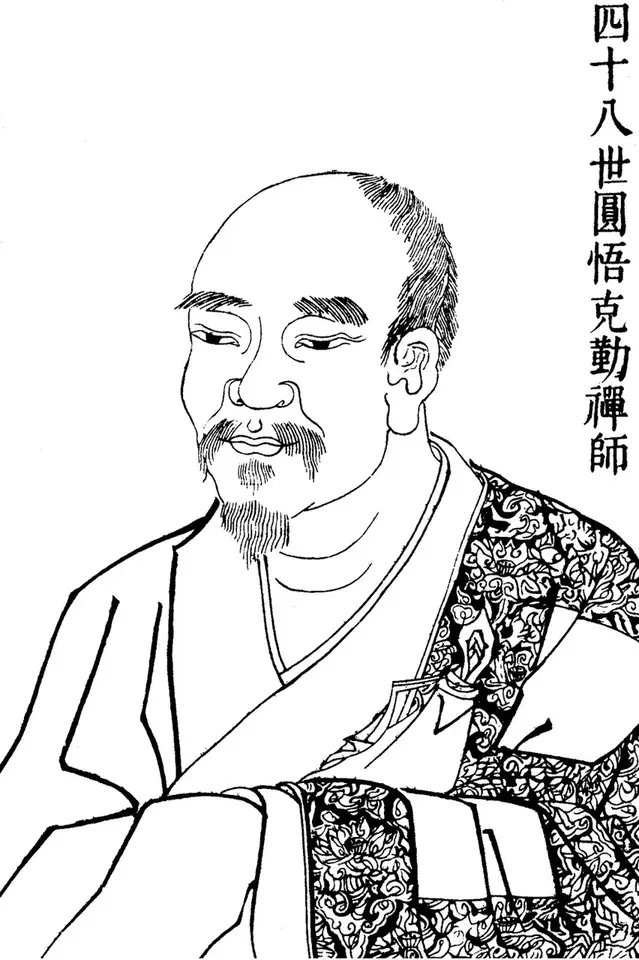
圆悟克勤
Yuanwu Keqin (圆悟克勤, 1063–1135), lay surname Luo (骆), courtesy name Wuzhuo (无着), and dharma name Keqin (克勤), was a native of Chongning in Pengzhou (present-day Pidu District, Chengdu, Sichuan Province). He was an illustrious Chan Buddhist leader spanning the Northern and Southern Song dynasties, the fourth-generation patriarch of the Yangqi branch of the Linji School, and the consummate master of Literary Chan (Wenzi Chan).…
Yuanwu Keqin (圆悟克勤, 1063–1135), lay surname Luo (骆), courtesy name Wuzhuo (无着), and dharma name Keqin (克勤), was a native of Chongning in Pengzhou (present-day Pidu District, Chengdu, Sichuan Province). He was an illustrious Chan Buddhist leader spanning the Northern and Southern Song dynasties, the fourth-generation patriarch of the Yangqi branch of the Linji School, and the consummate master of Literary Chan (Wenzi Chan). Ordained in 1080 at Miaoji Temple, he traveled extensively across central China, ultimately achieving profound spiritual awakening under Chan Master Wuzu Fayan at Mount Wuzu in Huangmei. During the Zhenghe era of the Northern Song, Keqin engaged in famous philosophical dialogues regarding the Avatamsaka Sutra with former Chancellor Zhang Shangying, who subsequently invited him to assume the abbacy of Lingquan Monastery at Mount Jiashan. There, Keqin delivered his monumental commentary on Xuedou Chongxian's One Hundred Verses on Ancient Cases, which was recorded as the celebrated Blue Cliff Record (Biyan Lu), earning him the title "Chan Master Foguo" from Emperor Huizong. In 1127, he was summoned by Emperor Gaozong to head Jinshan Monastery in Zhenjiang, where seventeen monks attained sudden enlightenment in a single night, leading to the naming of the Great Penetration Hall (Dache Tang). In his later years, he returned to Sichuan to lead Zhaojue Monastery, passing away at age seventy-three with the imperial posthumous title "Chan Master Zhenjue." Synthesizing Avatamsaka non-obstruction with Chan insight, he coined the immortal dictum "Tea and Chan are of one flavor," while his disciples Dahui Zonggao and Huqiu Shaolong established the paramount lineages of East Asian Chan.
Born into an esteemed scholar household of the Luo clan in Chongning County, Pengzhou.
Received monastic tonsure under Master Zisheng at Miaoji Temple in Chengdu and took full precepts at age eighteen.
Departed Sichuan to seek instruction from eminent masters including Jinluan Xin, Dawai Mozhe, and Huitang Zuxin.
Attained sudden enlightenment under Wuzu Fayan at Mount Wuzu, receiving transmission into the Yangqi branch of Linji.
Debated the non-obstruction philosophy of the Avatamsaka Sutra with former Chancellor Zhang Shangying, who became his disciple.
Delivered his celebrated commentaries on Xuedou's One Hundred Verses at Mount Jiashan; granted the title "Chan Master Foguo" by Emperor Huizong.
Appointed abbot of Taiping Xingguo Monastery on Mount Jiang in Jinling and subsequently Tianning Wanshou Monastery in Kaifeng.
Granted the title "Chan Master Yuanwu" by Emperor Gaozong; led Jinshan Monastery where seventeen monks awakened simultaneously.
Retired due to advancing age and returned to Chengdu to assume the abbacy of Zhaojue Monastery, reviving southwestern monasticism.
Passed away peacefully in the seated meditation posture at age seventy-three; posthumously honored as "Chan Master Zhenjue" by Emperor Gaozong.
Yuanwu Keqin was born in 1063 into the Luo family, a respected literary household in Chongning, Pengzhou. From early childhood, he showed extraordinary cognitive gifts, memorizing over a thousand words of classical prose daily. While excelling in Confucian studies, he felt an innate detachment toward secular political ambitions, harboring a profound reverence for Buddhist teachings. In 1080, at the age of eighteen, Keqin formally requested permission from his parents to renounce lay life, entering Miaoji Temple to become a disciple of Master Zisheng and taking full monastic precepts within the year.
Following ordination, Keqin studied scriptural exegesis under Master Yuanming in Chengdu, mastering doctrinal classics such as the Surangama Sutra, the Perfect Enlightenment Sutra, and Yogacara epistemology. Yet despite acquiring deep scriptural learning, Keqin realized that textual commentaries could not resolve the fundamental dilemma of life and death. A severe bout of illness that brought him to the brink of mortality crystallized this insight, convincing him that theoretical knowledge was hollow without existential realization. Upon recovery, he took a solemn vow to leave Sichuan and seek out enlightened Chan masters across the empire.
During the Yuanyou era of Emperor Zhezong, the young Keqin crossed the rugged mountain paths of Sichuan on foot. Carrying only straw sandals and a bamboo staff, he visited monastic centers throughout central China. He sought instruction from prominent patriarchs including Jinluan Xin, Dawai Mozhe, Yuquan Chenghao, Donglin Changzong, and Huitang Zuxin. While his sharp intellectual grasp impressed these masters, Keqin remained conscious that he had not yet shattered the final barrier of spiritual awakening.
Continuing his itinerant journey, Keqin arrived at Haihui Monastery on Mount Wuzu in Shuzhou (present-day Qianshan, Anhui Province), paying homage to Chan Master Wuzu Fayan, the foremost patriarch of the Yangqi branch of the Linji School. During their initial encounter, Keqin presented his intellectual deductions, but Fayan responded with cool indifference, refusing to grant spiritual validation. Chafing at this reception, Keqin departed down the mountain.
Fayan calmly predicted that this gifted young monk would return once he experienced a shattering physical crisis. Indeed, upon reaching Jinling, Keqin contracted a virulent typhoid fever. Burning with delirium and sweating cold exhaustion on his sickbed, Keqin realized that all his accumulated scholarship was powerless before death. In bitter agony, he swore that if he survived, he would return to Mount Wuzu and submit wholeheartedly to Fayan's guidance.
Upon recovering, Keqin faithfully returned to Mount Wuzu, serving as Fayan's personal attendant. One day, a high-ranking judicial official visited Fayan to enquire about the nature of Chan. Fayan cryptically cited a line from a romantic Tang poem: "Repeatedly calling out to maidservant Xiaoyu implies no real errand; it is solely to let her handsome lover recognize her voice." Listening beside the master, Keqin felt a profound pang of doubt. Retiring to the corridor outside the abbot's quarters, he suddenly heard a rooster flutter onto a rustic fence and crow piercingly into the sky. In that crystalline instant, Keqin's mental projections collapsed entirely. He rushed into the abbot's room and presented his enlightenment verse. Fayan joyfully validated his realization, declaring that the supreme transmission of the patriarchs was safely preserved. Keqin was subsequently celebrated alongside his dharma brothers Fojian Huilin and Foyan Qingyuan as the "Three Buddhas of Fayan's Gate."
Having received dharma transmission, Keqin began his public teaching career. During the early Zhenghe era of the Northern Song, Keqin traveled to Jingzhou, where former Chancellor Zhang Shangying was residing in political exile. Celebrated for his deep mastery of the Avatamsaka Sutra, Zhang Shangying had developed an intellectual arrogance toward Chan masters. Hearing of Keqin's presence, Zhang invited the master to a banquet to debate the core doctrines of the Avatamsaka.
During the debate, Zhang quoted extensively from canonical texts regarding the Four Dharmadhatu realms. Keqin smiled serenely and penetrated directly to the existential core, observing that while the non-obstruction between principle and phenomenon was sublime, it remained conceptual; only the "Dharmadhatu of non-obstruction between phenomenon and phenomenon" (shishi wu'ai fajie) represented the unfettered realization of living Chan. Drawing seamlessly from mundane daily affairs, Keqin demonstrated how dynamic Chan practice embodied the infinite interpenetration of the cosmos. Overwhelmed with spiritual awe, Zhang Shangying stood up, prostrated himself before Keqin, and formally pledged discipleship.
At the petition of Zhang Shangying and regional magistrates, the court appointed Keqin abbot of Lingquan Monastery on Mount Jiashan in Lizhou. Mount Jiashan was the sacred sanctuary founded by Tang master Shanhui. Over several years of residence at Jiashan's Blue Cliff spring, Keqin delivered his famous lectures and commentaries on master Xuedou Chongxian's One Hundred Verses on Ancient Cases. His disciples transcribed these lectures into the ten-volume masterpiece Blue Cliff Record (Biyan Lu). Privy Councilor Deng Zichang visited the master and petitioned the throne, leading Emperor Huizong to confer upon Keqin a purple robe and the prestigious title "Chan Master Foguo."
During the late Zhenghe era, Keqin's spiritual renown reached Kaifeng. By imperial decree, he was transferred to Taiping Xingguo Monastery on Mount Jiang in Jinling, vigorously promoting the Linji lineage. Shortly thereafter, Emperor Huizong summoned him to the metropolitan capital to assume the abbacy of Tianning Wanshou Monastery. High ministers, imperial princes, and thousands of monastic seekers crowded his lectures in Kaifeng.
Following the Jurchen invasion and the fall of the Northern Song, Keqin relocated southward during the early Jianyan reign. In 1127, Emperor Gaozong halted at Yangzhou and summoned Keqin to the imperial palace to enquire about spiritual equanimity and the governance of the realm. Deeply moved by Keqin's profound compassion and transcendent wisdom, Emperor Gaozong bestowed upon him the honorific title "Chan Master Yuanwu" and appointed him abbot of Jiangtian Monastery on Mount Jinshan in Zhenjiang.
Perched majestically in the middle of the Yangtze River, Jinshan Monastery was the foremost Chan sanctuary of southern China. During his tenure at Jinshan, Keqin restored strict monastic discipline and delivered nightly teachings. On one luminous autumn night, Keqin expounded the direct transmission in the meditation hall, triggering instantaneous spiritual awakening in seventeen dedicated practitioners simultaneously. This extraordinary event astounded the Buddhist world, and the meditation hall of Jinshan was forever rechristened the "Great Penetration Hall" (Dache Tang).
Around 1130, as the Southern Song court stabilized at Lin'an amid ongoing warfare along the Yangtze, Keqin approached his seventieth year. Burdened by advancing age and bodily fatigue, he repeatedly petitioned the throne for permission to retire to his native Sichuan. The imperial court granted his plea, and Keqin traveled westward up the Yangtze gorges, returning to his beloved Sichuan after decades of separation.
Upon his return, Keqin took up the abbacy of the ancient Zhaojue Monastery on the northern outskirts of Chengdu. Ravaged by earlier warfare, Zhaojue Monastery was in physical decay. Keqin supervised the reconstruction of main halls, restored monastic communal guidelines, and reopened public meditation platforms, attracting monastics and lay scholars from across southwestern China. In his final years, he resided peacefully in the abbot's quarters, offering direct spiritual guidance to his final cadre of disciples.
On the fifth day of the eighth lunar month in 1135, Keqin recognized that his worldly journey had reached its end. Having bathed and donned fresh monastic vestments, he took up a brush and composed his death verse: "Having fully penetrated, there is no merit; it requires no praise. The final sentence embodies total dynamic action." Casting down his brush, he passed away peacefully in the seated meditation posture at the age of seventy-three, having completed fifty-four monastic summers. Monastics and lay followers wept throughout Chengdu. Emperor Gaozong issued an imperial edict granting him the posthumous title "Chan Master Zhenjue" and naming his funerary stupa "Lingzhao" atop Mount Weifeng at Zhaojue Monastery. In 1734, the Qing Emperor Yongzheng added the ennoblement "Chan Master Mingzong Zhenjue," honoring his enduring spiritual supremacy.
Yuanwu Keqin's crowning intellectual contribution to world religion and literature was his creation of the public-case commentary genre, culminated in the monumental ten-volume Blue Cliff Record (Biyan Lu), universally hailed as the "foremost book of the Chan gate."
Prior to Keqin, Master Xuedou Chongxian of the Yunmen School had selected one hundred foundational Chan encounters and composed poetic verses (songgu) to illuminate their spiritual essence. While lecturing at Mount Jiashan, Keqin integrated his comprehensive doctrinal mastery and dynamic spiritual insight into an exhaustive pedagogical analysis of these one hundred cases.
Keqin established an intricate five-part structural framework for the Blue Cliff Record: opening with an incisive "Introduction" (chuishi) outlining the essential point; followed by the "Core Case" (gong'an) accompanied by biting and witty "Interlinear Notes" (zhuoyu); an expansive "Commentary" (pingchang) penetrating the psychology of the masters; Xuedou's poetic "Verse" (songgu) enriched with further interlinear glosses; and an exhaustive philosophical "Explication" (jieshuo). Merging aesthetic prose with electrifying Chan vitality, the Blue Cliff Record elevated Song Dynasty Literary Chan to its supreme philosophical and artistic summit.
In Buddhist philosophical synthesis, Yuanwu Keqin bridged the historic divide between scholastic exegesis and radical Chan iconoclasm. He successfully synthesized the profound cosmological philosophy of the Avatamsaka School with the direct realization of Chan mind-transmission.
Countering the dual dangers of scholastic dogmatism on the one hand and wild ungrounded Chan on the other, Keqin formulated the dialectical teaching that "principle demands sudden enlightenment, while phenomena require gradual cultivation." He embraced the Avatamsaka doctrine of the Four Dharmadhatu realms and the sixfold harmony, asserting that only when an adept enters the "Dharmadhatu of non-obstruction between phenomenon and phenomenon" can true Chan action unfold.
This expansive cosmological perspective endowed his Chan teachings with intellectual rigor and humanistic warmth. His holistic vision attracted leading Song literati including Su Shi, Huang Tingjian, and Zhang Shangying, directly catalyzing the golden age of Song Dynasty lay Buddhist culture (jushi fojiao).
Beyond monastic doctrine, Yuanwu Keqin was the paramount philosophical founder of the spiritual union between tea culture and meditative awareness. During his abbacy at Mount Jiashan, Keqin immersed himself in the agricultural Chan traditions established by Tang master Shanhui, contemplating the correspondence between the quietude of tea and the luminous tranquility of the enlightened mind.
Keqin harmonized the sensory qualities of fine tea—bitterness, stillness, purity, and sweetness—with Chan disciplines of releasing intellectual attachments to discover one's primordial nature, coining the immortal formulation "Tea and Chan are of one flavor" (chachan yiwei). He taught that mindful tea consumption was an immediate portal into pure, non-dual presence.
According to East Asian cultural records, Keqin inscribed the four characters "Tea and Chan are of one flavor" upon a certificate of spiritual succession presented to his disciple Huqiu Shaolong. In later centuries, Japanese tea masters Murata Juko and Sen no Rikyu adopted Keqin's calligraphy and philosophy as the foundational spiritual charter of the Japanese tea ceremony (Chado). Preserved today as a revered cultural treasure in Japan, Keqin's insight transformed tea into an enduring medium of spiritual contemplation across East Asia.
In the transmission of Zen lineages, Yuanwu Keqin served as the vital bridge ensuring the historical continuity and global expansion of the Linji School. Through his masterly stewardship, the Yangqi branch became the dominant stream among the classical Five Houses and Seven Schools of Chan.
Keqin nurtured an extraordinary assembly of seventy-five fully realized dharma heirs, among whom Dahui Zonggao and Huqiu Shaolong stood foremost, revered in monastic lore as the "Two Sweet Dew Gates." Dahui Zonggao inherited Keqin's critique of textual dogmatism to formulate the revolutionary "Koan Introspection Chan" (Kanhua Chan); while Huqiu Shaolong established his community at Mount Huqiu in Pingjiang Prefecture, inaugurating the Huqiu branch that carried the primary institutional lineage of Linji down to modern times.
The vast majority of Linji lineages surviving today in China, Japan, and Korea trace their spiritual ancestry directly back to Huqiu Shaolong and Dahui Zonggao. During Japan's Kamakura period, out of twenty-four distinct Zen schools introduced from China, twenty belonged directly to Keqin's lineage, establishing his enduring stature as a patriarch of world Buddhism.
FIGURES ASSOCIATED WITH THIS DYNASTY