Birth in Shimotsuke
Born into the prominent Mibu clan; entered Daiji Temple at age nine under preceptor Koji following his father's death.
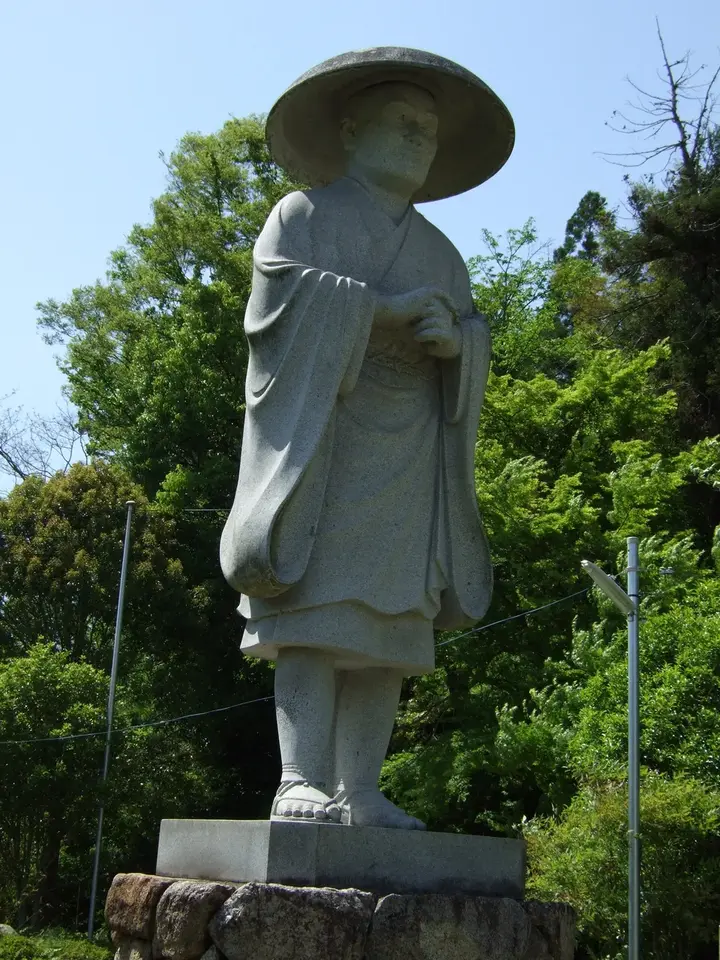
圆仁
Ennin (圆仁, 794–864), secular surname Mibu, was a native of Tsuga District in Shimotsuke Province (modern Mibu, Tochigi Prefecture, Japan), an illustrious patriarch of Japanese Tendai Buddhism, the founder of the Mountain Branch (Sanmon-ha) based at Mount Hiei, and one of the Eight Pilgrims to Tang China (Nitto Hakka). He was posthumously granted the title Jikaku Daishi ("Master of Compassionate Awakening") by Emperor…
Ennin (圆仁, 794–864), secular surname Mibu, was a native of Tsuga District in Shimotsuke Province (modern Mibu, Tochigi Prefecture, Japan), an illustrious patriarch of Japanese Tendai Buddhism, the founder of the Mountain Branch (Sanmon-ha) based at Mount Hiei, and one of the Eight Pilgrims to Tang China (Nitto Hakka). He was posthumously granted the title Jikaku Daishi ("Master of Compassionate Awakening") by Emperor Seiwa. Having lost his father in early childhood, he was ordained at Daiji Temple at age nine before ascending Mount Hiei at fifteen to study the Lotus Sutra and the Mahayana Bodhisattva Precepts under Saicho, the founding patriarch of Japanese Tendai. After undergoing rigorous ascetic disciplines, Ennin emerged as the leading intellectual pillar of the Tendai community. In 838, during the Kaicheng reign of Emperor Wenzong of Tang, Ennin traveled to China as an officially appointed inquiry monk attached to the final Japanese diplomatic embassy to the Tang dynasty. Over nearly a decade in China, he undertook an epic pilgrimage across the empire: studying Sanskrit and esoteric rituals in Yangzhou, walking on foot across northern China to Mount Wutai to master Tendai doctrines and Pure Land chanting, and residing in the imperial capital of Chang'an at Da Xingshan Temple and Qinglong Temple to receive complete initiation into the Diamond and Womb Realm mandalas. While in Chang'an, he witnessed firsthand the devastating anti-Buddhist purges of Emperor Wuzong—the Great Huichang Persecution of 845—before successfully smuggling over five hundred volumes of sacred scriptures, commentaries, and ritual implements back to Japan in 847. Appointed the third abbot of Enryaku Temple on Mount Hiei, Ennin integrated esoteric Esoteric Buddhism and Pure Land practices into Tendai, establishing the foundation of medieval Japanese religious culture. His daily Chinese diary, Record of a Pilgrimage to China in Search of the Dharma (Nitto Guho Junrei Koki), is celebrated alongside Xuanzang's Great Tang Records on the Western Regions and Marco Polo's Travels as one of the three great medieval travel chronicles of the East, standing as an indispensable historical window into the late Tang world.
Born into the prominent Mibu clan; entered Daiji Temple at age nine under preceptor Koji following his father's death.
Ascended Mount Hiei at fifteen, studying Tiantai meditation, the Lotus Sutra, and Mahayana monastic precepts under Saicho.
Received full monastic vows at the ordination platform of Todai Temple in Nara; embarked on six years of ascetic hermitage at Mount Hiei.
Dispatched to China as an inquiry monk aboard the embassy fleet of Ambassador Fujiwara no Tsunetsugu, landing in Yangzhou.
Resided at Kaiyuan Temple in Yangzhou, studying Sanskrit under Zongrui and esoteric rituals under Quanya.
Lodged at Fahua Cloister on Mount Chishan; journeyed on foot to Mount Wutai to master Tiantai exegesis under monk Zhiyuan.
Arrived in the metropolitan capital of Chang'an, receiving initiation into both esoteric mandalas at Da Xingshan and Qinglong temples.
Survived the imperial anti-Buddhist suppression; stripped of clerical robes and forcibly expelled toward the coast as a laicized foreigner.
Smuggled 559 volumes of rare canonical texts and ritual implements aboard an international merchant ship, arriving safely in Japan.
Appointed third Zasu of Enryaku Temple; built the Soshijin and inaugurated the perpetual nembutsu chanting practice.
Died peacefully at Enryaku Temple at age seventy-one; posthumously granted the title Jikaku Daishi by Emperor Seiwa.
Ennin was born in 794 in Tsuga District, Shimotsuke Province, into the influential regional gentry clan of Mibu. Having suffered the early loss of his father, he was raised in rural seclusion by his mother. Showing an early disinclination for worldly pursuits, he was taken at age nine to Daiji Temple, where he shaved his head and undertook elementary monastic training under Master Koji.
In 808, at the age of fifteen, Ennin embarked on a journey to Mount Hiei near Kyoto, where the visionary monk Saicho was establishing the new Tendai school. Recognizing Ennin's spiritual depth, Saicho personally oversaw his instruction in the Lotus Sutra, Tiantai meditation (zhiguan), and Bodhisattva vows. At twenty-one, Ennin received orthodox monastic ordination at Todai Temple in Nara. Seeking to master his passions, he retired to an austere thatched hermitage in the northern ravine of Mount Hiei, practicing solitary asceticism for six years before lecturing on canonical scriptures at Horyu Temple and Shitenno Temple, earning widespread veneration across the Japanese monastic world.
Following Saicho's demise, the Japanese Tendai tradition faced intellectual isolation and an incomplete transmission of esoteric rituals. In 838, the imperial court dispatched the final official Japanese embassy (Kentoshi) to Tang China under Ambassador Fujiwara no Tsunetsugu. Ennin joined the mission as an official "inquiry monk" (shinsho). After enduring storms and shipwrecks in the East China Sea, his vessel reached the mouth of the Yangtze River near Yangzhou in the seventh month of 838.
Lodging at Kaiyuan Temple in the bustling international metropolis of Yangzhou, Ennin pursued scholarship with unflagging dedication. He studied Siddhaṃ script and phonetics under Master Zongrui and received formal initiation into the Vajradhātu (Diamond Realm) mandala from Master Quanya. Realizing that the official embassy schedule would compel him to return home before he could master the profound depths of the Chinese Buddhist tradition, Ennin took the dangerous step of remaining behind in China without imperial exit clearance, evading local passport authorities to continue his pilgrimage.
In late 839, while attempting to secure passage northward, Ennin was driven by storms onto the coast of Wendeng County in the Shandong peninsula. There, he took refuge at the Fahua Cloister on Mount Chishan, an influential Buddhist monastery established by the Silla maritime merchant and military commissioner Jang Bogo. During his stay among the Silla expatriate community, Ennin observed Tang coastal trade networks and municipal administration.
In the spring of 840, aided by Silla monks, Ennin commenced his arduous pilgrimage to Mount Wutai in Shanxi, carrying a scripture pack on his back across thousands of miles. At Mount Wutai, he lodged at Da Huayan Temple and Zhulin Temple, where he studied canonical Tiantai exegesis under Master Zhiyuan. He transcribed voluminous commentaries that had vanished in Japan and was initiated into the Five-Assembly Nembutsu chanting tradition originated by Master Fazhao.
In 841, having secured an official travel pass, Ennin arrived in the magnificent imperial capital of Chang'an, where he was assigned to reside at Zisheng Temple. During his five years in the capital, Ennin reached the zenith of his esoteric and exoteric education. He studied the Womb Realm mandala under Master Yuanzheng at Da Xingshan Temple, received full transmission of the Vajradhātu (Diamond Realm) mandala and the secret acharya seals from Master Faquan at Qinglong Temple, and perfected his meditation under Chan Master Zongying.
However, Emperor Wuzong fell under the influence of Daoist grandees and launched an imperial suppression of Buddhism. In 845, the Great Huichang Persecution reached its climax: over 4,600 monasteries were demolished, 260,000 monks and nuns were forcibly returned to lay status, and copper statues were melted into coinage. In Chang'an, Ennin was targeted as a foreign cleric; his monastic robes were confiscated, and he was forcibly laicized and ordered to be deported to the border under armed escort.
Throughout the harrowing journey to the coast, Ennin endured severe privation and surveillance, yet he managed to conceal hundreds of volumes of transcribed scriptures and sacred implements inside his travel bags. In 847, following the accession of Emperor Xuanzong and the rehabilitation of the monastic orders, Ennin boarded an international merchant vessel in Shandong, completing his epic nine-year pilgrimage.
In late 847, Ennin arrived at the port of Hakata in Japan, bringing with him an astonishing cultural treasure: 559 scrolls of Buddhist scriptures and commentaries, esoteric mandalas, ritual implements, and fine Tang calligraphy rubs. Received with reverence by the imperial court in Kyoto, he established the Soshijin at Mount Hiei as a dedicated initiation platform, founding the Japanese Tendai Esoteric (Taimitsu) tradition.
In 854, Ennin was inaugurated as the third head abbot (Zasu) of Enryaku Temple. Over his ten-year tenure, he reformed monastic discipline, instituted perpetual nembutsu meditation in the Jogyo Sammaido, and established the institutional supremacy of Mount Hiei. Ennin passed away in deep meditation on Mount Hiei in 864 at the age of seventy-one. Emperor Seiwa subsequently conferred upon him the posthumous title Jikaku Daishi, the highest imperial honor ever granted to a Buddhist master in early Japanese history.
Ennin's foremost legacy to world literature is his four-volume Chinese-language travel journal, Record of a Pilgrimage to China in Search of the Dharma (Nitto Guho Junrei Koki). Spanning from his departure in 838 to his return in 847, the text preserves a continuous, day-by-day eyewitness account of mid-ninth-century China.
Comprising over 70,000 Chinese characters, the work documents municipal administration, grain transportation along the Grand Canal, commodity prices, local religious festivals, Silla maritime commerce, and the international cosmopolitanism of Chang'an. Crucially, Ennin provided the only surviving detailed eyewitness narrative of the Huichang Persecution, surpassing official dynastic records in precision and vividness. Modern historians universally recognize the work alongside Xuanzang's Great Tang Records on the Western Regions and Marco Polo's Travels as one of the three great medieval travelogues of the Orient.
Upon his return, Ennin synthesized the esoteric initiations he received at Qinglong Temple with original Tendai philosophy, establishing Tendai Esotericism (Taimitsu) to rival Kukai's Shingon (Tomitsu) school.
By harmonizing esoteric rituals with the exoteric teachings of the Lotus Sutra, Ennin transformed Mount Hiei into the paramount religious institution of medieval Japan. His introduction of the continuous vocal chanting of Amitabha's name (insei nembutsu) directly laid the foundation for the Kamakura Pure Land movement championed by Honen and Shinran centuries later.
FIGURES ASSOCIATED WITH THIS DYNASTY