Fame via "White Swallow"
Composed the famous poem "White Swallow" at Yang Weizhen's banquet, winning empire-wide literary fame.
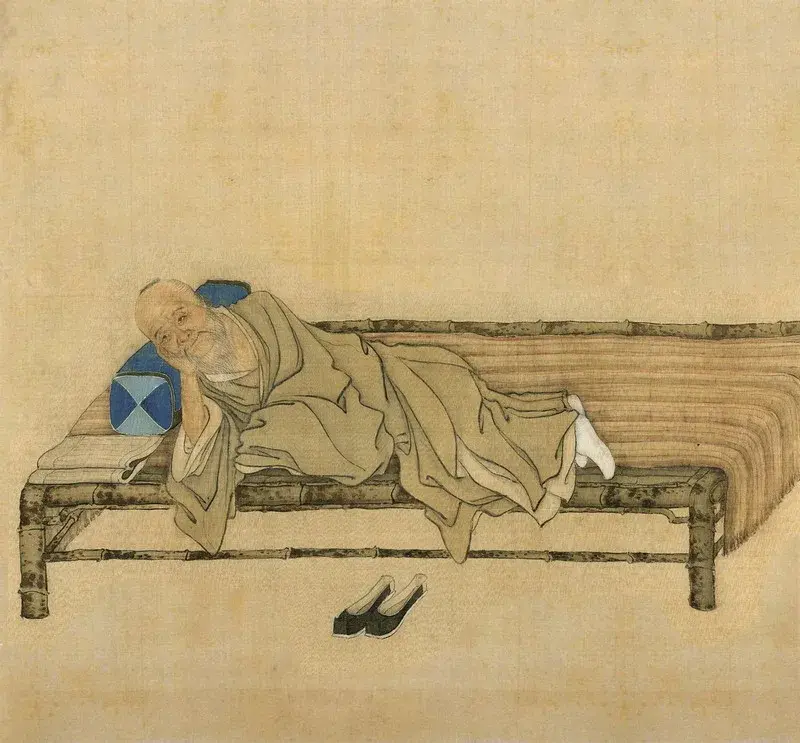
袁凯
Yuan Kai (袁凯), courtesy name Jingwen and art name Haisou, was a native of Huating County, Songjiang Prefecture (present-day Songjiang District, Shanghai). He was a distinguished early Ming dynasty poet who, alongside Gao Qi, Liu Ji, and Liu Song, played a defining role in shaping early Ming poetic style. Possessing precocious talent and broad classical learning, he composed the seven-character regulated poem "White Swallow"…
Yuan Kai (袁凯), courtesy name Jingwen and art name Haisou, was a native of Huating County, Songjiang Prefecture (present-day Songjiang District, Shanghai). He was a distinguished early Ming dynasty poet who, alongside Gao Qi, Liu Ji, and Liu Song, played a defining role in shaping early Ming poetic style. Possessing precocious talent and broad classical learning, he composed the seven-character regulated poem "White Swallow" (Bai Yan) during a banquet hosted by literary patriarch Yang Weizhen in the late Yuan dynasty, stunning the audience and earning the enduring epithet "Yuan the White Swallow." In 1370, Yuan was recommended to the imperial court and appointed Investigating Censor. During his tenure, he submitted memorials advocating the appointment of classical Confucian scholars to instruct palace garrison commanders in history and ritual, earning Emperor Taizu's high commendation. Later, tasked with transmitting capital punishment dockets between the ruthless Emperor Taizu (Zhu Yuanzhang) and the benevolent Crown Prince Zhu Biao, he was trapped between their opposing views and accused by the emperor of "hedging between two sides." Fearing execution, Yuan feigned madness and endured extreme degradation to save his life, ultimately securing his dismissal and returning home. He spent over two decades in quiet retirement in Huating, later serving as instructor in the Huating County School and exchanging poetry with Gao Qi, Wang Feng, and Yang Weizhen. His ancient-style verse emulated the austere vigor of Han and Wei poetry, while his regulated verse reflected the profound pathos and structural density of Du Fu. His masterworks, such as "White Swallow," "Receiving a Letter from Home in the Capital," and "New Year's Eve as a Traveler," achieved timeless acclaim. Ming literary leader He Jingming hailed him as the "foremost poet of the early Ming." His surviving verse is collected in Hai Sou Ji and Zai Ye Ji.
Composed the famous poem "White Swallow" at Yang Weizhen's banquet, winning empire-wide literary fame.
Recommended to the Ming court as a scholar and appointed Investigating Censor, memorializing on military education.
Trapped between conflicting verdicts of the emperor and Crown Prince; feigned madness to escape execution and returned home.
Composed "Heavy Drinking Facing Chrysanthemums" at home, celebrating his escape from political perils.
Gathered with Wang Feng and other elders at Xiaotang during the Lantern Festival, composing celebratory joint verse.
Appointed instructor in the Huating County School, educating local scholars and reviving regional culture.
Composed verse in response to Minister of Revenue Xia Yuanji at Yilan Tower; lived peacefully in retirement until his death.
Yuan Kai was born during the late Yuan dynasty into a scholarly family in Huating, Songjiang Prefecture. Naturally gifted and possessing an exceptional memory, he read voraciously across the Classics, dynastic histories, and philosophical texts, excelling in rapid intellectual debate and poetic composition. During the chaotic final years of the Yuan dynasty, Yuan served briefly as a clerk in the Songjiang prefectural yamen, yet his core aspirations remained dedicated to literary creation. At that time, late-Yuan literary master Yang Weizhen was residing in Songjiang, hosting grand gatherings that attracted renowned literati from across China.
One day, during an elegant banquet, Yang Weizhen presented a poem on a "White Swallow" written by one of his guests, which the company praised lavishly. Standing beside the table, Yuan inspected the draft and stated with composure that while graceful, the verses had failed to capture the inner spiritual essence of the subject. Intrigued, Yang invited Yuan to compose his own seven-character regulated verse. Yuan took up the brush and produced: "Fallen and drifting, the old kingdom's affairs have changed; rare are the sightings of old aristocratic mansions. Under the bright moon over the Han River, shadows vanish; snow blankets Liang Garden, yet it does not return. Willows by the pond waft fragrance into dreams; pear blossoms in the courtyard chill one's robes. The Zhao sisters harbor deep mutual jealousy; fly not toward the Zhaoyang Palace." The poem expressed profound sorrow over dynastic ruin through soaring, exquisite imagery. Yang Weizhen was so moved that he personally transcribed the poem to circulate among all guests, making Yuan famous throughout the region under the name "Yuan the White Swallow."
Following the founding of the Ming dynasty, Emperor Taizu (Zhu Yuanzhang) issued imperial decrees to recruit learned scholars capable of civic governance. In 1370, Yuan was recommended to the capital in Nanjing. Impressed by his eloquent debate and deep learning, Emperor Taizu appointed him Investigating Censor in the Censorate.
Serving as an imperial remonstrator, Yuan performed his duties with vigilance. He observed that many founding generals and garrison troops had risen from unlettered peasant ranks; though valiant in combat, they lacked formal education in Confucian Classics and court decorum, which he feared might lead to arrogance and indiscipline over time. Yuan submitted a detailed memorial urging the emperor to select upright scholars to deliver regular lectures on history and ethics within military encampments, instilling the duties of loyalty, respect, and benevolence. Emperor Taizu was pleased with the proposal, praising its long-term foresight and commanding the relevant ministries to implement it across garrison units.
Emperor Taizu was inherently suspicious and ruled through severe judicial intimidation, placing court officials in constant peril. On one occasion, the emperor ordered mass executions in a major criminal case and commanded Censor Yuan Kai to convey the judicial dockets to Crown Prince Zhu Biao for review. Crown Prince Zhu Biao, who favored benevolent and lenient governance, noted his disagreements on the dockets and requested imperial clemency. When Yuan returned to court and reported the Crown Prince's dissenting opinion, Emperor Taizu flared up in anger, demanding: "Between my strict enforcement of law and the Crown Prince's plea for clemency, which of us is right and which is wrong?"
This sudden trap placed Yuan in mortal jeopardy: agreeing with the emperor would betray the Crown Prince, while endorsing the Crown Prince would constitute treasonous insolence against the monarch. In desperation, Yuan answered: "Your Majesty's strict enforcement arises from the public duty to punish evil and uphold state order; the Crown Prince's clemency reflects the profound virtue of cherishing life and practicing benevolence." Rather than appeasing the emperor, the reply infuriated him; Taizu accused Yuan of devious duplicity: "A slippery knave like you excels only at hedging between both sides!"
Yuan withdrew from the palace drenched in cold sweat, realizing that imperial paranoia had sealed his doom. The following morning, as he approached the palace gates for morning audience, he suddenly shrieked wildly, collapsed onto the pavement, and threw himself into violent convulsions, pretending to be deranged. Suspecting deceit, Taizu ordered guards to drive iron awls into his limbs; Yuan clenched his teeth and endured the agonizing pain without crying out, convincing the court to dismiss him on grounds of mental madness and send him home to Huating.
Back in Huating, Yuan remained terrified of imperial spies and Brocade Guards. He instructed his family to fasten a heavy iron chain around his neck, sitting unkempt in the yard amidst the dirt and babbling incoherently. Emperor Taizu indeed dispatched secret agents to Songjiang to verify his condition. Spying through the brush hedge, the agent saw Yuan crouching beside a wall picking up and eating what appeared to be dog feces. The agent reported back to Nanjing in disgust, finally convincing Emperor Taizu of his genuine insanity, which ended the surveillance.
In reality, Yuan had planned this ruse meticulously: he had his family roast flour mixed with dark sugar and aromatic oils, pressing the sweet paste through bamboo tubes into the shape of animal droppings and scattering them inconspicuously along the fence. In 1380, when the Hu Weiyong treason purges decimated thousands of officials in the capital, Yuan composed his poem "Heavy Drinking Facing Chrysanthemums," rejoicing that he had preserved his life amidst bloodshed. In 1396, the aging Yuan was appointed instructor in the Huating County School, peacefully educating students. In early Yongle, Minister Xia Yuanji visited him at Yilan Tower while overseeing water conservancy, and Yuan composed responsive verses in good health, living peacefully until his death.
Yuan Kai's most celebrated achievement was his masterpiece "White Swallow" (Bai Yan). Using delicate and evocative imagery, the poem described a snow-white swallow to allegorize the grief, displacement, and vulnerability of former Yuan dynasty literati amidst dynastic change. The concluding couplet—"The Zhao sisters harbor deep mutual jealousy; fly not toward the Zhaoyang Palace"—used the Han dynasty palace rivalry of Zhao Feiyan and Zhao Hede to issue an acute warning against perilous political intrigues and despotic royal courts.
The poem achieved universal acclaim, celebrated as an unrivaled masterpiece of seven-character regulated verse on natural objects. Winning Yuan the lifelong moniker "Yuan the White Swallow," it established his prestige throughout the Jiangnan region and served as a vital stylistic landmark in the transition from ornate late-Yuan lyricism to the robust pathos of early Ming poetry.
Yuan was a pioneering figure in early Ming poetry who led the movement to emulate the high Tang style of Du Fu. While many contemporaries remained under the spell of delicate Yuan styles, Yuan drew upon the unvarnished vigor of Han and Wei ballads alongside the complex emotional depth of Du Fu's regulated verse. Late Ming critic Cheng Mengyang remarked: "Since the Song and Yuan dynasties, no one has emulated Du Fu with such effortless naturalness as Master Haisou."
His travel and homesickness poems are marked by stark emotional sincerity without contrived artifice. His celebrated poem "Receiving a Letter from Home in the Capital"—"Three thousand leagues of river waters, fifteen lines in a letter from home; line after line contains no other words, only telling me to return home early"—used spare, unadorned brushwork to express poignant familial longing, becoming a household classic across generations. Works such as "New Year's Eve as a Traveler," "Sitting Alone in Huaxi," and "Spring Gazing at Caishi" displayed classical balance, resonant gravity, and somber vision, reflecting the deep trauma inflicted on common lives by late-Yuan warfare.
During the archaist literary movements of the mid-Ming Hongzhi and Zhengde eras, He Jingming, a prominent leader of the Earlier Seven Masters, exalted Yuan in the Dafu Ji, crowning him the "foremost poet of the early Ming." Mid-Ming scholars, including Lu Shen, Li Mengyang, and He Jingming, collected and re-edited Yuan's extant poems, grouping him alongside Gao Qi, Liu Ji, and Liu Song as the four pillars who founded Ming poetry.
Although Qing dynasty scholars Zhu Yizun and Chen Tian offered more tempered assessments—noting that his scope did not match Gao Qi's grandeur—they consistently praised his verse for its "seasoned classical bone, lofty clarity, and uncannily accurate emulation of ancient masters." Yuan's poetic output played an irreplaceable historical role in liberating Ming verse from the superficiality of late-Yuan styles and steering it toward robust classical vigor.
In his later years, Yuan personally selected and edited his lifelong poetic compositions into Hai Sou Ji (also known as Zai Ye Ji). The transmission of his anthology was perilous; early Ming woodblock prints were nearly lost over time. During the Longqing reign, book collector He Yuanzhi acquired an original Xiangze Zhang edition, printing one hundred copies with movable type to rescue the collection from oblivion.
During the Wanli reign, scholar Zhang Suowang recollated and reprinted the work. In the Qing Kangxi era, bibliophile Cao Bingceng cross-referenced multiple manuscripts to produce the definitive edition of Collected Poems of Haisou, containing nearly four hundred poems. This collection provides an invaluable primary record of the psychological dilemmas, cultural adaptations, and artistic experiments of Jiangnan literati during the Yuan-Ming transition.
FIGURES ASSOCIATED WITH THIS DYNASTY