Imperial Lineage
Born in Lushan as a descendant of the Northern Wei dynasty; high-spirited and adventurous in youth.
元结
Yuan Jie (元结, 719–772), courtesy name Cishan, pseudonyms Mansou, Aosou, Yiyuzi, Langshi, and Manlang, was a native of Luoyang, Henan who relocated to Lushan, Ruzhou (modern Lushan, Henan). A distant descendant of the Northern Wei imperial house, he was an eminent writer, poet, and incorruptible regional administrator of the mid-Tang dynasty, recognized as a pivotal precursor to the Classical Prose Movement and the New Yuefu…
Yuan Jie (元结, 719–772), courtesy name Cishan, pseudonyms Mansou, Aosou, Yiyuzi, Langshi, and Manlang, was a native of Luoyang, Henan who relocated to Lushan, Ruzhou (modern Lushan, Henan). A distant descendant of the Northern Wei imperial house, he was an eminent writer, poet, and incorruptible regional administrator of the mid-Tang dynasty, recognized as a pivotal precursor to the Classical Prose Movement and the New Yuefu Movement. Wild and unrestrained in his youth, he underwent a rigorous change of life at age seventeen to dedicate himself to scholarship under Yuan Dexiu. In 747, during the imperial examinations manipulated by Chief Minister Li Linfu to declare that no talent was left in the wilderness, Yuan was unfairly disqualified and retired to the Shangyu Mountains. In 754, he successfully earned the Jinshi degree. With the eruption of the An Lushan Rebellion, Yuan Jie led his extended clan southward to take refuge in the Xiang-Han valleys. In 759, as rebel general Shi Siming advanced upon Heyang, Yuan Jie presented three strategic memorials on current affairs to Emperor Suzong. Highly impressed, the emperor appointed him Military Adjutant of the Right Chin-wu Guard and Acting Investigating Censor. Mobilizing thousands of civilian volunteers across Tang, Deng, Ru, and Cai prefectures, Yuan Jie tenaciously defended strategic mountain passes and preserved fifteen cities from devastation. During the Guangde era, Emperor Daizong appointed him Prefect of Daozhou. Finding the prefecture gutted and depopulated following tribal rebellions, Yuan Jie resisted central demands for harsh taxation, exempted the survivors from all corvee and grain levies, and resettled over ten thousand displaced households. His realistic poems Song of Chongling and Showing to the Officials after the Bandits Retreated earned the highest admiration from Du Fu. Later appointed Area Commander of Rongzhou and Military Commissioner of Rongguan, he personally visited tribal settlements to achieve peaceful pacification. In 772, he died of illness in Chang'an at the age of fifty-four. His celebrated prose Eulogy on the Resurgence of the Great Tang, transcribed onto the cliffs of Wuxi by calligrapher Yan Zhenqing, remains immortalized as one of the Three Wonders of stone epigraphy.
Born in Lushan as a descendant of the Northern Wei dynasty; high-spirited and adventurous in youth.
Committed himself to scholarly pursuits at age seventeen, studying classical literature under Yuan Dexiu.
Journeyed to Chang'an for the examinations; all candidates failed due to Li Linfu's political deceit; retired to Mount Shangyu.
Succeeded in the imperial examination; before receiving an office, the An Lushan Rebellion broke out, forcing his clan southward.
Presented strategic memorials to Emperor Suzong, gained appointment, and mobilized volunteers defending Tang and Deng.
Resigned to care for aged parents near Xiangyang, retreating to Yiyu Cave in Huangshi and adopting the name Yiyuzi.
Appointed Prefect of Daozhou, suspended tax levies to shelter displaced subjects, and composed Song of Chongling.
Promoted to Area Commander of Rongzhou and Military Commissioner, pacifying southern tribal territories through civil diplomacy.
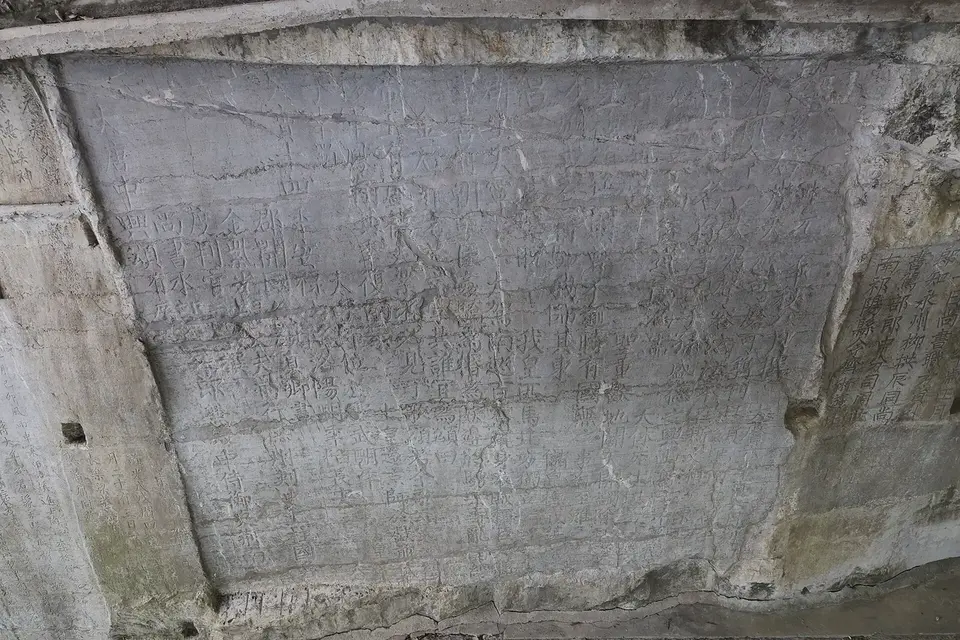
Authored Eulogy on the Resurgence of the Great Tang at Wuxi in Yongzhou, inscribed onto the rock face by Yan Zhenqing.
Traveled to the capital on official business, succumbed to illness at his private residence at age fifty-four.
Yuan Jie was a distant scion of the Tuoba imperial house of Northern Wei, tracing his lineage through fourteen generations to Emperor Zhaocheng, Tuoba Shiyijian. His father, Yuan Yanzu, served in regional posts including registrar of Weicheng and assistant magistrate of Yantang, maintaining a life of frugality and simplicity before receiving posthumous honors as Grand Master of Left Admonition. In 719, during the Kaiyuan reign of Emperor Xuanzong, Yuan Jie was born in Luoyang, later moving with his family to the foot of Mount Shangyu in Lushan, Ruzhou. In his youth, Yuan Jie was headstrong, unconventional, and contemptuous of rigid social conventions. He associated freely with wandering knights and spent his days galloping on horseback, hunting game, and traversing mountain wildernesses, neglecting formal study of classical texts until his late adolescence. In 735, acutely conscious that he was wasting his youth, the seventeen-year-old Yuan Jie made a profound determination to reform, placing himself under the tutelage of the revered local scholar Yuan Dexiu. He secluded himself in study, immersing his mind in the Confucian classics and ancient historiography.
In 747, Emperor Xuanzong decreed that scholars across the empire possessing exceptional literary or technical abilities should gather in Chang'an for imperial examinations. Yuan Jie responded to the summons. However, the authoritarian chancellor Li Linfu, petrified that independent scholars from the provinces would expose his administrative malpractice to the throne, instructed examiners to fail every single applicant, cynically claiming to the emperor that all worthy talents had already been recruited and that "no talent remained in the wilderness." Disillusioned by court corruption, Yuan Jie returned to Mount Shangyu in Lushan, building a thatched hermitage to engage in farming and writing satirical prose pieces such as Discourse on Begging and Rules for Dwelling. In 753, urged by family and peers, he journeyed once more to Chang'an, passing the imperial examinations in the spring of 754 to obtain the Jinshi degree. Yet before he could receive an official assignment, the catastrophic An Lushan Rebellion erupted in the winter of 755. With the imperial capitals Luoyang and Chang'an falling in rapid succession, Yuan Jie led his clan southward to the Han River basin, taking refuge in the secluded Yiyu Cave near Daye (modern Huangshi, Hubei). Adopting the sobriquet "Yiyuzi," he continued his literary endeavors amidst the upheavals of civil war.
In 759, rebel general Shi Siming launched a fierce counter-offensive, recapturing Luoyang and pressing upon Heyang, cutting off the vital grain transport routes along the Bian and Huai rivers. With the imperial court in Guanzhong thrown into severe anxiety, Su Yuanming, a director in the Directorate of Education who recognized Yuan Jie's strategic intellect, enthusiastically recommended him to Emperor Suzong. Summoned to the temporary imperial headquarters, Yuan Jie presented his Three Essays on Current Affairs, systematically evaluating the military situation and outlining practical strategies to exhaust the enemy's momentum through asymmetric defensive maneuvers and provincial militia mobilization. Delighted by his strategic clarity, Emperor Suzong immediately appointed him Adjutant of Military Affairs in the Right Chin-wu Guard and Acting Investigating Censor, assigning him to serve as military advisor on the staff of Shi Hui, Military Commissioner of Shannan East Circuit.
Confronting aggressive rebel vanguards probing the corridors leading toward Jianghan, Yuan Jie personally visited Tang, Ru, Deng, and Cai prefectures, enlisting local gentry and recruiting several thousand resilient volunteer fighters. Maintaining strict disciplinary standards while sharing hardships with his soldiers, he fortified critical mountain defiles and repulsed successive rebel assaults. His resolute defense successfully safeguarded fifteen strategic cities throughout the Nanyang Basin from massacre and plundering, preserving an indispensable lifeline between the imperial court and southern agricultural resources. For these military accomplishments, he was confirmed as Investigating Censor and later promoted to Vice Director of the Bureau of Waterways, assisting Military Commissioner Lü Yin in fortifying the Jingzhou region. In 763, following Emperor Daizong's accession, Yuan Jie resigned his office to care for his aging mother, taking up residence along the Xiang River near Xiangyang, adopting the literary names "Manlang" and "Aosou."
In 764, southern indigenous tribal groups in western Hunan rose in violent revolt against corrupt regional magistrates, overrunning Daozhou (modern Dao County, Hunan). The administrative compound was torched, the magistrate fled, and thousands of residents were slaughtered or taken captive, leaving the city in smoking ruins. Recognizing that only an administrator of towering moral authority could heal the devastated borderlands, the imperial court appointed Yuan Jie as Prefect of Daozhou. Traveling with modest baggage, Yuan Jie wept upon arrival: of Daozhou's former population, fewer than four thousand emaciated and traumatized survivors remained huddled among skeletal remains and ash-covered streets. Yet central revenue envoys arrived almost immediately, brandishing imperial decrees demanding that Daozhou yield the full statutory quota of grain and fabric taxes based on pre-war registers.
Yuan Jie adamantly refused to squeeze the dying populace. Risking imprisonment for insubordination, he submitted impassioned memorials to the Ministry of Revenue and the imperial throne, recounting the gruesome devastation and questioning how any moral ruler could levy taxes upon starving survivors. He took the daring step of unilaterally declaring total exemption from all grain taxes, silk tributes, and labor corvee for the entire prefecture, opening official granaries to distribute emergency relief. Leading a life of extreme austerity, he erected public shelters, restored seized agricultural plots to original owners, and invited scattered refugees to return. Moved by his boundless compassion, over ten thousand refugee households returned to settle in Daozhou within several years, reviving its commerce and agriculture. During this tenure, Yuan Jie composed his landmark poems Song of Chongling and Showing to the Officials after the Bandits Retreated, laying bare the brutality of tax collectors and the anguish of commoners. Deeply moved upon reading these verses, the poetic sage Du Fu penned an answering poem celebrating Yuan Jie's unyielding character and monumental governance.
In late 766, in recognition of his outstanding administrative success, Yuan Jie was appointed Prefect of Rongzhou and elevated in 767 to Area Commander of Rongzhou and Military Commissioner of Rongguan, governing fourteen prefectures across modern Guangxi. Rongzhou was an isolated frontier region characterized by rugged mountain caves where ethnic Liao tribes and regional chieftains frequently engaged in bloody feuds. Dismissing aggressive punitive campaigns, Yuan Jie traveled with a small retinue directly into indigenous settlements, convening tribal leaders to explain imperial benevolence while slashing burdensome tariffs and instituting fair marketplace barter. Touched by his sincerity, the chieftains laid down their weapons and swore allegiance to the Tang court, ushering in an era of peace across the fourteen prefectures. Local inhabitants erected commemorative stone steles praising his civilizing virtues.
In 771, while traveling through Qiyang in Yongzhou along the Xiang River, Yuan Jie was captivated by the sheer limestone cliffs and clear waters of Wuxi. He cleared the mountain paths, built pavilions, and named the site Wuxi and Wutai. Reflecting upon the monumental restoration of dynastic peace after the catastrophic An Lushan Rebellion and the immense suffering of the realm, he authored the renowned Eulogy on the Resurgence of the Great Tang. Composed in archaic three-phrase rhymes reminiscent of ancient Qin and Han monumental inscriptions, the essay offered profound reflections on dynastic governance and historical cycles. Yuan Jie invited the premier calligrapher Yan Zhenqing to transcribe the text in grand, robust regular script onto the sheer rock face of Wuxi. The organic harmony of Yuan Jie's heroic prose, Yan Zhenqing's majestic brushwork, and the dramatic precipice of Wuxi was revered by later generations as the immortal "Three Wonders of Wuxi."
In early 772, summoned by imperial decree, Yuan Jie traveled to Chang'an to report on regional administration. Exhausted by decades of arduous service in southern frontier environments, he fell gravely ill at his private quarters in the capital. Emperor Daizong dispatched imperial physicians to administer medical aid, but his health continued to decline. In the fourth month of 772, Yuan Jie passed away in Chang'an at the age of fifty-four. The imperial court and civil society mourned his loss, and the people of Daozhou and Rongzhou wept openly in the streets upon hearing the news of his death. His disciples and former subordinates escorted his remains back to his ancestral home in Lushan for burial.
During the Kaiyuan and Tianbao eras, when the literary sphere was dominated by ornate parallel prose and superficial tonal games, Yuan Jie was among the earliest to champion a return to classical antiquity. He argued that literature must explore the principles of imperial order and disorder while serving as an instrument for moral admonition, vehemently rejecting frivolous ornamentation. His prose masterpieces, such as Discourse on Begging, Hatred of Roundness, Hatred of Crookedness, and Rules for Dwelling, were marked by sharp wit, realistic vigor, and unsparing social criticism. His anthology Qiezhong Collection (Qiezhong Ji) highlighted the work of unpretentious commoner poets, fostering a lean, antique style that laid the theoretical and stylistic groundwork for the Classical Prose Movement later led by Han Yu and Liu Zongyuan.
Inheriting the social conscience of the Classic of Poetry and Han-Wei folk ballads, Yuan Jie excelled in archaic five-character verse characterized by rugged naturalism and profound moral weight. In works such as Song of Chongling, Showing to the Officials after the Bandits Retreated, Grief of the Peasant Official, and Lament for the Famine, he documented the crushing intersection of war and predatory taxation with unvarnished honesty. His poetry served as the direct fountainhead of the mid-Tang New Yuefu Movement, providing immediate inspiration for Du Fu's social ballads and the later didactic poetry of Bai Juyi and Yuan Zhen.
As a provincial governor, Yuan Jie fully realized the Confucian ideal of benevolent governance. Serving as Prefect of Daozhou, he defied bureaucratic pressure by suspending all taxes for an impoverished populace, rehabilitating ten thousand displaced households and transforming a ruined landscape into a thriving community. As Military Commissioner of Rongguan, he pacified ethnic unrest through diplomatic integrity rather than armed suppression, securing lasting regional peace. Throughout decades of public office, he maintained spotless personal integrity, universally acclaimed by successive generations as an exemplary benevolent official.
In 771, Yuan Jie etched his monumental Eulogy on the Resurgence of the Great Tang onto the riverside cliffs of Wuxi in Qiyang. Drawing upon the rise and fall of the dynasty during the An Lushan Rebellion, the inscription delivered profound warnings to contemporary rulers in an austere, ancient style. Transcribed by the towering calligrapher Yan Zhenqing in monumental regular script, the work attained immortal status as the "Three Wonders of Wuxi" (combining Yuan's prose, Yan's calligraphy, and Wuxi's stone), standing as an enduring peak of Chinese epigraphic literature and calligraphic art.
FIGURES ASSOCIATED WITH THIS DYNASTY