Birth in Huguang
Born into a scholar-official clan in Gong'an; educated in classical prose and poetry from childhood.
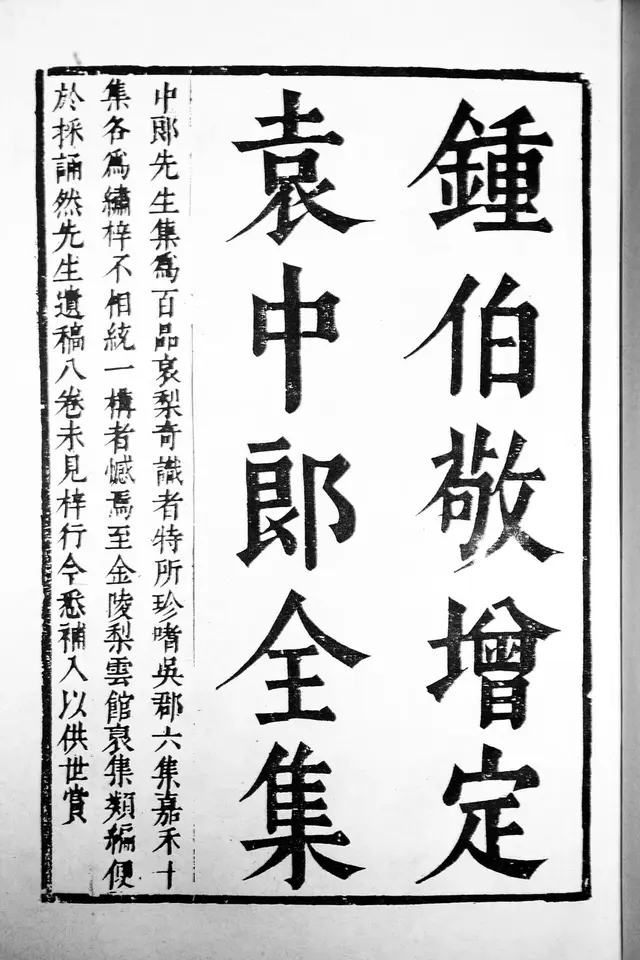
袁宏道
Yuan Hongdao (袁宏道, 1568–1610), courtesy name Zhonglang, pseudonym Shigong, was an illustrious essayist, poet, and pioneer of literary modernity during the late Ming dynasty. Hailing from an intellectual scholar-gentry lineage in Gong'an, Huguang, he together with his elder brother Yuan Zongdao and younger brother Yuan Zhongdao were celebrated across the realm as the Three Yuans of Gong'an. Attaining the metropolitan jinshi…
Yuan Hongdao (袁宏道, 1568–1610), courtesy name Zhonglang, pseudonym Shigong, was an illustrious essayist, poet, and pioneer of literary modernity during the late Ming dynasty. Hailing from an intellectual scholar-gentry lineage in Gong'an, Huguang, he together with his elder brother Yuan Zongdao and younger brother Yuan Zhongdao were celebrated across the realm as the Three Yuans of Gong'an. Attaining the metropolitan jinshi degree in 1592, Yuan served in successive civil administrative posts including Magistrate of Wu County in Suzhou, Secretary in the Ministry of Rites, Professor and Doctor in the National University (Guozijian), and Director in the Ministry of Personnel. In the sphere of late Ming literary criticism, Yuan launched a revolutionary aesthetic movement against the dominant archaic revivalism championed by the Earlier and Later Seven Masters, who dogmatically prescribed that all prose must imitate the Qin and Han while all poetry must emulate the High Tang. Yuan formulated the iconic doctrine of expressing native sensibility (xingling), proclaiming that literature must evolve with time and arise directly from the author's authentic inner emotional consciousness rather than mechanical plagiarism of antiquity. Drawing ideological inspiration from philosopher Li Zhi's Theory of the Childlike Heart and championing vernacular drama and folk ballads, Yuan famously rediscovered and propagated the works of the eccentric genius Xu Wei. His exquisite lyrical travelogues, such as Record of Tiger Hill and Moon-Watching at the Six Bridges on West Lake, represent enduring summits of classical Chinese personal prose. He passed away in his ancestral hometown in 1610 at the age of forty-three.
Born into a scholar-official clan in Gong'an; educated in classical prose and poetry from childhood.
Formed the Puchi Literary Society at age sixteen in Gong'an, gaining widespread regional literary prestige.
Visited philosopher Li Zhi in Macheng; embraced the Theory of the Childlike Heart as the foundation for his literary reforms.
Passed the metropolitan examinations; returned home on leave to pursue independent literary writing.
Appointed Magistrate of Wu County in Suzhou; governed with equity and reform before resigning in exhaustion.
Travelled extensively through Tiger Hill and West Lake, composing his most celebrated travel memoirs.
Resumed office in Beijing; gathered scholars to champion native sensibility against conservative imitation.
Resigned from office following the death of his elder brother Zongdao; retired to his lakeside studio for six years.
Recalled to Beijing; served in the Ministry of Rites and advanced to Director in the Ministry of Personnel.
Granted sick leave to return to his ancestral home; passed away in October at the age of forty-three.
Yuan Hongdao was born on December 23, 1568, in Shipu village, Chang'anli, Gong'an County, Huguang. The Yuan clan was an established scholar-official lineage; his father, Yuan Dahua, and his uncles were respected provincial scholars. Growing up alongside his gifted brothers Zongdao and Zhongdao, Hongdao demonstrated astonishing intellectual agility, reading books at rapid speed and composing poetry at the age of five.
In 1583, at the age of sixteen, Yuan attained the status of licentiate. Possessing an expansive, independent temperament, he rebelled against the mechanical constraints of the eight-legged civil service examination essay. He founded the Puchi Literary Society in Gong'an with more than thirty young scholars. Although many members were significantly older, they willingly deferred to Yuan's editorial guidance. In 1588, at twenty-one, Yuan passed the Huguang provincial examinations as a juren, though he failed the imperial metropolitan examinations in Beijing the following year.
The temporary setback freed Yuan from examination conformism. Encouraged by his elder brother Zongdao, he immersed himself in Chan Buddhist dialogues and Wang Yangming's Neo-Confucian philosophy. In 1588, he travelled to Macheng to study under the iconoclastic thinker Li Zhi at the Zhifo Monastery. Li Zhi immediately recognized Yuan's exceptional spiritual intuition and literary courage, declaring him a true talent capable of shouldering great undertakings. Li Zhi's Theory of the Childlike Heart—which prioritized spontaneous, uncorrupted emotional truth over moral dogma—became the foundational cornerstone of Yuan's literary philosophy.
In the spring of 1592, Yuan passed the metropolitan examinations in Beijing, earning the jinshi degree. Disenchanted by political careerism at court, he deferred administrative posting and returned to Gong'an, spending three years writing beside the Shipu River. During this period, he articulated his dissatisfaction with the dominant literary circles led by Earlier and Later Seven Masters, who insisted that authentic prose must copy the pre-Qin dynasties while poetry must mimic the High Tang. Yuan mocked this as lifeless mimicry, writing that genuine poetry was to be found among village street ballads rather than antique pastiches.
In 1595, Yuan accepted imperial appointment as Magistrate of Wu County in Suzhou Prefecture. As one of the richest and most complex administrative jurisdictions in the empire, Wu County was fraught with litigious gentry and commercial taxation disputes. Yuan applied administrative transparency, suppressed extortionate clerks, overhauled land registries, and protected tenant farmers from rapacious local elites, bringing order to the district within a year.
Nonetheless, the endless bureaucratic minutiae and compulsory subservience to visiting court dignitaries proved profoundly suffocating to his artistic spirit. In letters to confidants, he lamented that serving as a county magistrate was the most agonizing misery an intellectual could endure. After submitting seven successive resignation memorials, he finally secured an official release in 1597.
Liberated from office, Yuan embarked on an intoxicating period of travel throughout the cultural landscapes of Jiangnan. He resided in Suzhou, exploring Tiger Hill, Tianping Mountain, and Dengwei, before sailing southward to Hangzhou to spend months wandering the banks of West Lake during changing seasons. His encounters with nature stimulated immense creative production, yielding classic masterpieces including Record of Tiger Hill and Moon-Watching at the Six Bridges on West Lake.
While visiting an antiquarian collector in Hangzhou, Yuan discovered the forgotten manuscripts of the reclusive Shaoxing genius Xu Wei (Xu Wenchang). Stunned by the wild vitality and tragic emotional depth of Xu's poems and plays, Yuan championed Xu as an immortal master whose incandescent talent had been neglected by superficial contemporaries. Yuan financed the reprinting of Xu's anthologies and composed the famous Biography of Xu Wenchang, ensuring Xu's rightful place in literary history.
In 1598, Yuan returned to bureaucratic service as Professor in Shuntian Prefecture and subsequent Doctor in the National University in Beijing. His elder brother Zongdao was already serving in the Hanlin Academy, while younger brother Zhongdao joined them in the capital. Gathering scholars including Tao Wangling, Jiang Yingke, and Huang Hui into the Grape Society, the Three Yuans mounted a concerted campaign for literary transformation. Yuan formulated his revolutionary creed: "Express native sensibility freely without conforming to formalistic moulds; refuse to write unless words emerge directly from one's own heart." Their fresh, accessible prose captivated scholars across China, giving birth to the dominant Gong'an School.
In the autumn of 1600, Yuan Zongdao passed away in Beijing at the age of forty-one. Devastated by the loss of his brother and intellectual mentor, Yuan Hongdao resigned his post and escorted the coffin back to Gong'an.
Beside the Willow Waves Lake in Gong'an, Yuan constructed a rural retreat known as the Liulang Pavilion, residing in peaceful seclusion for six years. During this pastoral interlude, he indulged his passion for horticulture and floral aesthetics, writing History of Vases (Ping Shi), a foundational classic on flower arrangement that was later exported to Japan, where it became the foundational manual for the Hongdao School of Ikebana. He also explored Buddhist and Daoist scriptures, authoring Comprehensive Treatise on the Western Pure Land (Xifang Helun).
In 1606, yielding to repeated imperial summons, Yuan returned to Beijing to serve in the Ministry of Rites. In 1609, he supervised provincial examinations in Shaanxi, and was subsequently promoted to Director in the Ministry of Personnel, administering official evaluations with complete integrity.
In early 1610, suffering from acute exhaustion and chronic respiratory ailments, Yuan obtained medical leave to return to Huguang. His health deteriorated rapidly, and he died at his residence on October 20, 1610, at the age of forty-three. Eminent Qing historian Qian Qianyi celebrated his historic contributions, writing that Yuan single-handedly transformed the literary atmosphere of his era and demolished the suffocating dogmas of archaic imitation.
Yuan Hongdao's theory of Xingling (expressive spiritual nature) represented the pinnacle of late Ming intellectual enlightenment within literary criticism. Directly challenging the archaist dogma of "prose must follow the Qin and Han, poetry must follow the High Tang" championed by the Former and Latter Seven Masters, Yuan argued that literature must evolve continuously with its era: "As worldly conditions change, literature changes accordingly; each dynasty experiences rises and declines, and literary methods cannot be slavishly repeated." He observed that ancient poetry was magnificent precisely because ancient authors expressed the authentic sentiments of their own time; blind imitation reduced writing to lifeless clay and wooden idols.
On creative subjectivity, Yuan insisted: "Express authentic spiritual nature freely without conventional constraints; unless words flow directly from one's own heart, do not set brush to paper." Influenced by Li Zhi's "childlike mind" philosophy, Yuan's Xingling denoted natural genuine emotion untainted by hypocritical neo-Confucian moralizing. He praised vernacular oral literature, arguing that popular street songs and rustic ballads possessed greater emotional vitality than pedantic court verses. By dismantling boundaries between elite and vernacular arts, he championed late Ming drama, popular novels like Water Margin, and folk music, vastly expanding the aesthetic scope of premodern Chinese literature.
Beyond poetic reform, Yuan Hongdao inaugurated a major movement in domestic aesthetics and lifestyle theory. During his retreat at Willow Waves Villa, he closely observed the character and forms of botanical life, composing his exquisite treatise on floral arrangement, Pingshi (History of Vases). Structured into twelve sections covering flower varieties, gradations, vessels, placement, aesthetics, and water care, the work codified a refined and naturalistic approach to floral art. Yuan advocated capturing subtle spiritual resonance while avoiding garish ornamentation, uniting scholarly elegance with Zen-like immersion in nature. The Pingshi achieved immense popularity and was later transmitted to Edo Japan, where it became the foundational classic of the Kōdō-ryū school of ikebana.
In landscape prose, Yuan transformed travel literature with his nimble, lively, and witty style. In essays such as Waiting for the Moon at the Six Bridges and Tiger Hill, he captured the ethereal interplay of spring waters and moonlit vistas, as well as the bustling holiday crowds of Suzhou. His fluid, unforced prose established a new paradigm for late Ming familiar essays, exerting a profound influence on later literary masters such as Zhang Dai, Li Yu, and Yuan Mei.
FIGURES ASSOCIATED WITH THIS DYNASTY