Marriage and Examination Studies
Married Lady Liu and had his firstborn son Yu Yingjia, studying for the examinations as a licensed student in Shaowu.
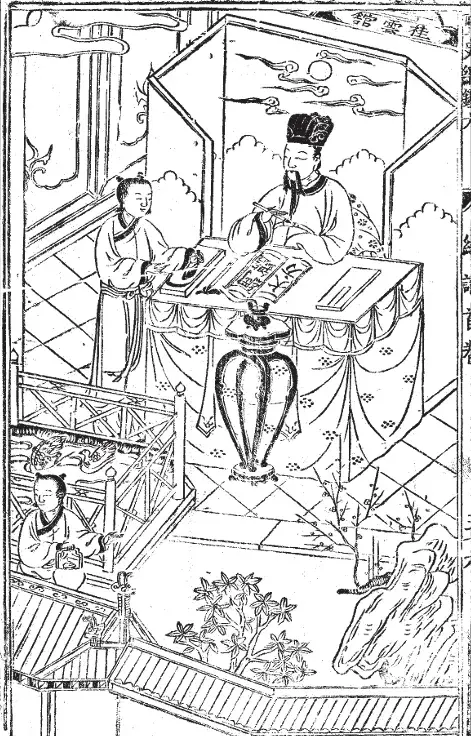
余象斗
Yu Xiangdou (active during the Wanli to Chongzhen eras), courtesy name Yangzhi and art name Santai Shanren (Master of Santai Guan), native of Shulin in Jianyang, Fujian (modern Shufang, Jianyang District, Nanping), was a celebrated late Ming dynasty commercial publisher, vernacular novelist, and literary critic. Descended from the prominent Jianyang Yu lineage that had operated woodblock publishing houses since the Northern…
Yu Xiangdou (active during the Wanli to Chongzhen eras), courtesy name Yangzhi and art name Santai Shanren (Master of Santai Guan), native of Shulin in Jianyang, Fujian (modern Shufang, Jianyang District, Nanping), was a celebrated late Ming dynasty commercial publisher, vernacular novelist, and literary critic. Descended from the prominent Jianyang Yu lineage that had operated woodblock publishing houses since the Northern Song, Yu was originally a certified scholar (zhusheng) in Shaowu before abandoning civil examinations to operate the Santai Guan and Shuangfeng Tang publishing houses. Capitalizing on expanding commercial markets, he printed examination manuals and daily encyclopedias while spearheading the popularization of vernacular fiction. He published the earliest extant complete simplified edition and earliest commented edition of Water Margin (Shuihu Zhichuan Pinglin, 1594), authored the fantasy novels Nanyou Ji and Beiyou Ji which joined Dongyou Ji and Xiyou Ji as the famous Four Journeys (Siyou Ji), compiled the earliest Ming courtroom litigation fiction collection Lianming Gong'an, and created the literary concept of a fictional prequel in Lieguo Qianbian. His signature "illustration-above-text-below" format democratized reading among urban commoners, leaving an indelible imprint on Chinese vernacular print culture.
Married Lady Liu and had his firstborn son Yu Yingjia, studying for the examinations as a licensed student in Shaowu.
Established the Santai Guan imprint, printing the medical manual Pingxue Dongwei Baojing and co-publishing Quanhan Zhichuan.
Fully abandoned civil examination pursuits to run the family publishing operations, hiring literati and illustrators for mass-market imprints.
Issued the illustrated and annotated Xinke Anjian Quanxiang Pipin Sanguo Zhichuan, popularizing marginal commentaries and full-page illustrations.
Published Jingben Zengbu Jiaozheng Quanxiang Zhongyi Shuihu Zhichuan Pinglin, the earliest extant complete simplified text and commented edition of the novel.
Compiled and published Huangming Zhusi Lianming Qipan Gong'an, inaugurating the vernacular courtroom mystery (gong'an) genre in China.
Composed the religious adventure novels Nanyou Ji and Beiyou Ji, later bound with companion works to form the popular Four Journeys.
Re-edited his clan uncle Yu Shaoyu's Lieguo Zhichuan and composed Lieguo Qianbian Shier Chao Chuan, creating China's earliest fictional prequel.
Traveled extensively across Guangdong and Fujian to assemble the comprehensive geomantic compendium Dili Tongyi Quanshu.
Issued Wuke Liqi Xiangbian Zuanyao Santai Bianlan Tongshu Zhengzong, his latest recorded woodblock imprint; granted honorary Confucian robes by local magistrates.
Yu Xiangdou was born in Shulin (modern Shufang Township, Jianyang District, Fujian), renowned across imperial China as the southern capital of woodblock printing. The Jianyang Yu family had continuously engaged in the cutting and distribution of woodblock texts since the Northern Song dynasty, spanning over thirty generations. In the Jiajing era, Yu Xiangdou's grandfather, Yu Ji'an, acquired extensive agricultural estates and established the Qingxiu Monastery as a scholarly academy and block storage facility, rescuing the family's publishing house from mid-Ming stagnation. Yu Xiangdou's father, Yu Menghe (art name Shuangfeng), established the Shuangfeng Tang workshop, specializing in the publication of classical histories and genealogies. Raised amidst the smell of fresh ink and seasoned pear-wood blocks, Yu Xiangdou gained an early mastery of traditional Confucian letters.
During his youth, Yu Xiangdou actively pursued civil degree qualifications, enrolling as a licensed scholar (zhusheng) in Shaowu County. Alongside his examination studies in the Eight-legged Essay, he developed a keen interest in eclectic subjects, including astronomy, divination, and fengshui geomancy. In 1585, he married Lady Liu, welcoming his eldest son, Yu Yingjia, the following year. However, observing the intense competition in provincial triennial examinations and the surging commercial demand among urban merchants and literate townsfolk for accessible books, Yu chose to abandon bureaucratic aspirations, committing his talents entirely to commercial publishing.
In 1588, Yu Xiangdou launched his independent workshop, Santai Guan, adopting the professional monikers Santai Shanren (Hermit of Mount Santai) and Master of Santai Guan, while continuing to utilize his father's Shuangfeng Tang hallmark. That same year, he published the medical guide Pingxue Dongwei Baojing and co-published Xiong Damu's historical romance Quanhan Zhichuan under the pseudonym Yu Shiteng, marking the inception of a prolific printing career spanning fifty years. By 1591, Yu was managing the clan's full publishing apparatus, establishing a coordinated assembly-line production system that contracted scribes, scholars, block cutters, and illustrators.
Beginning in 1592, Yu spearheaded a revolutionary surge in commercial vernacular fiction. He brought out Xinke Anjian Quanxiang Pipin Sanguo Zhichuan (1592) and Shuihu Zhichuan Pinglin (1594). By integrating continuous upper-register pictorial scenes with running head-note commentaries (meipi), Yu transformed intricate dynastic sagas into vivid, approachable narratives that captured the domestic market. Not content to remain a mere merchant, Yu began authoring works directly. Blending regional folk myths, Daoist hagiographies, and temple theater, he penned and printed Huangming Zhusi Lianming Qipan Gong'an (1598) and the mythological romances Nanyou Ji and Beiyou Ji around 1602, cementing his dual identity as author-publisher.
Across the late Wanli, Tianqi, and Chongzhen reigns, Yu Xiangdou continued to expand his commercial repertoire. Collaborating with his cousin Yu Zhangde, he engraved the phonological reference Gujin Yunhui Juyao Xiaobu. To expand reader engagement with historical sagas, he republished his clan uncle Yu Shaoyu's Lieguo Zhichuan while composing his own prequel, Lieguo Qianbian Shier Chao Chuan, establishing the literary precedent of serial prequels in Chinese narrative history. He subsequently compiled his own two mythological works with Wu Yuantai's Dongyou Ji and Yang Zhihe's Xiyou Ji, marketing them collectively as Siyou Ji (The Four Journeys).
During the Chongzhen era, although well advanced in years, Yu traveled to Guangdong to survey regional topography, compiling the monumental twelve-volume geomancy treatise Dili Tongyi Quanshu. In 1637, he published Wuke Liqi Xiangbian Zuanyao Santai Bianlan Tongshu Zhengzong, his final documented commercial imprint. Highly respected throughout northern Fujian for distributing practical medical texts, household almanacs, and educational primers, Yu was awarded honorary Confucian official robes (ruguan zhangfu) by local authorities before passing away peacefully in his ancestral village.
Yu Xiangdou stood as the undisputed leader of the private publishing industry in Jianyang (Jianben) during the late Ming dynasty. While earlier Jianyang imprints faced stiff competition from luxury editions produced in Nanjing and Suzhou due to coarse paper and typographical errors, Yu revolutionized production through strict division of labor and economies of scale. He coordinated script copyists, master block carvers, ink-makers, and bookbinders into an efficient commercial enterprise.
In book layout and design, Yu popularized and perfected the distinctive "upper-illustration, lower-text" (shangtu xiawen) format. Placing continuous woodblock illustrations across the upper third of each page while printing narrative prose below, Yu created an engaging visual-textual dialogue that lowered literacy barriers for ordinary readers. This layout dominated the popular book market across late imperial China, representing a milestone in the history of East Asian book culture and print illustration.
Yu Xiangdou occupies an indispensable position in the textual history and transmission of Chinese literary masterworks. His 1594 imprint, Shuihu Zhichuan Pinglin, represents the earliest surviving complete simplified text (jianben) of Water Margin extant in world collections, and constitutes the oldest known commented edition of the novel. The text preserves vital archaic plot structures and folk language, serving as an irreplaceable reference for scholars tracking the oral evolution of the Shuihu cycle.
Similarly, his annotated edition of The Romance of the Three Kingdoms incorporated running commentaries that guided readers on historical morality and military stratagems, pioneering the commercial commentator format. Carried aboard merchant junks and postal couriers, Yu's imprints circulated widely into Japan, Korea, and the Ryukyu Kingdom, exerting a lasting impact on pre-modern East Asian vernacular literature.
Yu Xiangdou was a remarkably versatile literary figure who synthesized writing, editing, commenting, and publishing into a cohesive vocation. Sensing the popular appetite for legal justice and spiritual salvation, he created innovative narrative subgenres. His Nanyou Ji (chronicle of Huaguang Dadi) and Beiyou Ji (chronicle of Zhenwu the Xuanwu God) codified Daoist popular devotions into heroic quest epics that remain celebrated in temple festivities across southeastern China and Southeast Asia.
In the realm of detective fiction, his Lianming Qipan Gong'an established the foundational structure of Ming courtroom litigation stories, directly inspiring later celebrated anthologies such as Bao Gong An and Hai Gong An. Furthermore, in Lieguo Qianbian, he created the earliest explicit "prequel" in Chinese literature, charting an innovative course for the serialization and world-building of vernacular narrative sagas.
FIGURES ASSOCIATED WITH THIS DYNASTY