Birth into Eminent Lineage
Born into an illustrious scholarly clan in Yuyao, Yuezhou, adopted and raised by his uncle Yu Ji.
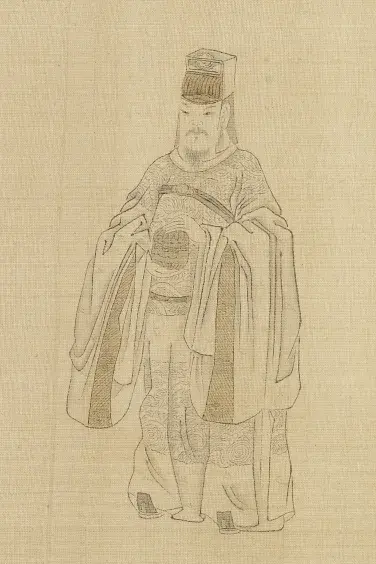
虞世南
Yu Shinan (虞世南, 558–638), courtesy name Boshi, was a native of Yuyao in Yuezhou. He was a celebrated statesman, master calligrapher, litterateur, and Confucian scholar of the Early Tang Dynasty, honored among the Twenty-Four Meritorious Officials of Lingyan Pavilion. Born into a prominent aristocratic clan of the Southern Dynasties, he was renowned from youth for his serene temperament, profound learning, and filial devotion.…
Yu Shinan (虞世南, 558–638), courtesy name Boshi, was a native of Yuyao in Yuezhou. He was a celebrated statesman, master calligrapher, litterateur, and Confucian scholar of the Early Tang Dynasty, honored among the Twenty-Four Meritorious Officials of Lingyan Pavilion. Born into a prominent aristocratic clan of the Southern Dynasties, he was renowned from youth for his serene temperament, profound learning, and filial devotion. After serving in the Southern Chen and Sui Dynasties, Yu Shinan entered the inner circle of Emperor Taizong of Tang during the rise of the Tang Empire. Throughout the Zhenguan era, he held pivotal posts including Scholar of the Hongwen Academy and Director of the Palace Library, receiving the ennoblement of Viscount of Yongxing. Renowned for his fearless moral counsel, he frequently submitted uncompromising remonstrances to correct imperial decisions regarding lavish construction, hunting expeditions, and royal tours. In the history of Chinese calligraphy, Yu Shinan is revered alongside Ouyang Xun, Chu Suiliang, and Xue Ji as one of the Four Great Masters of the Early Tang. Emperor Taizong praised him as possessing the Five Perfections: moral integrity, fearless counsel, vast erudition, refined prose, and supreme calligraphy. In 638, he died at the age of eighty-one, receiving the posthumous title Wenyi and eventual portraiture in the Lingyan Pavilion.
Born into an illustrious scholarly clan in Yuyao, Yuezhou, adopted and raised by his uncle Yu Ji.
Studied classics under master Gu Yewang for over a decade, earning praise from Minister Xu Ling alongside his brother.
Began official service as Legal Officer for the Prince of Jianan, earning high reputation across the south.
Relocated to Chang'an after the Sui conquest, living modestly as the Two Yu brothers gained fame.
Appointed Proofreader in the Palace Library under Emperor Yang of Sui, maintaining scholarly detachment from his brother's political influence.
Begged rebel leader Yuwen Huaji to execute him in place of his brother Yu Shiji, being spared due to exceptional brotherly devotion.
Following Yuwen Huaji's defeat, served briefly under Dou Jiande before Li Shimin defeated Dou and recruited him as Counselor to the Prince of Qin.
Li Shimin established the Hongwen Academy; Yu Shinan served alongside Fang Xuanling as Scholar, consulting on state policy.
Promoted to Senior Compiler upon Taizong's ascension, serving as a trusted confidant in drafting imperial decrees and formulating policy.
Elevated to Director of the Palace Library and ennobled as Viscount of Yongxing, directing the compilation of imperial encyclopedias.
Submitted frank memorials advising Taizong against excessive construction projects and ostentatious western inspection tours.
Passed away in Chang'an at age eighty-one, posthumously honored as Minister of Rites with the posthumous title Wenyi.
Commemorated by Emperor Taizong with his portrait installed among the Twenty-Four Meritorious Officials in Lingyan Pavilion.
Yu Shinan was born in 558 during the Southern Chen Dynasty into an elite scholar-gentry clan of Yuyao. His father Yu Li served as Chief Administrator to the Crown Prince, while his uncle Yu Ji was an acclaimed scholar and loyal minister. Having no heirs of his own, Yu Ji adopted Shinan and imparted strict classical training. Naturally reserved and unconcerned with material wealth, Yu Shinan dedicated his youth entirely to scholarly cultivation.
Together with his elder brother Yu Shiji, he entered the academy of Gu Yewang, the foremost classicist and philologist of the southern dynasties. For over a decade, Yu Shinan immersed himself day and night in Confucian canons and dynastic histories, enduring coarse clothing and meager sustenance without complaint. Xu Ling, the Minister of Personnel of the Chen court, was profoundly impressed by their writings, declaring that the two brothers were modern reincarnations of Western Jin literary giants Lu Ji and Lu Yun.
During this period, Yu Shinan sought instruction in calligraphy from Master Zhiyong, a seventh-generation descendant of the Sage Calligrapher Wang Xizhi. Residing at Yongxin Temple, Zhiyong possessed the genuine brushwork tradition of the Two Wangs. Yu Shinan spent years meticulously copying authentic masterpieces under Zhiyong's personal guidance, mastering both standard and cursive scripts with extraordinary spiritual resonance and structural discipline.
In 583, Yu Shinan entered official life as Legal Officer to Chen Shiqing, Prince of Jianan. Meanwhile, his elder brother Yu Shiji advanced rapidly through the central ministries. The brothers enjoyed widespread literary acclaim throughout the southern capital of Jiankang, where scholars eagerly sought their acquaintance.
In 589, the Sui Dynasty conquered the Southern Chen, ending centuries of division. The imperial court ordered eminent southern scholar-aristocrats to move northward to Chang'an. The brothers were collectively hailed by northern scholars as the Two Yu. However, during the reign of Emperor Wen of Sui, imperial policy favored northern military aristocrats, leaving Yu Shinan in junior administrative obscurity for nearly two decades.
Following the accession of Emperor Yang in 605, Yu Shiji won immense imperial favor through flattering rhetoric and administrative brilliance, becoming Vice Director of the Chancellery and controlling court affairs. In contrast, Yu Shinan remained a modest Proofreader in the Palace Library. Despite his brother's immense political power and opulent lifestyle, Yu Shinan continued to live in unadorned quarters, refusing to leverage his brother's influence for promotion and focusing his quiet energies on the collation of court archives.
In 618, military commander Yuwen Huaji orchestrated a bloody palace coup at the Jiangdu traveling palace, murdering Emperor Yang and arresting high officials. Yu Shiji was condemned to death as a principal imperial favorite. Facing the execution squad, Yu Shinan wept profusely and threw his body over his brother, desperately pleading with the rebel commanders to spare Shiji and take his own life instead. Yuwen Huaji was deeply moved by this extraordinary fraternal devotion, and though he refused to pardon Shiji, he spared Shinan from execution.
Following Shiji's death, Yu Shinan was forcibly swept along with the rebel forces into northern China. Later captured by the warlord Dou Jiande in Hebei, he served briefly as Secretarial Vice Minister. In 621, Li Shimin, Prince of Qin, crushed Dou Jiande's forces at the Battle of Hulao. Li Shimin, who had long admired Yu Shinan's peerless erudition and moral reputation, immediately invited him into his princely administration, appointing him Secretarial Attendant and Academician of the newly founded Hongwen Academy.
When Li Shimin ascended the throne as Emperor Taizong in 626, Yu Shinan was promoted to Senior Compiler and later elevated to Director of the Palace Library, receiving the hereditary title of Viscount of Yongxing. As head of the Palace Library, he supervised the empire's vast collection of classical texts, national archives, and dynastic history projects.
In the court of Zhenguan, Yu Shinan appeared physically frail and humble in demeanor, yet whenever court policies or imperial conduct deviated from propriety, he stepped forward to offer resolute counsel. When Emperor Taizong developed a penchant for hunting expeditions and luxurious palace construction, Yu Shinan submitted urgent memorials demonstrating the ruinous consequences of imperial indulgence in past dynasties.
In 634, following an earthquake in Longyou, Taizong issued a general call for political critique. Yu Shinan presented a profound memorial urging the monarch to remain vigilant against complacency and to halt expensive royal tours. Taizong accepted his counsel with deep gratitude, keeping the memorial on his desk as a daily reminder. Taizong remarked to his ministers that if all officials displayed the candor and selfless devotion of Yu Shinan, the empire would remain tranquil indefinitely.
In his late seventies, Yu Shinan repeatedly requested permission to retire due to failing health. Reluctant to part with his trusted mentor and friend, Emperor Taizong granted him relief from daily court attendance while retaining him as a senior imperial advisor in the Hongwen Academy.
In August 638, Yu Shinan died in Chang'an at the age of eighty-one. Overcome with grief, Emperor Taizong suspended court sessions and wept bitterly, declaring that the empire had lost a unique paragon of virtue and learning. He posthumously bestowed upon him the office of Minister of Rites, the posthumous title Wenyi, and the honor of burial in the imperial Zhaoling cemetery. In 643, Taizong commissioned artist Yan Liben to paint the portraits of the Twenty-Four Meritorious Officials in Lingyan Pavilion, placing Yu Shinan among the foremost founders of the Tang Dynasty.
Emperor Taizong held Yu Shinan in the highest regard, famously bestowing upon him the accolade of the Five Perfections. These comprised unblemished moral conduct, fearless and loyal remonstrance, encyclopedic erudition, refined literary composition, and consummate mastery of calligraphy. Taizong observed that possessing even one of these virtues distinguished a person, while Yu Shinan uniquely united all five in a single lifetime.
Throughout the Zhenguan era, whenever questions arose regarding ancient ceremonial rites, astronomical records, or administrative precedents, Taizong turned to Yu Shinan. His instant, comprehensive responses never faltered. Moreover, when Taizong practiced calligraphy or composed poetry, he frequently sought Yu Shinan's critical appraisal, valuing his honest artistic critique over empty court flattery.
Yu Shinan occupies a towering summit in the history of Chinese calligraphy, forming the Four Great Masters of the Early Tang with Ouyang Xun, Chu Suiliang, and Xue Ji. Having received direct instruction from Master Zhiyong, he inherited the authentic brush technique of Wang Xizhi and Wang Xianzhi. His style achieved a harmonious balance between inner structural strength and outer elegance, described by traditional critics as like a gentleman concealing his supreme tools within modesty.
His regular script masterpiece, the Stele of the Confucius Temple, was composed and inscribed upon imperial order during the early Zhenguan era. The work displays rounded strokes, balanced proportions, and profound classical serenity, completely devoid of ostentatious display. It was immediately hailed as the definitive model of Tang standard script. His surviving running script works, such as the Epitaph for Princess Runan and his traced copy of the Preface to the Orchid Pavilion Gathering, further demonstrate his fluid elegance, establishing the Two Wangs tradition as the aesthetic foundation of Tang calligraphy.
Yu Shinan was also an accomplished poet who played an important role in reforming Early Tang verse, steering it away from the superficial ornamentation of the Southern Dynasties toward classical gravity. His five-character regulated verse Cicada is universally recognized as an immortal masterpiece of allegorical poetry, depicting the insect drinking pure dew and singing from high parasol trees.
In this celebrated poem, Yu Shinan used the cicada's lofty perching and pure diet of dew to symbolize the immaculate integrity of the noble scholar. The poem asserts that genuine virtue and true merit naturally command respect throughout the world without needing to borrow the influence of political patronage or worldly power.
As the chief organizer of state cultural projects under Emperor Taizong, Yu Shinan made lasting contributions to bibliography and encyclopedic scholarship. He directed the gathering of lost manuscripts from across China, restoring the imperial library collections after centuries of wartime devastation.
Drawing upon imperial archives, he compiled the monumental encyclopedia Beitang Shuchao in one hundred and sixty volumes. Divided into nineteen comprehensive sections covering imperial government, penal law, administrative offices, Confucian learning, arts, and music, the work gathered citations from hundreds of ancient texts. Because many original works cited within it subsequently vanished, Beitang Shuchao preserved invaluable fragments of early Chinese historical, legal, and literary scholarship, ranking among the four greatest imperial encyclopedias of ancient China.
Yu Shinan consistently defended orthodox Confucianism as the foundational ideological pillar of the Tang Empire. In imperial debates concerning the balance between Buddhist, Daoist, and legalist administrative methods, he championed the benevolent governance of ancient sage-kings Yao and Shun alongside the ethical teachings of the Duke of Zhou and Confucius.
In the Hongwen Academy, he organized the systematic study of the Rites of Zhou, the Zuo Tradition, and the Classic of Filial Piety, personally lecturing Crown Prince Li Chengqian and imperial princes on moral discipline. His memorials insisted on prioritizing moral reform and public welfare over severe punishments, playing a foundational role in shaping the enlightened, humane ethos of the Zhenguan reign.
FIGURES ASSOCIATED WITH THIS DYNASTY