Meeting in Wu
Xiang Liang and Xiang Yu raise their rebellion in Kuaiji; Consort Yu enters Xiang Yu's retinue, accompanying the army.
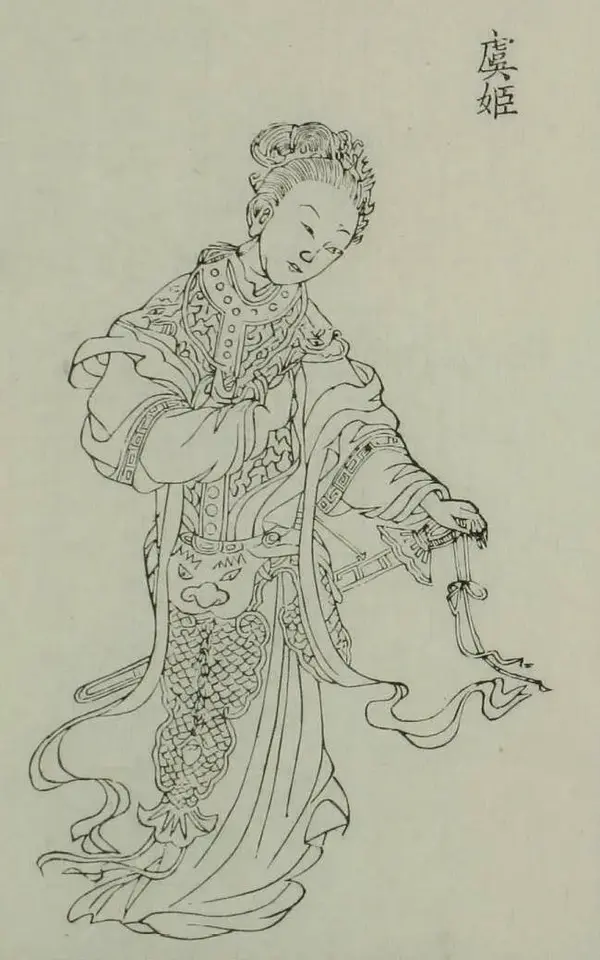
虞姬
Yu Ji (died 202 BC), whose given name was Yu (or surnamed Yu), lived during the late Qin and early Han period. She was the beloved consort of Xiang Yu, the Hegemon-King of Western Chu, and remains one of the most romanticized and poignant female figures in classical Chinese literature, poetry, and theater. Historical annals preserve no exact records of her birth year or ancestral lineage, though folk traditions suggest she…
Yu Ji (died 202 BC), whose given name was Yu (or surnamed Yu), lived during the late Qin and early Han period. She was the beloved consort of Xiang Yu, the Hegemon-King of Western Chu, and remains one of the most romanticized and poignant female figures in classical Chinese literature, poetry, and theater. Historical annals preserve no exact records of her birth year or ancestral lineage, though folk traditions suggest she joined Xiang Yu when he and his uncle Xiang Liang raised troops in the Wu region of Jiangnan. Throughout the turmoil of the anti-Qin rebellion and the Chu-Han Contention, Consort Yu faithfully accompanied Xiang Yu on campaign across the Central Plains, witnessing the Battle of Julu, the fall of the Qin capital of Xianyang, and protracted warfare around Xingyang. Historian Sima Qian recorded in Records of the Grand Historian (Shiji) that "there was a beauty named Yu, who was frequently favored and accompanied the King," attesting to their steadfast devotion amidst battlefield chaos. In the winter of 202 BC, as the Chu-Han conflict reached its catastrophic climax, Xiang Yu's army was encircled by hundreds of thousands of Han and allied forces under Liu Bang and Han Xin at the Battle of Gaixia (modern Lingbi, Anhui). Besieged, starved, and hearing Chu folk songs sung from all four quadrants of the Han encampment, Xiang Yu lamented the loss of his cause, drinking in his tent and chanting the tragic Song of Gaixia: "My strength could uproot mountains, my courage matched the world; but the times are unfavorable, and my steed Zhui can run no more. When Zhui runs no more, what can be done? Oh Yu, oh Yu, what shall become of you!" Stricken with sorrow, Consort Yu drew a sword, danced before the King, and sang in response the famed Harmonizing Song of Gaixia: "Han soldiers have already seized the land; the songs of Chu echo on all sides. When my Great King's noble spirit is exhausted, how could this humble concubine wish to live on!" Concluding her verse, she slit her throat to relieve Xiang Yu of anxiety for her safety during his final breakout. Consort Yu's suicide and Xiang Yu's final stand at the Wu River formed the immortal classical tragedy known as "Farewell My Concubine" (Bawang Bie Ji), celebrated for two millennia as a cultural emblem of marital loyalty and heroic devotion.
Xiang Liang and Xiang Yu raise their rebellion in Kuaiji; Consort Yu enters Xiang Yu's retinue, accompanying the army.
Xiang Yu overthrows the Qin, claims the title of Hegemon-King of Western Chu, and establishes his court at Pengcheng with Consort Yu.
The Chu-Han war erupts; Consort Yu accompanies Xiang Yu's field headquarters throughout campaigns around Xingyang and Chenggao.
Chu and Han divide the realm along the Honggou Canal; Xiang Yu withdraws east, accompanied by Consort Yu.
Han armies trap the Chu army at Gaixia; hearing Chu songs from all sides, Xiang Yu composes the Song of Gaixia, and Consort Yu harmonizes with a sword dance.
To unburden Xiang Yu before his desperate charge, Consort Yu commits suicide by the sword; Chu soldiers bury her at Gaixia.
Consort Yu's early family background and birth date are unrecorded in official Han dynasty historiography. The Records of the Grand Historian and Book of Han state concisely: "There was a beauty named Yu, who was frequently favored and accompanied the King." Commentators debate whether Yu was her personal name or surname, while "Ji" was an ancient honorific denoting an aristocratic woman or favored consort.
During the late Qin dynasty, Xiang Liang fled blood vendettas to Wu County in Kuaiji Commandery (modern Suzhou, Jiangsu), accompanied by his nephew Xiang Yu, training local warriors. Steppe and southern folk traditions recount that Lady Yu belonged to a respectable Jiangnan family and married Xiang Yu out of admiration for his youthful martial prowess.
In 209 BC, Chen Sheng and Wu Guang launched the Dazexiang rebellion, prompting Xiang Liang and Xiang Yu to execute the Kuaiji commandery governor Yin Tong, leading eight thousand Jiangnan warriors across the Yangtze River to overthrow Qin rule.
From the inception of the rebellion, Consort Yu remained at Xiang Yu's side. Throughout years of brutal campaigning across the Huai and Central Plains, she was an enduring fixture in the military encampments. Whether enduring the perilous siege of Julu or entering the conquered Qin palaces, Consort Yu shared the physical hardships of the field, watching Xiang Yu rise from a regional commander to the supreme hegemon of China.
In 206 BC, Xiang Yu led a coalition of four hundred thousand troops through Hangu Pass, capturing the Qin capital of Xianyang, dissolving the unified empire, and partitioning China among eighteen regional kings. Taking the supreme title of Hegemon-King of Western Chu, he established his capital at Pengcheng (modern Xuzhou, Jiangsu).
Soon after, Liu Bang, King of Han, crossed the Qinling Mountains and conquered the Three Qin territories, igniting the Chu-Han Contention. Xiang Yu spent the subsequent five years constantly on horseback, subduing Qi and Zhao in the north while holding off Han armies along the central front. Throughout this exhausting struggle, Consort Yu remained his most intimate emotional anchor.
As Sima Qian observed, while Xiang Yu was notoriously stern, unbending, and fearsome toward foes and subordinates, his encounters with Consort Yu revealed deep gentleness and tenderness. Her serene loyalty softened the psychological strain of continuous warfare, providing the Hegemon-King with an enduring oasis of domestic devotion.
In the autumn of 203 BC, after protracted stalemates at Mount Guangwu, Xiang Yu and Liu Bang negotiated the Treaty of Honggou, agreeing to partition the realm along the canal, with Chu ruling the east and Han ruling the west. Xiang Yu began withdrawing his forces eastward, but Liu Bang, following the strategic counsel of Zhang Liang and Chen Ping, violated the truce, mobilizing Han Xin, Peng Yue, and Ying Bu to trap the retreating Chu army.
In the winter of 202 BC, Han Xin deployed his famed "Ambush from Ten Sides," surrounding Xiang Yu's remaining forces at Gaixia on the northern bank of the Tuo River (modern Lingbi County, Anhui).
The Chu army was completely isolated, out of rations, and outnumbered by hundreds of thousands of besieging enemy troops. Cold northern winds swept across the frozen camp as hunger and exhaustion decimated morale.
In the dead of night, Han armies under Zhang Liang's direction began singing folk songs from the land of Chu from all four directions. The mournful, lilting southern melodies drifted over the encampment, inducing profound homesickness among the Chu soldiers, who wept openly in the trenches.
Awakened by the singing, Xiang Yu listened in terror, exclaiming: "Has Han already conquered all of Chu? How can there be so many Chu men among their ranks!"
Listening to the songs echoing in the darkness, Xiang Yu realized that his homeland was lost and his cause was doomed. The Hegemon-King rose from his couch, ordered wine brought to his command tent, and hosted a final farewell banquet.
Torches flickered against the canvas as the tragic monarch confronted his fate. At his side stood only his legendary warhorse, Zhui, and his faithful consort, Lady Yu. Gazing upon the horse and woman who had accompanied his conquests, Xiang Yu was overwhelmed with sorrow and chanted his immortal Song of Gaixia:
"My strength could uproot mountains, my courage matched the world! The times are unfavorable, and my steed Zhui can run no more! When Zhui runs no more, what can be done? Oh Yu, oh Yu, what shall become of you!"
Xiang Yu sang repeatedly, tears streaming down his face. His lyric expressed both heroic despair at cosmic betrayal and agonizing solicitude for the fate of his beloved. Surrounded by generals and attendants, the entire assembly wept, their heads bowed so deeply that none dared look up at their weeping King.
Listening to Xiang Yu's heartbreaking lament, Consort Yu recognized that her husband's martial resolve was paralyzed by his fear for her survival.
According to Lu Jia's Spring and Autumn Annals of Chu and Han and Sima Zhen's commentary in Seeking the Obscure in the Records of the Grand Historian, Consort Yu bowed respectfully before Xiang Yu. Drawing a double-edged sword, she danced before him in the flickering torchlight, singing in harmonization:
"Han soldiers have already seized the land; The songs of Chu echo on all sides. When my Great King's noble spirit is exhausted, How could this humble concubine wish to live on!"
Through these poignant lines, Consort Yu affirmed her unyielding virtue: with the homeland fallen and the Great King's cause broken, she refused to preserve her life to become a captive trophy of the Han victors.
Reaching the climax of her dance, Consort Yu swept the sword across her throat, collapsing dead in a pool of blood upon the tent floor, ending her life at Gaixia so that Xiang Yu might ride out unencumbered.
Grief-stricken, Xiang Yu mounted Zhui and led eight hundred elite cavalry in a midnight charge through the Han lines, eventually fighting to the death at the Wu River.
Following the battle, local villagers buried Consort Yu's remains near the Gaixia encampment (east of modern Lingbi, Anhui), raising a tumulus that became a place of pilgrimage for generations.
Consort Yu's most celebrated literary legacy was her creation, alongside Xiang Yu, of one of the highest aesthetic achievements in ancient Chinese poetry: the Song of Gaixia and the Harmonizing Song of Gaixia.
While Xiang Yu's poem captured the grandeur and despair of a fallen hero, Consort Yu's response represents one of the earliest documented five-character poems in Chinese literary history. Comprising merely twenty characters, her verse harmonized dramatic reality, military doom, and calm self-sacrifice, devoid of sentimental complaint. Revered by generations of poets, it established a classical standard for heroic tragedy.
Consort Yu's suicide gave rise to an evocative botanical legend in Chinese culture.
According to Song dynasty traditions, in the spring following her death, an extraordinary wild flower sprouted from her burial mound where her blood had soaked the earth. Possessing slender, graceful stems and petals as red as blood, the blossom swayed in the gentlest breeze, evoking Consort Yu's final sword dance. The flower was named Yu Meiren (the Shirley poppy, or "Beauty Yu flower"), inspiring the famed ci lyric meter of the same name. Song master Su Shi commemorated her in his poem Tomb of Consort Yu: "When commoners rose in arms to soar to heaven, slaughtering tens of thousands without end; twenty years of striving left heroes pitiful in their partition. Vying for seats and riches, how could they compare with the King parting with Consort Yu!"
Consort Yu's artistic apotheosis was achieved on the traditional Chinese stage through the Beijing Opera classic Farewell My Concubine (Bawang Bie Ji).
In the early twentieth century, opera masters Yang Xiaolou and Mei Lanfang adapted the Ming play The Thousand Pieces of Gold, creating the definitive Mei-school masterpiece. Mei Lanfang choreographed the iconic double-sword dance set to the haunting melody "Deep into the Night" (Ye Shen Chen), combining acrobatic sword martial arts with exquisite feminine grace. The opera became an internationally acclaimed masterpiece of Chinese cultural heritage, carrying Consort Yu's heroic image to global audiences.
FIGURES ASSOCIATED WITH THIS DYNASTY