Birth in Exile
Born during the political crisis when Emperor Zhongzong was deposed as Prince of Luling and banished to Junzhou and Fangzhou.
李仙蕙
Princess Yongtai (李仙蕙, 685–701), courtesy name Nonghui, was the seventh daughter of Emperor Zhongzong of Tang (Li Xian) and a granddaughter of Emperor Gaozong and Wu Zetian. She is the only princess in Chinese imperial history whose burial place was officially elevated to imperial mausoleum status (ling). Born amidst the intense political turmoil of the Wu Zhou usurpation, she spent her formative years in exile in Fangzhou…
Princess Yongtai (李仙蕙, 685–701), courtesy name Nonghui, was the seventh daughter of Emperor Zhongzong of Tang (Li Xian) and a granddaughter of Emperor Gaozong and Wu Zetian. She is the only princess in Chinese imperial history whose burial place was officially elevated to imperial mausoleum status (ling). Born amidst the intense political turmoil of the Wu Zhou usurpation, she spent her formative years in exile in Fangzhou and Junzhou alongside her deposed father. Following Li Xian's reinstatement as crown prince during the Shengli era, she was created Commandery Princess Yongtai and married Wu Yanji, Prince of Wei, cementing a fragile political conciliation between the imperial Li clan and the Wu family. In 701, after her husband and elder brother Li Chongrun secretly criticized Wu Zetian's male favorites, Zhang Yizhi and Zhang Changzong, both were executed; overcome by grief and shock, the pregnant princess died in childbirth the following day at seventeen. Following Emperor Zhongzong's restoration in the Shenlong Coup, she was posthumously elevated to imperial princess and reinterred at Qianling, with her tomb designated an imperial mausoleum.
Born during the political crisis when Emperor Zhongzong was deposed as Prince of Luling and banished to Junzhou and Fangzhou.
Li Xian was recalled to Luoyang and restored as crown prince; she was granted the title Commandery Princess Yongtai with a fief of 1,500 households.
Married Wu Yanji, Prince of Wei, cementing a political marriage alliance between the Li and Wu lineages.
Her husband and elder brother were executed for criticizing the Zhang brothers; the princess suffered a traumatic miscarriage and died in Luoyang.
Emperor Zhongzong regained the throne and posthumously elevated her to Princess Yongtai, decreeing that her tomb be designated an imperial mausoleum.
Reinterred alongside Prince Consort Wu Yanji in the attendant cemetery of Qianling with imperial honors.
Princess Yongtai was born in 685 during the Sisheng reign. Her birth coincided with the dramatic dethronement of Emperor Zhongzong by Empress Dowager Wu Zetian, who installed Emperor Ruizong before ultimately establishing the Wu Zhou Dynasty. Demoted to Prince of Luling, Li Xian and his immediate family were escorted under close military surveillance to remote Junzhou and Fangzhou in modern Hubei. Throughout fourteen years of rigorous confinement, the imperial household endured material privation and constant dread of execution.
Growing up in the isolated mountains of Fangling, the princess was noted for her elegance, modesty, and extraordinary intelligence, becoming deeply cherished by Li Xian and Lady Wei. Prolonged adversity shaped her resilient yet cautious nature, giving her acute awareness of the precarious survival of the Li clan beneath the autocratic shadow of Wu Zetian.
During this period of domestic banishment, the Prince of Luling's residence remained under continuous scrutiny by imperial overseers. Li Xianhui shared trials and hardships with her elder brother Li Chongrun and younger sister Princess Anle (Li Guo'er). These arduous childhood experiences nurtured intense fraternal devotion, particularly between Li Xianhui and Li Chongrun.
In 698 (Shengli 1), senior ministers led by Di Renjie persuaded Empress Wu Zetian to recall the Prince of Luling to the capital Luoyang. In 699, Li Xian was reinstated as crown prince, reversing the fortunes of the imperial family. Li Xianhui was formally created Commandery Princess Yongtai, receiving a noble fiefdom of 1,500 households.
To alleviate persistent friction between the imperial Li family and the rising Wu clansmen, Empress Wu orchestrated strategic intermarriages. In 700 (Jiushi 1), the fifteen-year-old princess was wedded to Wu Yanji, Prince of Wei and eldest son of Wu Chengsi. Celebrated for his cultured refinement among the Wu nobility, Wu Yanji's marriage to the princess was meant to seal a dynastic compact; however, it inexorably dragged the young princess into the deadly vortex of late Wu Zhou court intrigues.
In 701 (Dazu 1), the aging Empress Wu Zetian lavished favoritism upon her courtiers Zhang Yizhi and Zhang Changzong. The Zhang brothers exercised pervasive influence over state affairs, sparking deep indignation among younger imperial princes. In private gatherings, Li Chongrun, Wu Yanji, and Wu Chongxun openly voiced grievances regarding the favorites' unlawful conduct. The Zhang brothers uncovered these conversations and denounced the young nobles to Wu Zetian, alleging treasonous conspiracy.
Enraged by the affront, the eighty-two-year-old empress ordered immediate interrogations and commanded the execution of nineteen-year-old Li Chongrun and Prince Consort Wu Yanji. Pregnant at the time, the seventeen-year-old Commandery Princess Yongtai was overwhelmed by terror and grief upon learning of their simultaneous executions. The traumatic shock brought about violent premature labor and fatal post-partum hemorrhage, resulting in her death on the following day, the fourth day of the ninth month of 701.
Historical accounts regarding her death diverged over centuries. The Old Book of Tang and New Book of Tang briefly claimed that she was ordered to commit suicide alongside her brother and husband. However, her epitaph unearthed in 1960 explicitly confirmed that she succumbed to complications of severe obstructed childbirth triggered by psychological trauma. Modern physical anthropological examinations of her pelvic remains verified that she possessed an underdeveloped, narrow birth canal, corroborating the stone inscription's testimony.
In 705 (Shenlong 1), senior officials spearheaded the Shenlong Coup, compelling Wu Zetian to abdicate and restoring Emperor Zhongzong to the throne. Upon his restoration, Zhongzong immediately undertook the rehabilitation of relatives martyred under Wu Zetian's reign of terror. Overcome with grief over the tragic loss of his seventh daughter, Zhongzong issued an imperial decree posthumously elevating her to Princess Yongtai.
In the fifth month of 706 (Shenlong 2), Emperor Zhongzong broke precedent by decreeing that her remains and those of Wu Yanji be moved from Luoyang and reinterred in the Qianling cemetery in Shaanxi. Zhongzong issued the rare pronouncement designating her burial site as an imperial mausoleum (ling), conferring imperial-grade honors, guards, and architectural structures historically reserved exclusively for sovereigns.
Beyond parental devotion, elevating her tomb served a paramount political objective. By establishing an imperial-scale resting place adjacent to the joint tomb of Emperor Gaozong and Wu Zetian, Zhongzong publicly repudiated the legitimacy of Wu Zetian's persecutions, rallying political consensus around the restored Li Tang dynastic legitimacy.
In ancient Chinese mortuary protocol, the term \"ling\" was strictly reserved for the burial mounds of emperors and empresses, while princes, princesses, and dukes were consigned to \"mu\" or \"zhong.\" Driven by profound remorse and mourning, Emperor Zhongzong breached millennia-old imperial etiquette by conferring mausoleum rank upon Princess Yongtai's tomb. This unprecedented dispensation rendered Princess Yongtai the sole imperial princess in two thousand years of dynastic history whose final resting place was officially elevated to imperial mausoleum status.
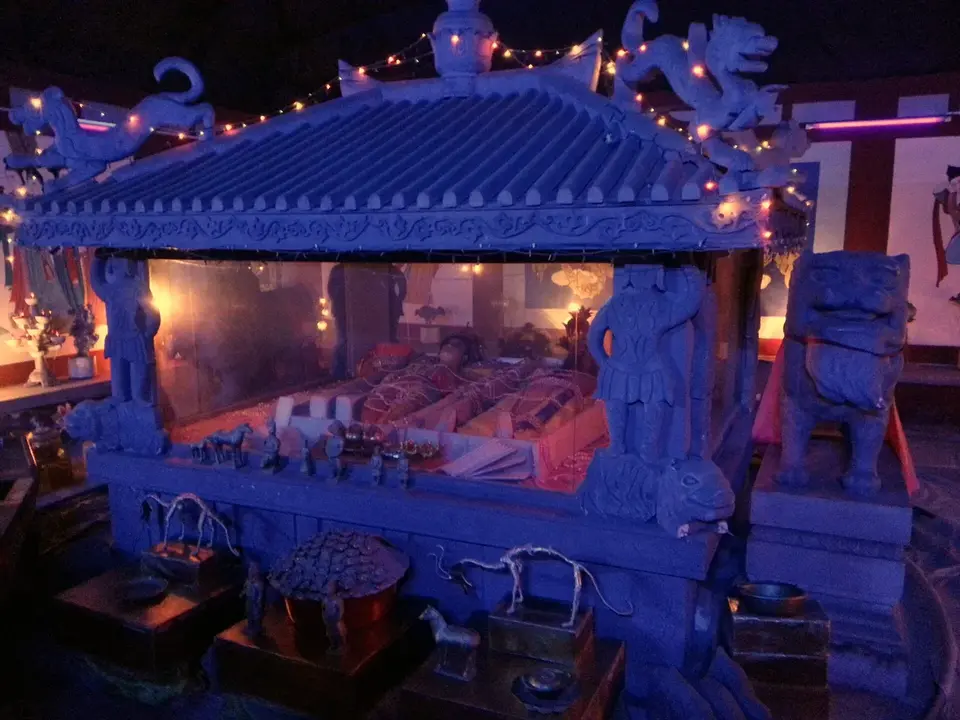
The surface architecture of Princess Yongtai's mausoleum reflected sovereign majesty. Spanning over 6,000 square meters enclosed by rammed-earth walls, the southern gate was flanked by stone crouching lions, stone attendants, and monumental octagonal pillars (huabiao) of sovereign caliber. The truncated pyramidal tumulus rose fourteen meters high with base dimensions of fifty-six meters on each side, occupying the most distinguished position among Qianling's seventeen attendant burials.
Princess Yongtai's mausoleum, situated in modern Qian County, represents an exceptionally intact archaeological repository. Measuring 87.5 meters in total length, the structure incorporates a sloping ramp, five corridors, six light wells, eight side niches, a vaulted passage, and brick-vaulted chambers mimicking Tang imperial palatial architecture. Excavations recovered 1,354 precious relics, including tri-color glazed figurines, foreign cavalrymen, heavenly guardians, tomb beasts, and glazed pottery reflecting the cosmopolitan vibrancy of the High Tang.
Over 1,200 square meters of polychrome murals adorn the subterranean walls. The approach ramp displays colossal azure dragons, white tigers, watchtowers, and armored honor guards; the chambers feature life-sized palace maidens with elaborate high coiffures and cascading robes, capturing the serene elegance of court life. In the rear burial chamber stands a colossal carved limestone sarcophagus with fifteen incised panels of court ladies and paired Mandarin ducks atop the double doors, universally regarded as a pinnacle of Tang line-engraving art.
FIGURES ASSOCIATED WITH THIS DYNASTY